






Louis XVI Period Oval Salon Table In Walnut And Burl Walnut – 18th Century
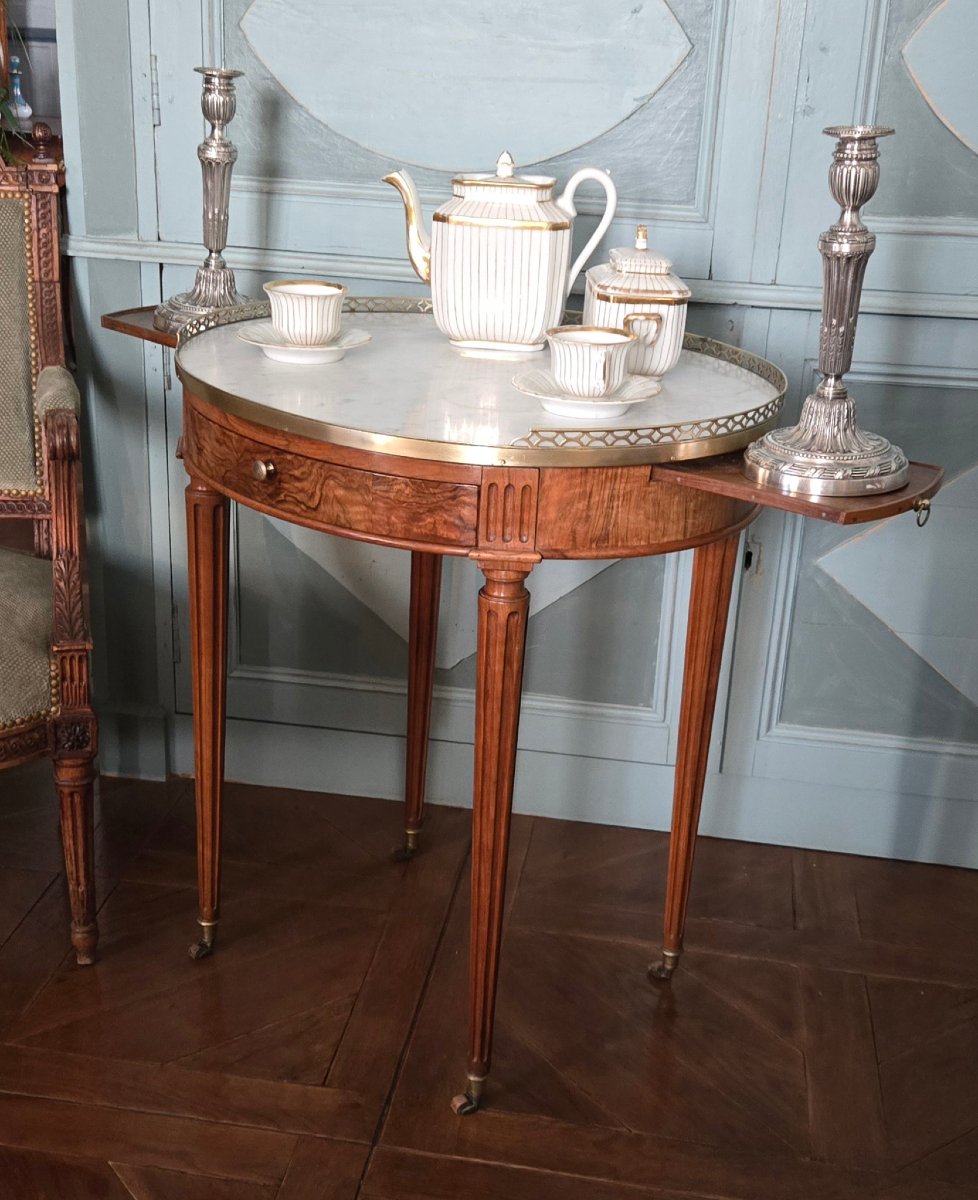
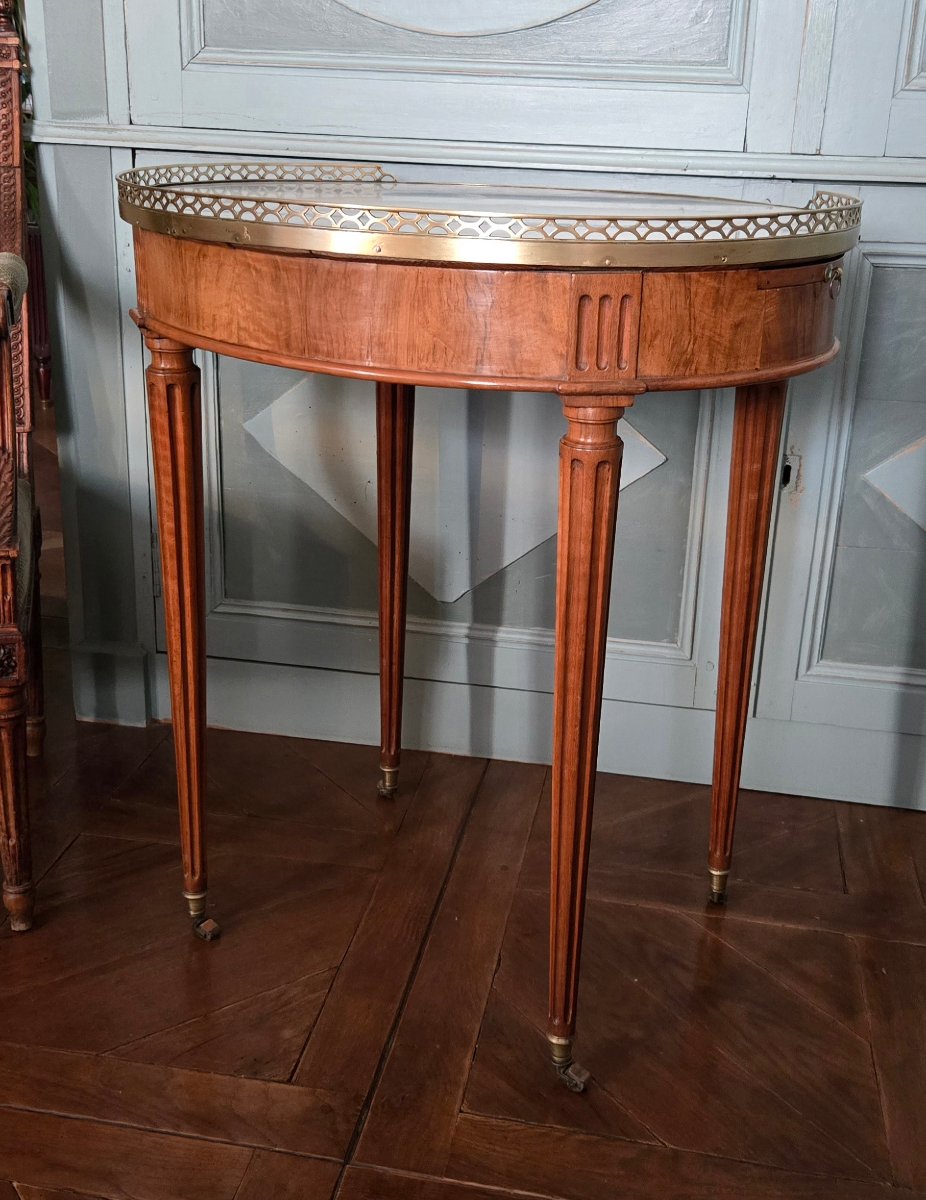
Elegant oval salon table dating from the Louis XVI period, second half of the 18th century, crafted from solid walnut and walnut veneers, and raised on four tapered, fluted legs.
A fine example of French provincial cabinetmaking, possibly originating from Dijon, in eastern France.
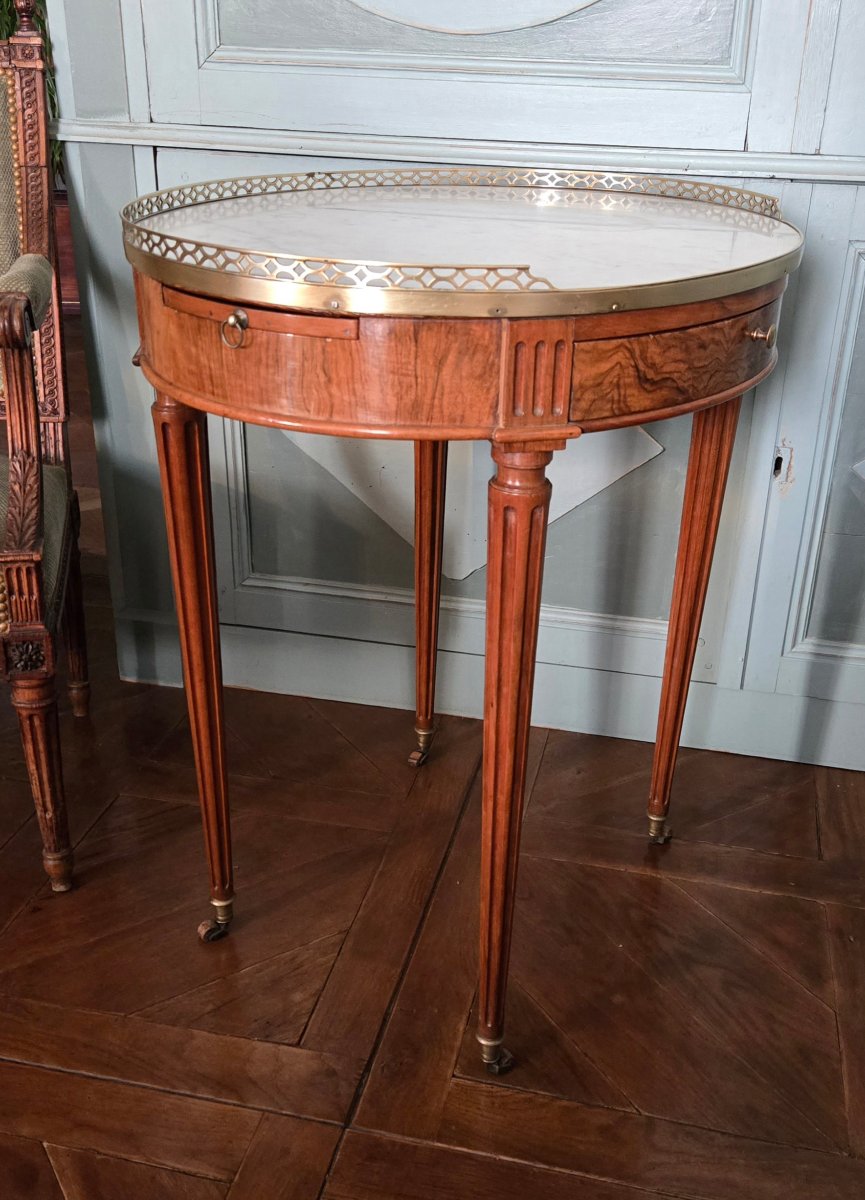
In its design, this table is closely related to the table bouillotte, a fashionable form of French salon furniture developed during the Louis XVI period. It shares several characteristic features, including four legs, a drawer and pull-out slides beneath a marble top surrounded by a brass gallery. However, it differs from the traditional round bouillotte table in its oval shape and single front drawer.
Its design also recalls the small tables known in 18th-century France as tables en cabaret, which were used for serving tea or coffee. Such pieces reflected the growing importance of sociability, conversation, and refined domestic entertaining in French interiors.
The oval apron is constructed from solid walnut, covered with vertically arranged walnut veneer, creating a subtle decorative rhythm through the natural grain of the wood.
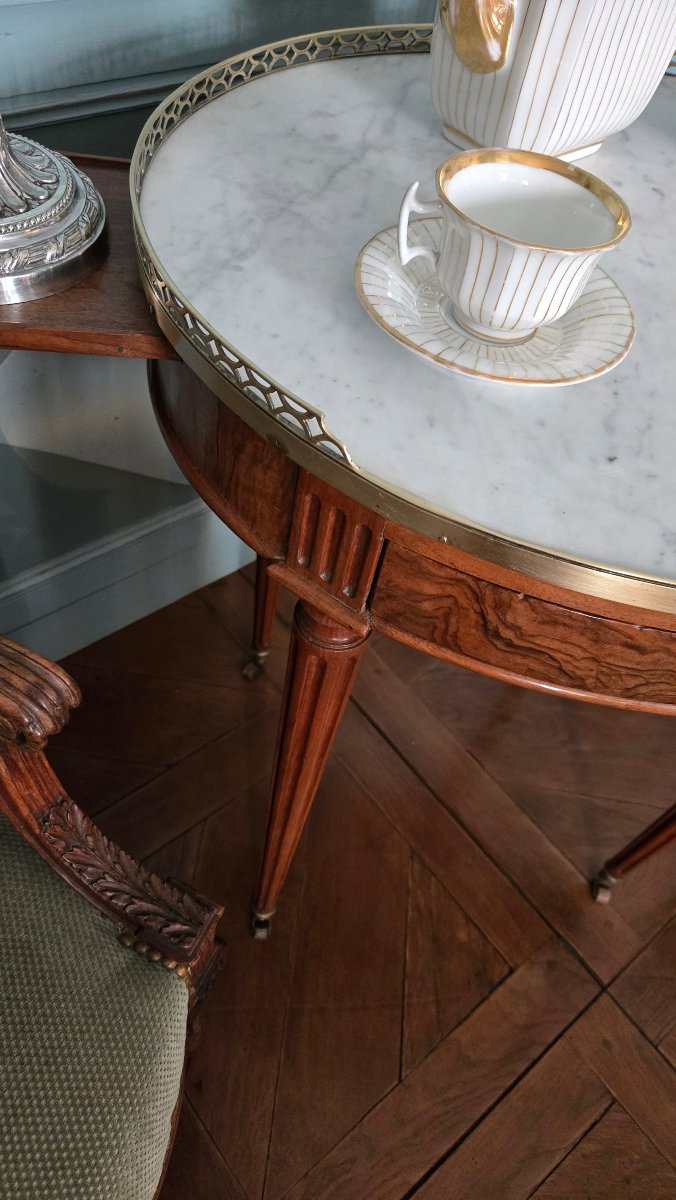
The table features a single front drawer, its solid walnut front veneered in beautifully figured burl walnut, displaying a particularly rich and lively grain pattern that contrasts with the more regular veneer of the apron.
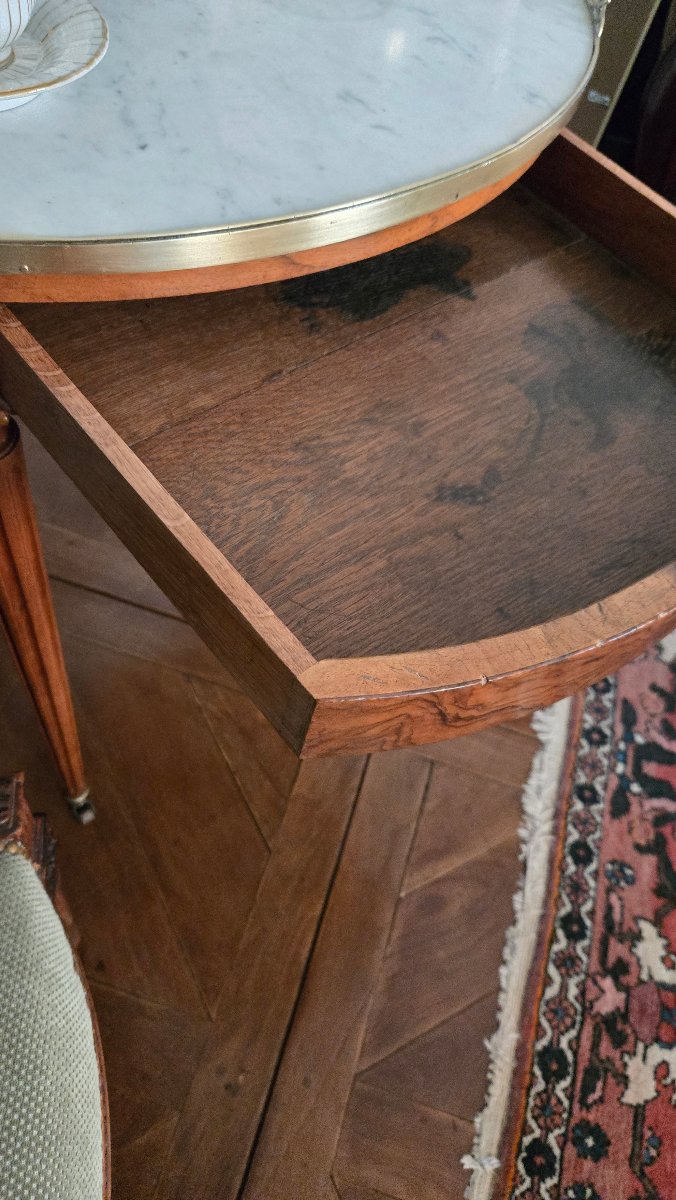
The drawer is constructed in oak, with traditional dovetail joinery. Softwood, specifically fir, was used only for secondary structural elements, including the internal platform and underside of the table.
Two pull-out slides, one on either side of the table, are fitted with ring pulls. These additional surfaces could have been used to accommodate candlesticks, allowing the central marble top to remain available for serving.
The apron rests on four solid walnut tapered and fluted legs, joined to the apron by corner blocks decorated with three vertical flutes.
Each leg retains its original bronze sabots and casters, allowing the table to be moved easily within a room.
The original white marble top, delicately veined with gray, is surrounded by an openwork brass gallery decorated with an elegant geometric pattern of intersecting arches and diamond-shaped openings.
Unlike the gallery of a traditional bouillotte table, this gallery has a distinctive feature: it is lowered along the front section, directly above the drawer, providing easier access to the marble surface.
French Provincial Cabinetmaking – Possible Dijon Origin
The construction of this table, combining solid walnut with walnut and burl walnut veneers, recalls certain cabinetmaking traditions of eastern France, particularly those practiced in Dijon during the second half of the 18th century.
Cabinetmakers working in Dijon and the neighboring town of Dole adopted the elegant neoclassical forms fashionable in Paris while maintaining regional preferences in their choice of woods and construction techniques.
The documented work of Jean Demoulin, a cabinetmaker active in Dole and later in Dijon, illustrates the use of solid walnut carcasses combined with decorative veneers, a practice relatively uncommon in Parisian cabinetmaking.
The restrained proportions, tapered and fluted legs, and elegant neoclassical design of this table also recall, in spirit, certain pieces produced by Jean-Baptiste Courte, who became a master cabinetmaker in Dijon in 1777.
These stylistic and technical similarities suggest a possible Dijon origin, although no definitive attribution to a particular workshop can be established.
Condition and Restoration
This table has been carefully restored in our workshop.
The previous varnish was completely removed, and the wood was refinished using a traditional grain-filling and wax-polishing technique (rempli-ciré).
This finish enhances the warm natural tones of the walnut and beautifully reveals the distinctive figuring of the burl walnut veneer, giving the piece an attractive soft luster and a rich, warm appearance.
The original marble top has never been restored and remains in its original condition.
The openwork brass gallery has an older repair to its rear section.
All four legs retain their original bronze sabots and casters. The casters show age-related wear to their rolling mechanisms, consistent with their age and use.
The front drawer retains its pull knob, while both lateral slides are fitted with ring pulls.
An elegant and beautifully proportioned Louis XVI period salon table, combining the restrained sophistication of French neoclassical furniture with the natural beauty of walnut and burl walnut.
A fine example of French provincial craftsmanship from the late 18th century.
Dimensions
Height to marble top: 28.35 inches (72 cm)
Width: 25.39 inches (64.5 cm)
Depth: 21.85 inches (55.5 cm)
1 450 €
Period: 18th century
Style: Louis 16th, Directory
Condition: Fully restored
Material: Wallnut
Reference (ID): 1849154
Availability: In stock
Print