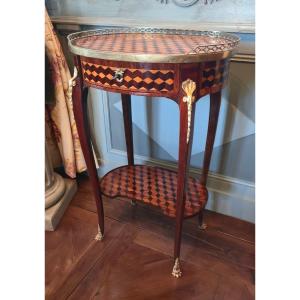





French Louis XV–louis XVI Transitional Commode – Paris, Circa 1770
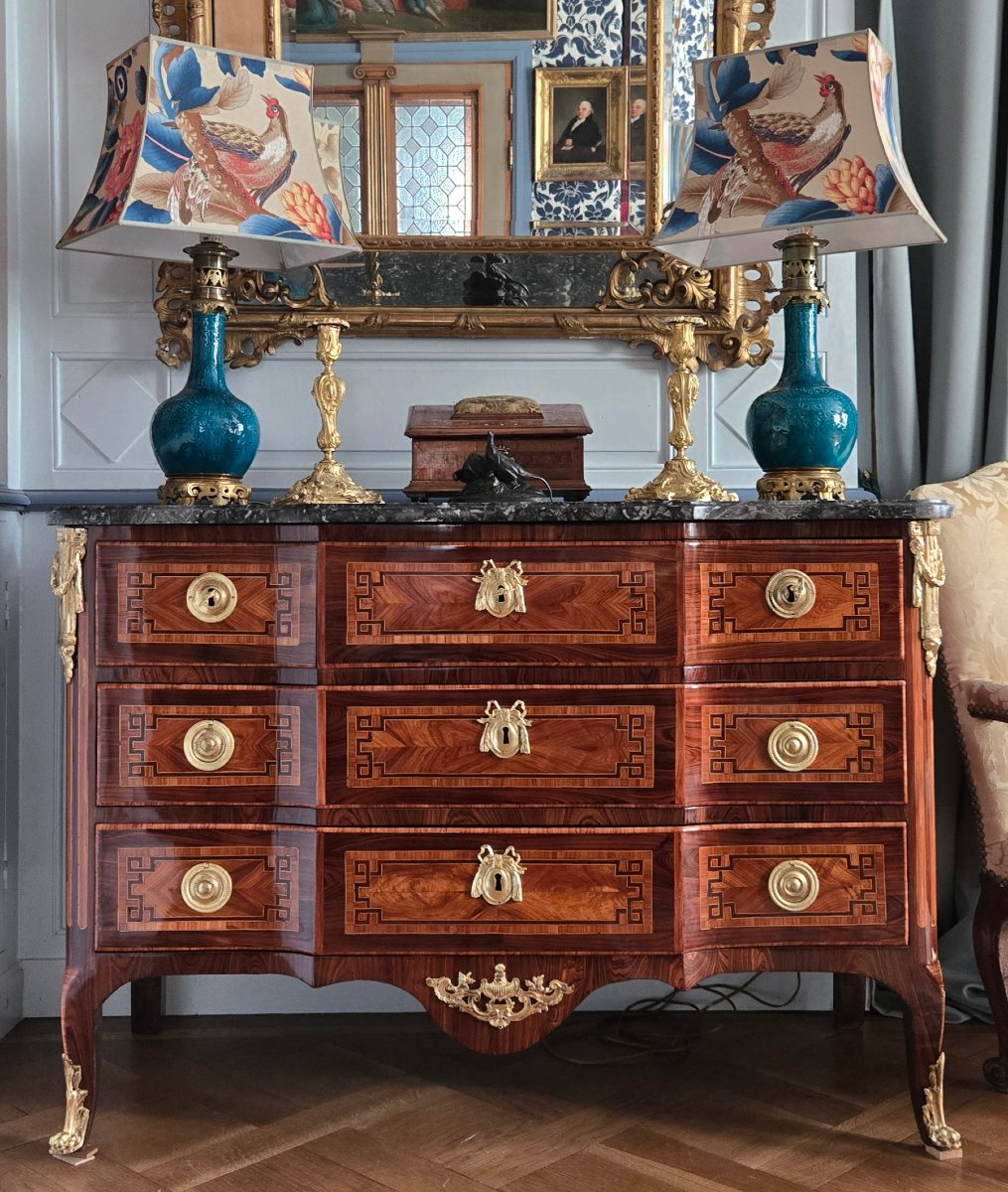
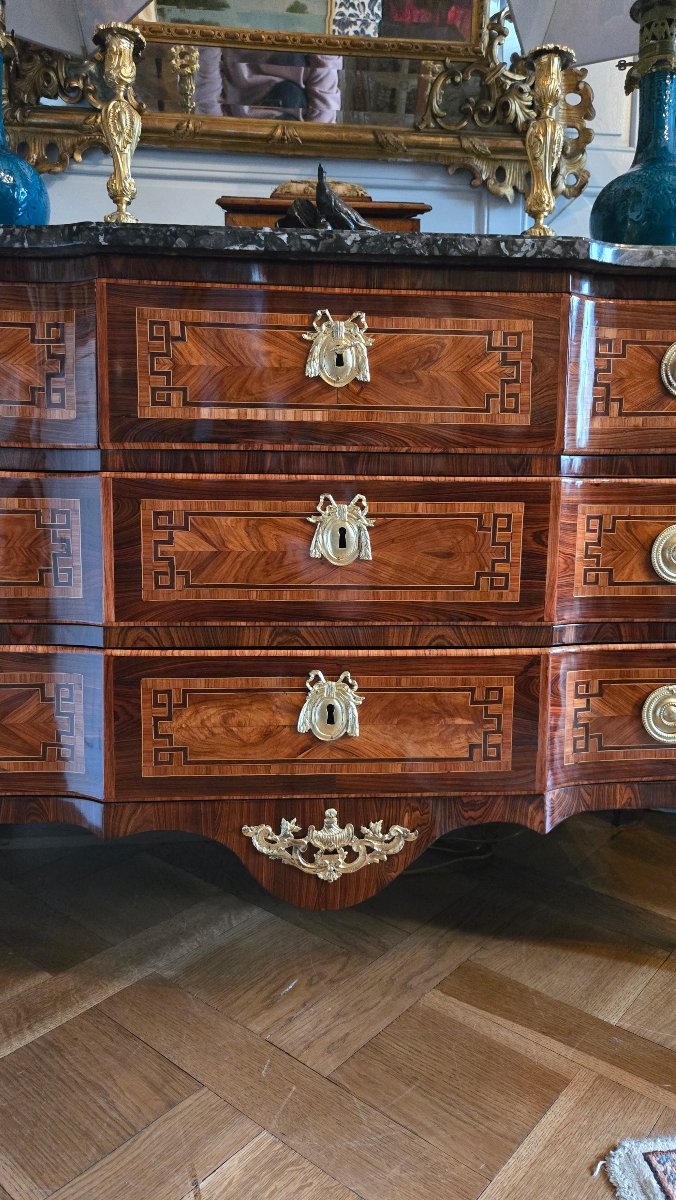
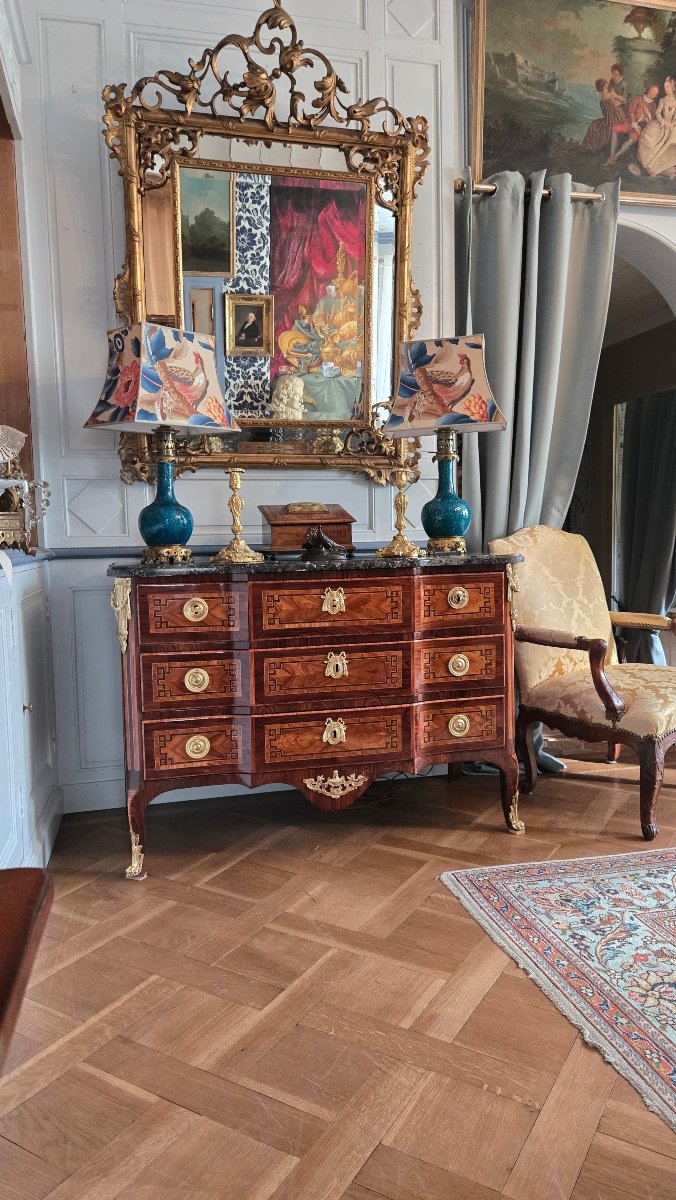
A fine Parisian commode dating to the Louis XV–Louis XVI Transitional period, circa 1770, featuring a stepped façade and richly figured veneers of kingwood, tulipwood, satinwood, and amaranth, accented with delicate boxwood stringing and gilt-bronze mounts.
The Transitional style, which developed primarily between 1760 and 1775, represents an important evolution in French cabinetmaking. As interest in classical antiquity grew, the flowing, curvilinear forms of the Louis XV period gradually gave way to more architectural designs and geometric decoration.
This transformation was progressive rather than abrupt. Parisian cabinetmakers continued to incorporate cabriole legs, shaped aprons, and curved profiles while introducing stepped façades, fluting, rectangular panels, and Greek-key motifs that anticipated the Louis XVI style.
This commode illustrates this stylistic evolution, combining the graceful curves of earlier French furniture with the geometric precision of emerging Neoclassical design.
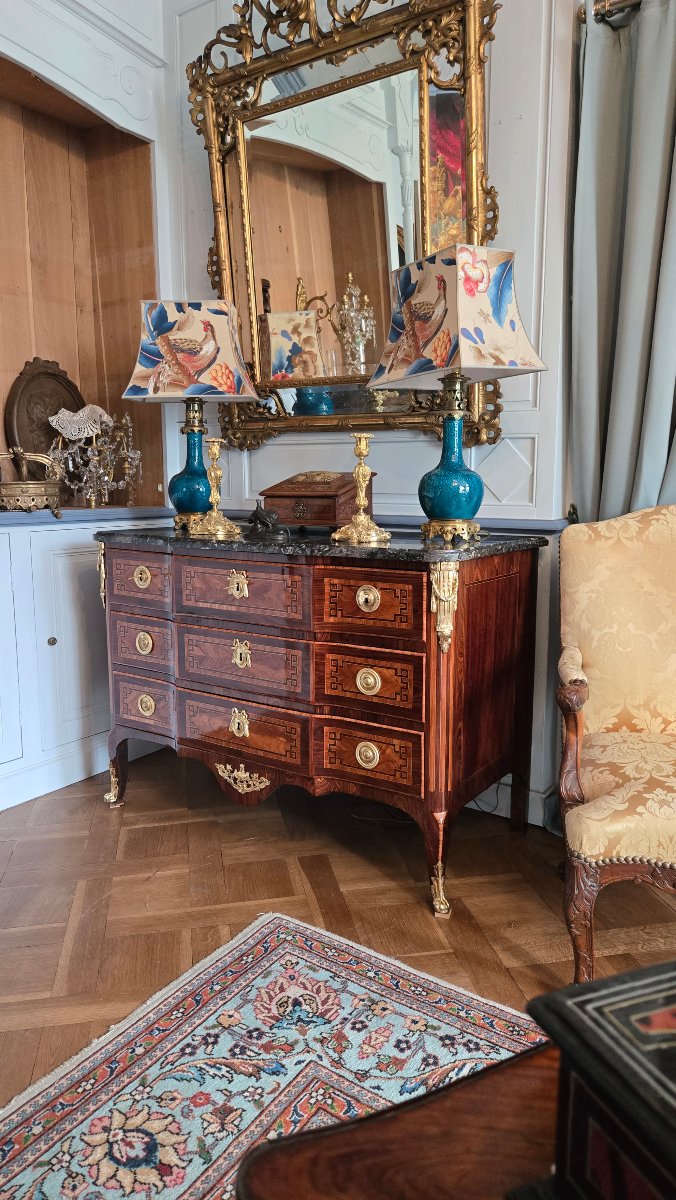
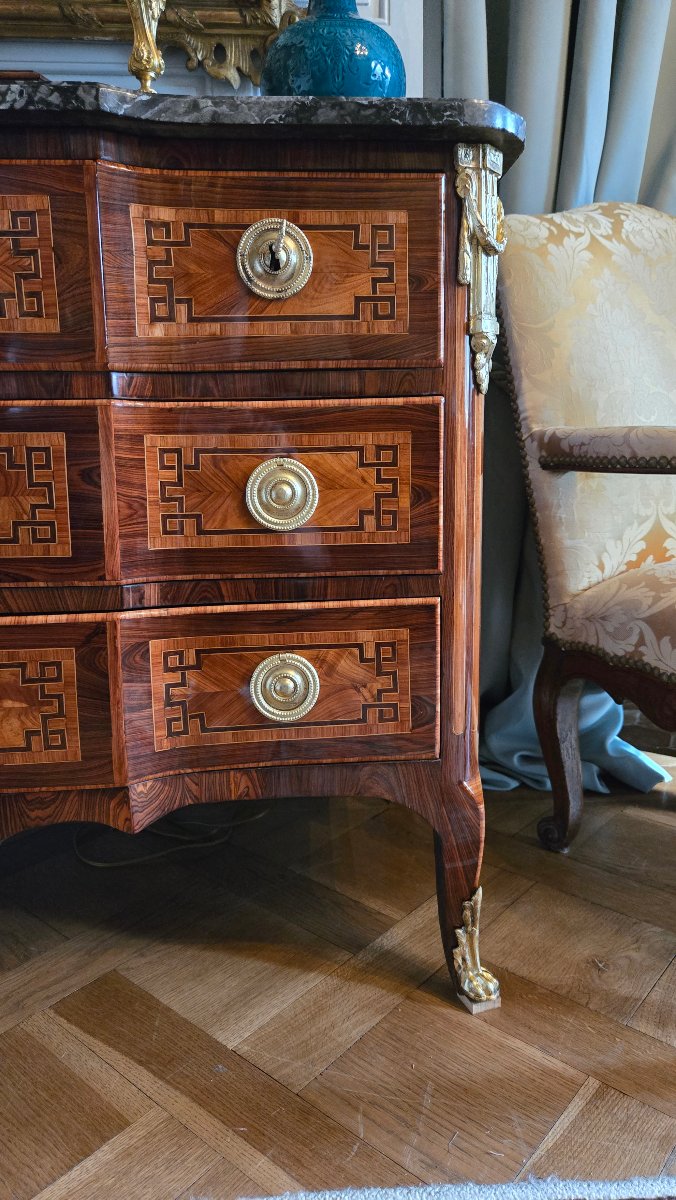
Its façade features a central projecting section flanked by two recessed sections. The rounded front corners are decorated with simulated fluting in contrasting veneers and extend into gently curved cabriole legs, terminating in gilt-bronze lion's-paw sabots. The rear corners are also stepped, contributing to the distinctive architectural design of the case.
The shaped lower apron features a central gilt-bronze mount depicting a covered classical vase surrounded by scrolling foliage.
The commode opens with five drawers arranged in three tiers: three drawers across the upper tier and two large drawers below. The lower drawer fronts are visually divided into three decorative sections, creating a balanced and symmetrical composition. The tiers are separated by visible horizontal rails.
The quality of the veneering is one of the most distinctive features of this piece, both in the selection of woods and in the careful arrangement of their grain patterns and natural colors.
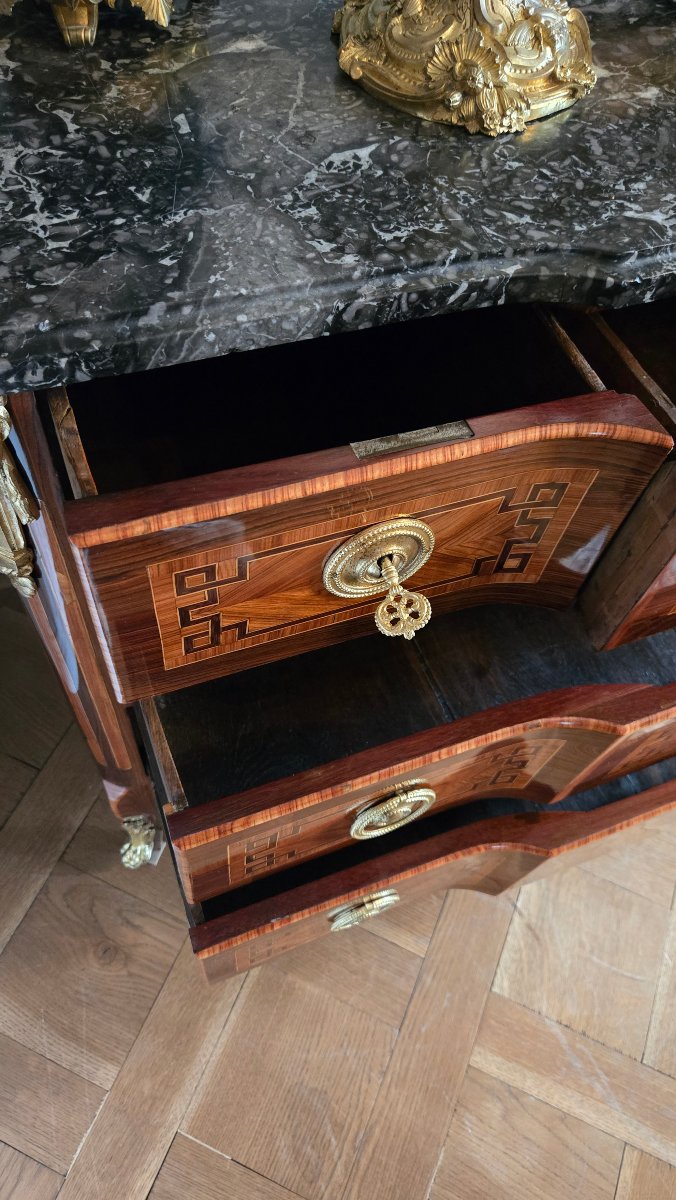
The drawer fronts feature central panels of tulipwood veneer arranged in a butterfly pattern, creating symmetrical grain figures with warm pink and golden tones. These panels are framed by geometric Greek-key designs executed in amaranth and highlighted with fine boxwood stringing.
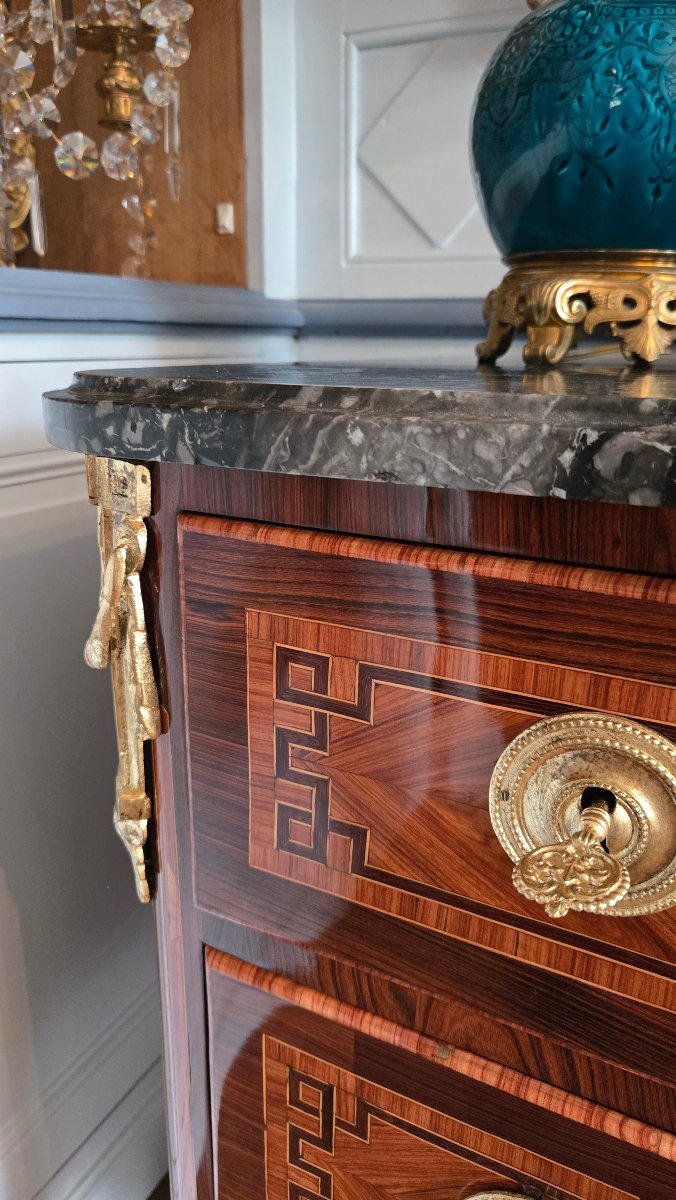
The Greek-key decoration is particularly noteworthy for its successive right-angle turns, stepped transitions, and carefully aligned connections. Repeated across the drawer fronts, this elaborate geometric arrangement reflects the precision of Parisian marquetry during the early Neoclassical period.
Kingwood borders, with their pronounced grain patterns and rich contrasting tones, frame the various sections of the façade.
The sides feature large satinwood-veneered panels outlined with delicate stringing and surrounded by kingwood borders. The natural figure and warm coloration of the woods create a harmonious contrast with the more elaborate decoration of the front.
The commode retains an extensive arrangement of gilt-bronze mounts that complements its architecture and reflects the decorative vocabulary of the Transitional period.
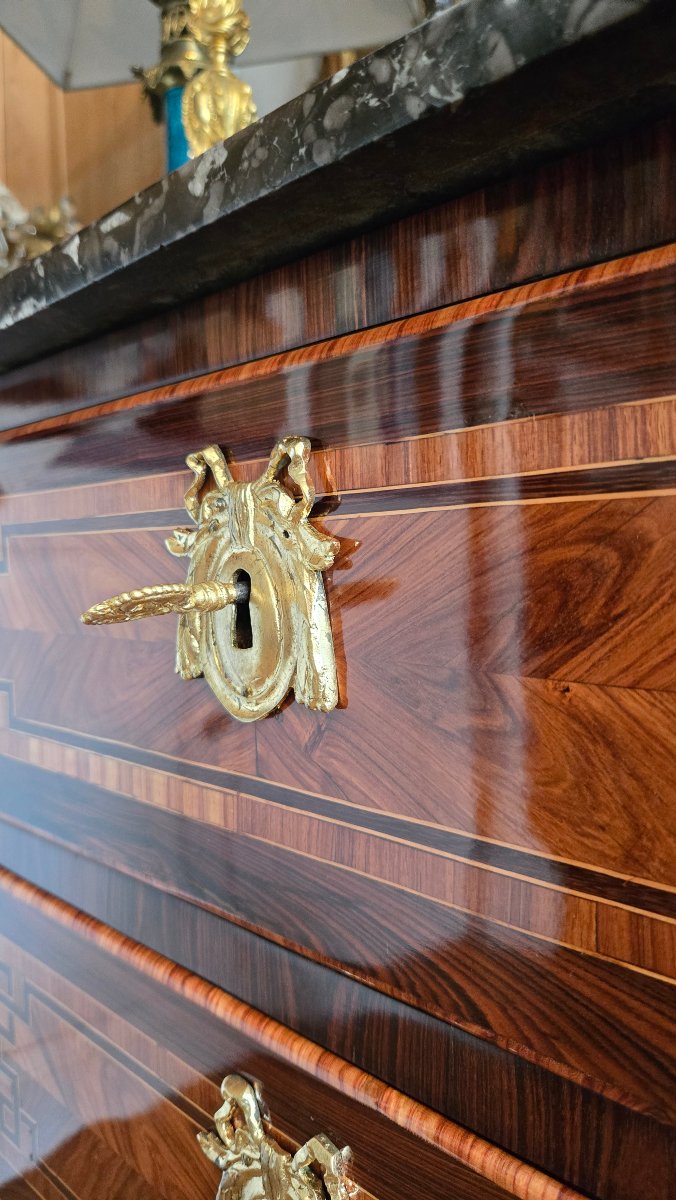
The rounded front corners are fitted with decorative mounts featuring fluted elements and suspended laurel garlands. The oval keyhole escutcheons are surmounted by tied ribbons, while the circular ring pulls are mounted on beaded rosettes.
The front legs terminate in gilt-bronze lion's-paw sabots, and the shaped apron is centered by a mount depicting a classical covered vase surrounded by scrolling foliage.
These decorative elements combine motifs inspired by classical antiquity with the graceful movement inherited from the Louis XV style.
The gilt-bronze mounts retain their old gilding. They have been carefully cleaned while preserving areas of natural patina and minor age-related wear.
The commode retains its original, substantial gray Sainte-Anne marble top, with a molded edge following the projections and rounded contours of the façade. This marble, characterized by its deep gray background, lighter veining, and visible fossil inclusions, complements the architectural proportions of the piece.
The quality of craftsmanship is equally evident in the interior construction.
The case is constructed of oak and softwood, while all five drawers are made entirely of solid oak, including their fronts, reflecting a particularly careful choice of materials.
The drawer bottoms consist of oak boards fitted into grooves along the sides and extending into grooves in the drawer fronts. This traditional construction demonstrates the attention given to the strength and durability of the piece, including its less visible components.
The commode retains its period locks and is accompanied by three keys with bronze bows.
Comparison with Parisian Cabinetmaking of the Transitional Period
Through its stepped architectural design, rounded front corners, carefully selected veneers, and elaborate Greek-key marquetry, this commode belongs stylistically to the refined Parisian cabinetmaking tradition of the third quarter of the 18th century, represented by celebrated masters such as Pierre Roussel, Jean-Chrysostome Stumpff, and Roger Vandercruse, known as Lacroix.
A closely related commode bearing the stamp of Pierre Roussel (1723–1782), who became a master cabinetmaker in 1745, was offered at Tajan in Paris on December 3, 2019, lot 423.
That example displays a remarkably similar architectural arrangement and, in particular, a closely related Greek-key marquetry design, with comparable stepped connections and geometric transitions. One of the visible differences lies in the shaping of the lower apron.
Although this comparison does not establish an attribution to Pierre Roussel, it provides a valuable reference for placing the present commode within the tradition of high-quality Parisian cabinetmaking of the period.
Condition and Restoration
The commode has been professionally restored and is presented in excellent condition.
The veneers have been restored, and the entire piece has been finished using the traditional French hand-applied shellac polishing technique, known as vernis au tampon or French polishing.
This finish enhances the depth of the wood grain, the contrasts between the different veneers, and their natural coloration, particularly the warm tones of the tulipwood, the rich figure of the kingwood, and the golden hues of the satinwood.
The gilt-bronze mounts have been carefully cleaned, retaining their old gilding with minor traces of patina and age-related wear.
The commode retains its original gray Sainte-Anne marble top and period locks.
Style: Louis XV–Louis XVI Transitional.
Date: Circa 1770, 18th century.
Origin: Paris, France.
Bibliography and Comparative References
- Pierre Kjellberg, Le Meuble français et européen, du Moyen Âge à nos jours, chapter devoted to the Transitional style.- François Quéré, Les Roussel, une dynastie d'ébénistes au XVIIIe siècle, particularly pages 166–170.- Tajan, Paris, December 3, 2019, lot 423, commode stamped Pierre Roussel.
Dimensions – Measured at the Marble Top
Overall height: 34.84 in (88.5 cm)
Width at rear: 50.79 in (129 cm)
Width at front: 50 in (127 cm)
Depth at center projection: 23.62 in (60 cm)
Depth at left and right ends of marble top: 22.83 in (58 cm)
All depth measurements refer to the marble top, not to the sides of the wooden case.
4 800 €
Period: 18th century
Style: Louis 15th - Transition
Condition: Fully restored
Material: Wood marquetry
Reference (ID): 1847629
Availability: In stock
Print