



Louis XV Period Solid Mahogany Port Chest Of Drawers – 18th Century
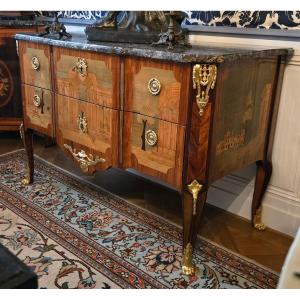
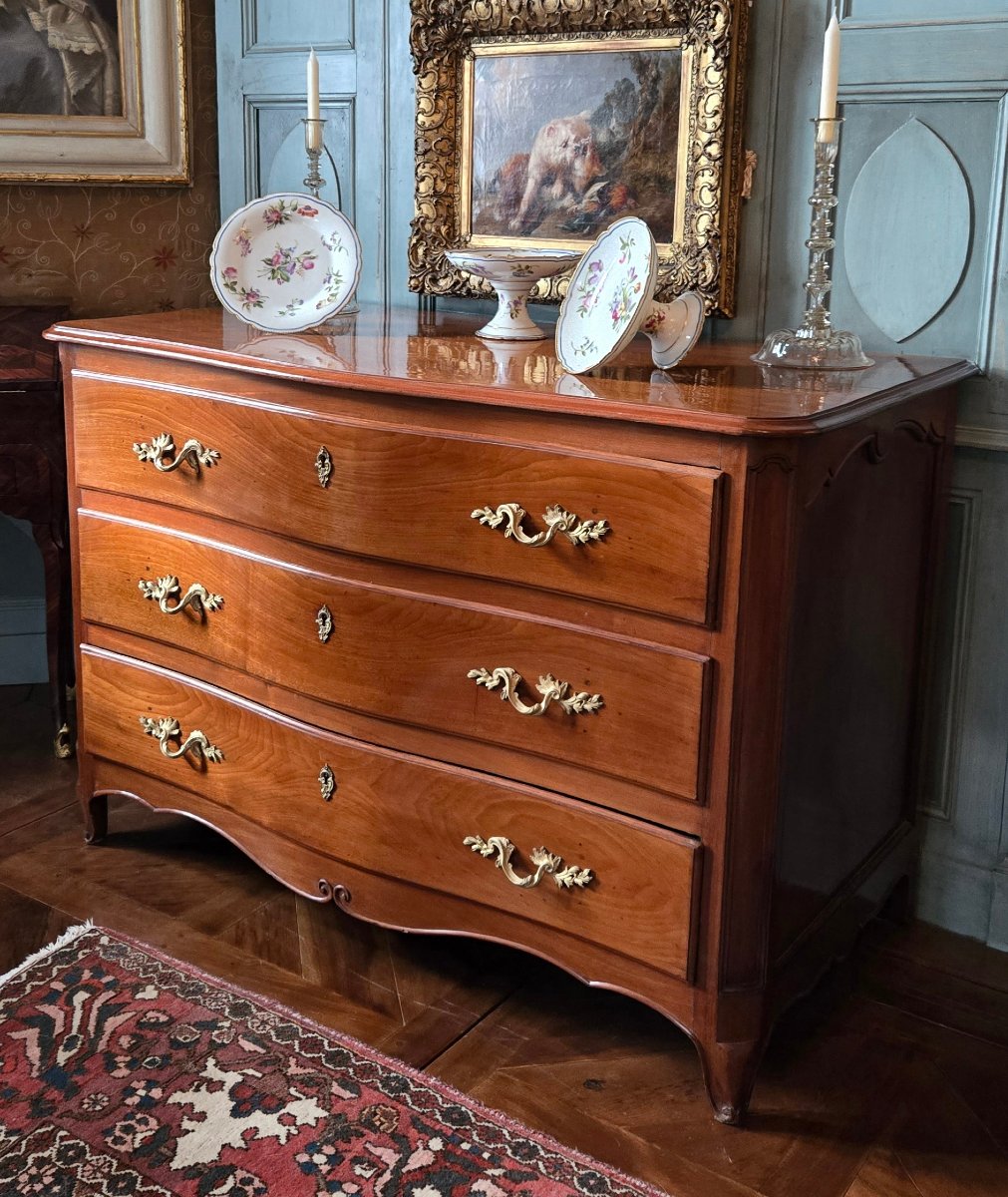
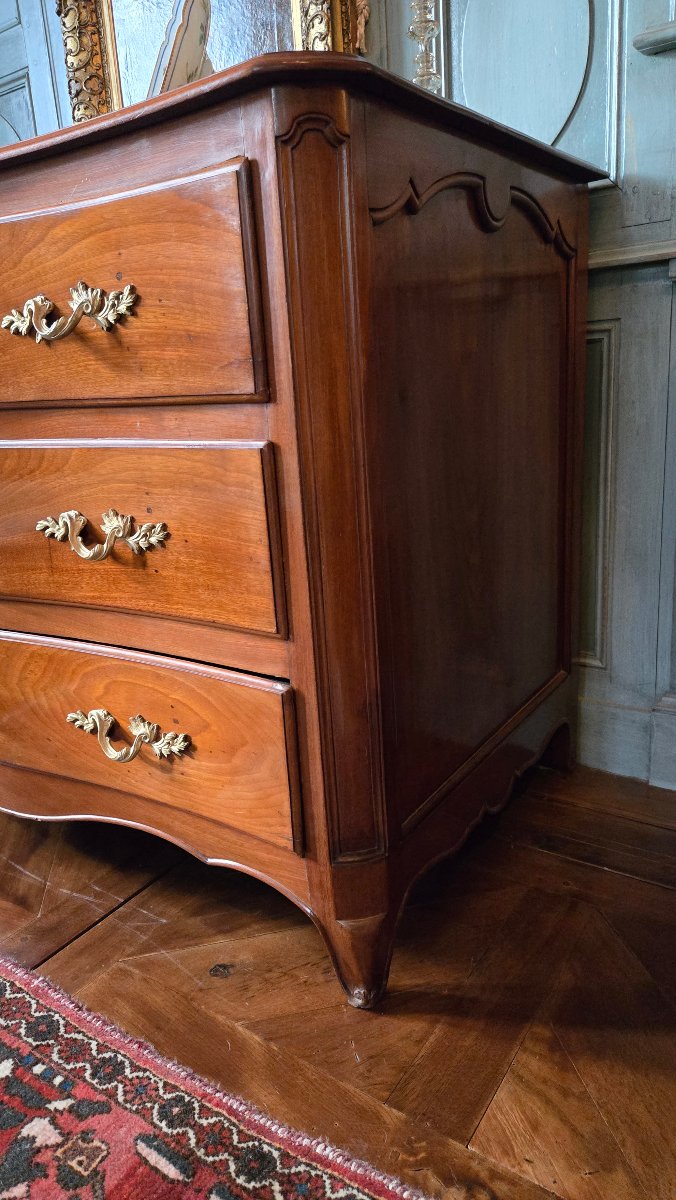
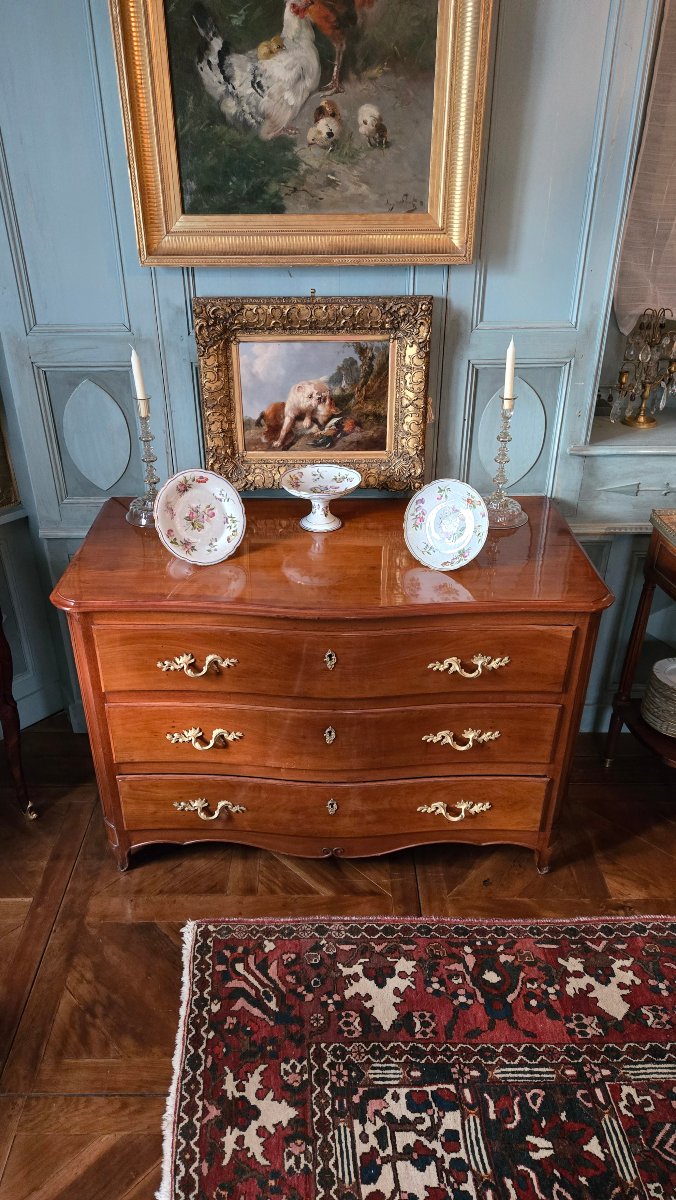
An 18th-century French Louis XV period port chest of drawers, crafted in solid mahogany and featuring three full-width drawers.
This chest is distinguished by its clean, understated lines and elegant proportions, allowing the natural beauty and rich grain of the mahogany to take center stage. Its gently flowing design is enhanced by delicate moldings that follow the contours of the piece.
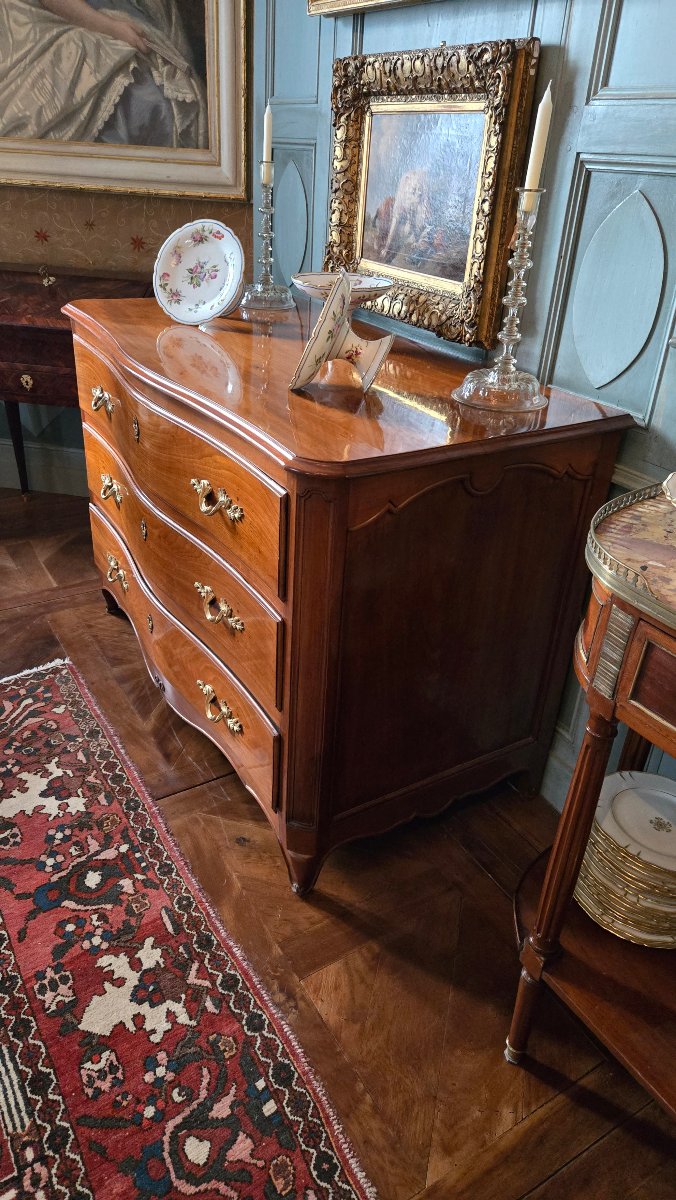
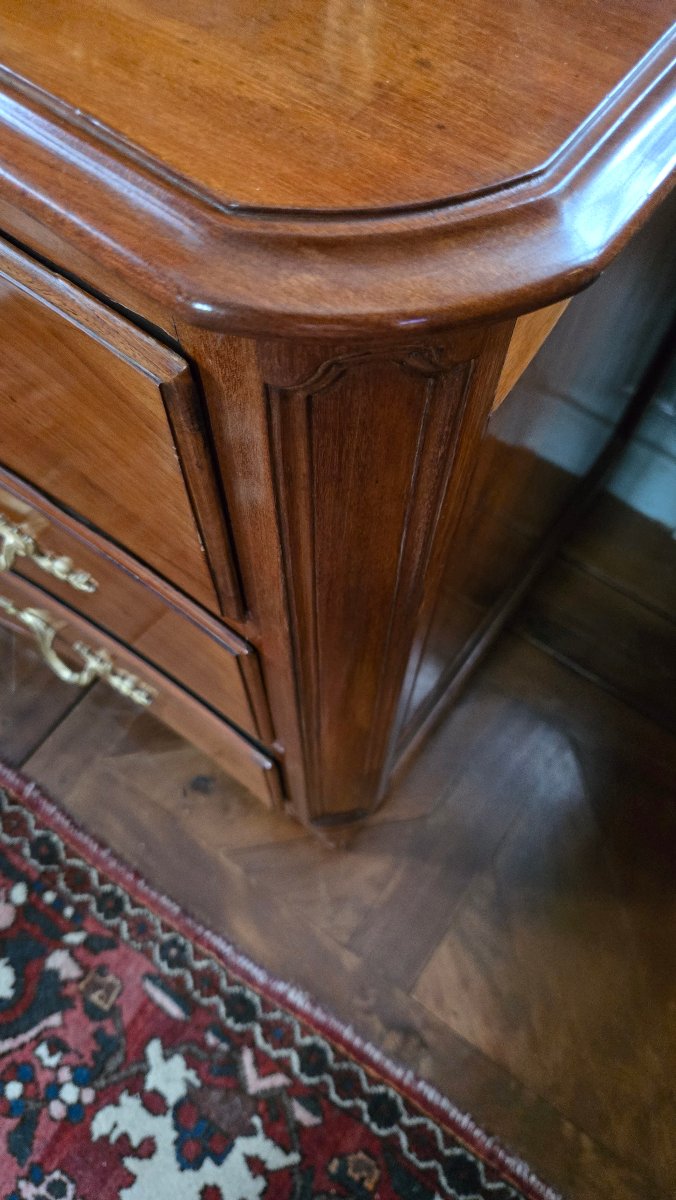
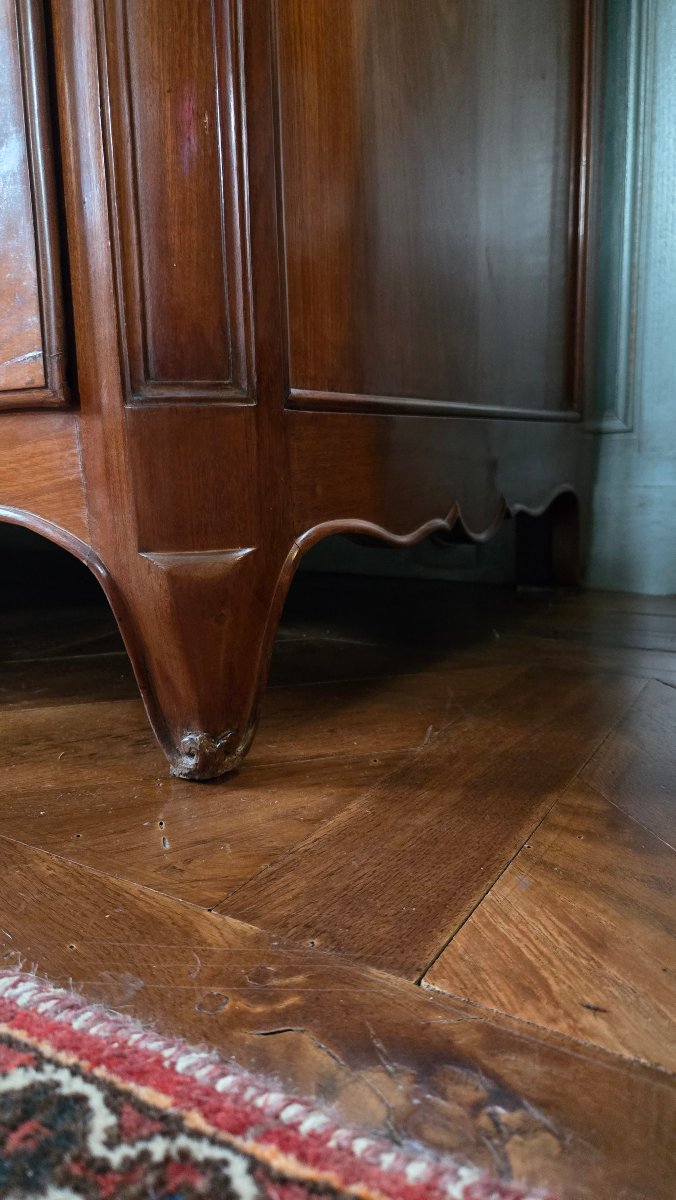
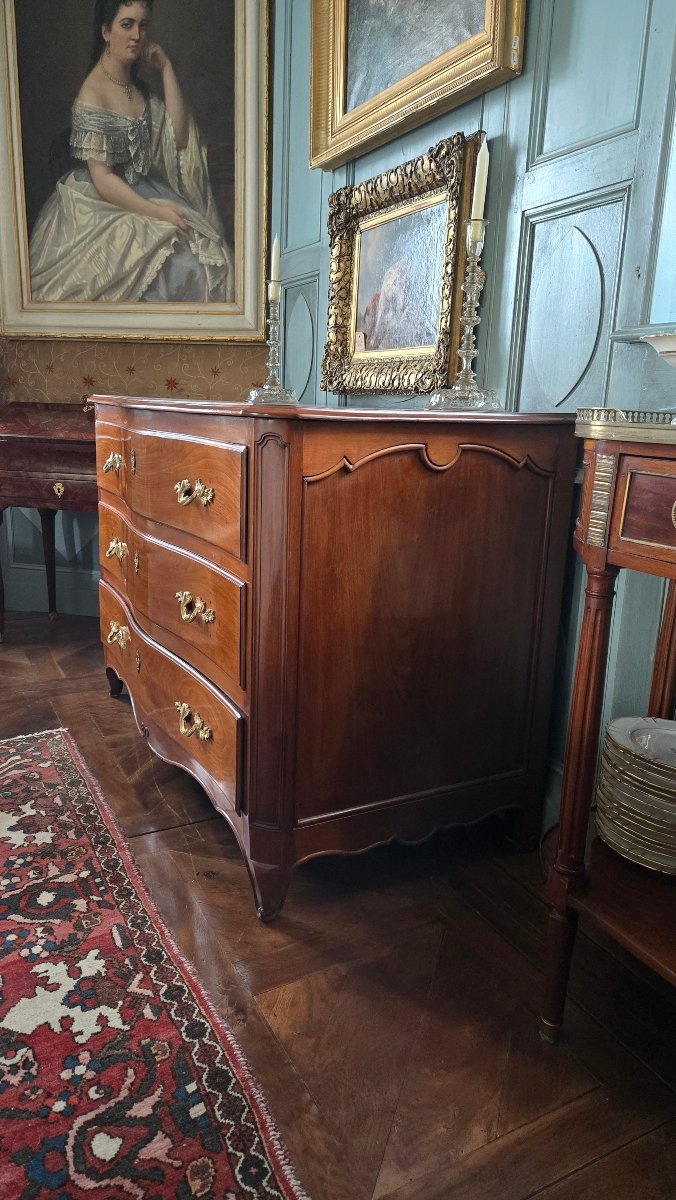
The front is subtly serpentine in plan, with three drawers framed by finely executed moldings. The rounded front corners feature recessed molded panels and extend into small, inward-curving scroll feet.
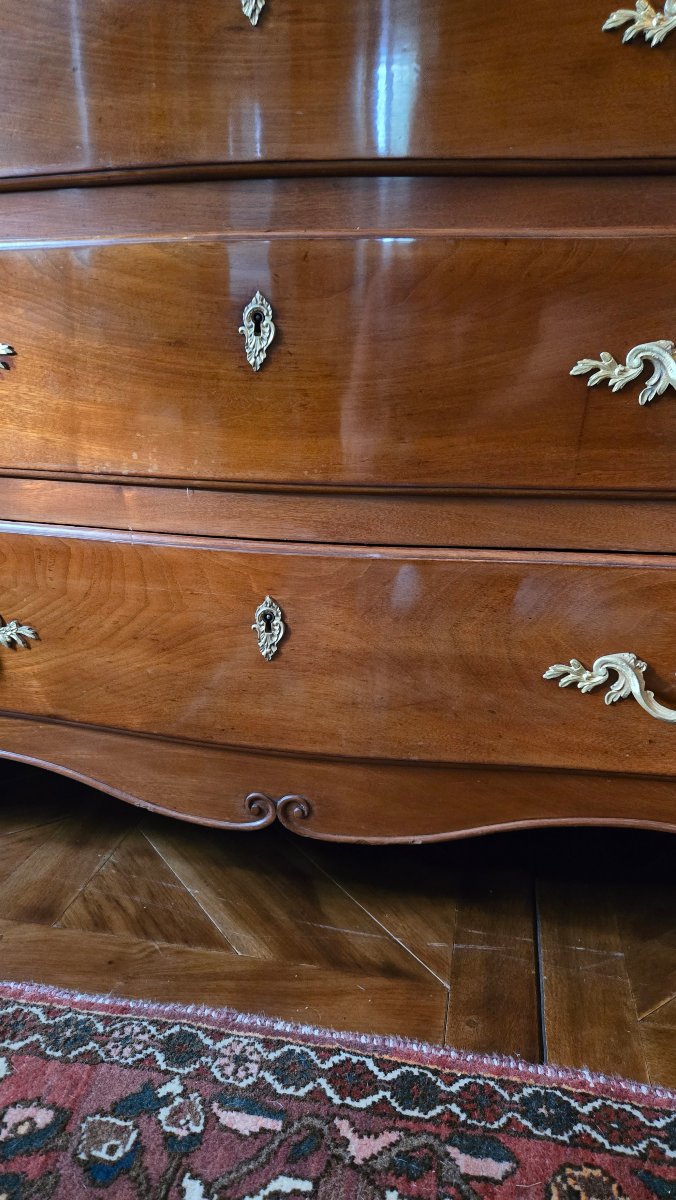
The shaped lower apron displays gracefully flowing curves meeting at the center in two opposing scrolls, carved directly from the solid mahogany.
Each side features a single wide board of solid mahogany, set within the surrounding frame. The upper rails are delicately shaped with alternating curves, reverse curves, and subtle angular transitions, all highlighted by fine moldings.
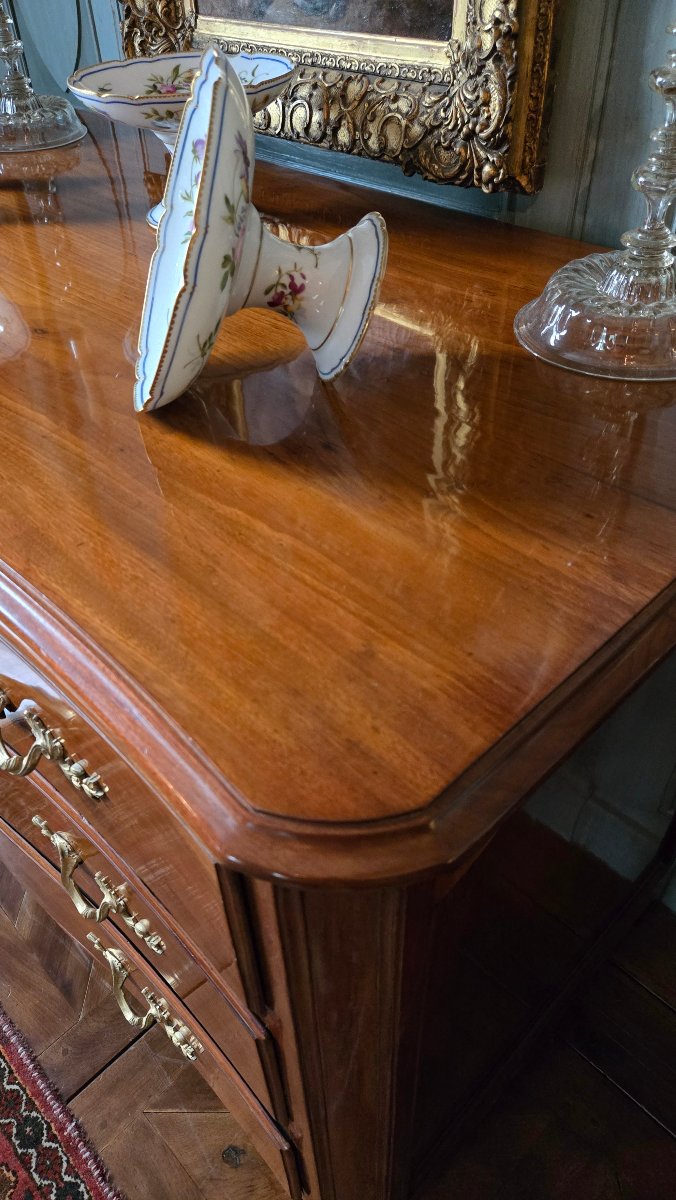
The original solid mahogany top is made from two wide boards cut from the same log and bookmatched along the longitudinal centerline. Their symmetrical arrangement creates a balanced grain pattern extending outward from the central joint. The top features rounded corners, a finely molded edge, and follows the gentle curve of the front.
The overall design reflects careful attention to proportions, wood selection, and craftsmanship.
Construction and Wood Species
The construction combines solid mahogany for the visible surfaces, elm for the drawer sides and backs, and softwood for the drawer bottoms and interior structural components.
The three drawers have solid mahogany fronts, joined to their elm sides with traditional dovetail joints. The drawer backs are also made of elm, while the bottoms are constructed from softwood boards.
Between the drawers are full intermediate wooden platforms made from softwood boards running perpendicular to the front. The drawers slide directly on these platforms.
The back of the chest consists of vertically arranged softwood boards, joined and nailed in place.
The use of elm for the drawer sides and backs is particularly noteworthy. Elm was used in woodworking traditions throughout northern France and Flanders. It can be found in 18th-century seating furniture attributed to workshops in the Saint-Omer region, particularly from the Louis XVI period, as well as in certain furniture produced in the historic Low Countries.
Although this construction detail does not establish a specific geographic origin, it provides an interesting point of comparison with northern European cabinetmaking traditions.
Bronze Hardware and Restoration
The chest is fitted with finely chased bronze drawer pulls decorated with acanthus leaves and scrolling foliage.
These antique mounts are of good quality but are later additions to the piece. They are secured by threaded fasteners tightened from inside the drawers.
The decorative keyhole escutcheons are also later additions, as are the locks, which were replaced during a previous restoration.
Professionally restored several years ago, the chest remains in very good condition. Its traditional French-polished finish enhances the warm color, depth, and natural grain of the mahogany.
Historical Background – Maritime Trade and Port Furniture in the 18th Century
The development of port furniture during the 18th century was closely connected to the expansion of maritime trade and the importation of exotic hardwoods from the Caribbean and the Americas.
Mahogany became particularly desirable for its density, durability, rich color, and ability to take a fine polish. These qualities encouraged the production of solid-wood furniture in which the natural grain became an essential part of the design.
In his book Le meuble de port, Louis Malfoy brings together historical accounts and archival material concerning the harvesting, transportation, and trade of these imported woods.
Among the sources he cites is Father Jean-Baptiste Labat's Nouveau Voyage aux Isles d'Amérique, which describes mahogany from Saint-Domingue as early as 1700, emphasizing its hardness, deep color, and durability.
Throughout the 18th century, Nantes, Bordeaux, La Rochelle, and Saint-Malo developed into important centers for receiving and distributing colonial hardwoods. Ports along the English Channel and the North Sea also participated in this trade, either directly or through European merchant networks.
The historical research of Michel Morineau, referenced by Malfoy, highlights the important role of Dutch merchants in the trade of exotic American hardwoods and their distribution between French ports, the Dutch Republic, and inland commercial centers.
These trading networks, operating within a colonial economy closely connected to Atlantic slavery and the slave trade, contributed to the development of furniture combining imported hardwoods for visible surfaces with European timber for interior construction.
Furniture Production Along the Northern French Coast
Louis Malfoy also discusses the mahogany trade through Dunkirk during the 18th century, mentioning the shipowner Bonaventure Tresca, who reportedly imported mahogany from the Americas.
Malfoy illustrates furniture attributed to Dunkirk workshops, noting features such as rounded uprights with recessed moldings, gently curved fronts, and restrained, shaped rails.
Several of these characteristics can be compared with the present chest, particularly the treatment of its rounded corners and the delicacy of its moldings.
While these stylistic similarities do not establish a definitive geographic attribution, they suggest that the furniture-making traditions of the northern French coast and the historic Southern Netherlands deserve consideration.
This chest belongs to the broader tradition of 18th-century French port furniture, combining the natural beauty of solid mahogany with carefully executed joinery and refined proportions.
Bibliography
Louis Malfoy, Le meuble de port – Les bois des « Isles », les artisans, les ports, les mobiliers… Tout un patrimoine redécouvert, Éditions de l'Amateur.
See particularly pages 22–23, 78–79, 98–99, and 143–153.
Dimensions
Height: 33.46 in (85 cm)
Width: 49.61 in (126 cm)
Depth: 25.59 in (65 cm)
3 600 €
Period: 18th century
Style: Louis 15th - Transition
Condition: Good condition
Material: Mahogany
Reference (ID): 1843408
Availability: In stock
Print