
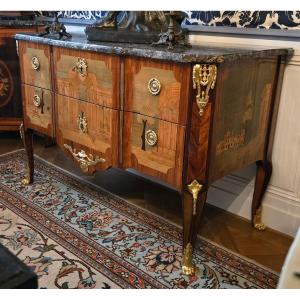


18th-century Marquetry Commode Stamped A. L. Gilbert
Artist: André Louis Gilbert
18th-century marquetry commode stamped A. L. Gilbert
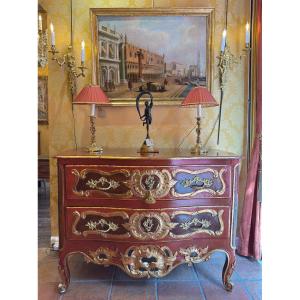
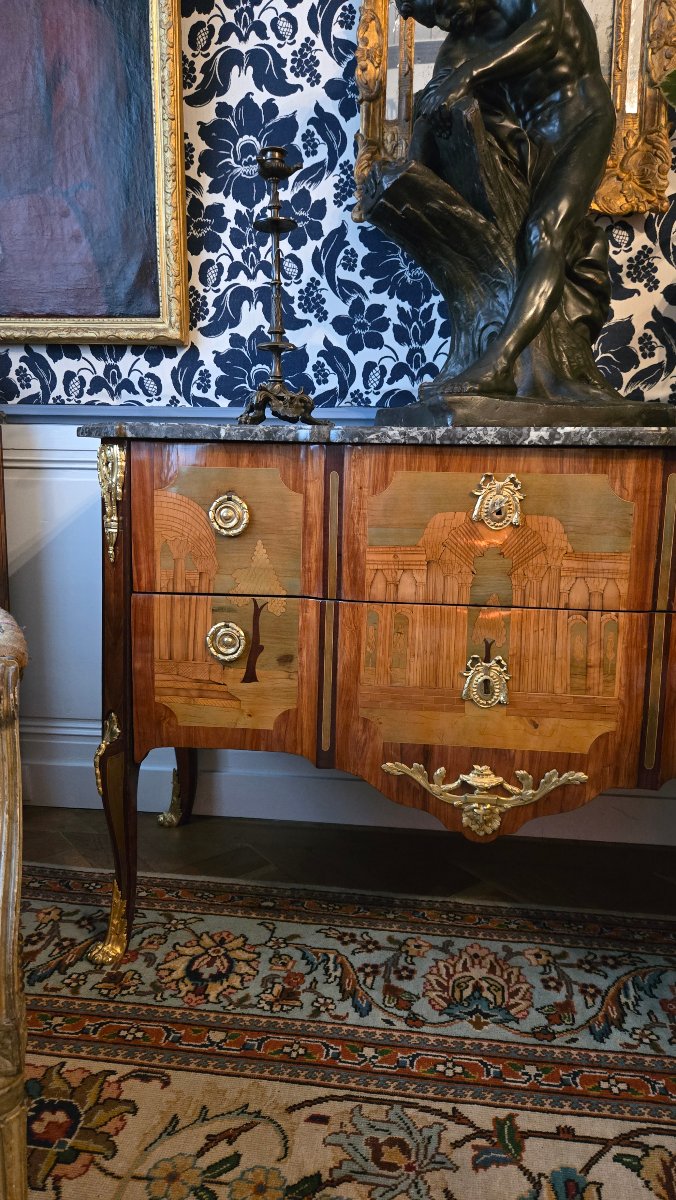
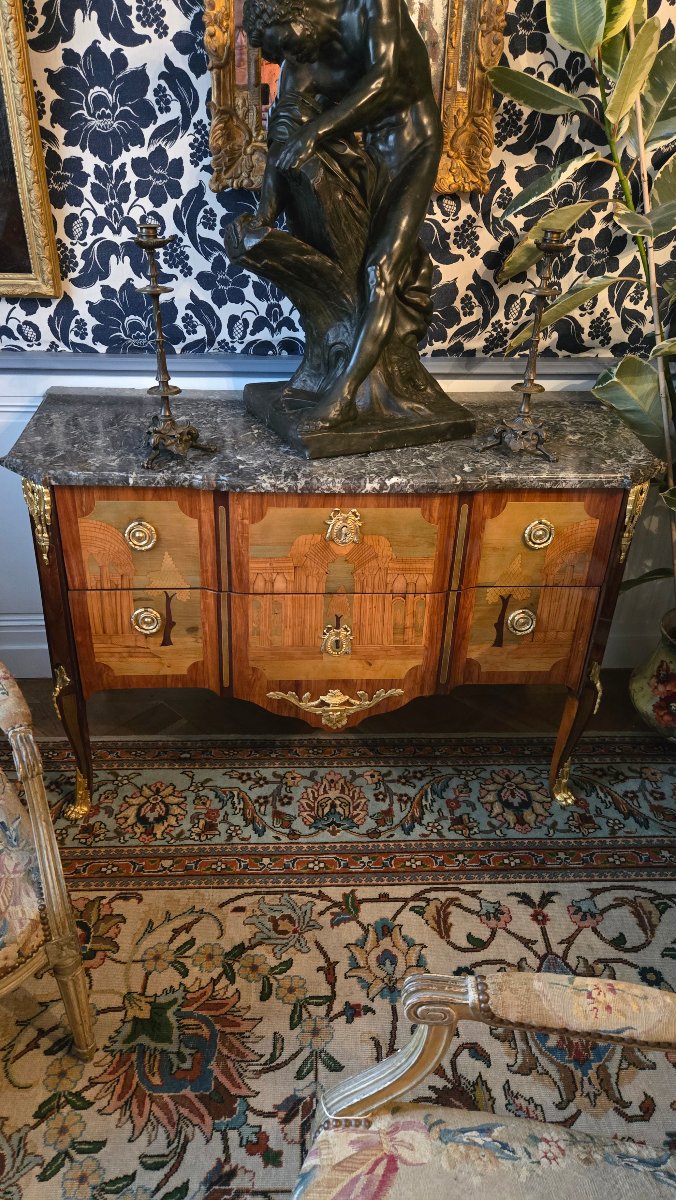
An important Parisian Louis XVI period commode, dating from circa 1775, bearing two stamps of André-Louis Gilbert (1746–1809), together with the JME mark of the Parisian Guild of Master Cabinetmakers.
This commode belongs to a particularly interesting period in the history of French furniture, when marquetry developed into a sophisticated pictorial art, depicting landscapes, architectural ruins and imaginary monuments.
It is a fine example of the work of André-Louis Gilbert, who became a master cabinetmaker in Paris on 20 July 1774 and was particularly renowned for his architectural and landscape marquetry.
Description
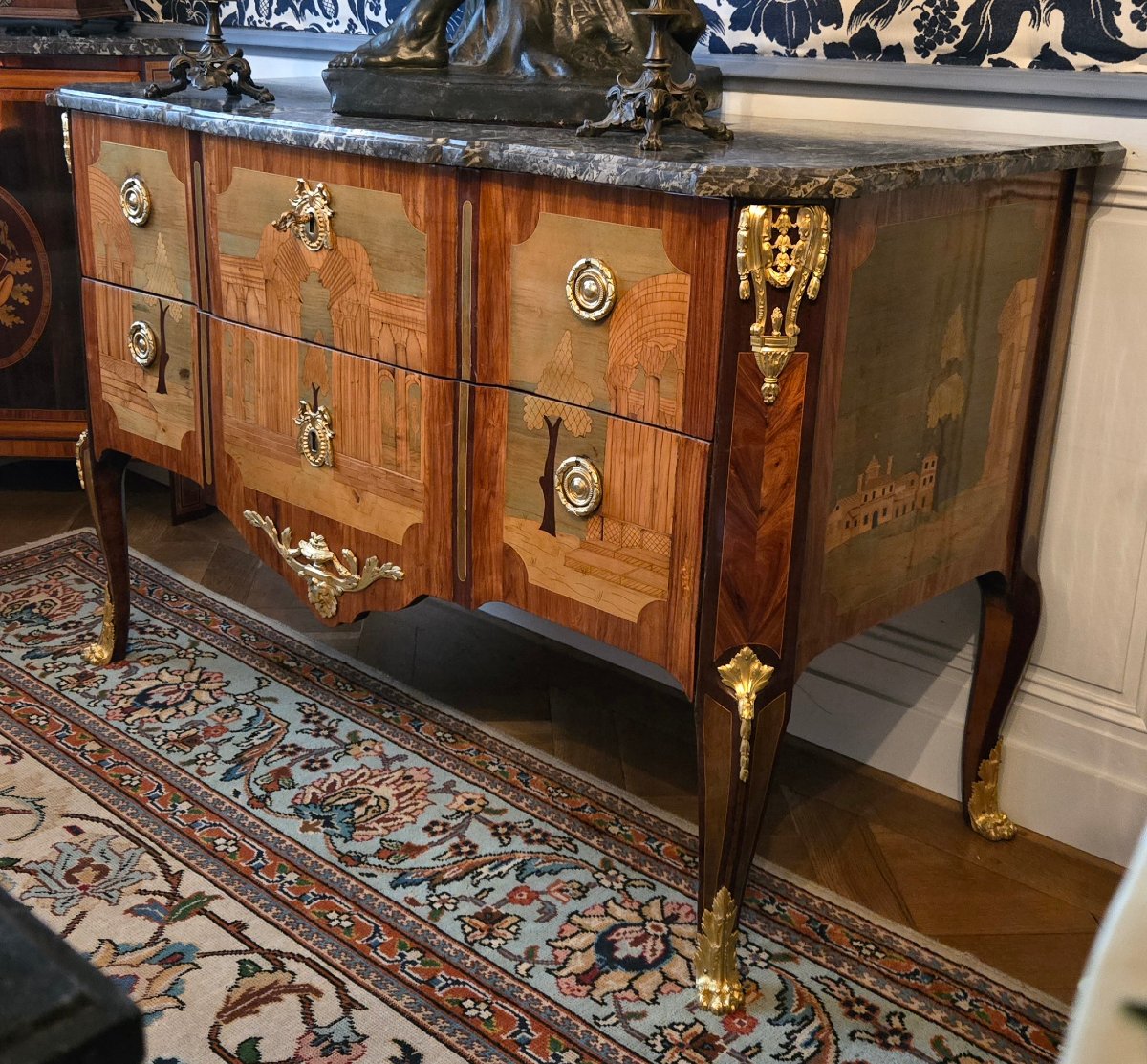
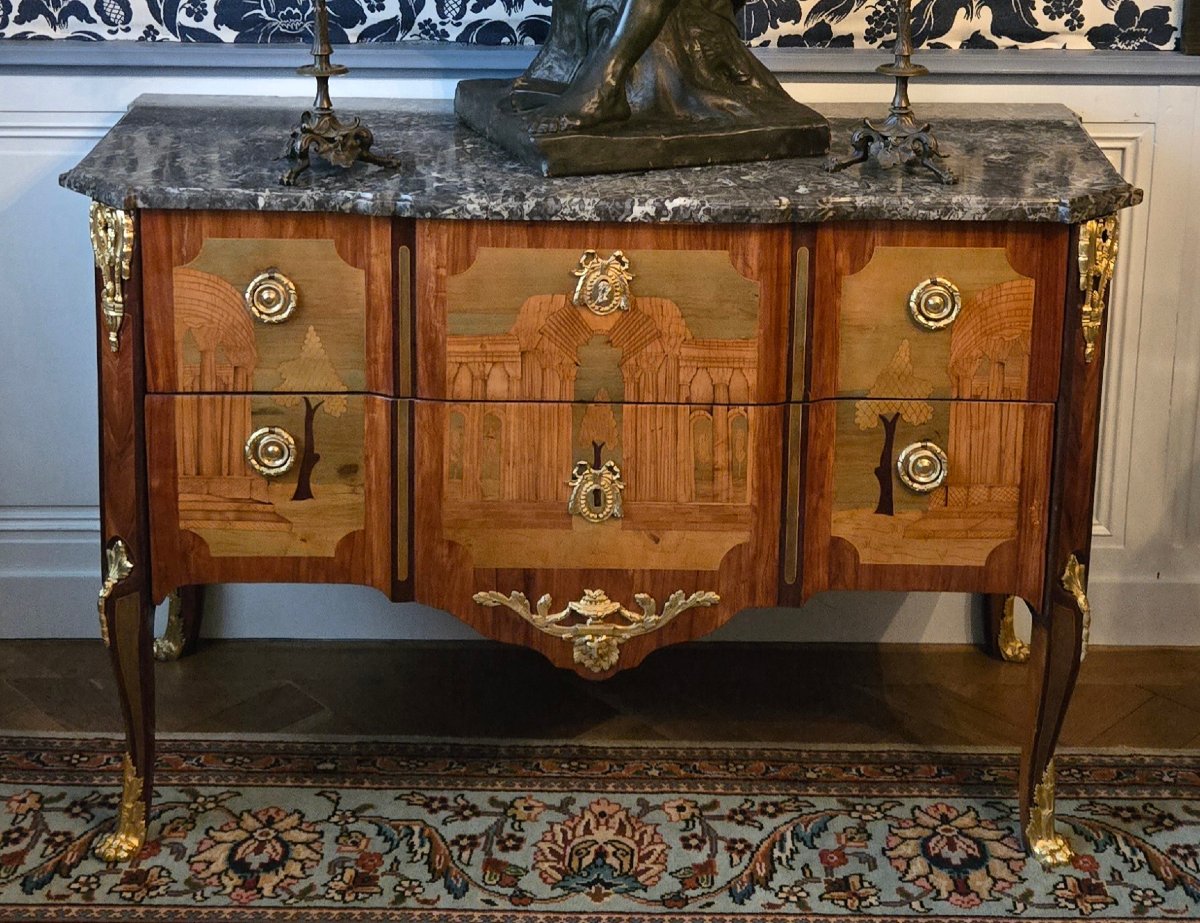
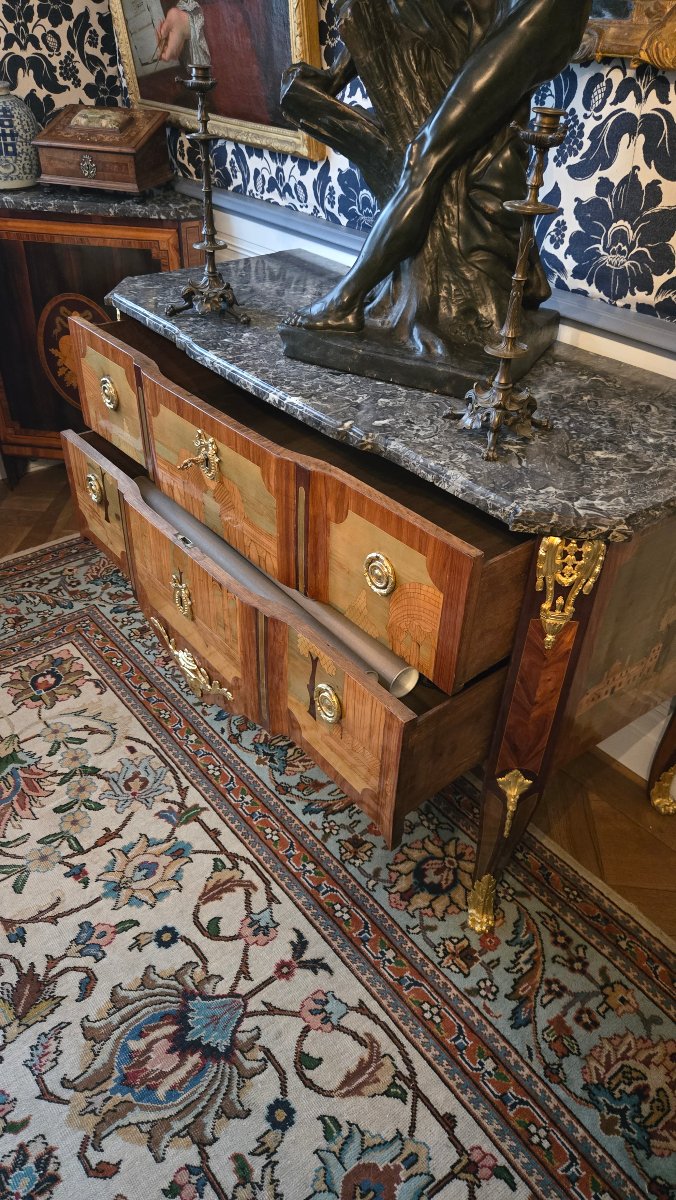
The commode features a breakfront façade with two large drawers, without a visible dividing rail, constructed on an oak carcass.
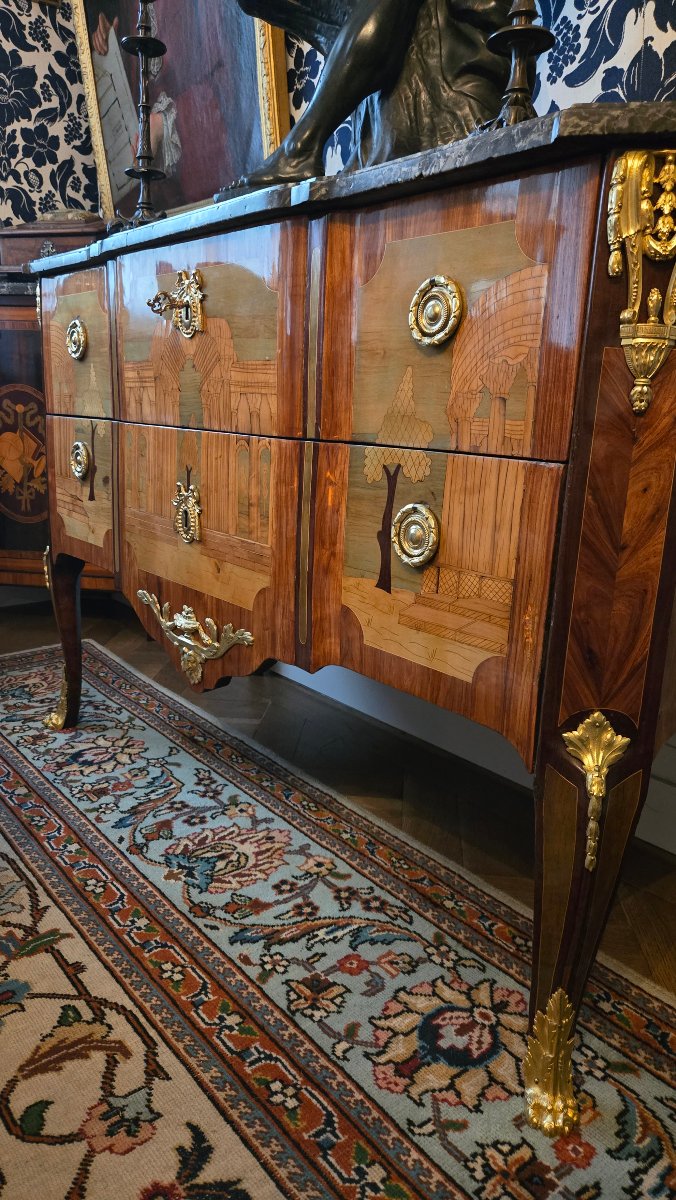
One of its most distinctive features is its unusual, slightly trapezoidal construction, gradually widening towards the back. Measuring 125 cm across the front and 130.5 cm at the rear, this sophisticated design required considerable precision in the construction of the carcass, the positioning of its joints and the fitting of the drawers.
Its architecture combines the geometric discipline of the emerging Neoclassical style with elegantly curved legs inherited from the Louis XV period.
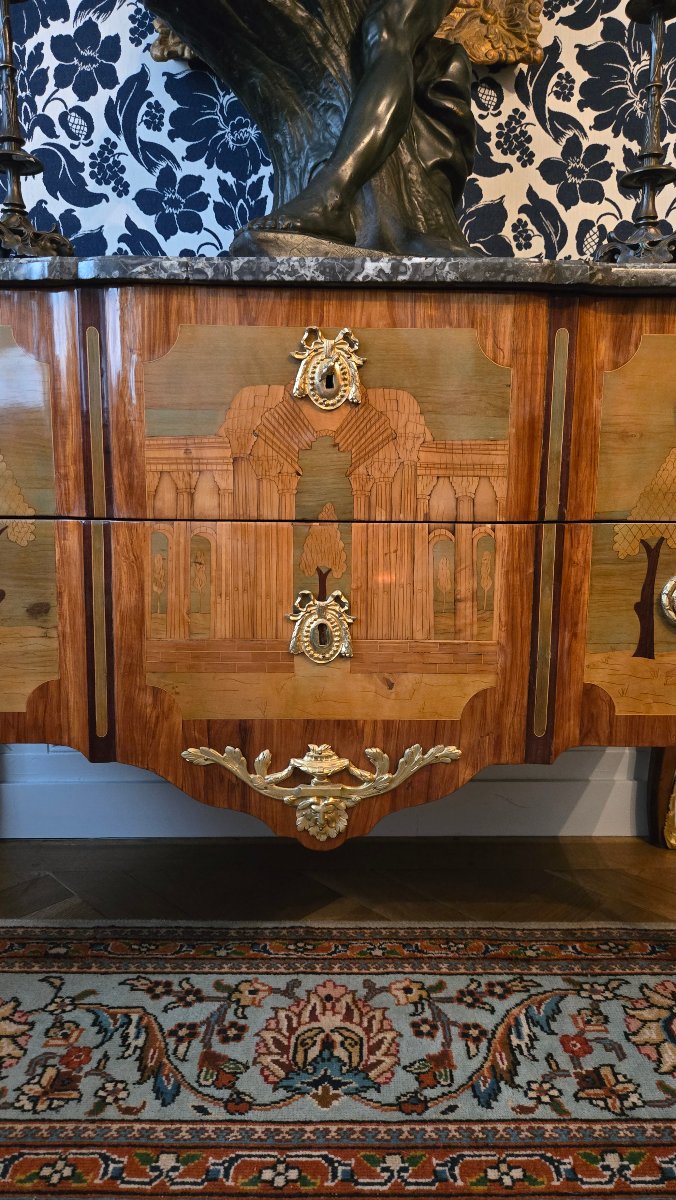
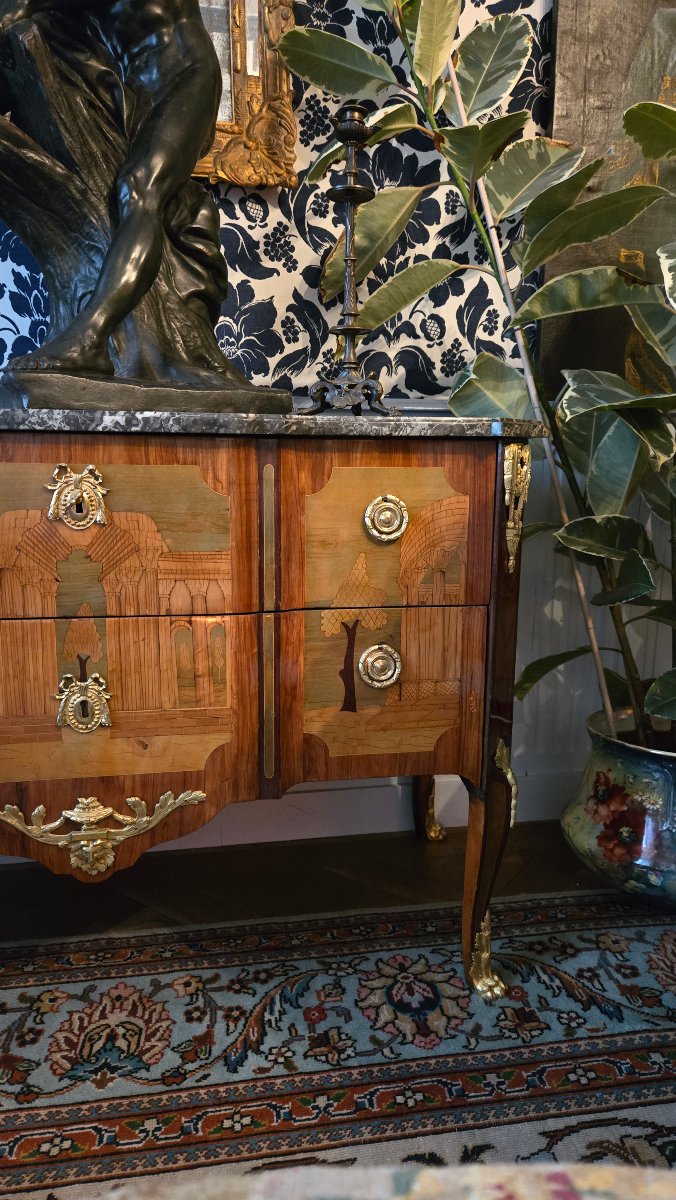
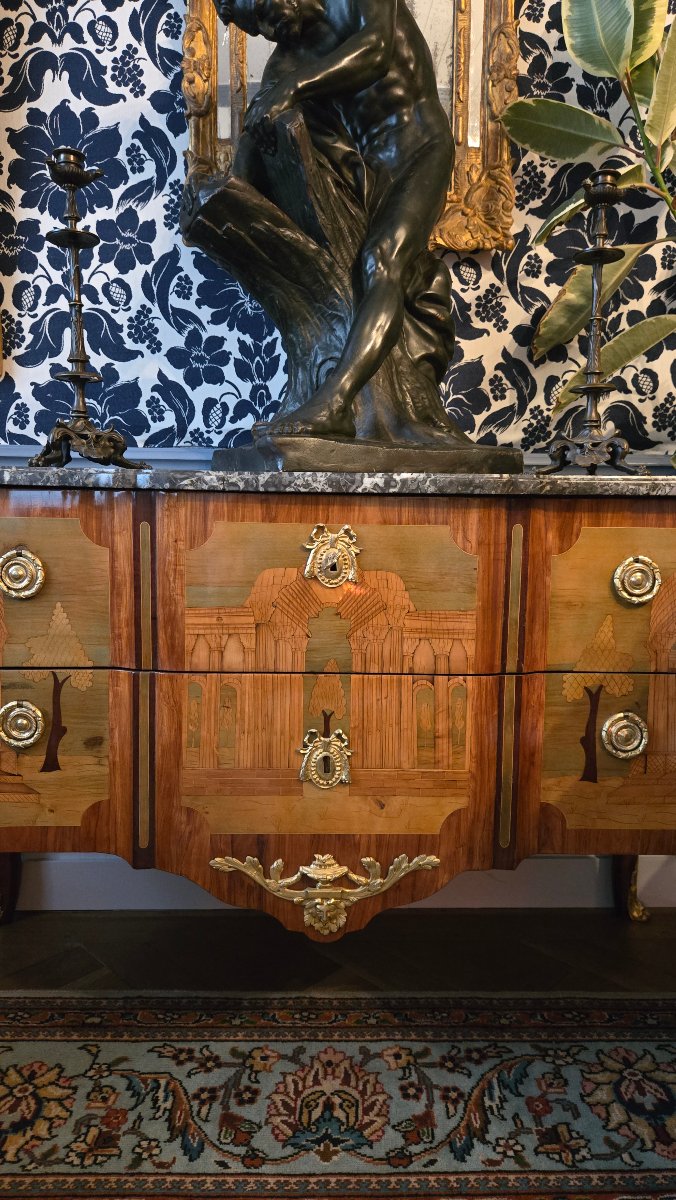
The façade is arranged into three large marquetry panels, separated by vertical sections highlighted with metal stringing. The compositions extend across both drawers, forming three complete architectural scenes when the drawers are closed.
The central panel depicts the remains of a monumental building with arches, columns and finely detailed capitals. The voussoirs, masonry, column shafts and architectural mouldings are represented with remarkable precision.
The two adjoining panels feature picturesque ruins surrounded by trees and architectural fragments. The natural colours and contrasting grains of the various wood veneers create subtle effects of perspective and depth.
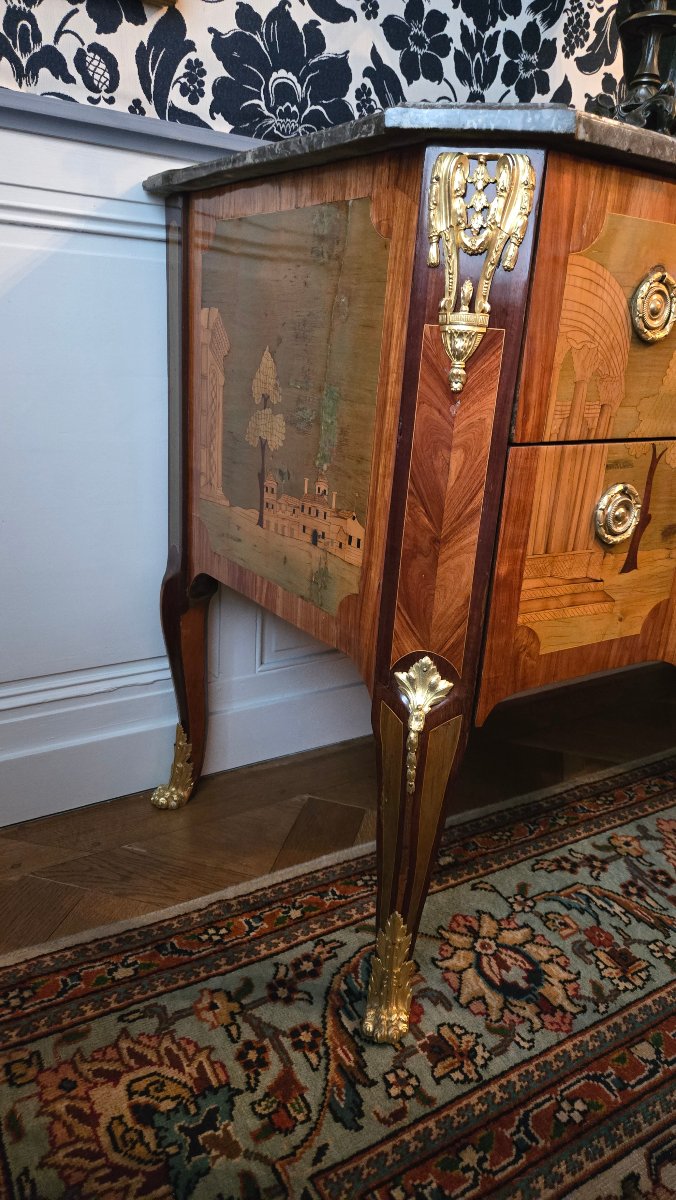
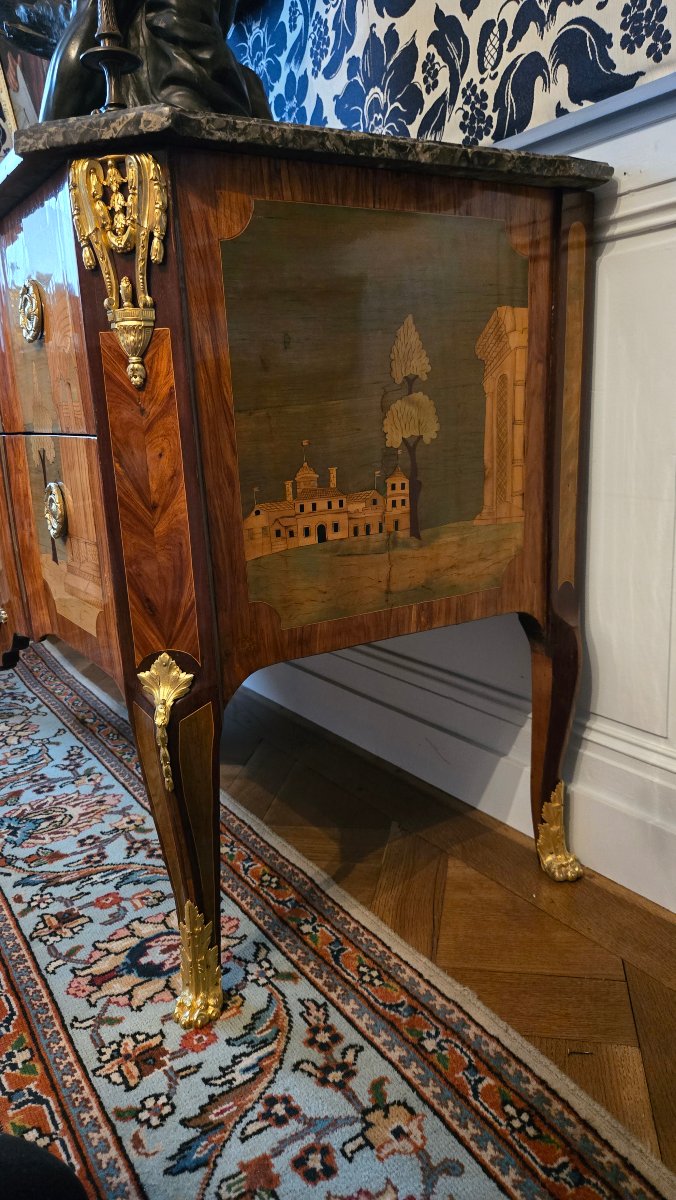
Both sides of the commode are also decorated with elaborate marquetry landscapes featuring buildings, towers, trees and imaginary architecture.
The front uprights are decorated with book-matched veneers, framed by fine stringing and enriched with gilt-bronze mounts featuring scrolling foliage.
The elegantly curved legs are embellished with foliate mounts and terminate in claw-form gilt-bronze sabots.
The drawers retain their circular handles with rosette backplates and oval escutcheons surmounted by ribbon bows. A decorative gilt-bronze composition featuring foliage and an ornamental urn enriches the central apron.
The commode retains its original moulded Grey Sainte-Anne marble top, carefully shaped to follow the breakfront façade and trapezoidal outline of the cabinet. The marble underwent an earlier restoration.
André-Louis Gilbert (1746–1809), a specialist in architectural marquetry
Admitted as a master cabinetmaker in Paris on 20 July 1774, André-Louis Gilbert belonged to a generation of craftsmen who contributed to the development of French furniture decoration during the final decades of the 18th century.
Having trained under Louis-Noël Malle (1734–1782), one of the most accomplished Parisian marquetry specialists of his time, Gilbert developed a distinctive production featuring picturesque landscapes, architectural ruins, colonnades, arcades and imaginary monuments.
Established in the Rue Traversière until 1785, he distinguished himself through his mastery of pictorial marquetry, in which the careful selection of veneers, precise cutting and subtle variations in colour allowed architectural compositions to be recreated in wood.
His activity appears to have extended beyond furniture produced for his own clientele.
Several known pieces bear both his stamp and that of Léonard Boudin (1735–1807), who became a master cabinetmaker in 1761 and also operated as an important furniture dealer.
These double stamps illustrate the professional relationship between the two craftsmen and the organisation of Parisian workshops, where specialist cabinetmakers could supply furniture or decorative marquetry panels to fellow craftsmen and dealers.
Architectural landscapes and ruins in 18th-century marquetry
The development of architectural landscape marquetry reflects the evolution of French taste during the middle of the 18th century.
The archaeological discoveries at Herculaneum, beginning in 1738, and Pompeii, from 1748, encouraged a renewed fascination with the remains of Antiquity.
Travel to Italy, architectural publications and the circulation of engravings further contributed to this growing enthusiasm.
The engravings of Giovanni Battista Piranesi, depicting Roman ruins and monumental architecture, together with the paintings of Hubert Robert, renowned for his picturesque ruins and imaginary architectural settings, illustrate this artistic sensibility.
However, the fascination with ruins was not exclusively archaeological. It also reflected a taste for picturesque landscapes, the poetry of abandoned monuments and imaginary architectural compositions combining classical, medieval and fanciful elements.
Parisian marquetry specialists translated these scenes into wood, decorating commodes, fall-front secretaries and cabinets with elaborate architectural compositions.
Gilbert's work belongs fully to this artistic movement, combining precise architectural drawing with imaginative interpretations of landscapes and ruins.
André-Louis Gilbert and the relationships between Parisian workshops
In his book Les Roussel, une dynastie d'ébénistes au XVIIIe siècle, François Quéré examines the architectural landscape marquetry produced by Parisian cabinetmakers, particularly the relationships between the workshops of Pierre Roussel, Louis-Noël Malle and André-Louis Gilbert.
The author identifies a group of architectural compositions featuring arcades, colonnades and ruins, with certain motifs appearing on furniture stamped by different cabinetmakers.
A commode attributed to Gilbert, illustrated in Pierre Kjellberg's reference work, features an architectural composition with arcades in a particularly complete arrangement. Adapted versions of similar motifs can also be found on furniture produced by the Roussel workshop.
These observations led François Quéré to suggest that Gilbert may have supplied ready-made marquetry panels to other cabinetmakers, which could subsequently be adapted or cut down to fit individual pieces of furniture.
This hypothesis highlights the possible importance of Gilbert in the creation and circulation of architectural marquetry designs among Parisian workshops.
The existence of furniture bearing both Gilbert's and Léonard Boudin's stamps further illustrates these professional relationships.
The present commode, with its extensive architectural marquetry covering the entire façade and both sides, is a particularly representative example of the decorative repertoire associated with André-Louis Gilbert.
Stamps and guild marks
The commode bears two A. L. GILBERT stamps, respectively located on the upper surface of the rear left upright and the front right upright.
It also bears the JME mark of the Parisian Guild of Master Cabinetmakers, the official guild inspection mark used during the 18th century.
Bibliography and comparisons
François Quéré, Les Roussel, une dynastie d'ébénistes au XVIIIe siècle, Éditions Faton, 2012, particularly pp. 176–179, discussing architectural landscapes and ruins in marquetry.
Pierre Kjellberg, Le Mobilier français du XVIIIe siècle, Les Éditions de l'Amateur, Paris, 2002, p. 403, illustrating a commode attributed to André-Louis Gilbert.
Geoffrey de Bellaigue, “Ruins in Marquetry”, Apollo, January 1968, discussing architectural ruins in marquetry and their iconographic sources.
Comparable commodes and secretaries stamped by or attributed to André-Louis Gilbert have also appeared in international sales at Christie's and Sotheby's, including examples bearing the stamps of both Gilbert and Léonard Boudin.
Carefully restored with respect for its original construction and historical character.
Oak carcass, marquetry in various wood veneers, period gilt-bronze mounts and original Grey Sainte-Anne marble top, previously restored.
Paris, circa 1775.
Dimensions
Height: 84.5 cm (33.27 in)
Width at rear: 130.5 cm (51.38 in)
Width at front: 125 cm (49.21 in)
Depth: 58 cm (22.83 in)
16 000 €
Period: 18th century
Style: Louis 15th - Transition
Condition: Good condition
Material: Wood marquetry
Reference (ID): 1841976
Availability: In stock
Print