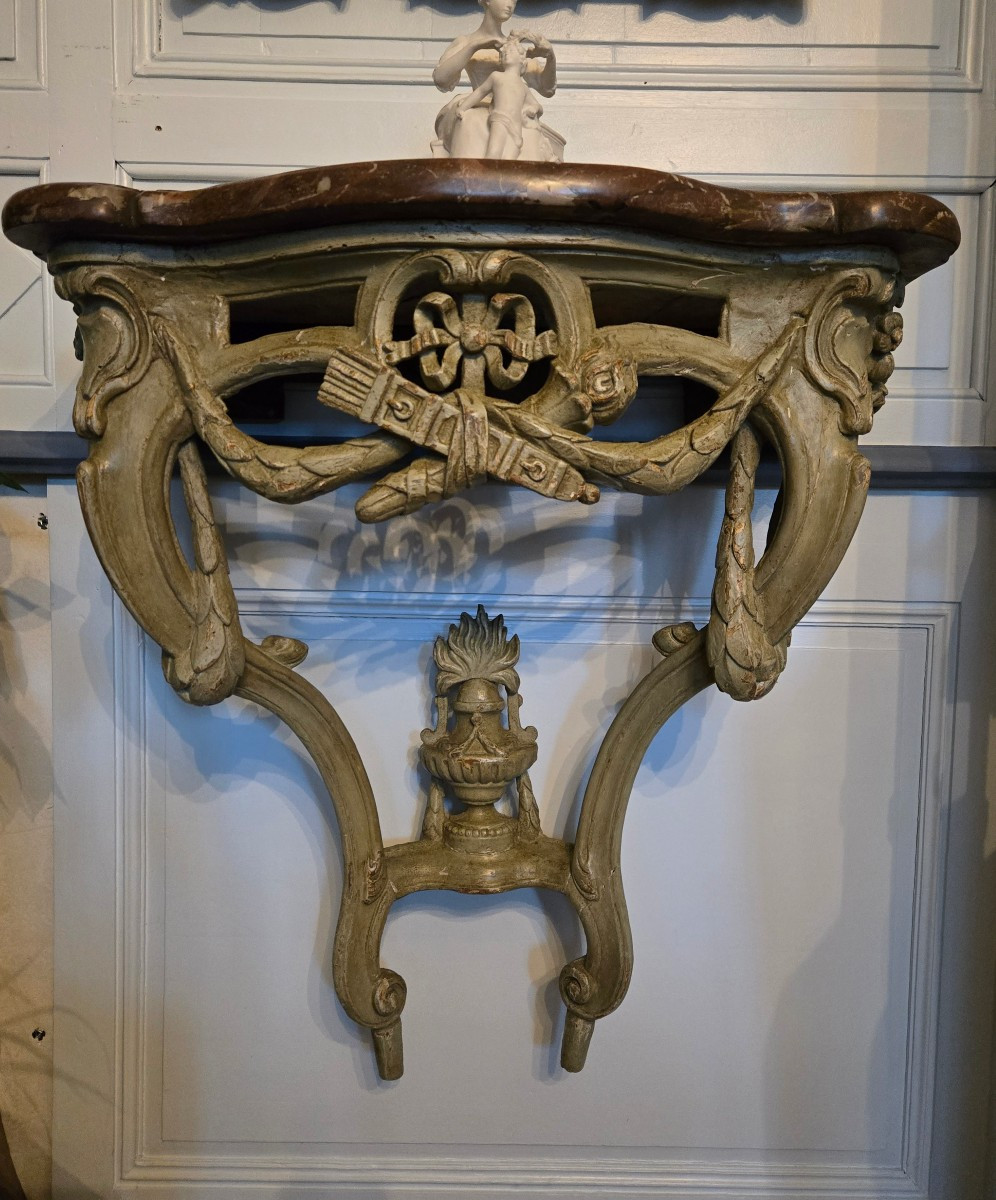
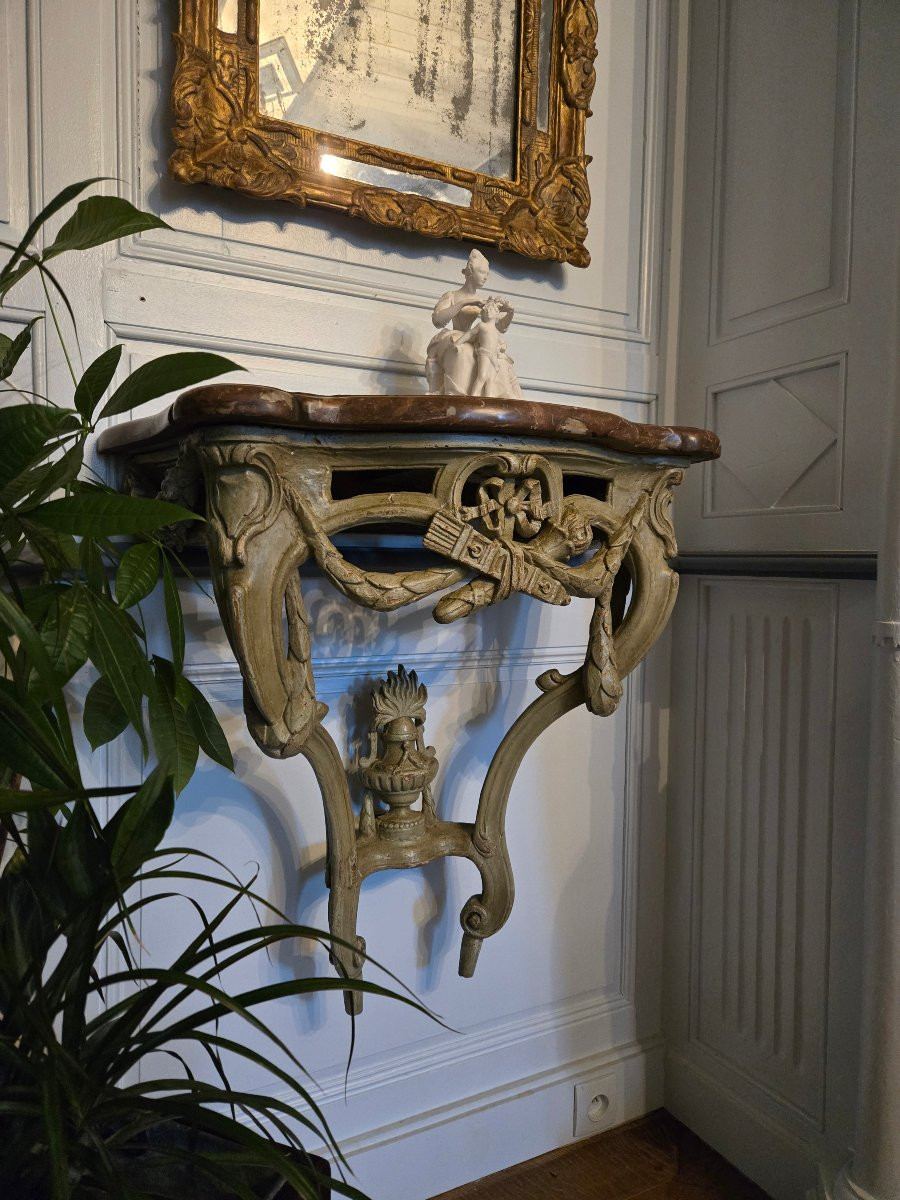
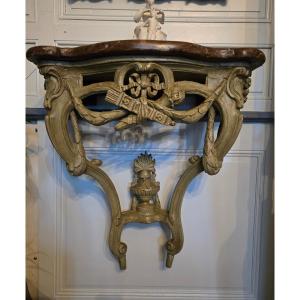


Wall Console With Attributes Of Love, Provincial Work, Late Louis XV Reign.
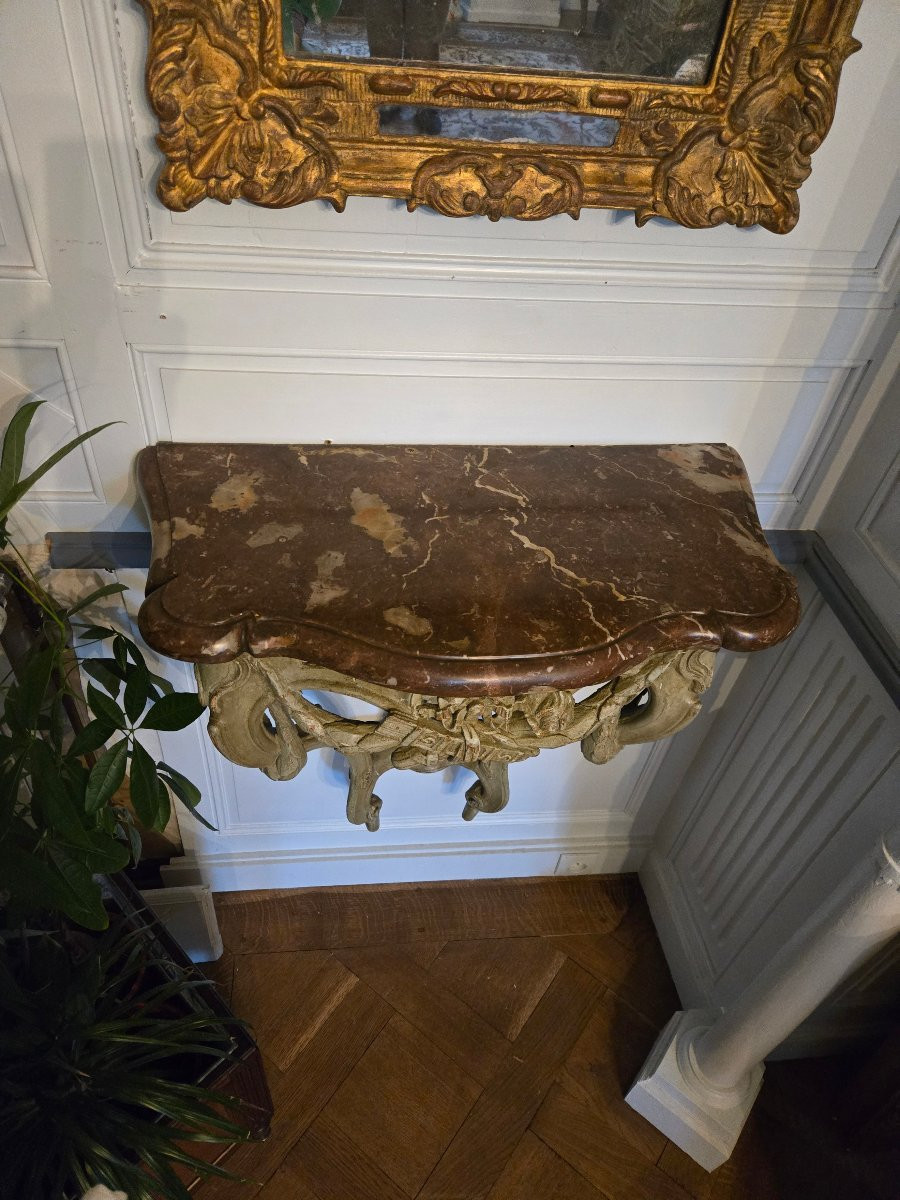
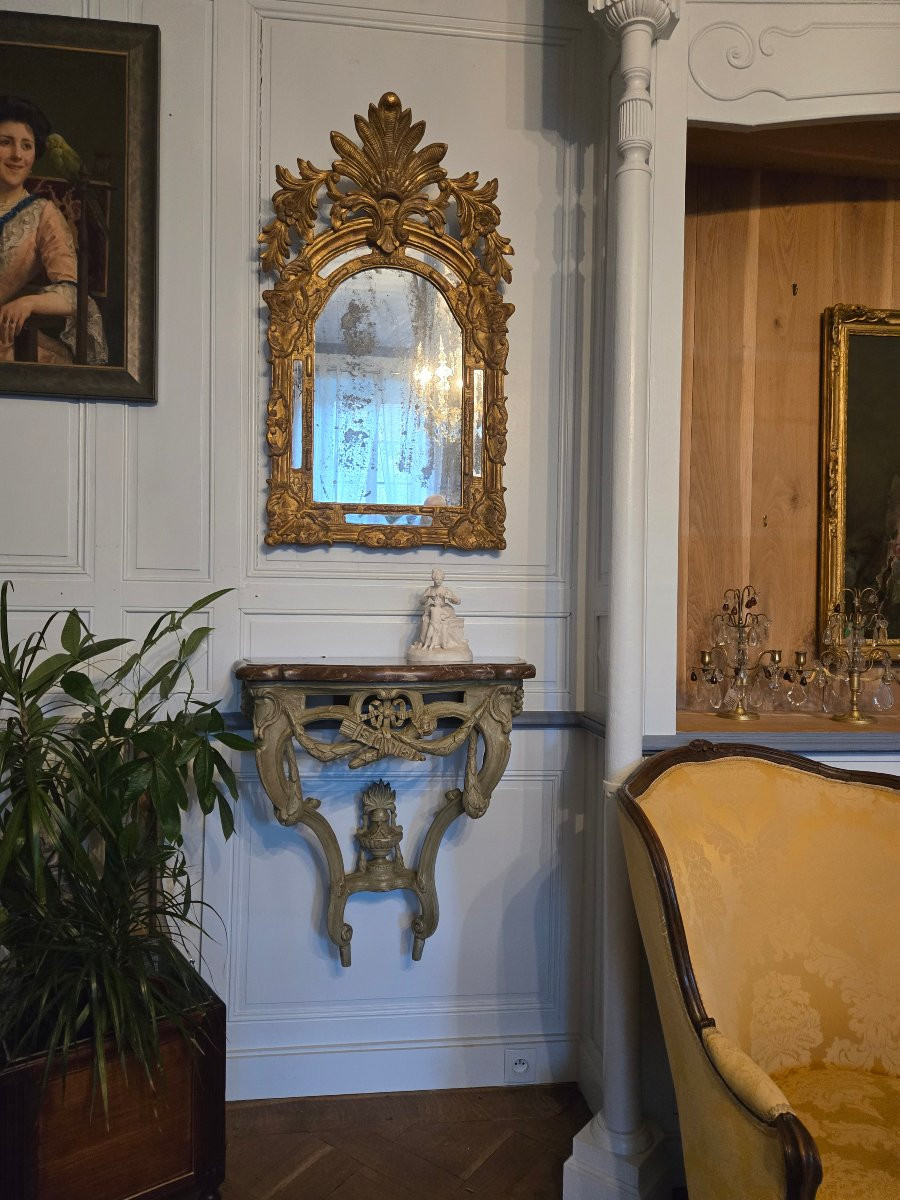
Intended for wall-mounting, this console table is of balanced proportions, allowing it to be easily integrated into a décor, notably between two windows, under a trumeau or surmounted by a mirror. This type of furniture, closely linked to interior architecture, plays a key role in the composition of 18th-century elevations and decorative ensembles.
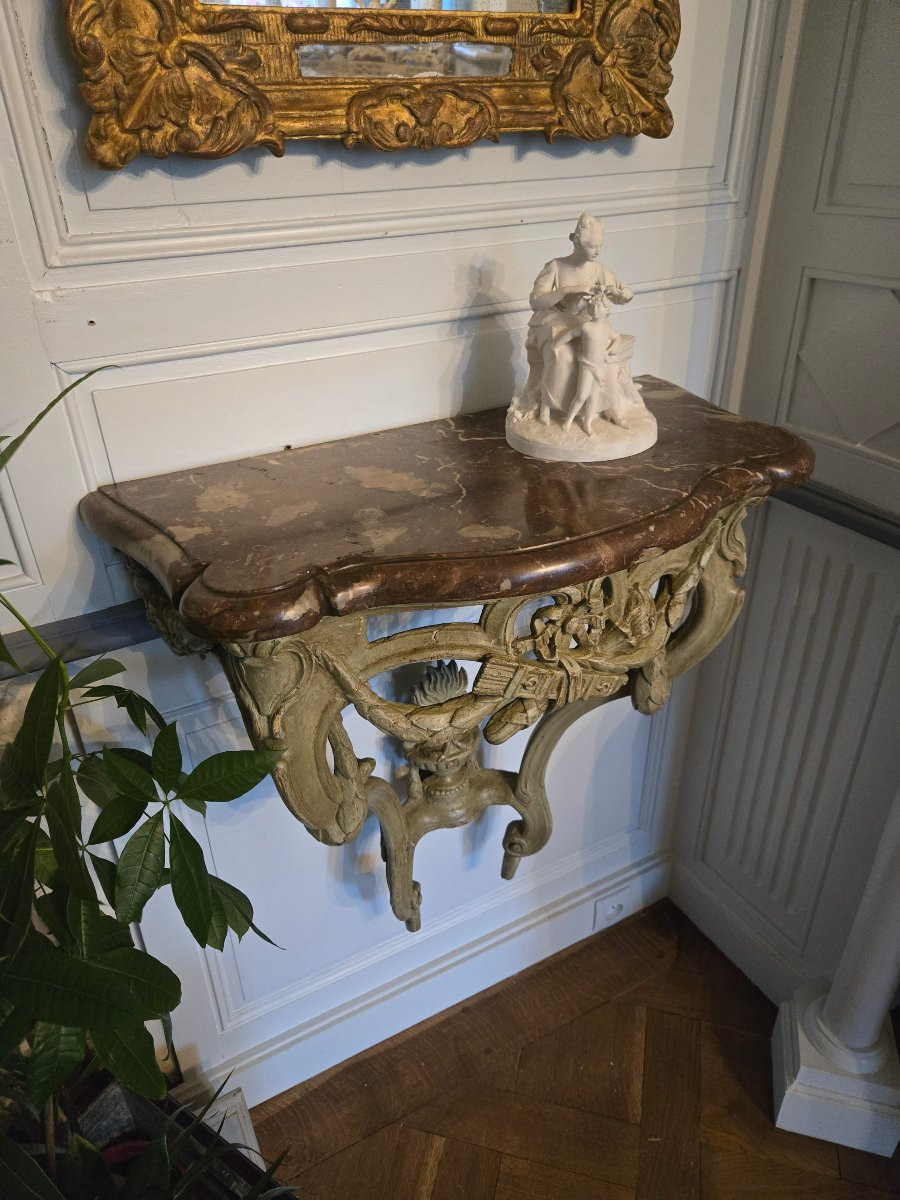
Its elegantly curved structure is still deeply rooted in the vocabulary of the Louis XV style, with a flowing belt and uprights with supple lines. However, it is part of the so-called "transition" movement, characteristic of the years 1760-1775, during which rocaille forms coexisted with decor inspired by Antiquity.
Far from a linear evolution, this moment saw the juxtaposition of two decorative languages: on the one hand, the curves and movement of the Louis XV style, and on the other, a nascent neoclassical repertoire, more ordered and structured. This stylistic tension is clearly evident here.
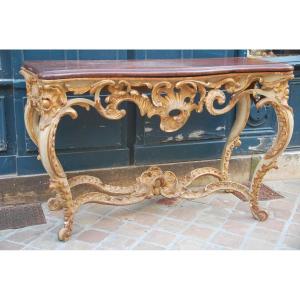
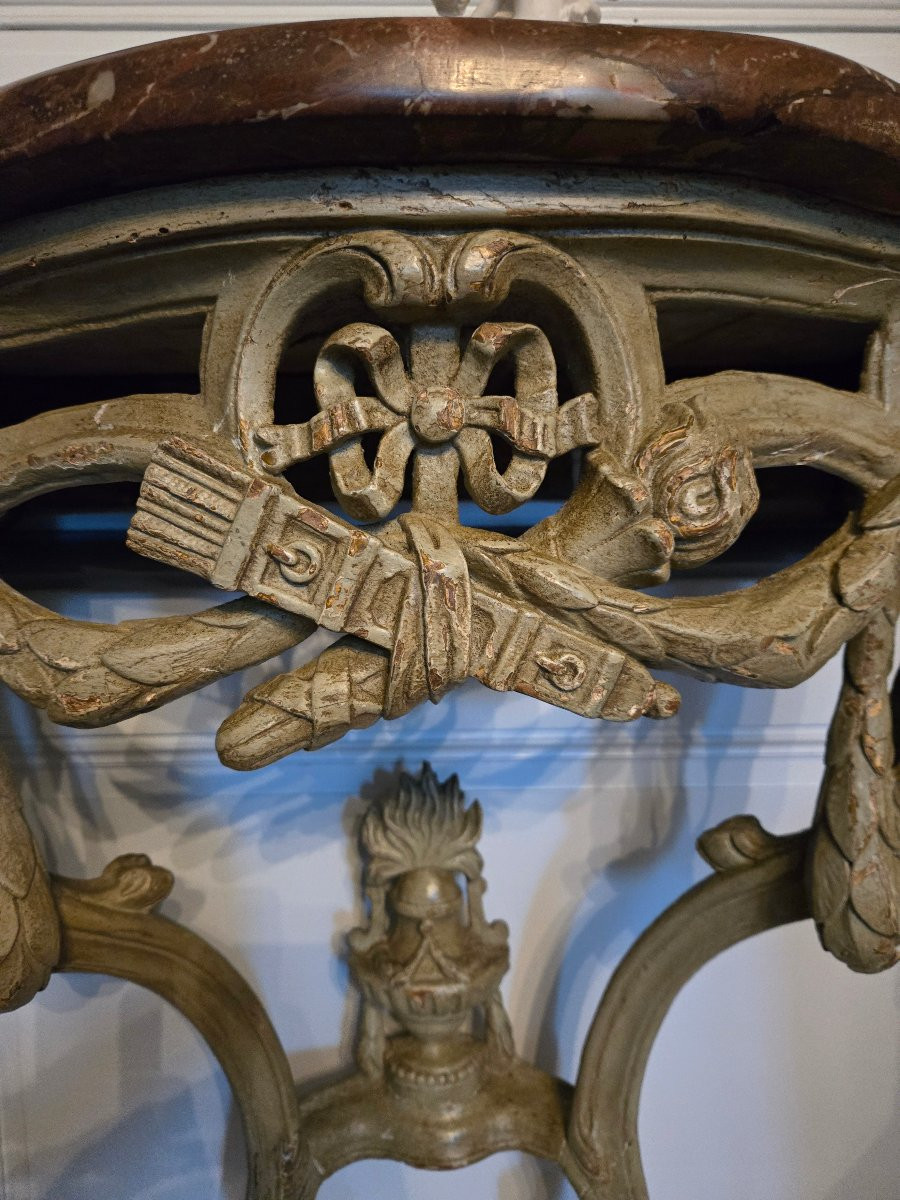
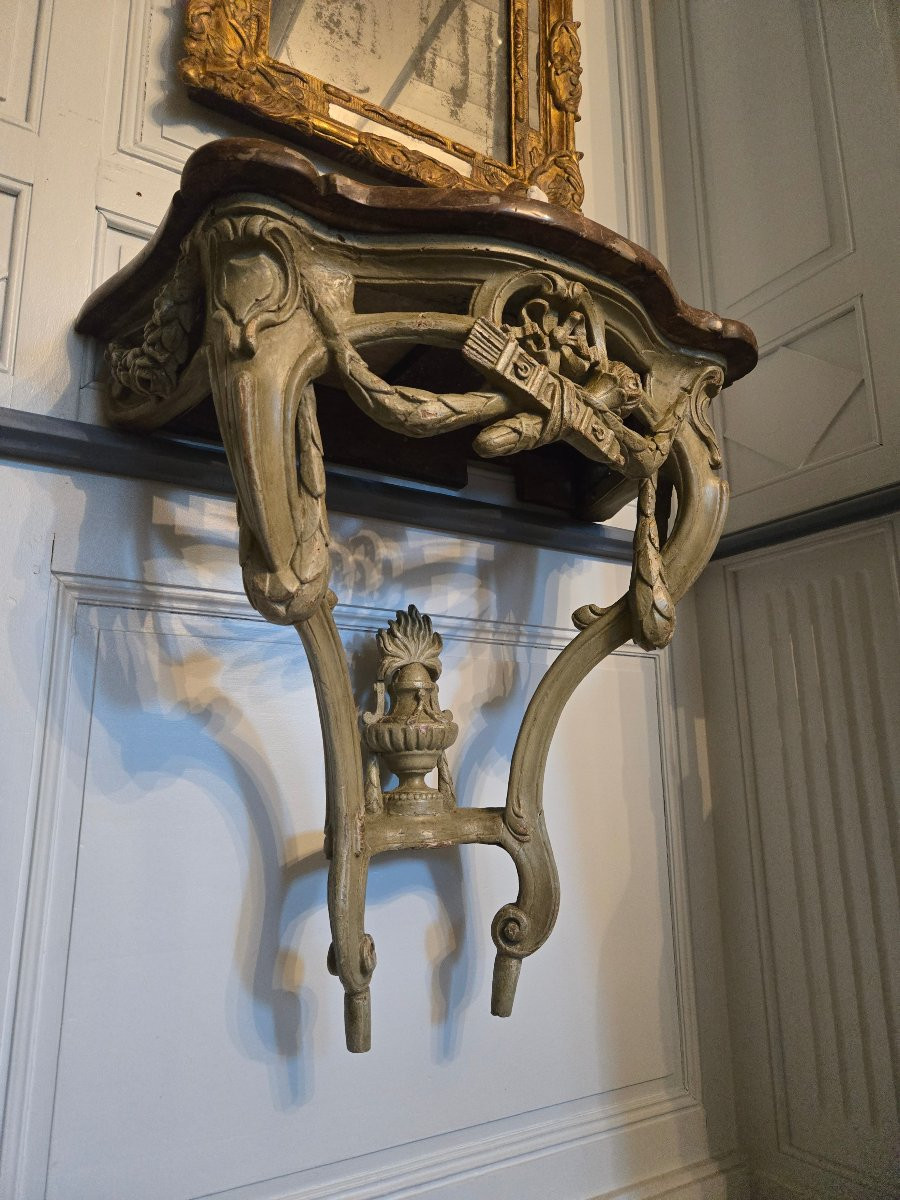
The broadly openwork belt features a central motif of a quiver and flaming torch, attributes of Love, held in place by a knotted ribbon. From this knot, laurel leaf garlands extend sideways to join the front jambs.
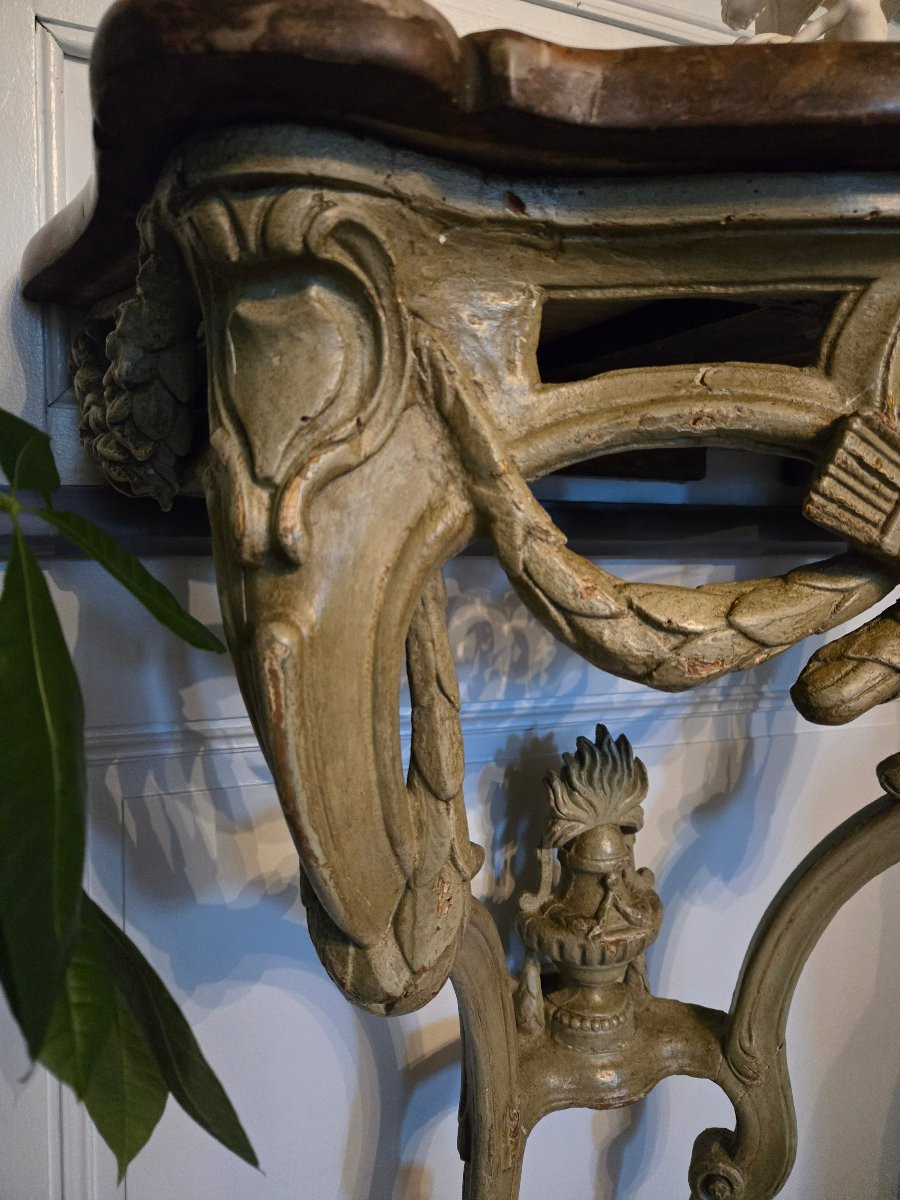
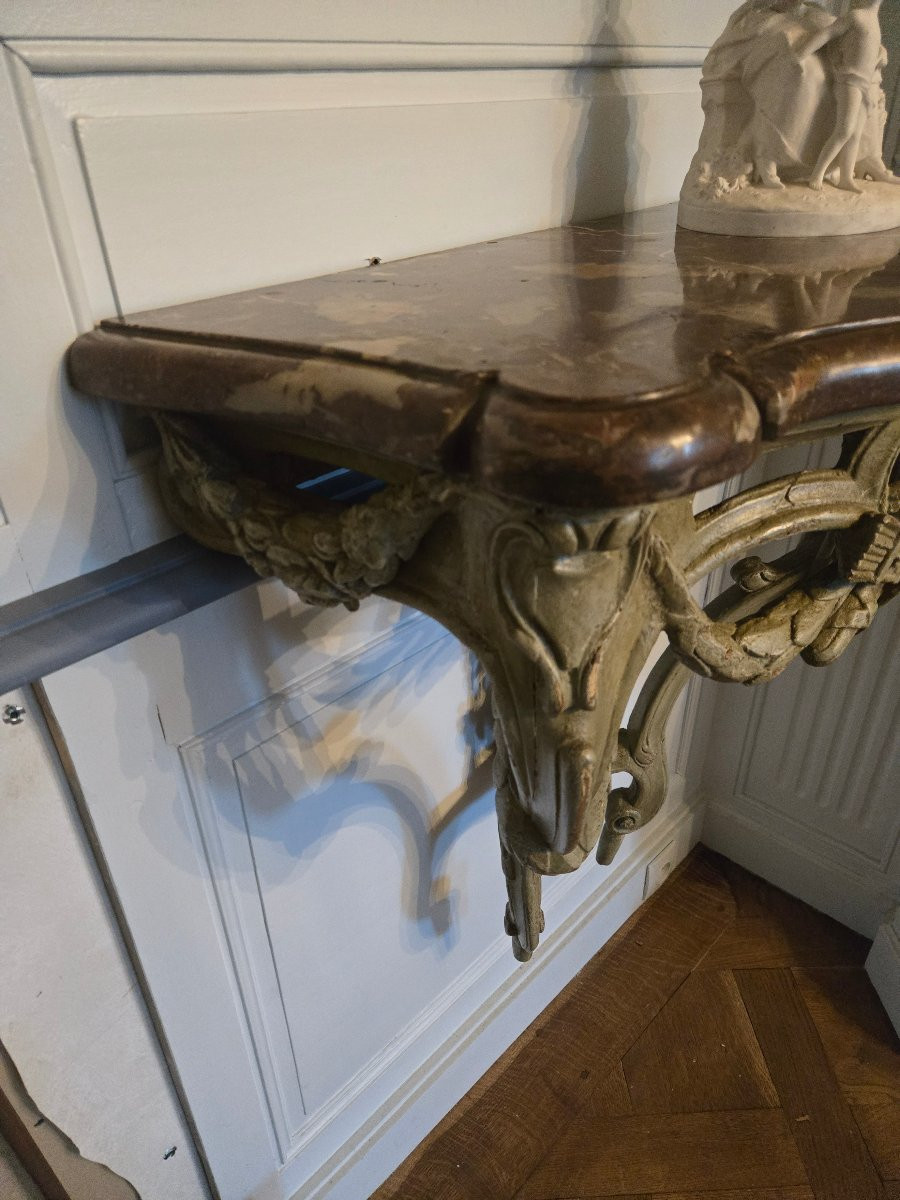
The latter feature heart-shaped cartouches at the corner masses, while their curves are emphasized by laurel leaf falls, reinforcing the coherence of the decoration.
The sides, also openwork, are adorned with garlands of foliage punctuated with flowers, testifying to the care taken with all visible faces.
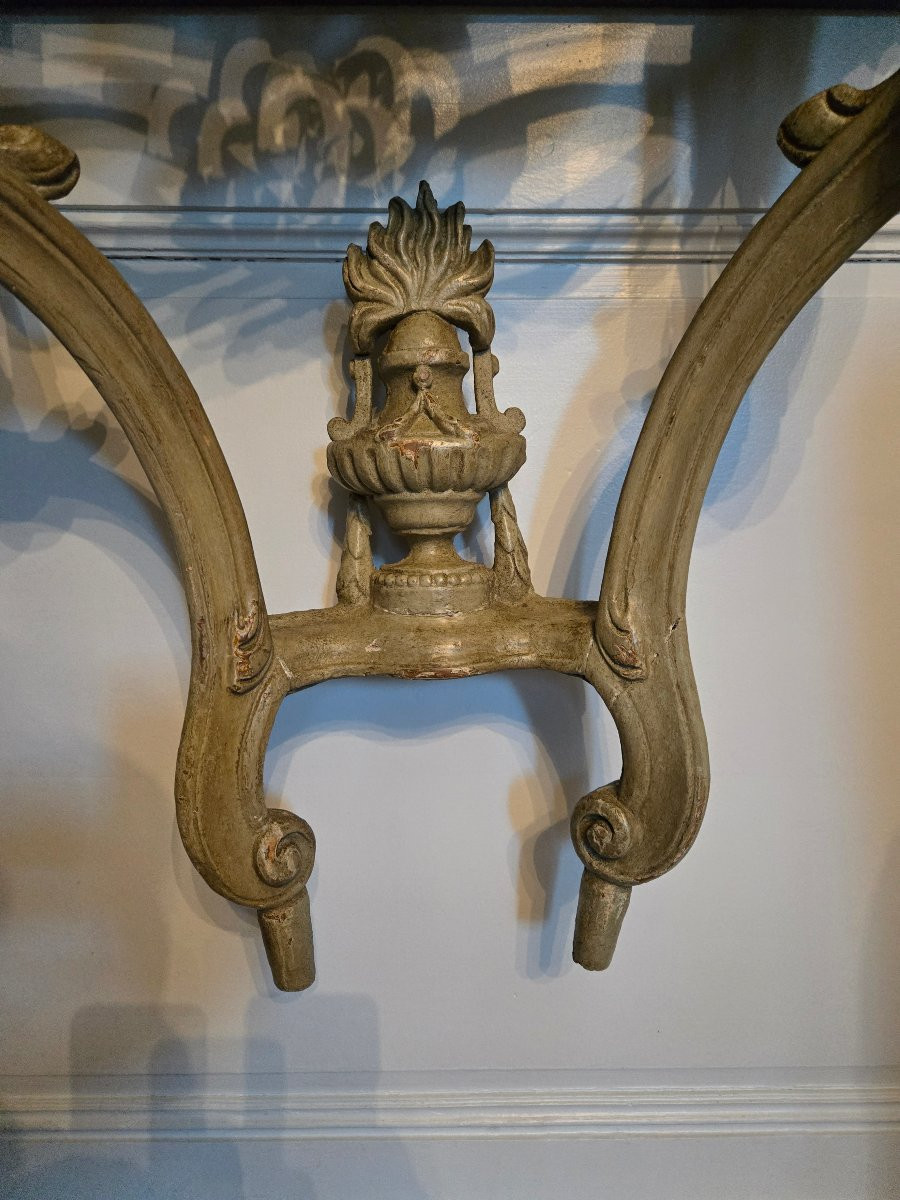
The two uprights are joined by an openwork brace adorned with a fire pot, an emblematic motif of the antique repertoire.
All of these elements - quiver, flaming torch, ribbon bow, laurel leaves, plant garlands and fire pot - belong fully to the neoclassical vocabulary that gradually took hold from the 1760s onwards. Applied to a structure that is still Louis XV, this decoration is a perfect illustration of these so-called "transitional" productions, where new ornaments are superimposed on older forms, without making them disappear.
The frame is made of softwood, a material frequently used in 18th-century provincial production, particularly for furniture designed to be painted and integrated into decorative ensembles. This characteristic, combined with the typology of the furniture and its carved treatment, points to provincial workmanship.
The console retains its polychromy in softened green tones, showing an old patina with wear and rework, contributing to the reading of the carved relief and the harmony of the whole.
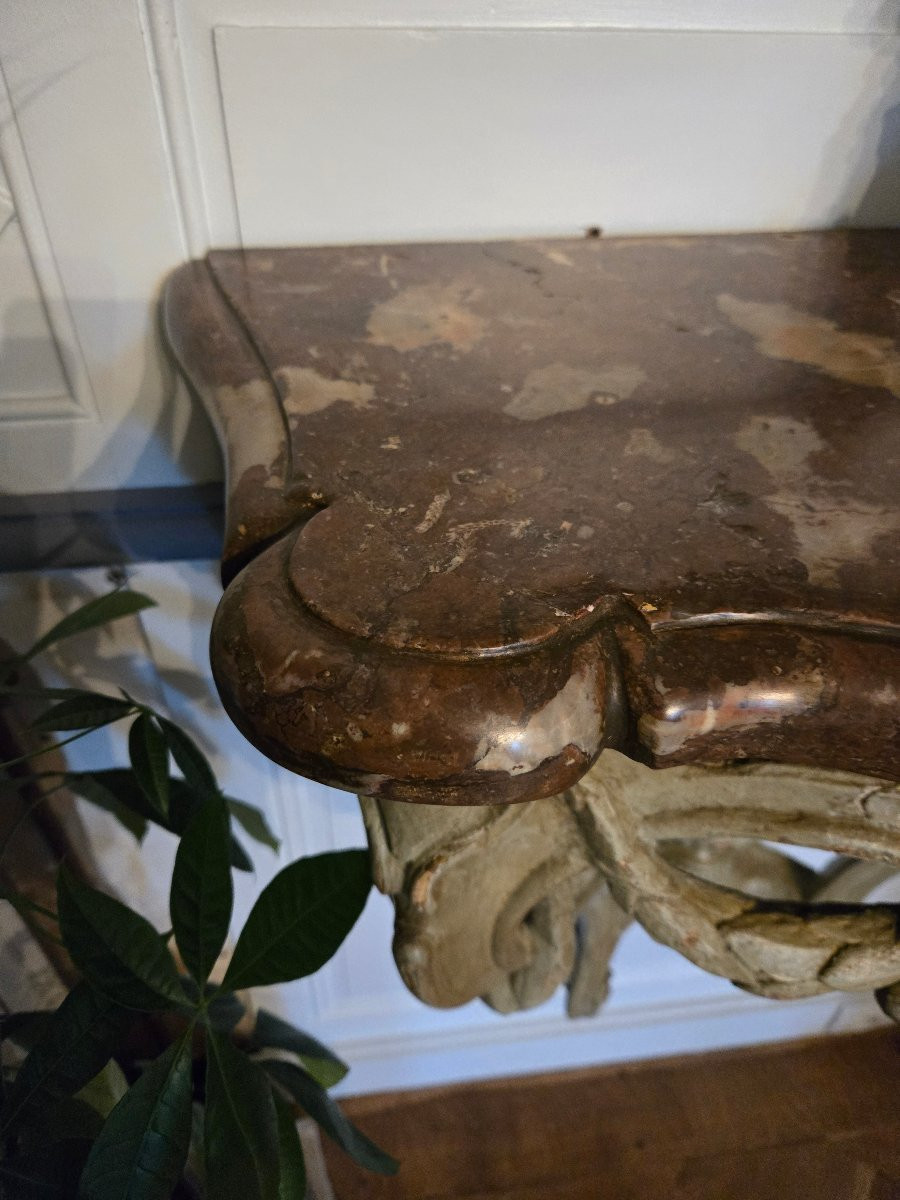
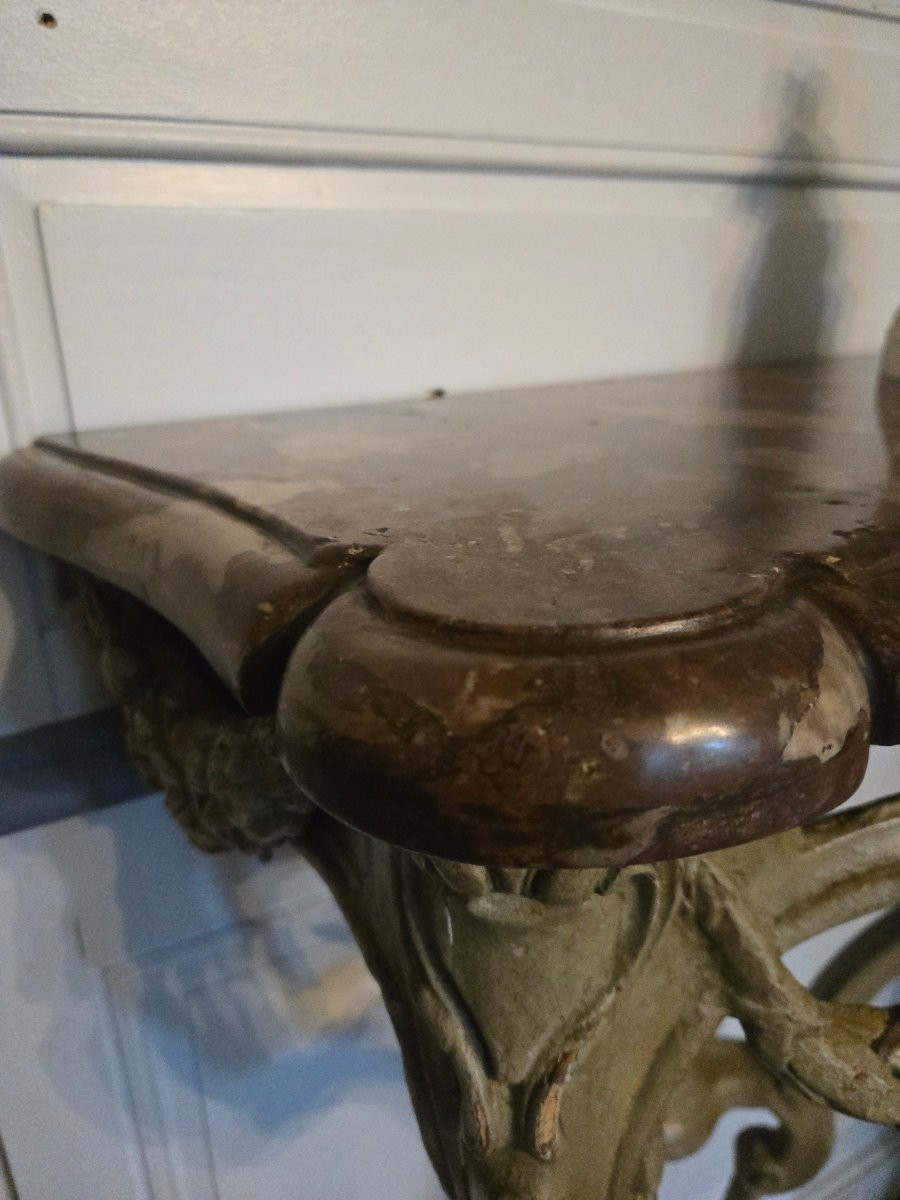
The mantel is topped with a thick, warm-brown Rance marble from Belgium, with contrasting veins. The top, molded with a corbel beak, follows the movement of the belt and underscores the quality of the composition.
Marble dimensions:
Height: 72.5 cm
Width: 73 cm
Depth: 38 cm
Marble thickness: 3.5 cm
Its elegantly curved structure is still deeply rooted in the vocabulary of the Louis XV style, with a flowing belt and uprights with supple lines. However, it is part of the so-called "transition" movement, characteristic of the years 1760-1775, during which rocaille forms coexisted with decor inspired by Antiquity.
Far from a linear evolution, this moment saw the juxtaposition of two decorative languages: on the one hand, the curves and movement of the Louis XV style, and on the other, a nascent neoclassical repertoire, more ordered and structured. This stylistic tension is clearly evident here.
The broadly openwork belt features a central motif of a quiver and flaming torch, attributes of Love, held in place by a knotted ribbon. From this knot, laurel leaf garlands extend sideways to join the front jambs.
The latter feature heart-shaped cartouches at the corner masses, while their curves are emphasized by laurel leaf falls, reinforcing the coherence of the decoration.
The sides, also openwork, are adorned with garlands of foliage punctuated with flowers, testifying to the care taken with all visible faces.
The two uprights are joined by an openwork brace adorned with a fire pot, an emblematic motif of the antique repertoire.
All of these elements - quiver, flaming torch, ribbon bow, laurel leaves, plant garlands and fire pot - belong fully to the neoclassical vocabulary that gradually took hold from the 1760s onwards. Applied to a structure that is still Louis XV, this decoration is a perfect illustration of these so-called "transitional" productions, where new ornaments are superimposed on older forms, without making them disappear.
The frame is made of softwood, a material frequently used in 18th-century provincial production, particularly for furniture designed to be painted and integrated into decorative ensembles. This characteristic, combined with the typology of the furniture and its carved treatment, points to provincial workmanship.
The console retains its polychromy in softened green tones, showing an old patina with wear and rework, contributing to the reading of the carved relief and the harmony of the whole.
The mantel is topped with a thick, warm-brown Rance marble from Belgium, with contrasting veins. The top, molded with a corbel beak, follows the movement of the belt and underscores the quality of the composition.
Marble dimensions:
Height: 72.5 cm
Width: 73 cm
Depth: 38 cm
Marble thickness: 3.5 cm
2 200 €
Period: 18th century
Style: Louis 15th - Transition
Condition: Good condition
Material: Painted wood
Reference (ID): 1750081
Availability: In stock
Print