THIS OBJECT WAS SOLD
Solid Mahogany And Island Wood Port Furniture, Mid-18th Century.


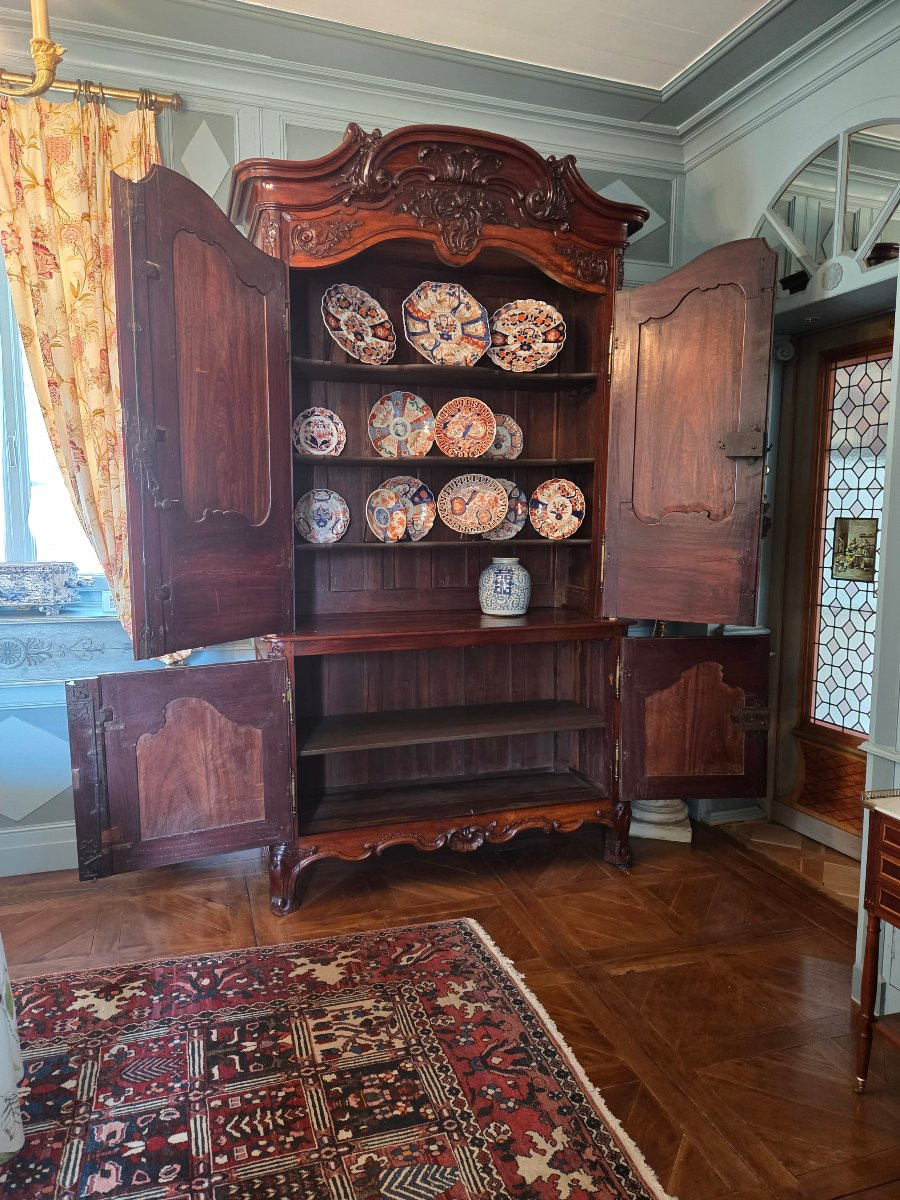


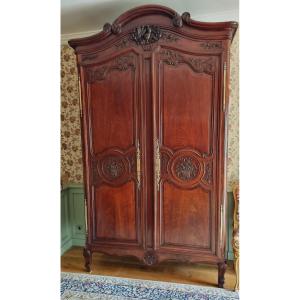
Born of a singular moment when French ports became true gateways to the world, this piece of furniture is part of the great adventure of 18th-century maritime trade. Thanks to trade with the West Indies and Central America, cargoes of exotic woods - mahogany, lemon wood, guaiac - arrived on the quays of La Rochelle, Nantes and Bordeaux. At first, they were considered simply as ballast or return freight, before being recognized for their exceptional qualities. Dense, rot-proof, tightly grained and richly colored, these woods were to profoundly transform French furniture, giving rise to what is known today as "port furniture".
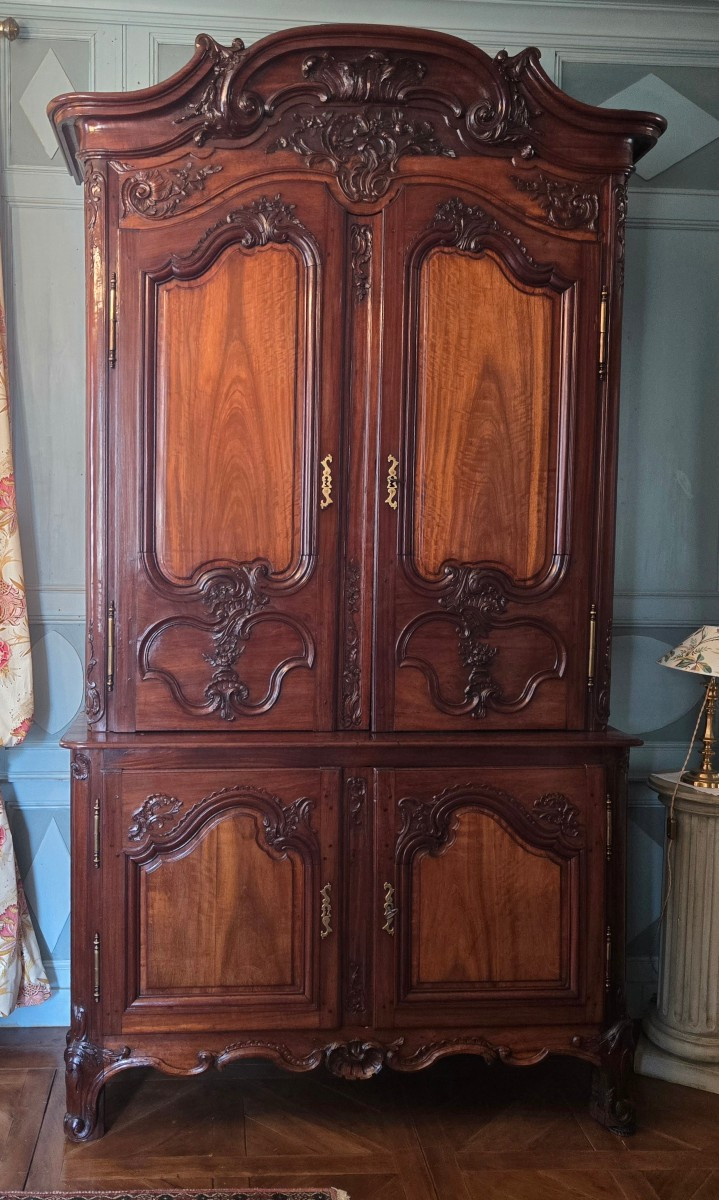
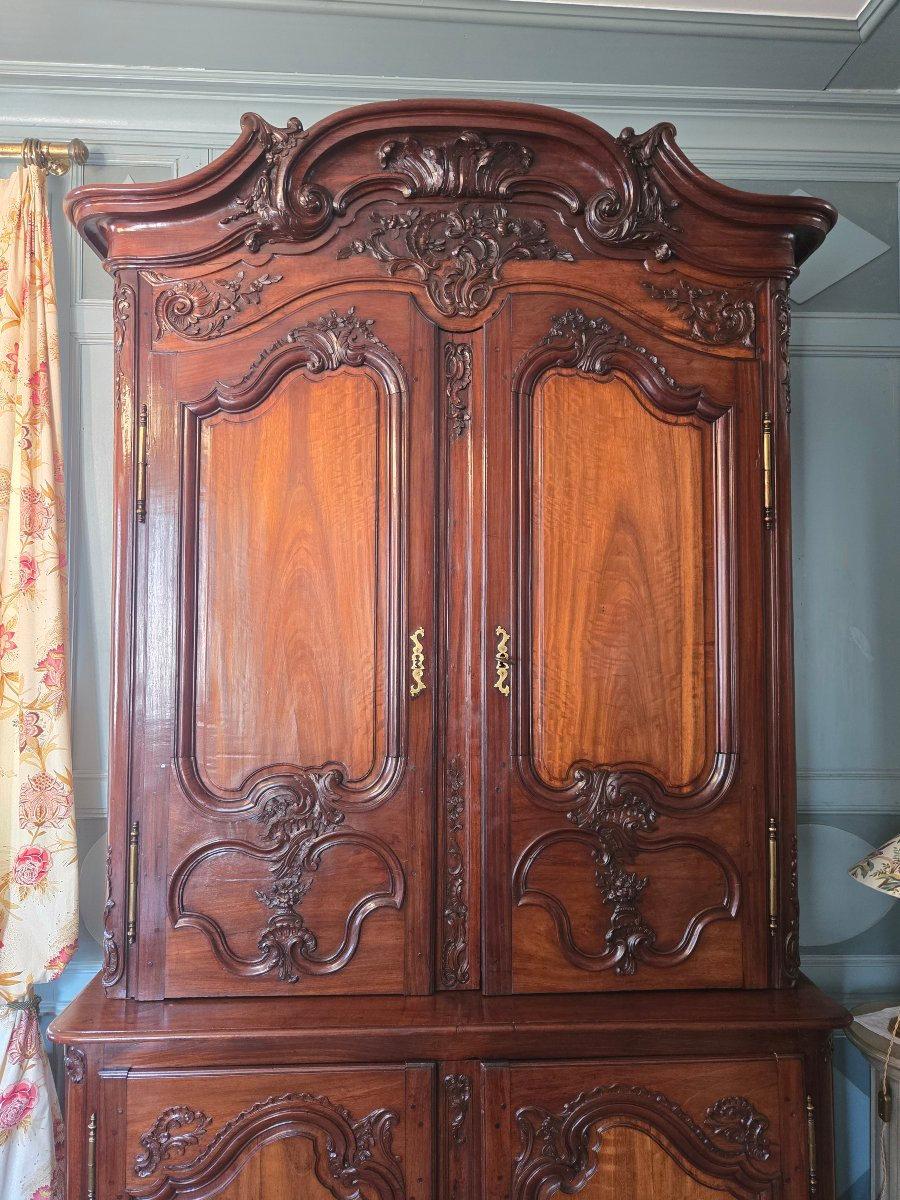
The present piece of furniture is a particularly accomplished example. Entirely made from island woods - right down to the structural parts - it bears witness to a deliberate and costly choice, far removed from more ordinary productions mixing native woods and exotic species. Here, mahogany dominates, probably from Santo Domingo, while some of the lighter, satin-finish, slightly wavy panels could be made of lemon wood, creating a subtle, sought-after contrast. This differentiated, symmetrical use of wood species reveals an almost cabinetmaker's approach to design, going beyond simple joinery to a genuine staging of the material.
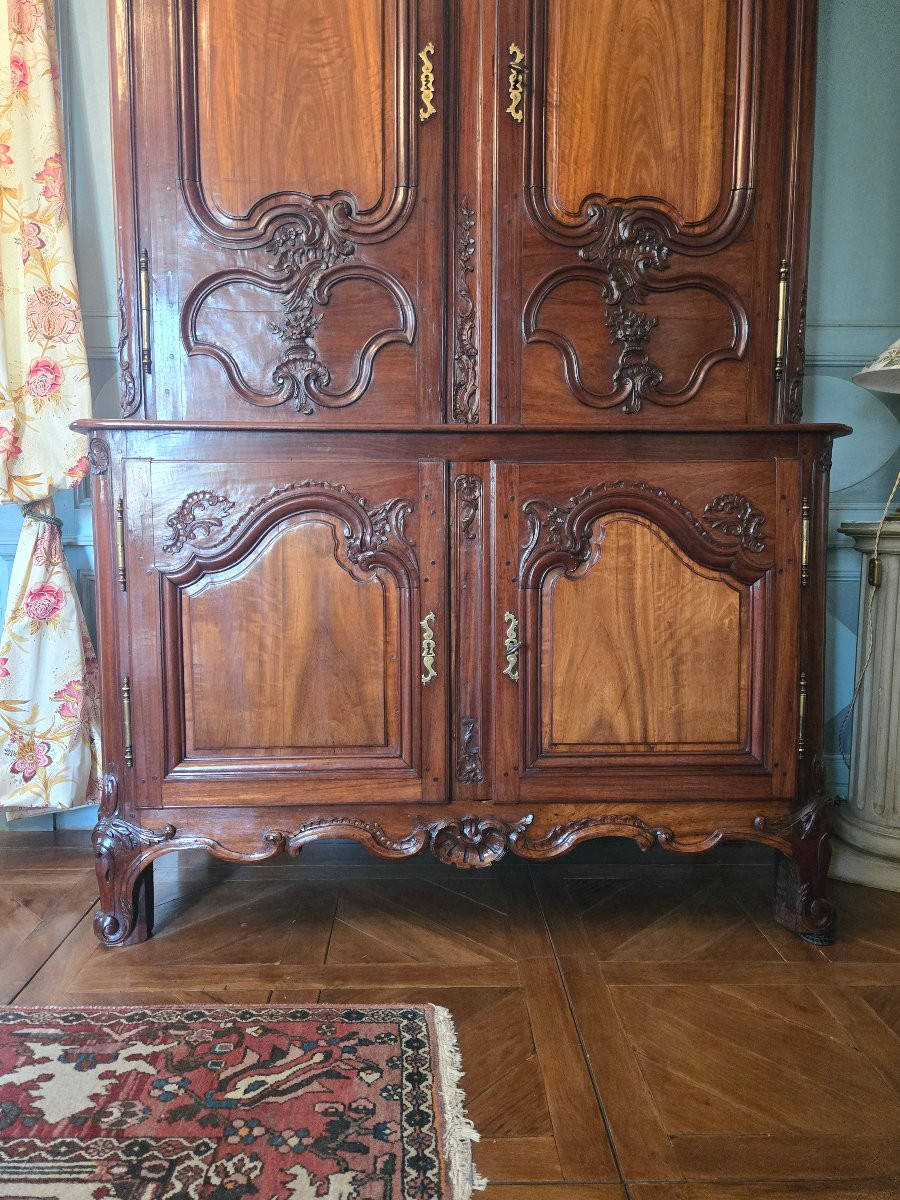
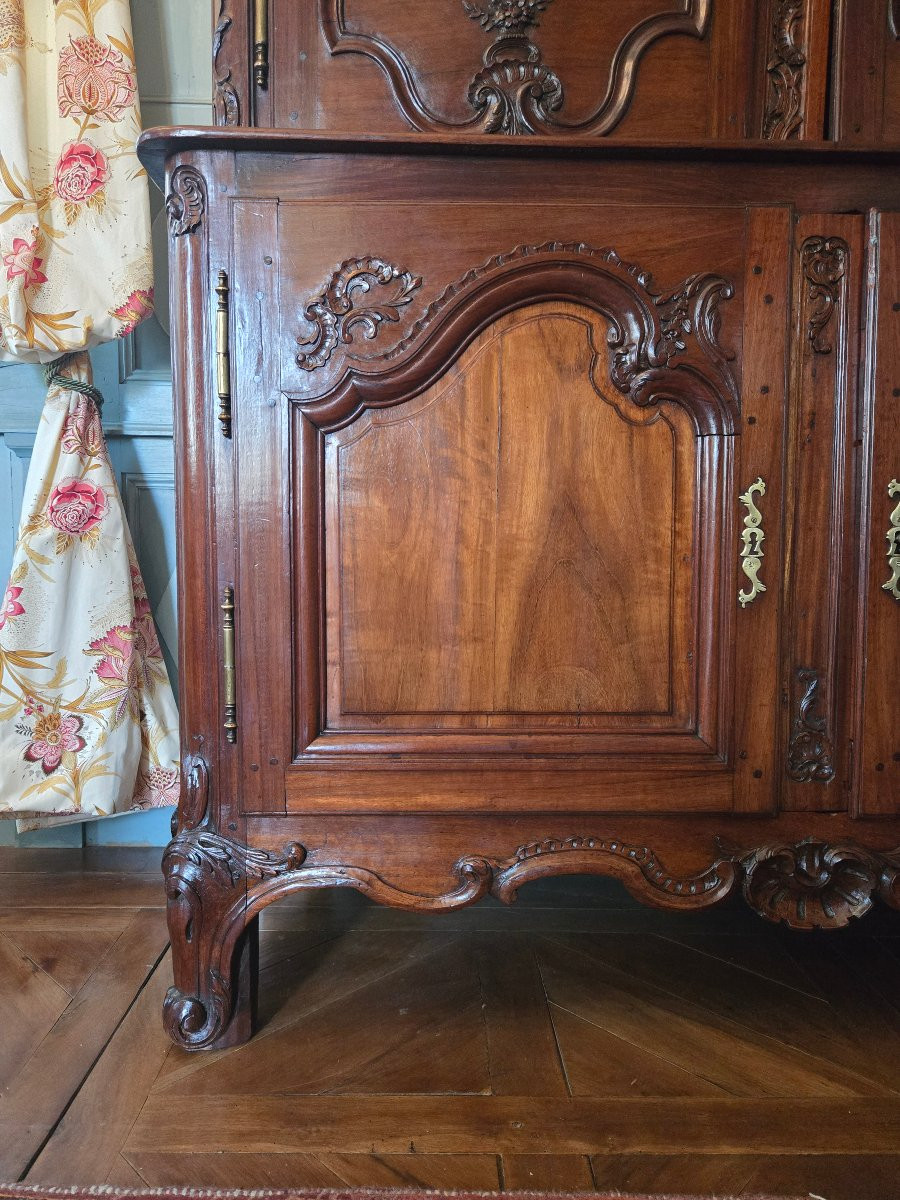
The powerfully architectural facade is fully in keeping with the Louis XV aesthetic. It features a rich rocaille décor, animated by shells, nervous foliage, delicately scattered florets and cock's crest motifs running across the panels. A large central shell at the bottom anchors the composition, while the deeply sculpted decor as a whole bears witness to perfect technical mastery: the relief is frank, the backgrounds subtly worked to catch the light, and each motif seems to vibrate with restrained energy.
The proportions themselves contribute to this impression of strength and presence. The uprights are thick, the curved legs generous in cross-section, affirming a piece of furniture designed to last as much as to impress. This is not a discreet piece of furniture, but a showpiece, destined for a high-ranking interior - a private mansion or the home of a shipowner enriched by maritime trade.
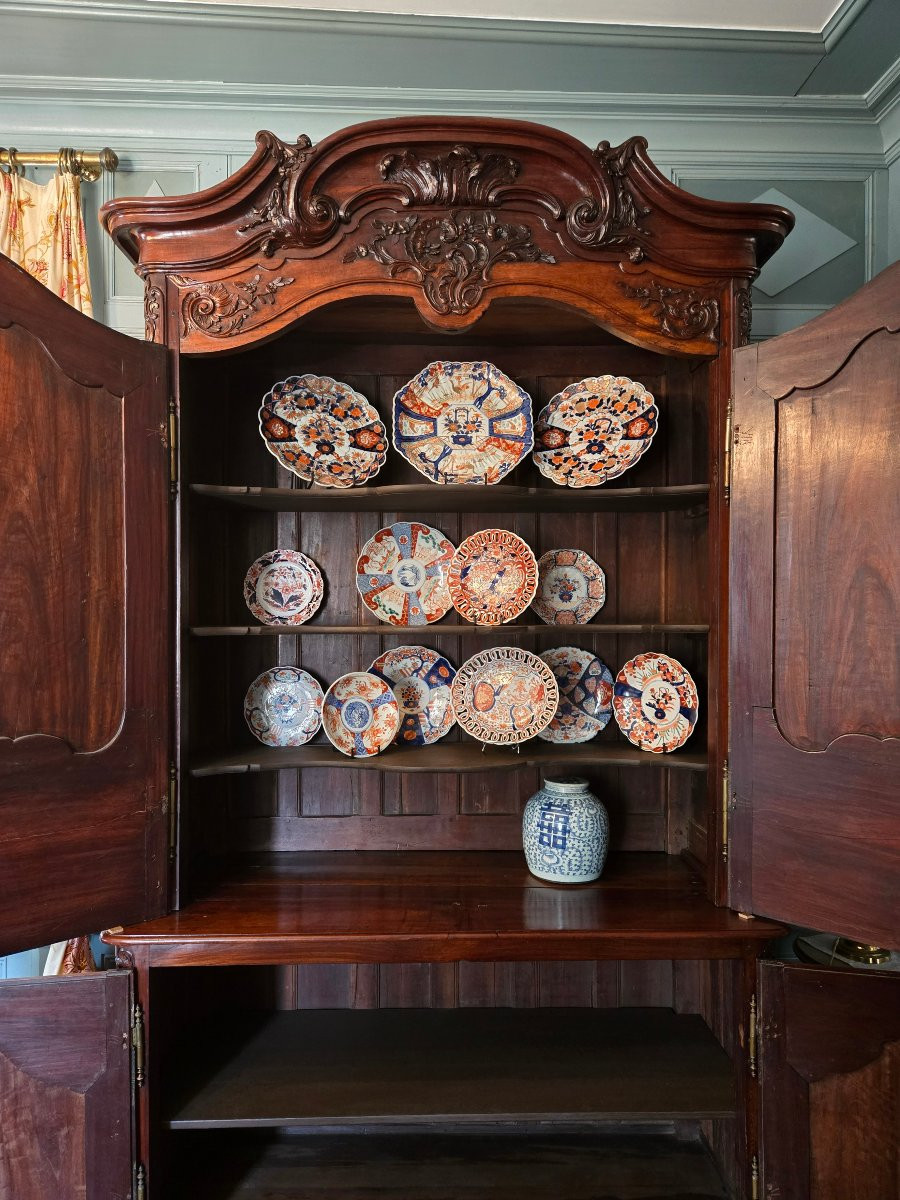
The cornice is a particularly striking feature. Wide and overhanging, it adopts a brace-like design forming an inverted "C" movement, framed by confronting scrolls - a silhouette found in certain Norman productions, notably in the Pays de Caux and around Fécamp. This formal kinship should not, however, mask the singularity of the ensemble: while the cornice evokes these northern models, the rest of the piece - in terms of both its material and its decorative vocabulary - is markedly different.
Indeed, no known Norman corpus presents such a combination: exclusive use of island woods, such assertive rocaille decoration, and such a demonstrative structure. Conversely, these characteristics are particularly evident in the products of the Atlantic seaboard ports, and more specifically in the orbit of La Rochelle and Aunis-Saintonge. Early sources mention exotic wood furniture in these regions, blending different species and sometimes adopting hybrid forms, reflecting the influence of trade and foreign models.
In this context, this piece of furniture can be seen as emblematic of these high-level port productions: a piece of commissioned furniture, probably intended for a wealthy patron - a merchant, shipowner or officer linked to maritime trade - eager to display his success through an object that was at once precious, exotic and resolutely modern for its time.
Through its presence, its quality of execution and the richness of its decoration, it fully embodies this aesthetic of port furniture: a meeting between the power of materials from overseas, the know-how of French craftsmen, and the social ambition of an elite born of maritime trade.
A rare piece of furniture, at the crossroads of influences, witness to a rapidly expanding world, where exoticism became synonymous with prestige and elegance.
Dimensions:
Height: 269 cmWidth: 146.5 cmDepth of lower body: 60 cmDepth of upper body: 47 cm
The present piece of furniture is a particularly accomplished example. Entirely made from island woods - right down to the structural parts - it bears witness to a deliberate and costly choice, far removed from more ordinary productions mixing native woods and exotic species. Here, mahogany dominates, probably from Santo Domingo, while some of the lighter, satin-finish, slightly wavy panels could be made of lemon wood, creating a subtle, sought-after contrast. This differentiated, symmetrical use of wood species reveals an almost cabinetmaker's approach to design, going beyond simple joinery to a genuine staging of the material.
The powerfully architectural facade is fully in keeping with the Louis XV aesthetic. It features a rich rocaille décor, animated by shells, nervous foliage, delicately scattered florets and cock's crest motifs running across the panels. A large central shell at the bottom anchors the composition, while the deeply sculpted decor as a whole bears witness to perfect technical mastery: the relief is frank, the backgrounds subtly worked to catch the light, and each motif seems to vibrate with restrained energy.
The proportions themselves contribute to this impression of strength and presence. The uprights are thick, the curved legs generous in cross-section, affirming a piece of furniture designed to last as much as to impress. This is not a discreet piece of furniture, but a showpiece, destined for a high-ranking interior - a private mansion or the home of a shipowner enriched by maritime trade.
The cornice is a particularly striking feature. Wide and overhanging, it adopts a brace-like design forming an inverted "C" movement, framed by confronting scrolls - a silhouette found in certain Norman productions, notably in the Pays de Caux and around Fécamp. This formal kinship should not, however, mask the singularity of the ensemble: while the cornice evokes these northern models, the rest of the piece - in terms of both its material and its decorative vocabulary - is markedly different.
Indeed, no known Norman corpus presents such a combination: exclusive use of island woods, such assertive rocaille decoration, and such a demonstrative structure. Conversely, these characteristics are particularly evident in the products of the Atlantic seaboard ports, and more specifically in the orbit of La Rochelle and Aunis-Saintonge. Early sources mention exotic wood furniture in these regions, blending different species and sometimes adopting hybrid forms, reflecting the influence of trade and foreign models.
In this context, this piece of furniture can be seen as emblematic of these high-level port productions: a piece of commissioned furniture, probably intended for a wealthy patron - a merchant, shipowner or officer linked to maritime trade - eager to display his success through an object that was at once precious, exotic and resolutely modern for its time.
Through its presence, its quality of execution and the richness of its decoration, it fully embodies this aesthetic of port furniture: a meeting between the power of materials from overseas, the know-how of French craftsmen, and the social ambition of an elite born of maritime trade.
A rare piece of furniture, at the crossroads of influences, witness to a rapidly expanding world, where exoticism became synonymous with prestige and elegance.
Dimensions:
Height: 269 cmWidth: 146.5 cmDepth of lower body: 60 cmDepth of upper body: 47 cm
Explore similar pieces and discover your ideal find:
Buffets