

Portrait Of A Man. Oil On Canvas. Attributed To José Campeche. 18th Century
Dimensions with frame: 122 cm high x 100 cm wide
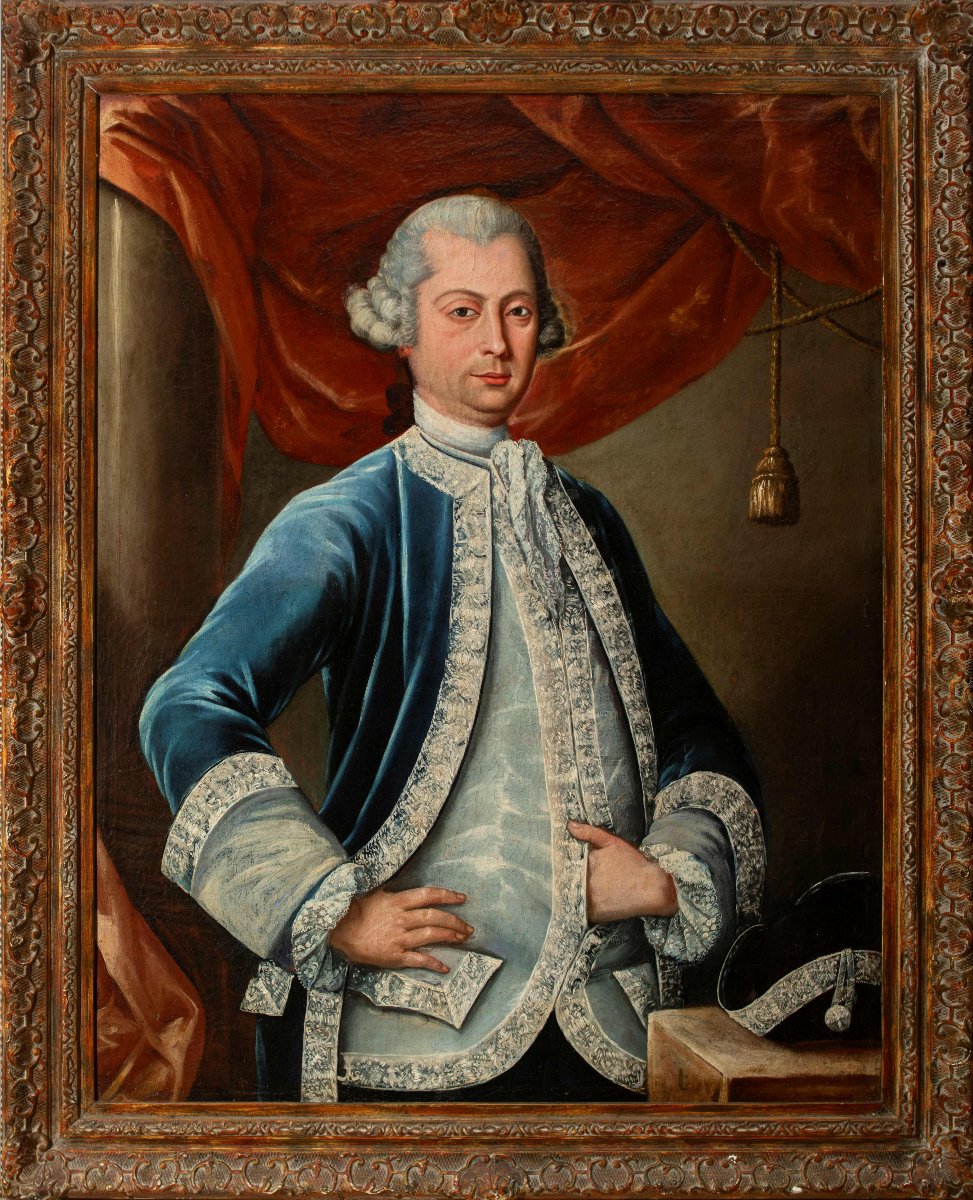
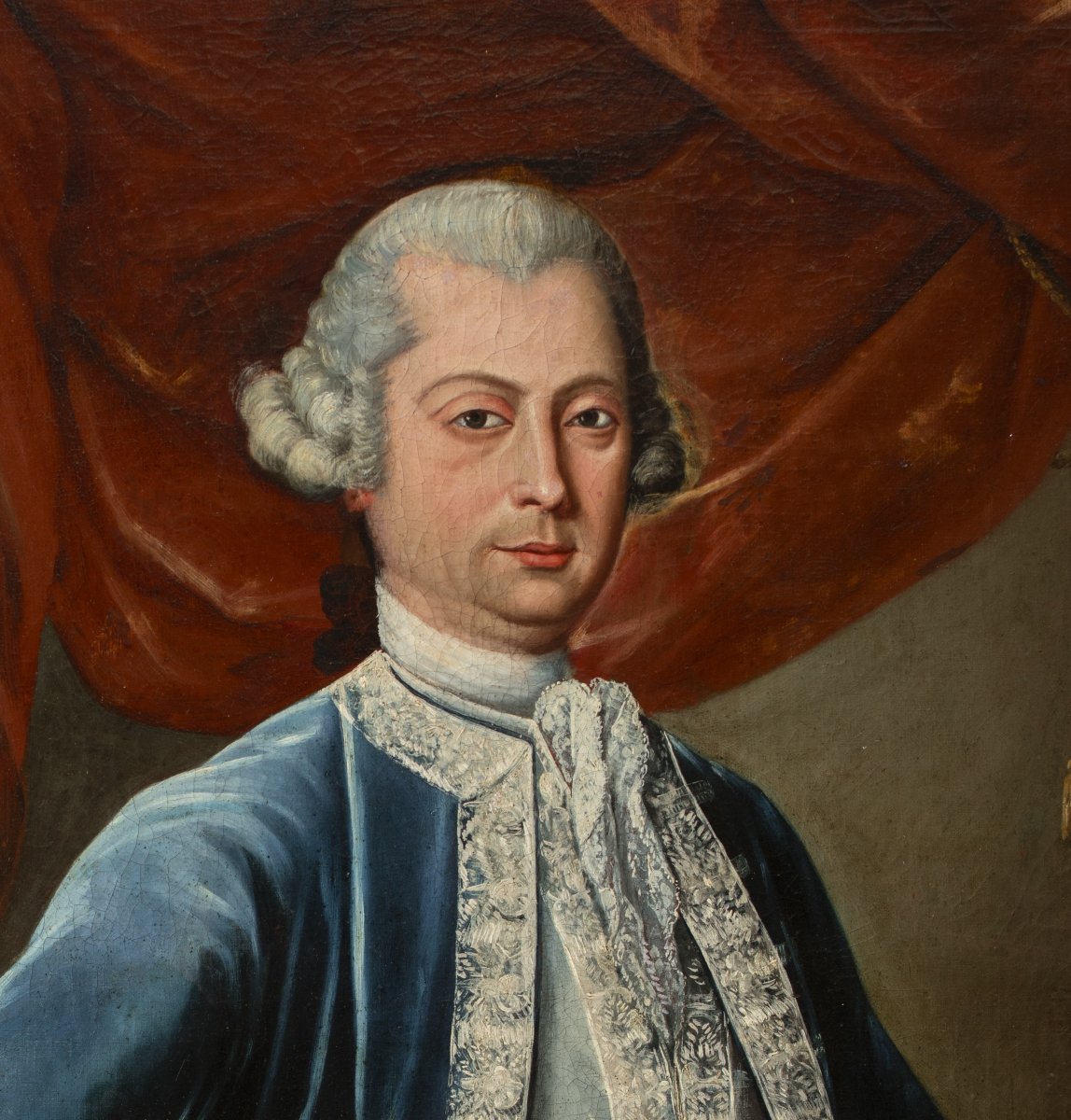
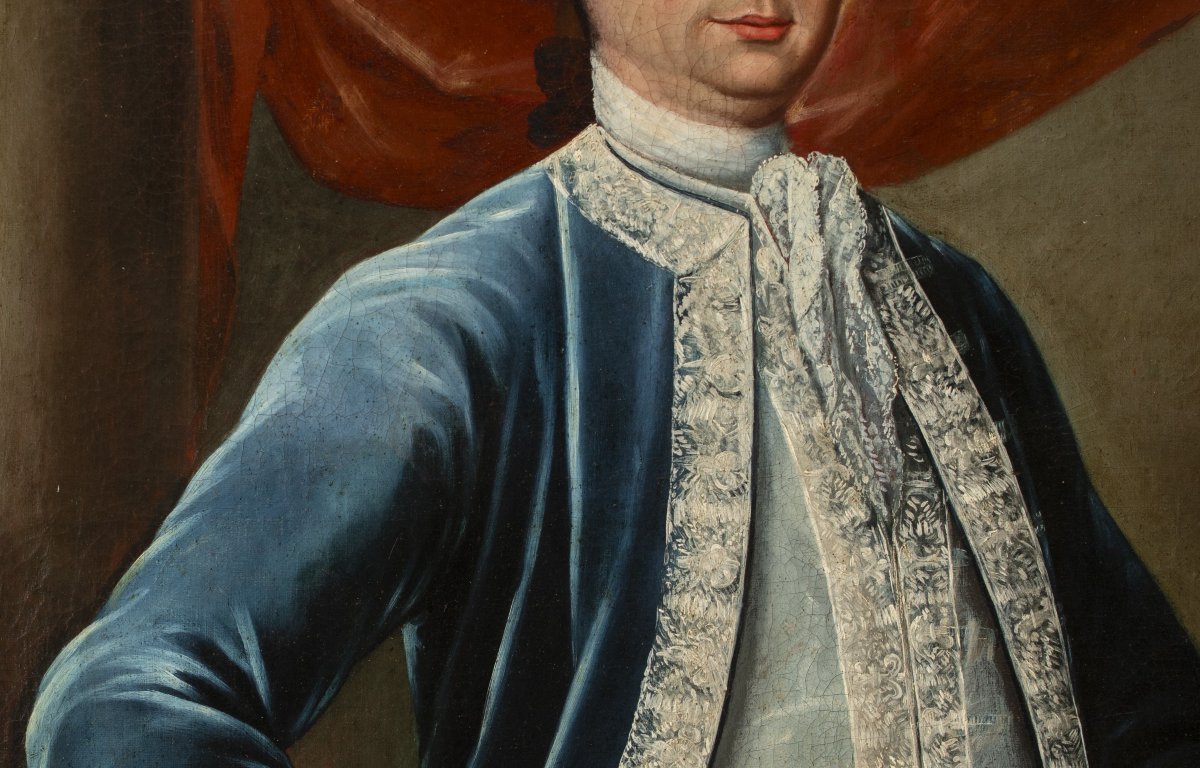
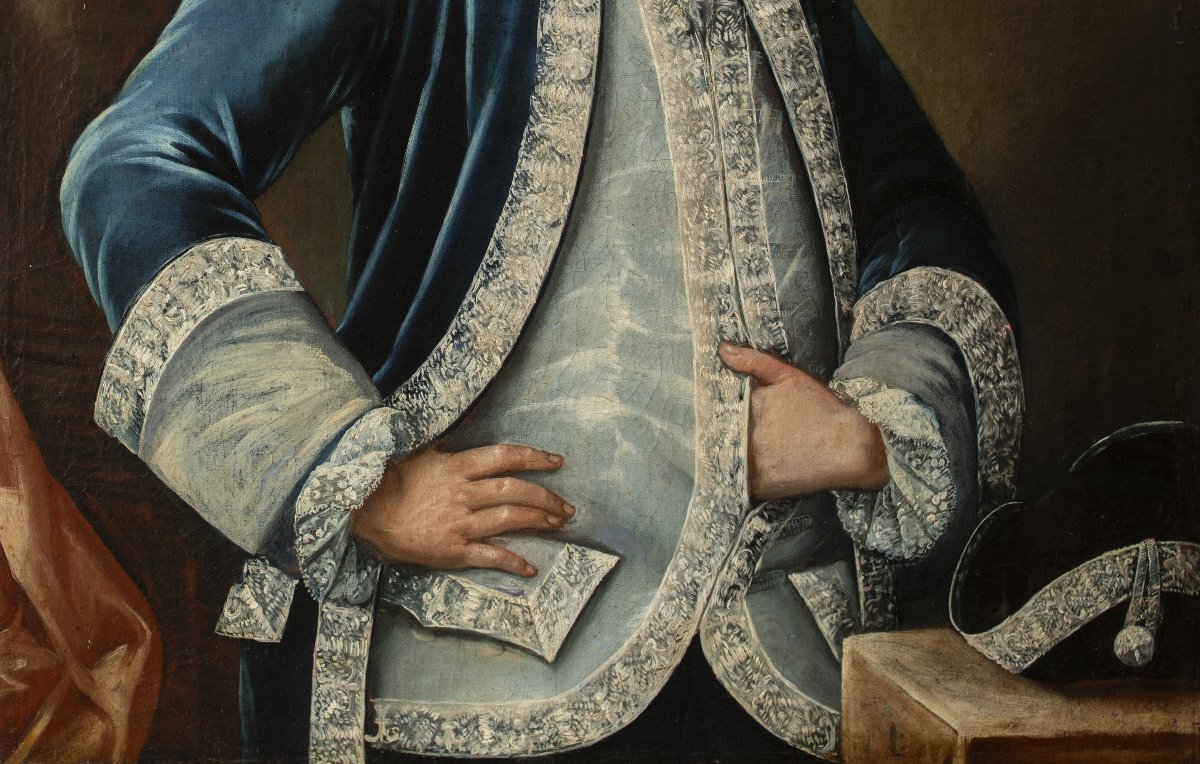
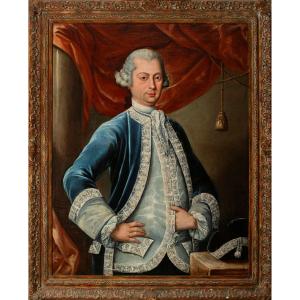
The composition unfolds within a solemn interior setting, where the subject commands the viewer's full attention. Don Miguel Antonio de Ustáriz is depicted in a half-length portrait, elegantly attired in a blue velvet coat; notable features include the turned-back cuffs and a meticulously crafted white lace jabot, partially concealed beneath his garments. His attire reflects the codes of distinction characteristic of 18th-century society, underscoring his social standing and status as a figure of public importance.
The subject also wears an elaborate powdered wig, in keeping with the prevailing fashion of the era. The use of such wigs—costly to both create and maintain—marked them as symbols of social prestige and membership in the wealthy classes. Thus, both his clothing and hairstyle serve a purpose in the portrait that goes beyond mere description, helping to visually construct the subject's identity and status.
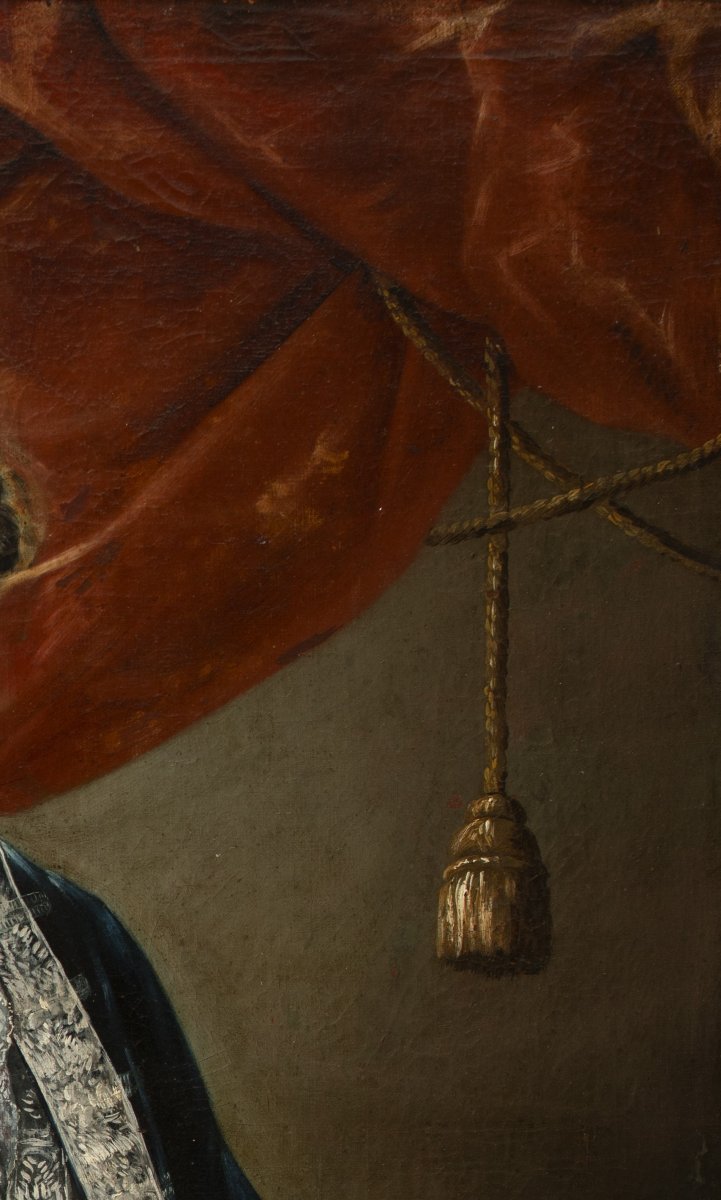
The background features deep red drapery, finished with a tassel, arranged around an architectural column. These elements—common in official and courtly portraiture—lend a sense of solemnity to the composition and serve to emphasize the subject's dignity and rank.
The rise of portraiture in the 18th century was closely linked to a new conception of individuality and social representation. The portrait increasingly became a tool for self-assertion and the crafting of one's public image, tied to new forms of social interaction and a taste for foreign novelties and fashions—particularly those originating in France. These trends, initially associated with European elites, gradually permeated Spanish society and its overseas territories. In this context, portraiture ceased to be associated exclusively with the depiction of figures whose status was deemed exemplary and began to extend to individuals whose significance was justified by their contributions to prosperity and the common good. The portrait of Don Miguel Antonio de Ustáriz can be understood within this new conception of representation. He gained prominence not only through the office he held but also through his involvement in specific urban improvements, such as the paving of the streets in San Juan, Puerto Rico.
The rise of portraiture during the second half of the 18th century marked a significant shift in how this genre was valued among various artistic forms. Its growing popularity was linked to the modernization of Spanish society and its territories, as well as the adoption of new representational models from Europe. Having one's portrait painted became a mark of prestige and social recognition, while the practice of portraiture itself gained increasing esteem among artists.
Don Miguel Antonio de Ustáriz served as governor and captain general of Puerto Rico between 1789 and 1792, during the era of the Bourbon Reforms and the reign of Charles IV. His portrait belongs to a tradition of depicting governors and other figures associated with the colonial administration. Several portraits of Ustáriz from this period survive, including one by José Campeche held in the collection of the Institute of Puerto Rican Culture.
Campeche’s work is characterized by placing his subjects in carefully constructed settings, where lavish and ornamental elements help convey their social standing. The inclusion of luxurious fabrics, architectural details, and meticulously rendered attire establishes a direct link between the depicted space and the subject's status. In this regard, the work in question reflects a concept of portraiture in which appearance is a fundamental element for expressing power, prestige, and recognition.
José Campeche (San Juan, Puerto Rico, 1751–1809) is considered one of the leading figures of 18th-century Puerto Rican painting and a pivotal figure in the development of Rococo painting on the island. Between 1776 and 1778, he was in contact with the Spanish painter Luis Paret y Alcázar, who had arrived in Puerto Rico following his exile by order of Charles III. His relationship with Paret had a significant influence on his artistic training and the evolution of his pictorial style.
835 A self-taught and multifaceted artist, Campeche cultivated various disciplines, including music, architecture, surveying, coat-of-arms design, and the construction of musical instruments. However, his output focused primarily on religious painting and, above all, portraiture. His pictorial style has been linked to the Rococo movement due to the emphasis placed on detail, elegance, and ornamentation. His palette is dominated by grayish, bluish, and pink tones—chromatic choices that reflect the assimilated influence of Luis Paret y Alcázar. These characteristics are also evident in the work under study, particularly in the rendering of the subject's attire, the delicacy of the tones, and the attention paid to the various elements that compose the portrait.
The composition unfolds within a solemn interior setting, where the subject commands the viewer's full attention. Don Miguel Antonio de Ustáriz is depicted in a half-length portrait, elegantly attired in a blue velvet coat; notable features include the turned-back cuffs and a meticulously crafted white lace jabot, partially concealed beneath his garments. His attire reflects the codes of distinction characteristic of 18th-century society, underscoring his social standing and status as a figure of public importance.
The subject also wears an elaborate powdered wig, in keeping with the prevailing fashion of the era. The use of such wigs—costly to both create and maintain—marked them as symbols of social prestige and membership in the wealthy classes. Thus, both his clothing and hairstyle serve a purpose in the portrait that goes beyond mere description, helping to visually construct the subject's identity and status.
The background features deep red drapery, finished with a tassel, arranged around an architectural column. These elements—common in official and courtly portraiture—lend a sense of solemnity to the composition and serve to emphasize the subject's dignity and rank.
The rise of portraiture in the 18th century was closely linked to a new conception of individuality and social representation. The portrait increasingly became a tool for self-assertion and the crafting of one's public image, tied to new forms of social interaction and a taste for foreign novelties and fashions—particularly those originating in France. These trends, initially associated with European elites, gradually permeated Spanish society and its overseas territories. In this context, portraiture ceased to be associated exclusively with the depiction of figures whose status was deemed exemplary and began to extend to individuals whose significance was justified by their contributions to prosperity and the common good. The portrait of Don Miguel Antonio de Ustáriz can be understood within this new conception of representation. He gained prominence not only through the office he held but also through his involvement in specific urban improvements, such as the paving of the streets in San Juan, Puerto Rico.
The rise of portraiture during the second half of the 18th century marked a significant shift in how this genre was valued among various artistic forms. Its growing popularity was linked to the modernization of Spanish society and its territories, as well as the adoption of new representational models from Europe. Having one's portrait painted became a mark of prestige and social recognition, while the practice of portraiture itself gained increasing esteem among artists.
Don Miguel Antonio de Ustáriz served as governor and captain general of Puerto Rico between 1789 and 1792, during the era of the Bourbon Reforms and the reign of Charles IV. His portrait belongs to a tradition of depicting governors and other figures associated with the colonial administration. Several portraits of Ustáriz from this period survive, including one by José Campeche held in the collection of the Institute of Puerto Rican Culture.
Campeche’s work is characterized by placing his subjects in carefully constructed settings, where lavish and ornamental elements help convey their social standing. The inclusion of luxurious fabrics, architectural details, and meticulously rendered attire establishes a direct link between the depicted space and the subject's status. In this regard, the work in question reflects a concept of portraiture in which appearance is a fundamental element for expressing power, prestige, and recognition.
José Campeche (San Juan, Puerto Rico, 1751–1809) is considered one of the leading figures of 18th-century Puerto Rican painting and a pivotal figure in the development of Rococo painting on the island. Between 1776 and 1778, he was in contact with the Spanish painter Luis Paret y Alcázar, who had arrived in Puerto Rico following his exile by order of Charles III. His relationship with Paret had a significant influence on his artistic training and the evolution of his pictorial style.
835 A self-taught and multifaceted artist, Campeche cultivated various disciplines, including music, architecture, surveying, coat-of-arms design, and the construction of musical instruments. However, his output focused primarily on religious painting and, above all, portraiture. His pictorial style has been linked to the Rococo movement due to the emphasis placed on detail, elegance, and ornamentation. His palette is dominated by grayish, bluish, and pink tones—chromatic choices that reflect the assimilated influence of Luis Paret y Alcázar. These characteristics are also evident in the work under study, particularly in the rendering of the subject's attire, the delicacy of the tones, and the attention paid to the various elements that compose the portrait.
4 000 €
Period: 18th century
Style: Other Style
Condition: Condition of use
Material: Oil painting
Width: 100
Height: 122
Reference (ID): 1823233
Availability: In stock
Print