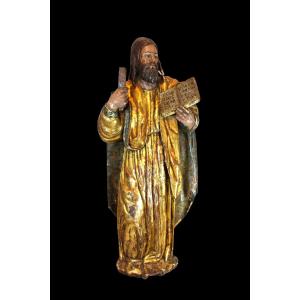


Saint Peter, A Wood Carving From The Castilian School, 16th Century
Dimensions: 66 cm high x 25 cm wide x 19 cmdeep
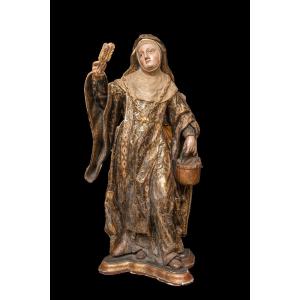
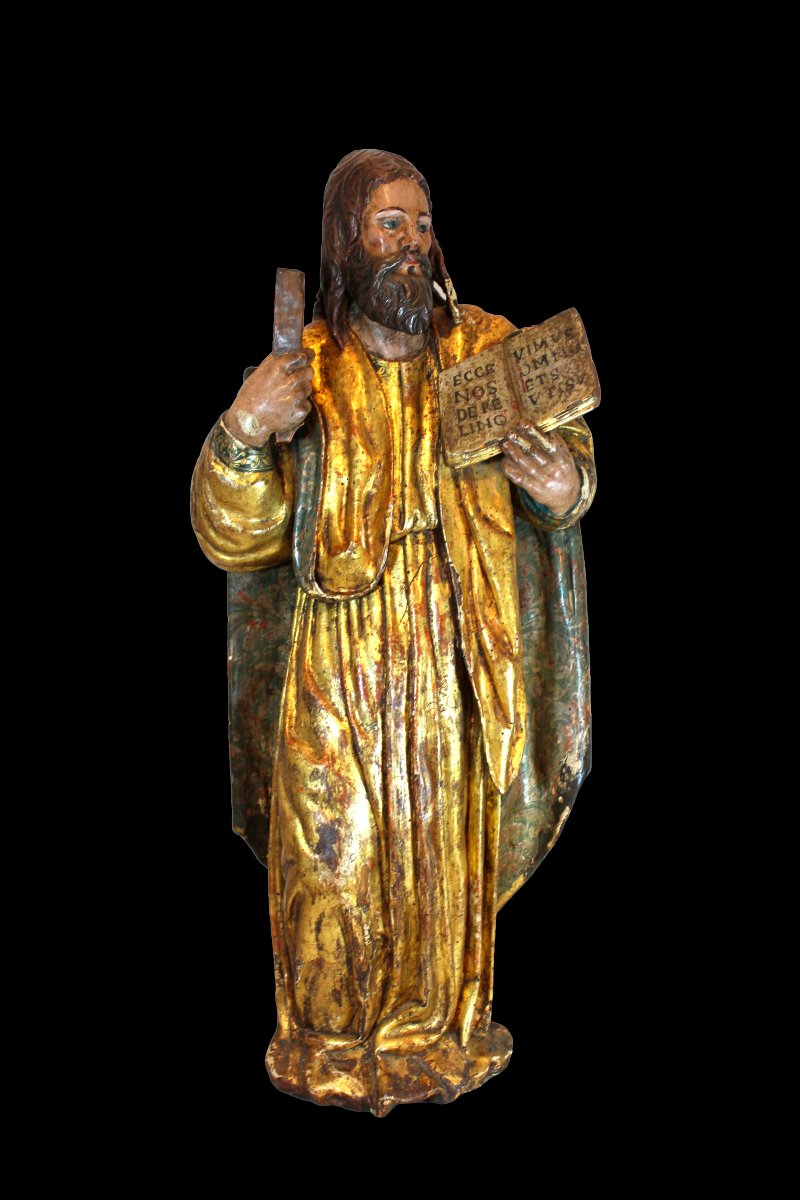
The sculpture depicts Saint Peter, carved frompolychrome wood.
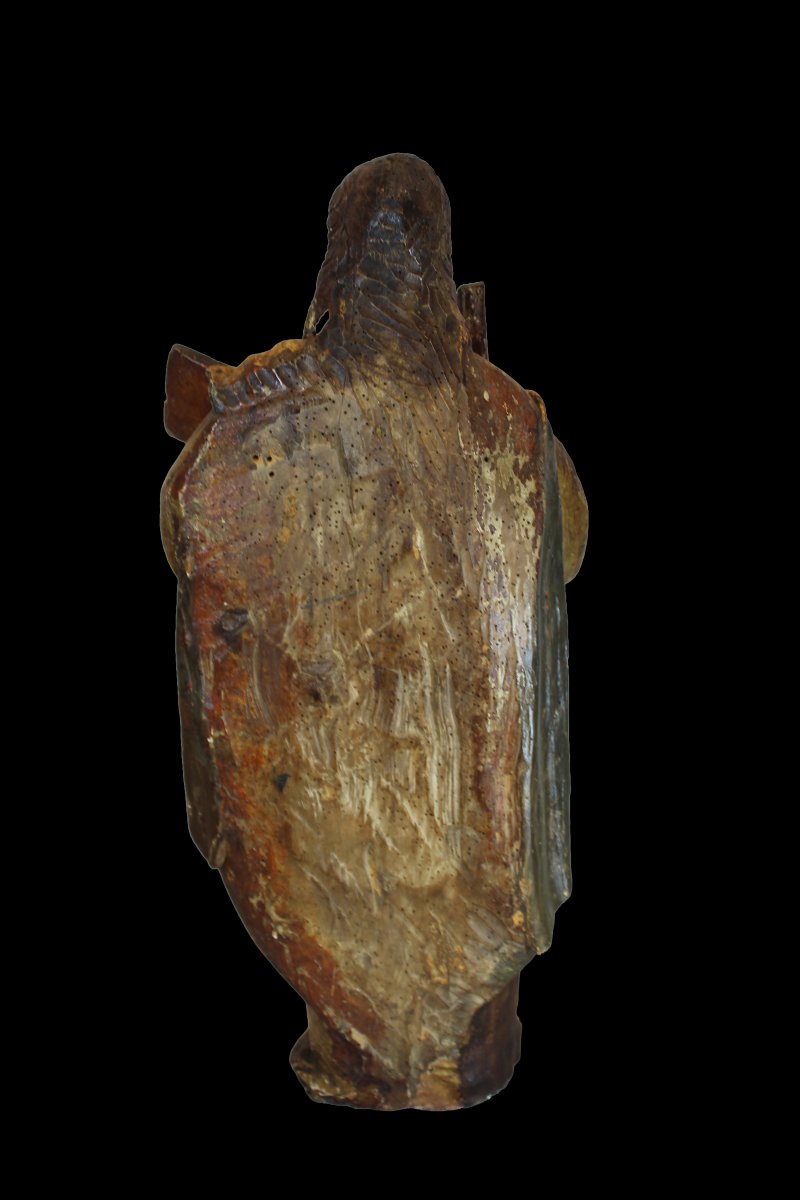
The piece stands out for its imposing presence and itsfrontal pose. The back is unfinished, which may indicatethat it was designed to be viewed from the front.
It is a perfect example of the shift that began totake place with the shift away from the Late Gothic style and the growing influence ofItalian art, even though certain medieval traditions are stillevident.
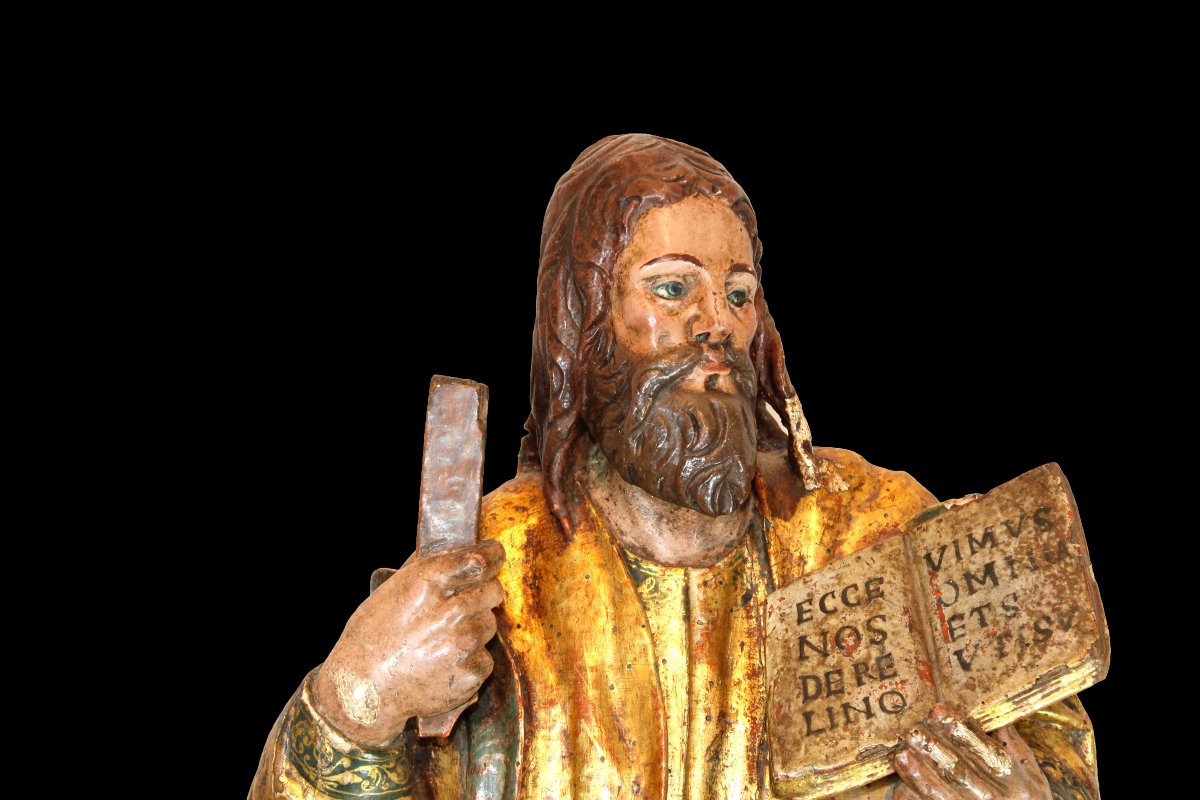
At this time, greaterimportance to human faces, even though Saint Peter’s expression remainssober. The evolution toward more naturalistic forms is clearly evident inhis eyes, whose irises reveal distinct shades ofcolor, lending him greater realism. The figure’s hairbegins to take on curved shapes. This characteristic is alsovisible in his beard, which serves as a distinctive feature that allowshim to be identified. The verticality and rigidity of 16th-century sculpturesbegin to fade, as can be seen in the movement ofleg of Saint Peter, which bends forward and lends him greaterdynamism. This movement is further accentuated by the folds of the saint’s robe.
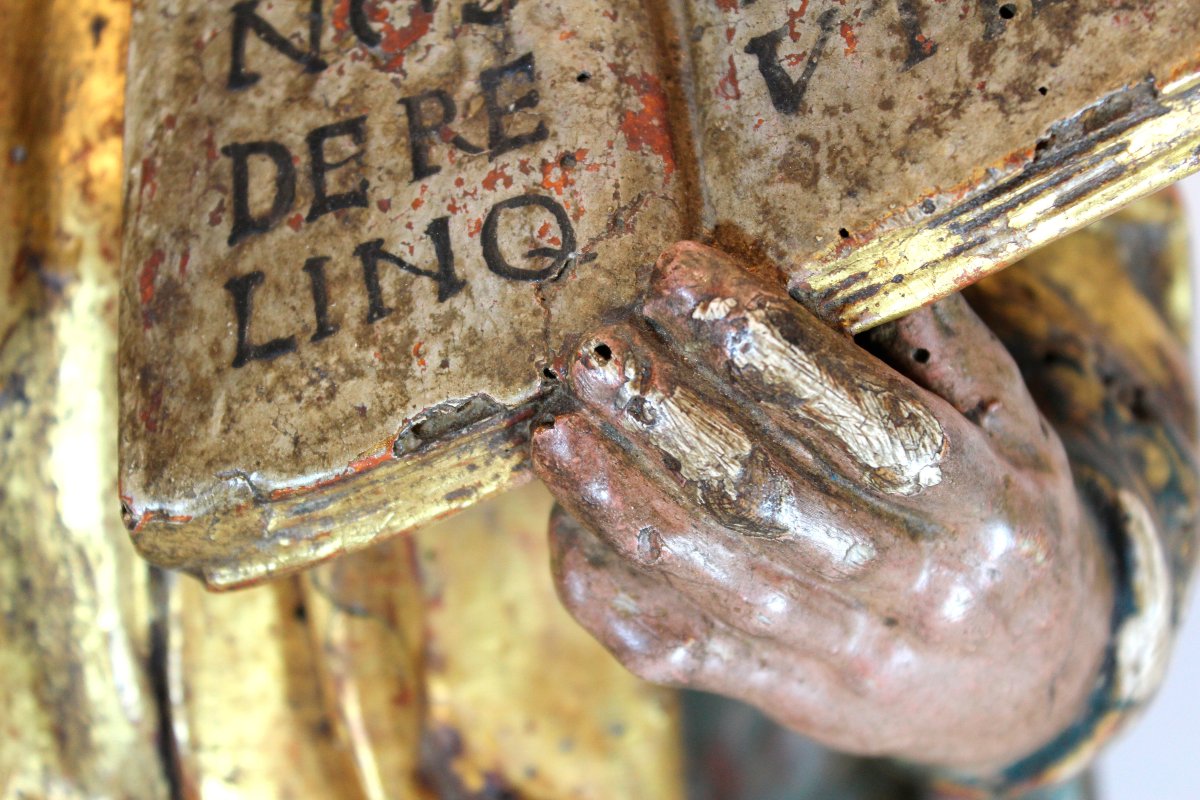
Among the new features, we note the book held by thefigure is holding in his left hand; it may reproduce in Latin the Gospelaccording to Matthew (19:27), in which Peter tells Jesus that his disciples haveleft everything to follow him: “Ecce nos dereliquimus Omnia et secuti sumus te.”
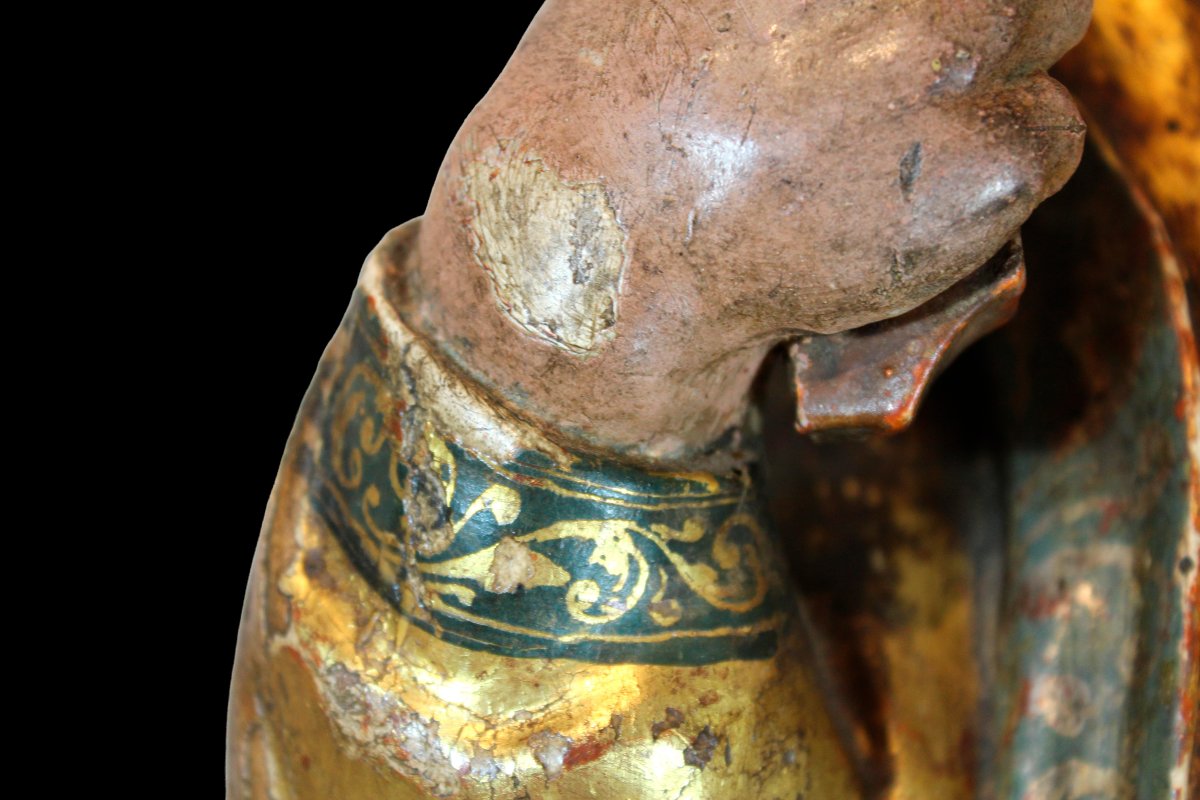
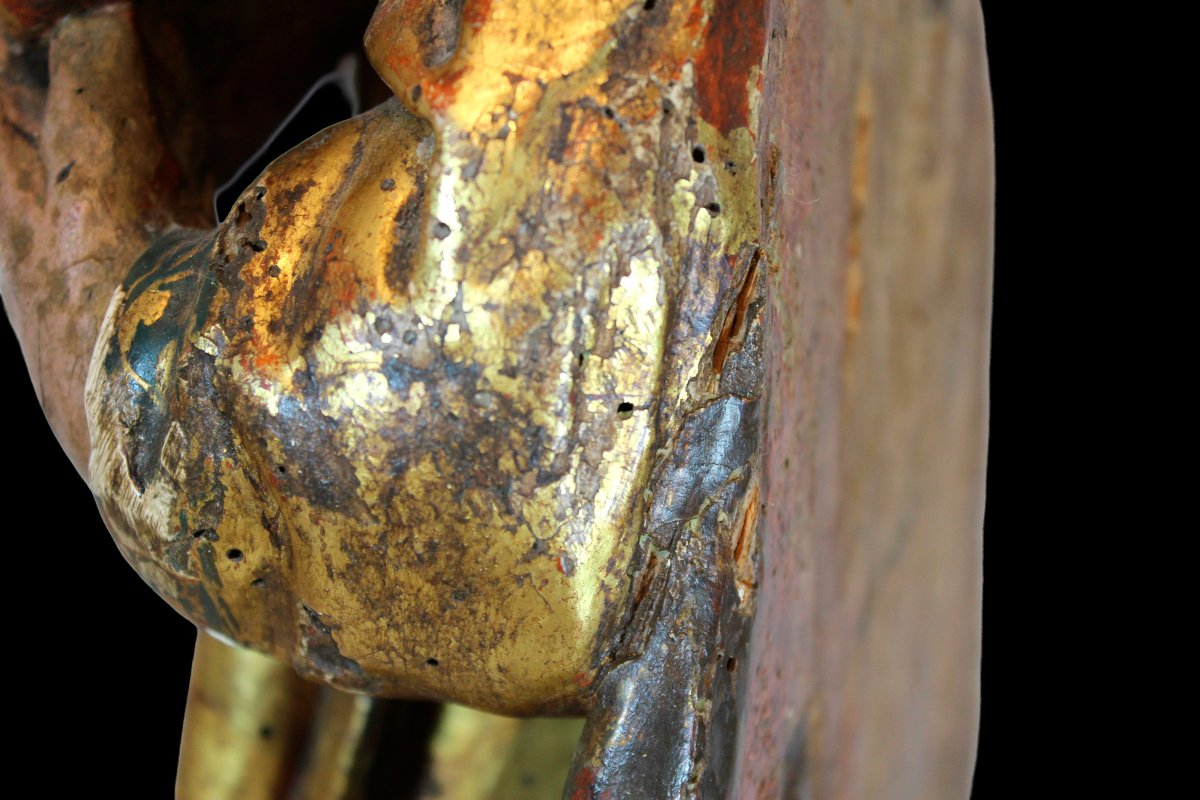
In his right hand, he holds what might be theremnants of the attributes that usually accompany him, such as the keys to theKingdom of Heaven or the cross; however, these are not preserved intheir entirety (see images).
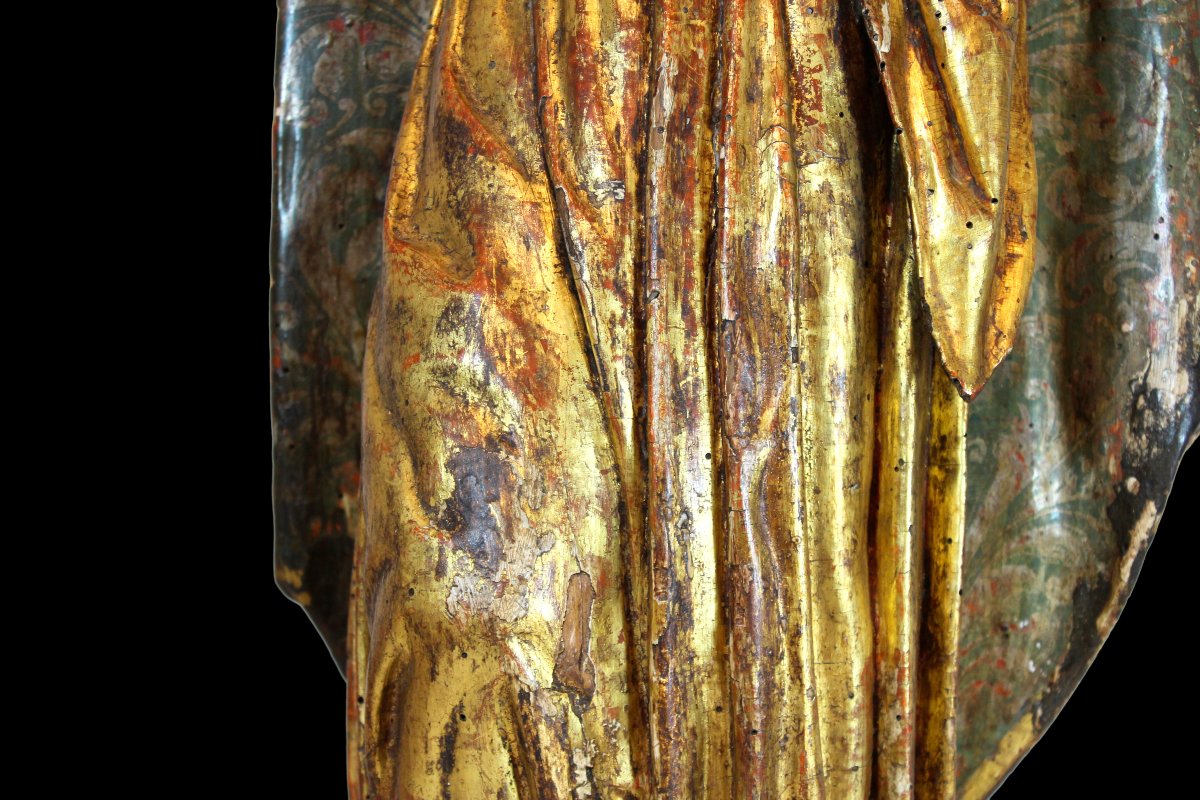
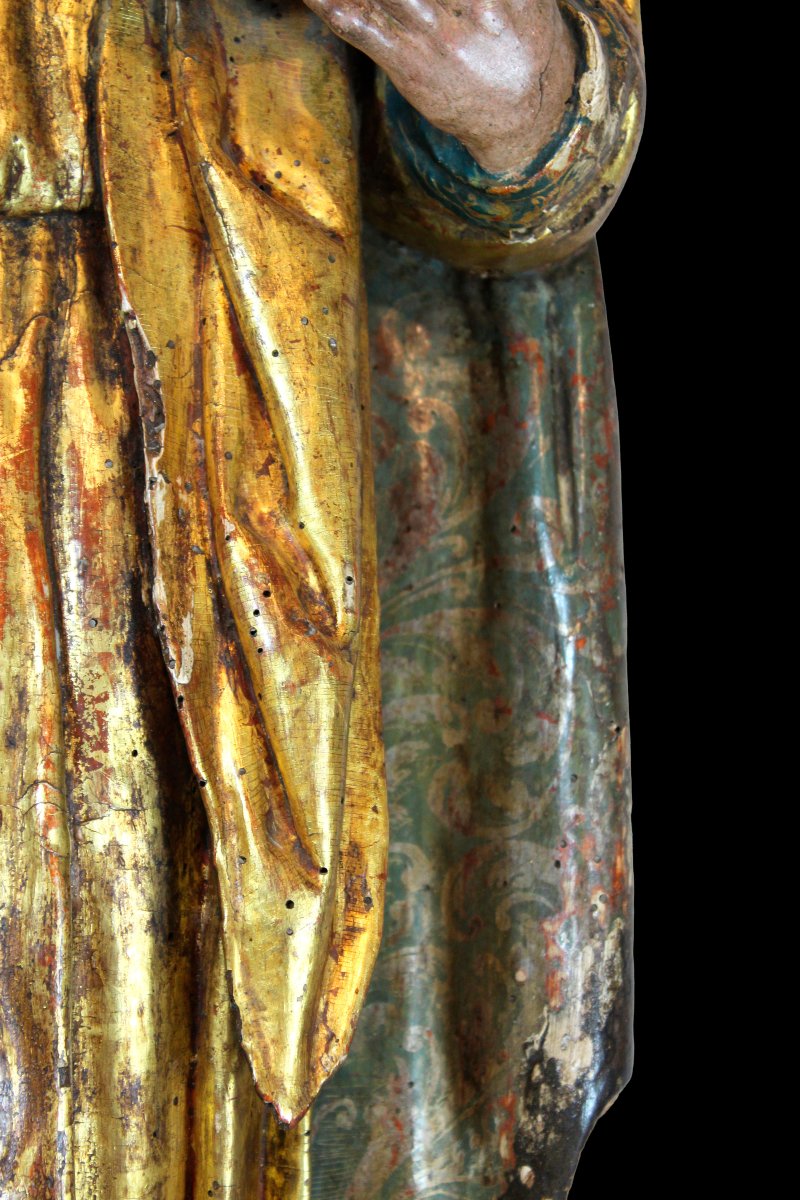
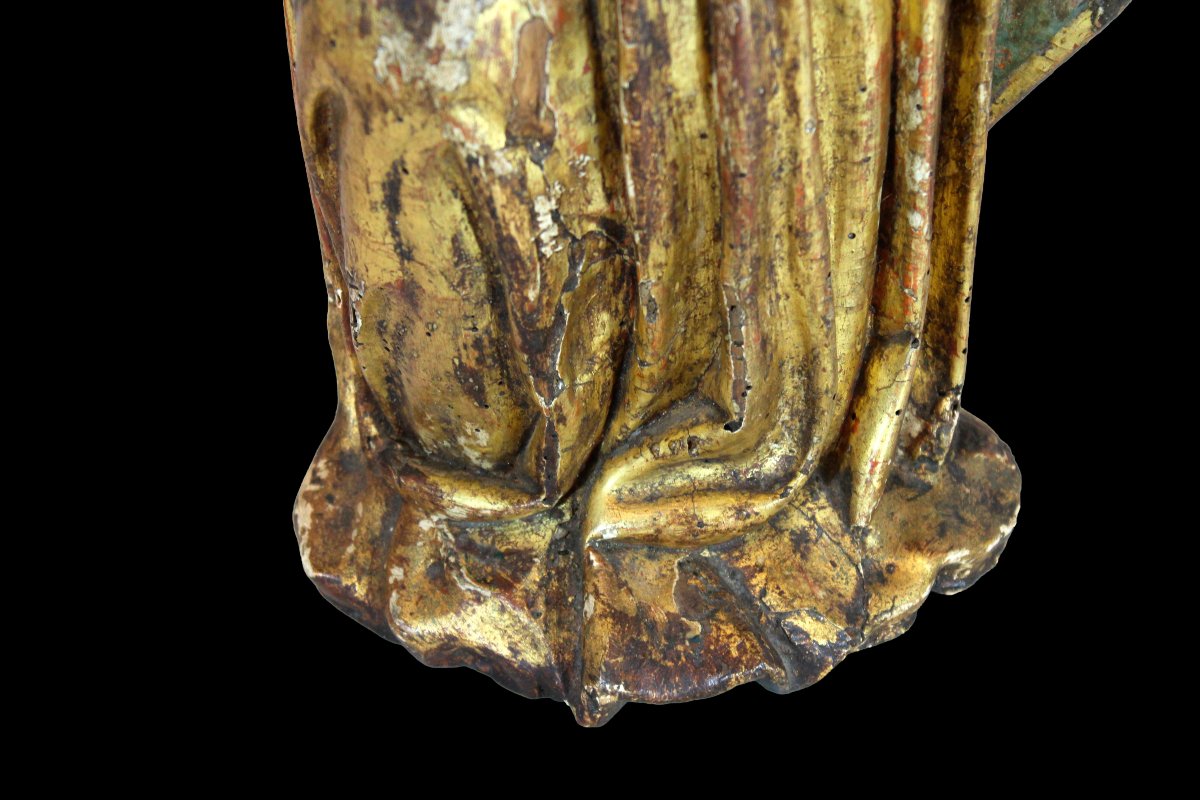
As for the polychromy, one notices the pigmentcharacteristic of the period—gold—which covers the entire frontof the figure’s tunic. The cloak is also adorned with floral motifsthat are clearly discernible against the green tones on its reverse side. Onthe cuffs of the tunic, one can see plant motifs, also inshades of green, which were executed with great precision.
Reddish hues are visible due to small areas ofpigment loss where the pigment served as a preparatory base for the subsequent application ofgilding.
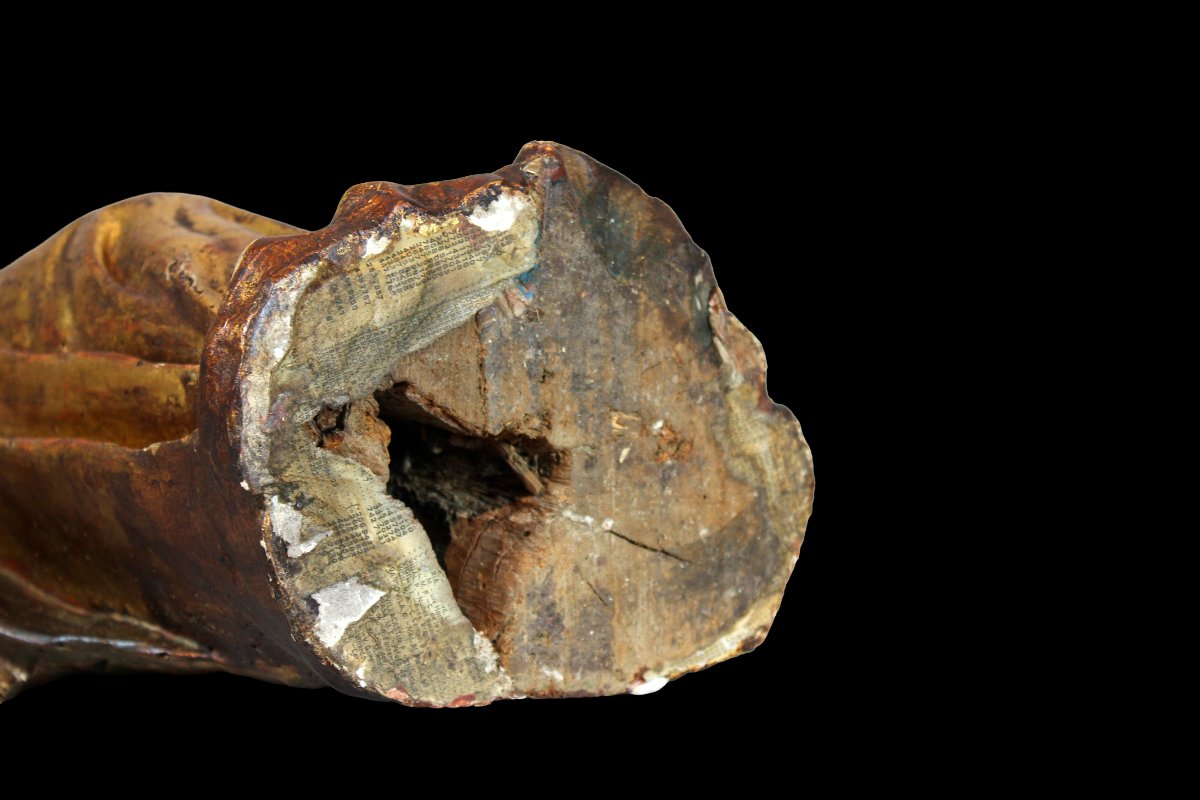
With regard to its polychromy, the piece exhibitssigns of wear consistent with its age (see images).
Today, very few sculptures retaintheir original polychromy in this condition, making this piecedepicting Saint Peter a highly prized and worthy subject of study.
The sculpture depicts Saint Peter, carved frompolychrome wood.
The piece stands out for its imposing presence and itsfrontal pose. The back is unfinished, which may indicatethat it was designed to be viewed from the front.
It is a perfect example of the shift that began totake place with the shift away from the Late Gothic style and the growing influence ofItalian art, even though certain medieval traditions are stillevident.
At this time, greaterimportance to human faces, even though Saint Peter’s expression remainssober. The evolution toward more naturalistic forms is clearly evident inhis eyes, whose irises reveal distinct shades ofcolor, lending him greater realism. The figure’s hairbegins to take on curved shapes. This characteristic is alsovisible in his beard, which serves as a distinctive feature that allowshim to be identified. The verticality and rigidity of 16th-century sculpturesbegin to fade, as can be seen in the movement ofleg of Saint Peter, which bends forward and lends him greaterdynamism. This movement is further accentuated by the folds of the saint’s robe.
Among the new features, we note the book held by thefigure is holding in his left hand; it may reproduce in Latin the Gospelaccording to Matthew (19:27), in which Peter tells Jesus that his disciples haveleft everything to follow him: “Ecce nos dereliquimus Omnia et secuti sumus te.”
In his right hand, he holds what might be theremnants of the attributes that usually accompany him, such as the keys to theKingdom of Heaven or the cross; however, these are not preserved intheir entirety (see images).
As for the polychromy, one notices the pigmentcharacteristic of the period—gold—which covers the entire frontof the figure’s tunic. The cloak is also adorned with floral motifsthat are clearly discernible against the green tones on its reverse side. Onthe cuffs of the tunic, one can see plant motifs, also inshades of green, which were executed with great precision.
Reddish hues are visible due to small areas ofpigment loss where the pigment served as a preparatory base for the subsequent application ofgilding.
With regard to its polychromy, the piece exhibitssigns of wear consistent with its age (see images).
Today, very few sculptures retaintheir original polychromy in this condition, making this piecedepicting Saint Peter a highly prized and worthy subject of study.
3 000 €
Period: 16th century
Style: Other Style
Condition: En l'etat
Material: Painted wood
Width: 25
Height: 66
Depth: 19
Reference (ID): 1796879
Availability: In stock
Print