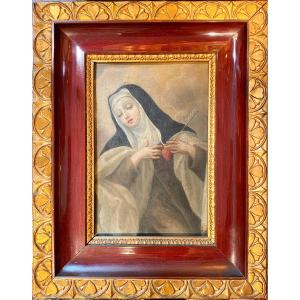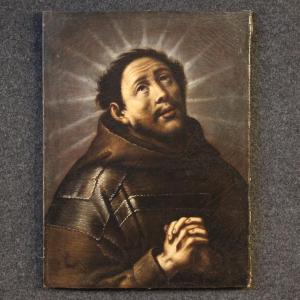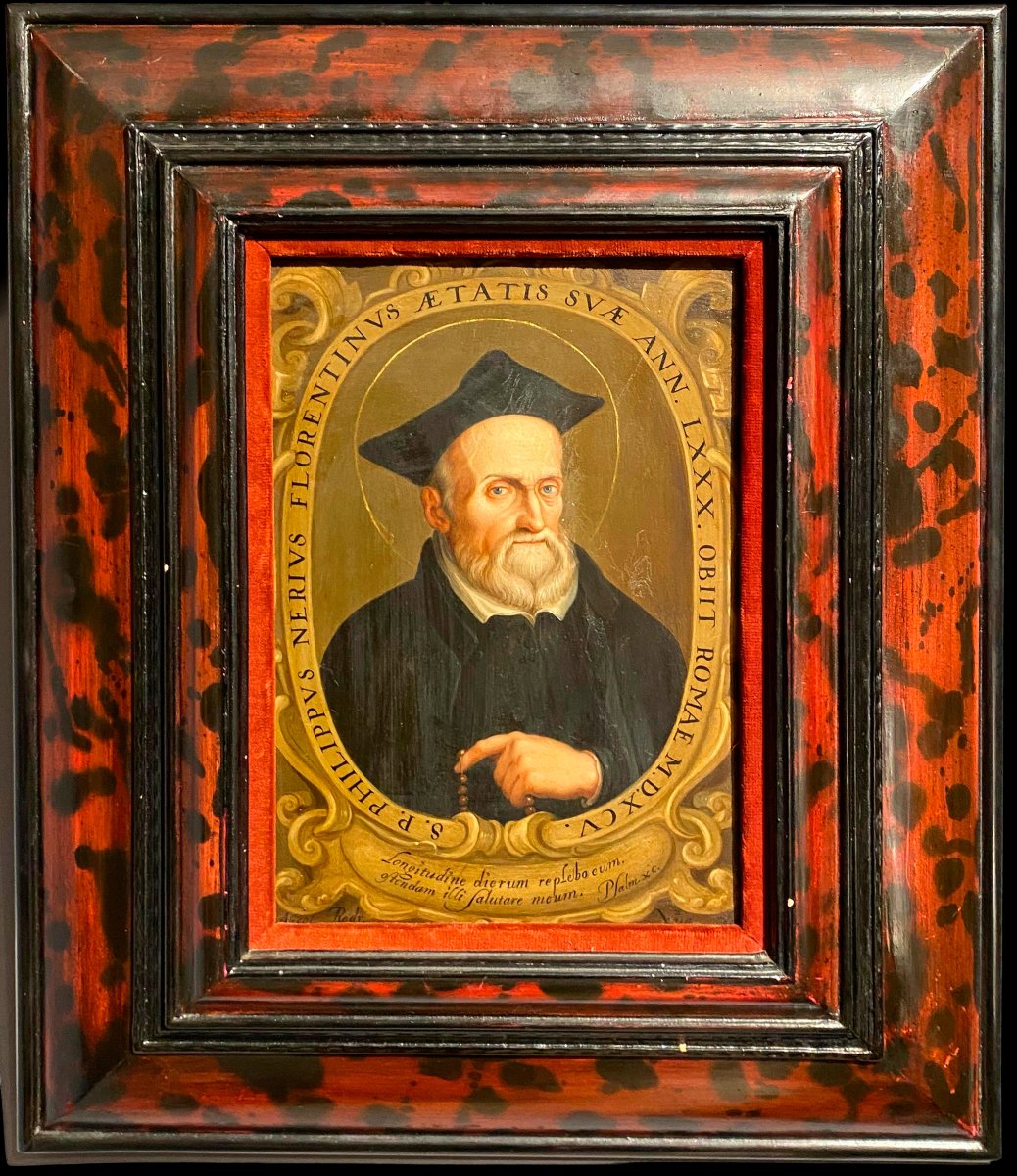
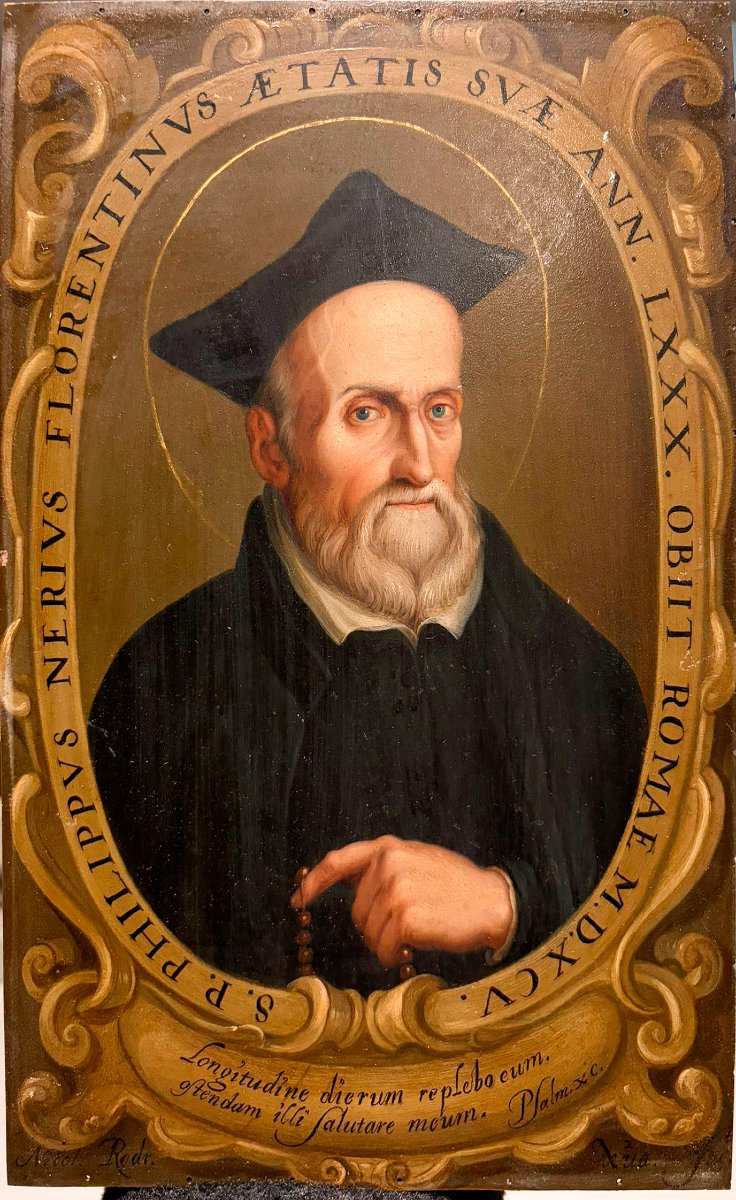
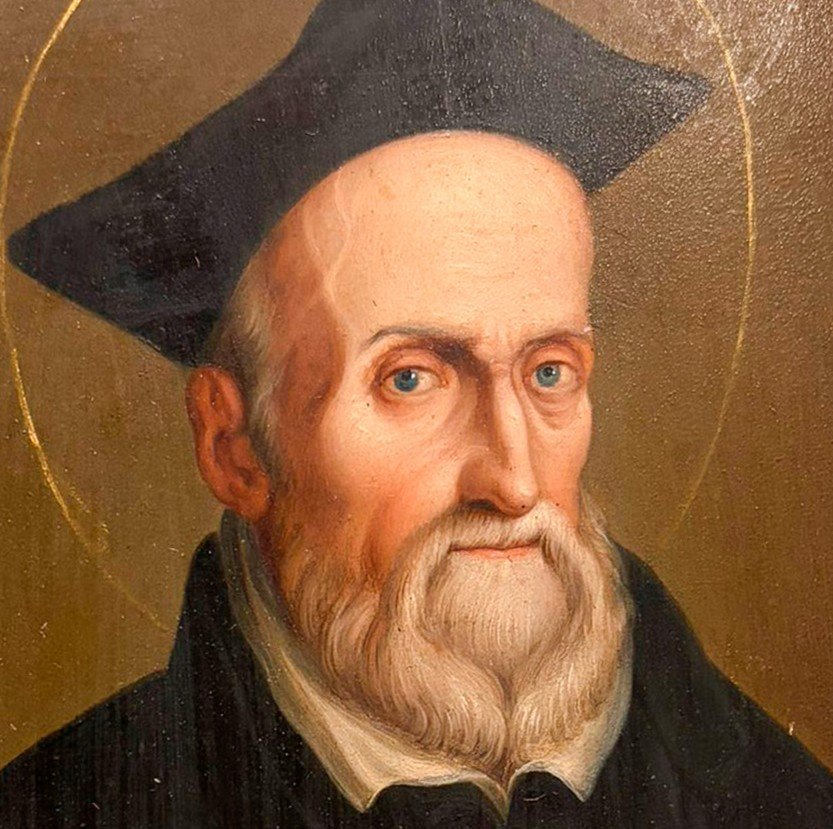
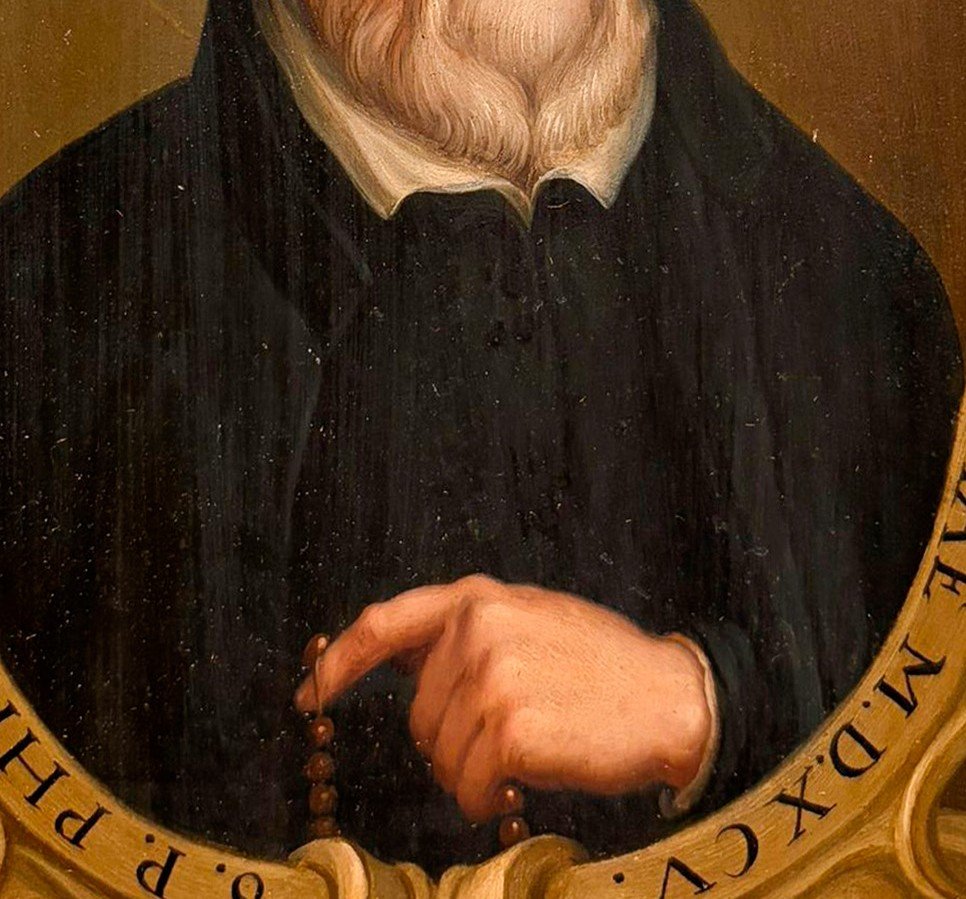
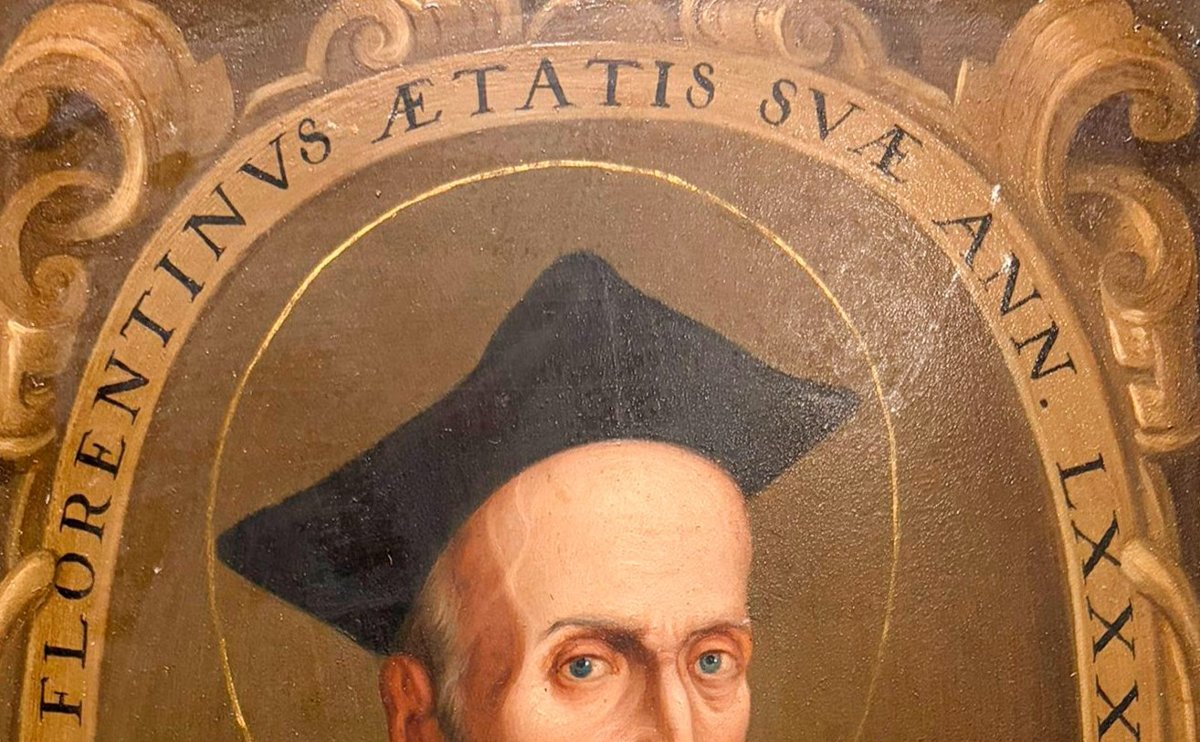
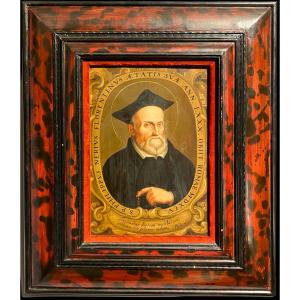


Saint Philip Neri. Oil On Copper. Signed Nicolás Rodriguez Juárez (1667–1734)
Artist: Nicolas Rodriguez Juarez
Saint Philip Neri. Oil on copper. Signed NicolásRodriguez Juárez (1667–1734)
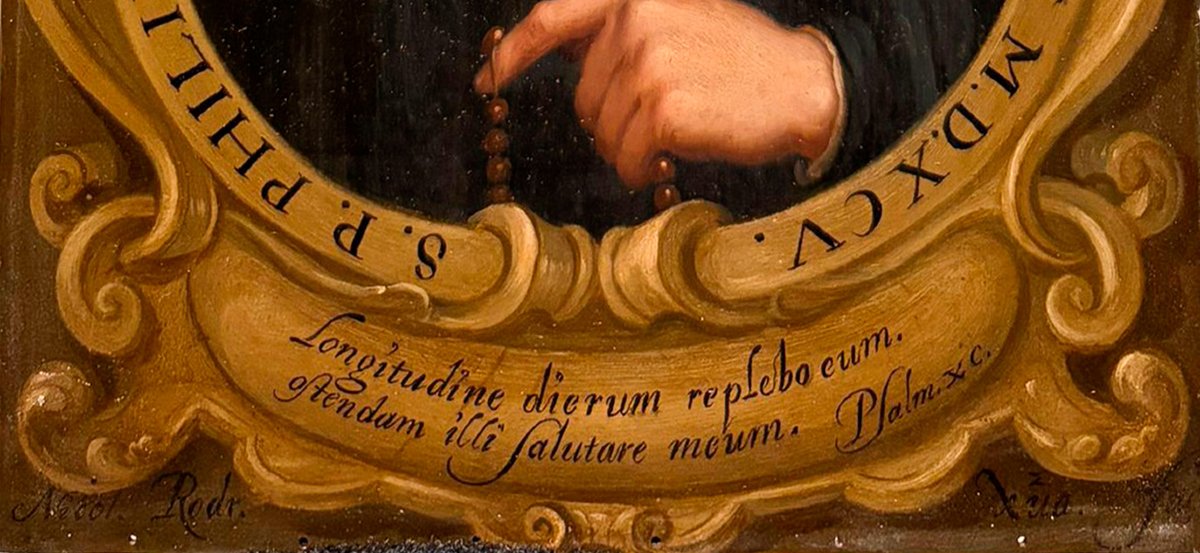
Inscription: “S. P. Philippus Nerius Florentinus, at the age of80, died in Rome in 1595 ”Translation: “Saint Philip Neri, a Florentine, at the age of 80years, died in Rome in 1595.”Inscription: “Longitudine dierum repleboeum, ostendam illisalutare meum”Translation: “I will satisfy him with long life; I willshow him my salvation”Dimensions with frame: 45 cm x 37 cm wideAt the bottom of the work is the following inscription:“S. P. Philippus Nerius florentinus aetatis suae ann. LXXXobiit Romae MDXCV”Its translation is: “Saint Philip Neri, a Florentine, atthe age of 80, died in Rome in 1595.”There is also a second inscription in Latin:“Longitudine dierum replebo eum, ostendam illi salutaremeum”which can be translated as: “I will satisfy him with longdays and show him my salvation.”This latter quote is taken from Psalm 91:16,one of the biblical texts traditionally associated with divine protection,refuge, and trust in God. This verse expresses the promise of along and fulfilling life, as well as spiritual salvation for those who place theirtrust in Him.For much of his life, he devoted himself toteaching catechism to the poorest members of society, as well as tocaring for the sick and the needy. He was ordained a priest in 1551 andgained a remarkable reputation as a confessor and spiritual director,thanks to his ability to guide the faithful and bring them closer to thepractice of the Christian faith.In 1575, he founded the Congregation of the Oratory, aninstitution dedicated to prayer, preaching, and religiousformation. His spirituality was closely linked to Eucharistic devotionand to the Virgin Mary, as well as to mystical experiences and episodesof ecstasy during prayer.He died in Rome in 1595 and was canonized in 1622. Becauseof his intense religious activity in the city, he is known as “the Apostle of Rome”; he is also considered one of its patron saintsand one of the most important religious figures of Italyduring the Counter-Reformation.Nicolás Rodríguez Juárez (1665–1734) was one of the leadingpainters of New Spain and a member of an illustrious artistic dynasty.He was a descendant of the painter Luis Juárez and the grandson of José Juárez,both major figures in the art of New Spain. Born in Mexico City,he married Josefa Ruiz Guerra, with whom he had several children. After becoming a widower,he decided to enter the priesthood and was ordained a priest.His artistic body of work was vast and varied, although, after hiswidowhood and his commitment to religious life, his painting activity appearsto have diminished. Despite this, he was considered in his time to be one of theleading painters of New Spain. His artistic style ischaracterized by a distinct Baroque style and by the incorporation of models andinfluences drawn from European religious painting.Rodríguez Juárez explored a wide variety of themes,among which stand out depictions of male and female saints,episodes from the life of the Virgin Mary and King David, angels, portraits, andcompositions of a triumphalist nature. The so-called “patronage” paintings,in which certain patron saints are depictedprotecting the faithful under their cloaks, are of particular interest.Some of his works bear the inscription “clericus presbit,”referring to his status as a priest.During the 17th and 18th centuries, engraving took onparticular importance in New Spain, both as a tool for evangelizationand as a means of disseminating artistic, scientific, andcultural knowledge. Its development was closely linked to the introduction ofprinting in Mexico in the 16th century and the gradual use ofmetal plates, which made it possible to produce prints of greaterprecision and richer in detail.These prints served as models for numerouspaintings, facilitating the dissemination of certain religiousrepresentations and contributing to the uniformity of their mainiconographic features. Thus, European engravings became one of themain vehicles for transmitting visual models to theAmerican territories, where they were reinterpreted and adapted by artists inNew Spain.
Inscription: “S. P. Philippus Nerius Florentinus, at the age of80, died in Rome in 1595 ”Translation: “Saint Philip Neri, a Florentine, at the age of 80years, died in Rome in 1595.”Inscription: “Longitudine dierum repleboeum, ostendam illisalutare meum”Translation: “I will satisfy him with long life; I willshow him my salvation”Dimensions with frame: 45 cm x 37 cm wideAt the bottom of the work is the following inscription:“S. P. Philippus Nerius florentinus aetatis suae ann. LXXXobiit Romae MDXCV”Its translation is: “Saint Philip Neri, a Florentine, atthe age of 80, died in Rome in 1595.”There is also a second inscription in Latin:“Longitudine dierum replebo eum, ostendam illi salutaremeum”which can be translated as: “I will satisfy him with longdays and show him my salvation.”This latter quote is taken from Psalm 91:16,one of the biblical texts traditionally associated with divine protection,refuge, and trust in God. This verse expresses the promise of along and fulfilling life, as well as spiritual salvation for those who place theirtrust in Him.For much of his life, he devoted himself toteaching catechism to the poorest members of society, as well as tocaring for the sick and the needy. He was ordained a priest in 1551 andgained a remarkable reputation as a confessor and spiritual director,thanks to his ability to guide the faithful and bring them closer to thepractice of the Christian faith.In 1575, he founded the Congregation of the Oratory, aninstitution dedicated to prayer, preaching, and religiousformation. His spirituality was closely linked to Eucharistic devotionand to the Virgin Mary, as well as to mystical experiences and episodesof ecstasy during prayer.He died in Rome in 1595 and was canonized in 1622. Becauseof his intense religious activity in the city, he is known as “the Apostle of Rome”; he is also considered one of its patron saintsand one of the most important religious figures of Italyduring the Counter-Reformation.Nicolás Rodríguez Juárez (1665–1734) was one of the leadingpainters of New Spain and a member of an illustrious artistic dynasty.He was a descendant of the painter Luis Juárez and the grandson of José Juárez,both major figures in the art of New Spain. Born in Mexico City,he married Josefa Ruiz Guerra, with whom he had several children. After becoming a widower,he decided to enter the priesthood and was ordained a priest.His artistic body of work was vast and varied, although, after hiswidowhood and his commitment to religious life, his painting activity appearsto have diminished. Despite this, he was considered in his time to be one of theleading painters of New Spain. His artistic style ischaracterized by a distinct Baroque style and by the incorporation of models andinfluences drawn from European religious painting.Rodríguez Juárez explored a wide variety of themes,among which stand out depictions of male and female saints,episodes from the life of the Virgin Mary and King David, angels, portraits, andcompositions of a triumphalist nature. The so-called “patronage” paintings,in which certain patron saints are depictedprotecting the faithful under their cloaks, are of particular interest.Some of his works bear the inscription “clericus presbit,”referring to his status as a priest.During the 17th and 18th centuries, engraving took onparticular importance in New Spain, both as a tool for evangelizationand as a means of disseminating artistic, scientific, andcultural knowledge. Its development was closely linked to the introduction ofprinting in Mexico in the 16th century and the gradual use ofmetal plates, which made it possible to produce prints of greaterprecision and richer in detail.These prints served as models for numerouspaintings, facilitating the dissemination of certain religiousrepresentations and contributing to the uniformity of their mainiconographic features. Thus, European engravings became one of themain vehicles for transmitting visual models to theAmerican territories, where they were reinterpreted and adapted by artists inNew Spain.
10 000 €
Period: 18th century
Style: Other Style
Condition: Condition of use
Material: Copper
Width: 37
Height: 45
Reference (ID): 1826904
Availability: In stock
Print