

Ecce Homo, Polychrome Terracotta, Granada School, 17th Century
Dimensions: 42cm high x 54 cm wide x 26 cm deep
The iconographyof the Ecce Homo depicts Christ during the most painful moments of hisPassion, just before the crucifixion, evoking episodes such as theflagellation, the crowning with thorns, and the journey to Calvary. Theseimages emphasize Jesus’ physical and spiritual suffering,inviting the faithful to contemplate and reflect on the redemptivesacrifice.
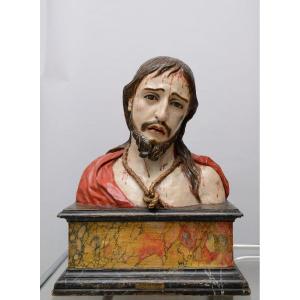
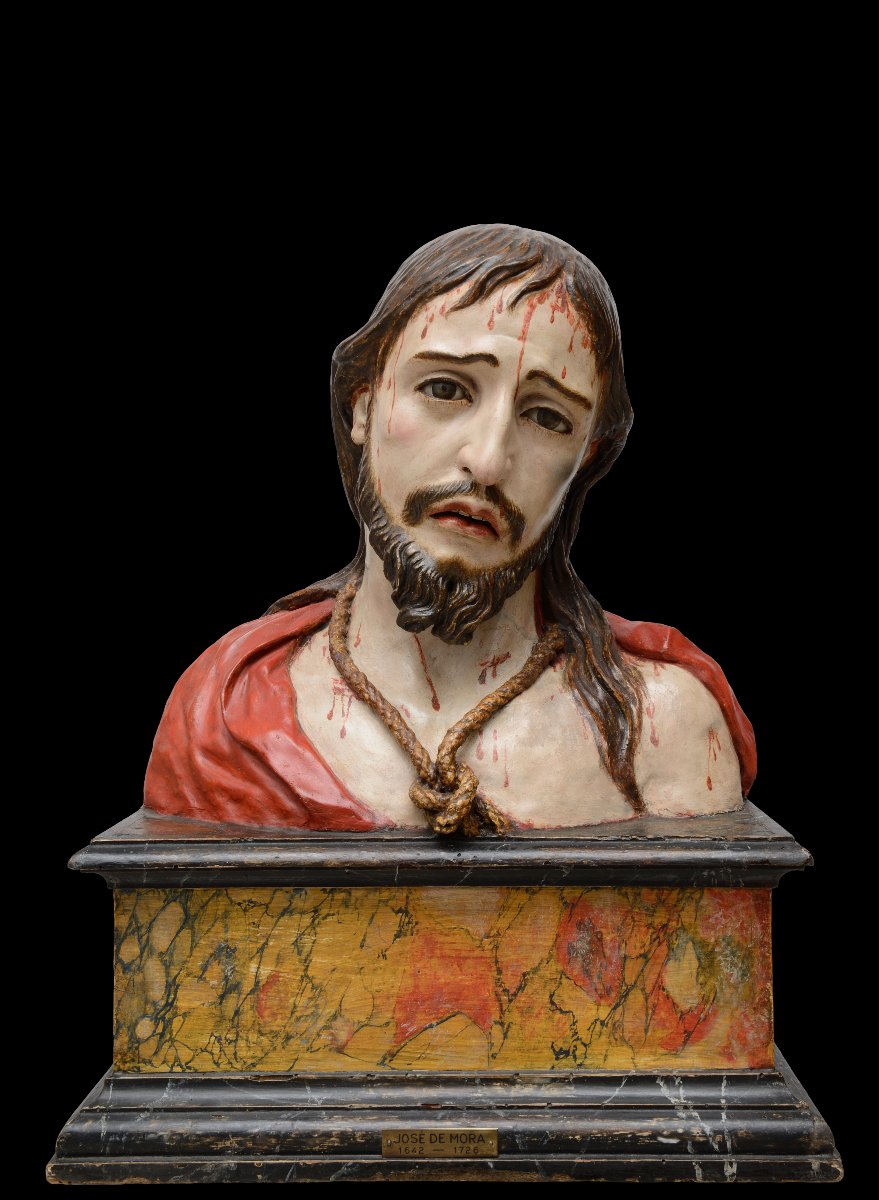
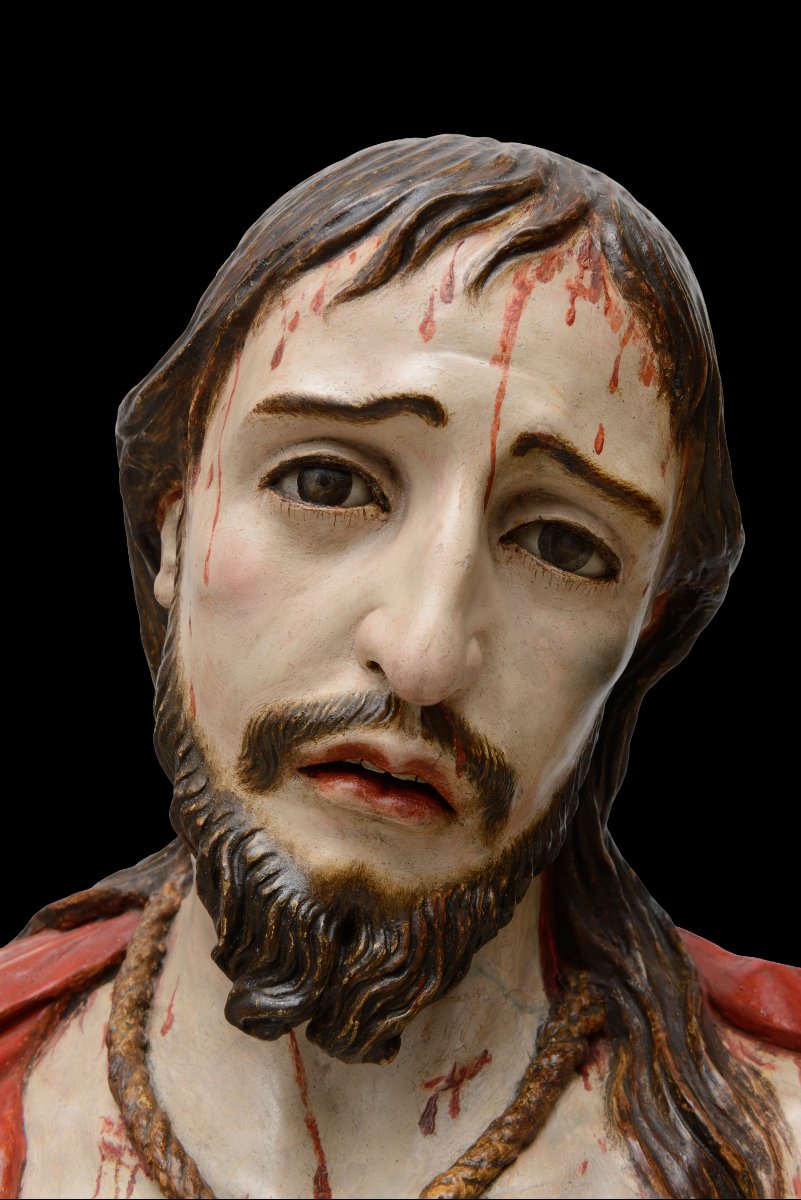
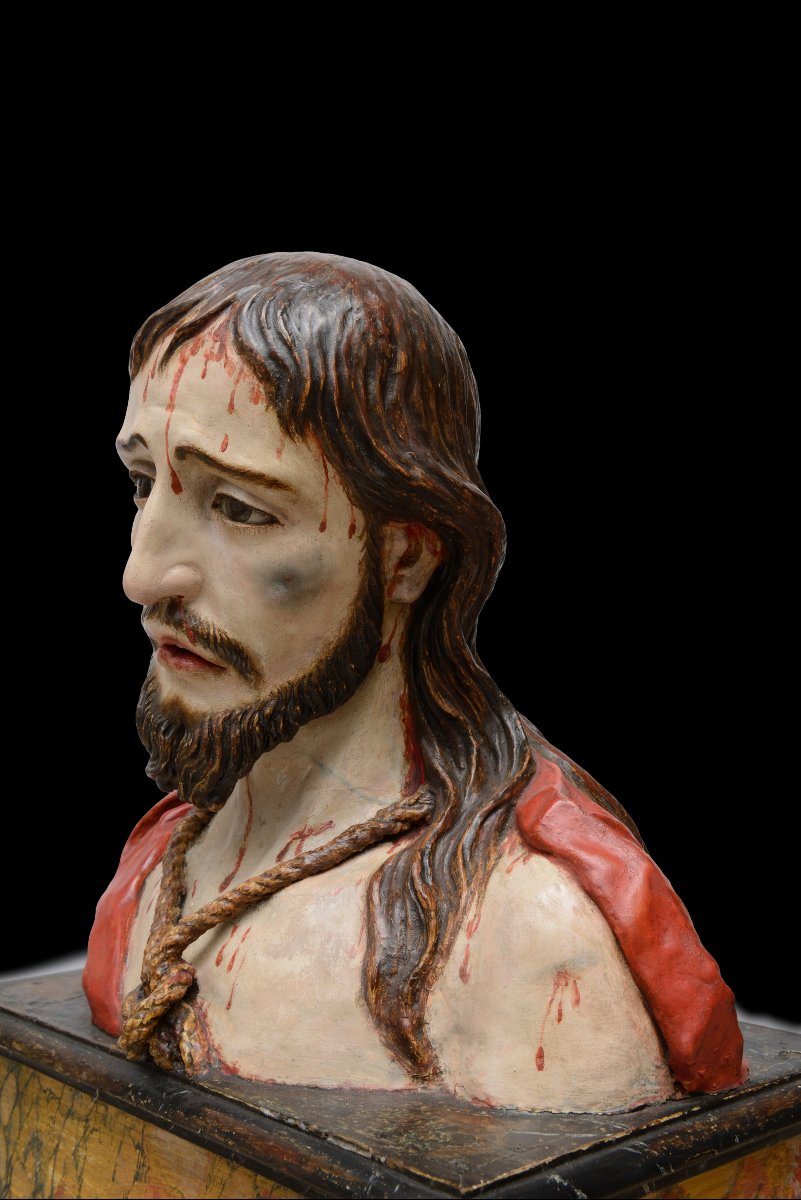
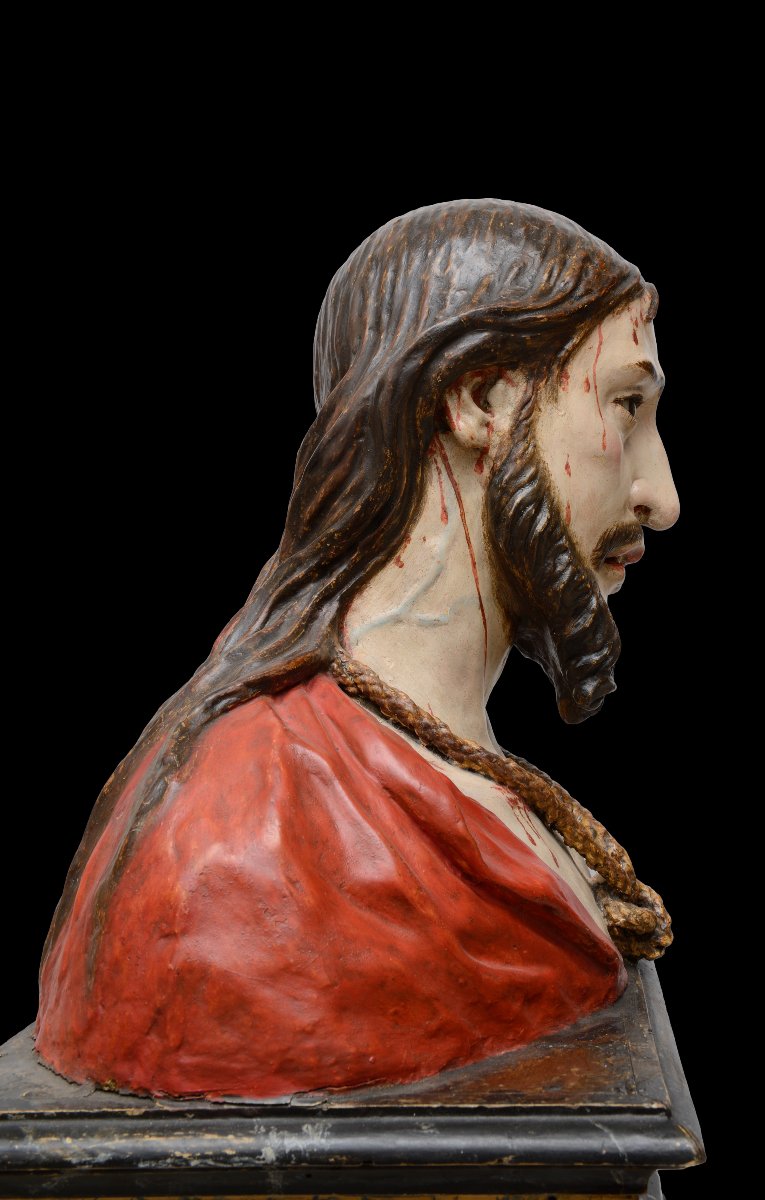
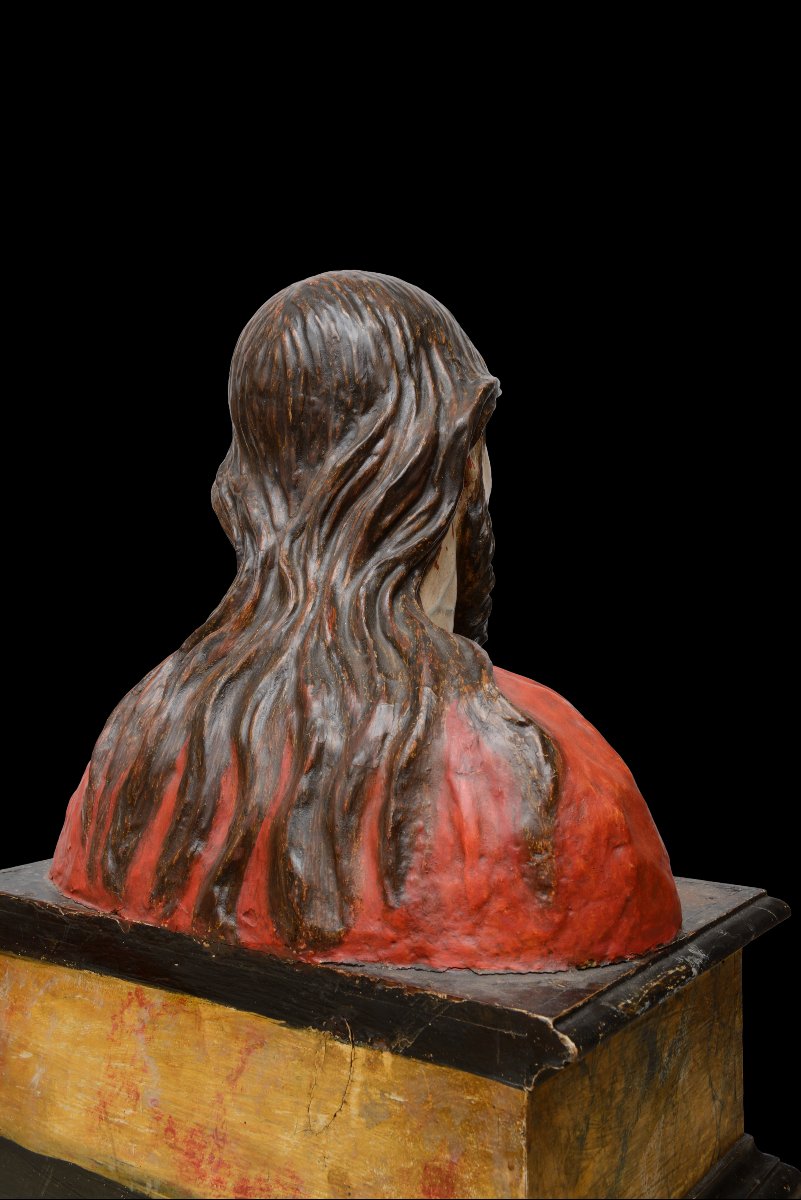
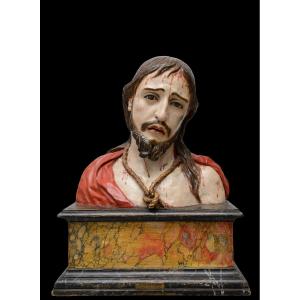
The sculpturedepicts Christ clad in a red tunic, a symbol of his status as amocked king and of the blood shed during the Passion. His face, marked by woundsand bruises on the cheekbones, bears witness to the violence of the martyrdom he endured.His hair, arranged in smooth strands falling over his shoulders, frames aface with elongated and delicately sculpted features. The large eyes, craftedfrom glass paste and accented with natural eyelashes, enhance the realism andexpressiveness of the image. The head is tilted slightly to one side, whilethe slightly parted mouth conveys restrained pain. A rope encircles herneck, an iconographic element alluding to the indignities suffered during thePassion. Her anguished gaze, raised toward the heavens, seems to implore divinehelp, thus becoming the primary focal point of the composition.
The statuerests on a narrow rectangular wooden pedestal, where a small plaque attributesthe work to the sculptor José de Mora.
José de Mora(Baza, Granada, 1642 – Granada, 1724) was one of the leading sculptors of theSpanish Baroque. The son of Bernardo de Mora, himself a sculptor, he served hisapprenticeship in the workshop of Alonso Cano, whose influence proved decisivein shaping his artistic style and in his adoption of certainiconographic models. In 1672, he was appointed court sculptor to CharlesII, but left Madrid shortly thereafter to settle permanently in Granada, wherehe produced the majority of his work.
From hisearliest works, he distinguished himself by creating pairs of bustsdepicting the Ecce Homo and the Dolorosas, generally small in size,intended for private worship or convent chapels. These sculpturesreflect the spirituality of the Counter-Reformation, which sought toinspire devotion through emotionally powerful images.
José de Mora’s styleis characterized by profound expressiveness and refined sensitivity. Hisfigures convey sadness, contemplation, melancholy, andsorrow through a masterfully controlled dramatic intensity. The sculptor drapesthe bodies in broad folds of fabric, eliminating any superfluous elements that mightdistract the viewer’s attention and focusing all expressive poweron the face and, in particular, on the gaze. Similarly, he stylizes theproportions and elongates the forms, thereby creating figures of greatelegance and spirituality—traits that make his work oneof the pinnacles of Grenadian Baroque sculpture
The iconographyof the Ecce Homo depicts Christ during the most painful moments of hisPassion, just before the crucifixion, evoking episodes such as theflagellation, the crowning with thorns, and the journey to Calvary. Theseimages emphasize Jesus’ physical and spiritual suffering,inviting the faithful to contemplate and reflect on the redemptivesacrifice.
The sculpturedepicts Christ clad in a red tunic, a symbol of his status as amocked king and of the blood shed during the Passion. His face, marked by woundsand bruises on the cheekbones, bears witness to the violence of the martyrdom he endured.His hair, arranged in smooth strands falling over his shoulders, frames aface with elongated and delicately sculpted features. The large eyes, craftedfrom glass paste and accented with natural eyelashes, enhance the realism andexpressiveness of the image. The head is tilted slightly to one side, whilethe slightly parted mouth conveys restrained pain. A rope encircles herneck, an iconographic element alluding to the indignities suffered during thePassion. Her anguished gaze, raised toward the heavens, seems to implore divinehelp, thus becoming the primary focal point of the composition.
The statuerests on a narrow rectangular wooden pedestal, where a small plaque attributesthe work to the sculptor José de Mora.
José de Mora(Baza, Granada, 1642 – Granada, 1724) was one of the leading sculptors of theSpanish Baroque. The son of Bernardo de Mora, himself a sculptor, he served hisapprenticeship in the workshop of Alonso Cano, whose influence proved decisivein shaping his artistic style and in his adoption of certainiconographic models. In 1672, he was appointed court sculptor to CharlesII, but left Madrid shortly thereafter to settle permanently in Granada, wherehe produced the majority of his work.
From hisearliest works, he distinguished himself by creating pairs of bustsdepicting the Ecce Homo and the Dolorosas, generally small in size,intended for private worship or convent chapels. These sculpturesreflect the spirituality of the Counter-Reformation, which sought toinspire devotion through emotionally powerful images.
José de Mora’s styleis characterized by profound expressiveness and refined sensitivity. Hisfigures convey sadness, contemplation, melancholy, andsorrow through a masterfully controlled dramatic intensity. The sculptor drapesthe bodies in broad folds of fabric, eliminating any superfluous elements that mightdistract the viewer’s attention and focusing all expressive poweron the face and, in particular, on the gaze. Similarly, he stylizes theproportions and elongates the forms, thereby creating figures of greatelegance and spirituality—traits that make his work oneof the pinnacles of Grenadian Baroque sculpture
15 000 €
Period: 17th century
Style: Other Style
Condition: En l'etat
Material: Painted wood
Width: 54
Height: 42
Depth: 26
Reference (ID): 1799280
Availability: In stock
Print