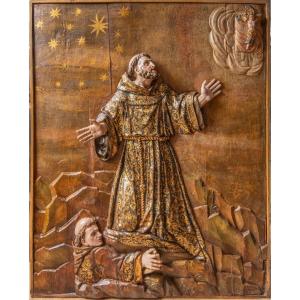


Relief Depicting The Imposition Of The Stigmata Of Christ On Saint Francis, 17th-century Andalusian School
Dimensions: 200 cm high x 161 cm wide x 19 cmdeep
The bestowal of the stigmata upon Saint Francis of Assisi isone of the most significant episodes in the Franciscan tradition. It tookplace on September 17, 1224, in Italy, on Mount Alverna, a remoteand rocky mountain in the Apennines that Saint Francis had chosen for its solitude andnatural beauty.
According to tradition, Saint Francis had withdrawn toMount Alverna to observe a forty-day fast in preparation for thefeast of Saint Michael the Archangel. He sought to unite himself fully with the suffering ofChrist’s Passion and to feel an extreme love for God.
During one of his intense prayers, Saint Francis hada vision in which a seraph—the highest heavenly spirit known tosurround the throne of God—was holding up a crucified man. During thisapparition, the rays of light emanating from the seraph marked the body ofSaint Francis.
Brother Leo was on Mount La Verna at that time andwitnessed not only the prayer but also the marks of SaintFrancis; he then took care of the saint. Brother Leo is the most famous ofSt. Francis’s brothers. He was a priest, and because of the purity of his souland his simplicity, St. Francis chose him as his companion and confidant. Healso gave him the name “Lamb of God.”
This event made Francis the first recognized stigmatized saintin the history of the Church, having received the five wounds of Christ (hands,feet, and side).
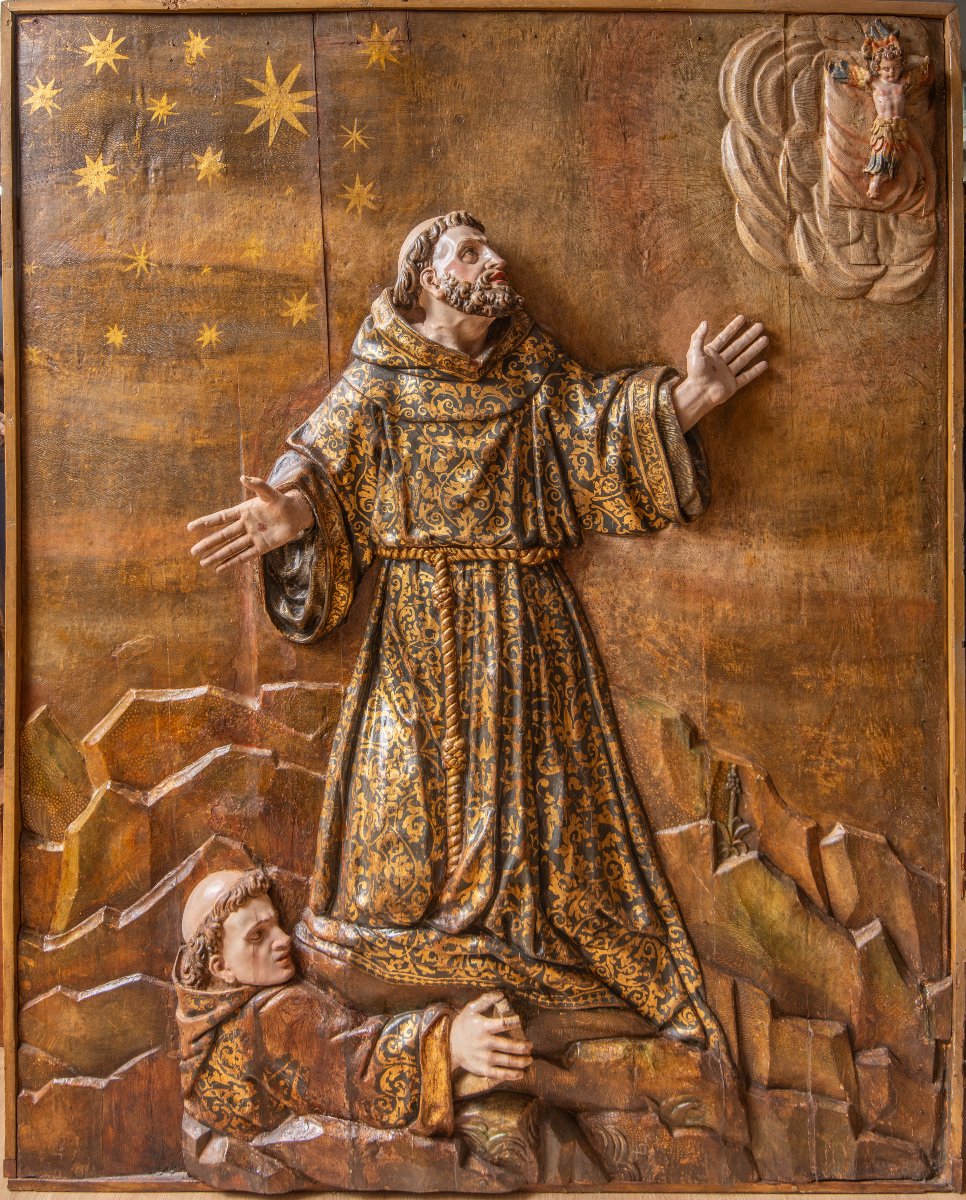
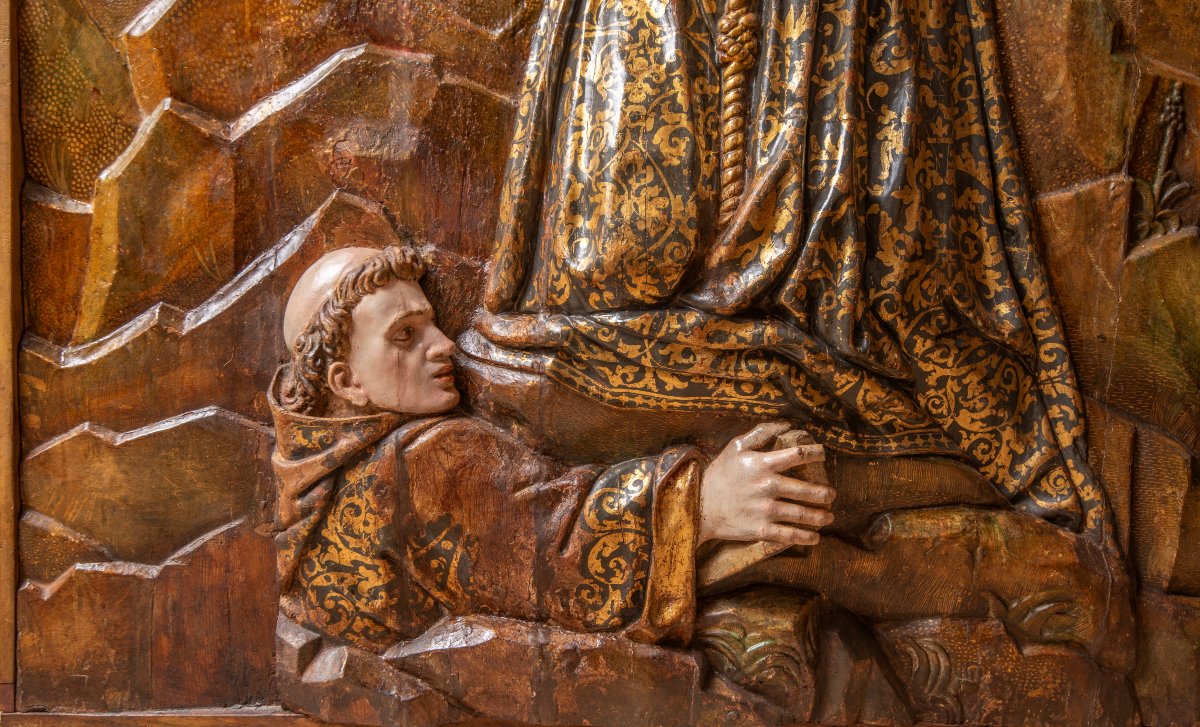
In the work before us, the figuresmentioned—St. Francis and Brother Leo—are depicted in a rocky landscapethat alludes to Mount Alverne. This place, characterized by itssolitude and steep cliffs, is the perfect illustration of the site wherethis mystical event took place.
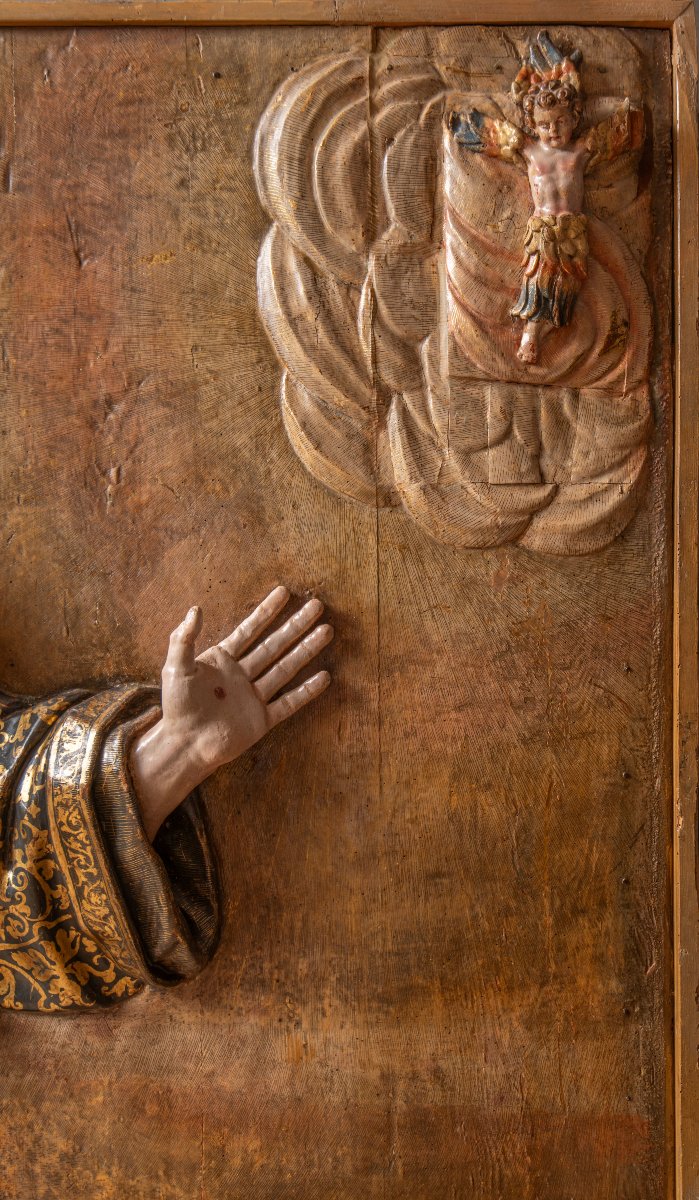
We also see the rays of light that markedthe saint. They burst forth from the cloud in which the six-wingedseraph appears, lending movement and radiance to the composition. As one of thehighest figures in the celestial hierarchy, the seraph is depicted withcharacteristic polychromy on its wings, in shades of yellow, red, andblue.
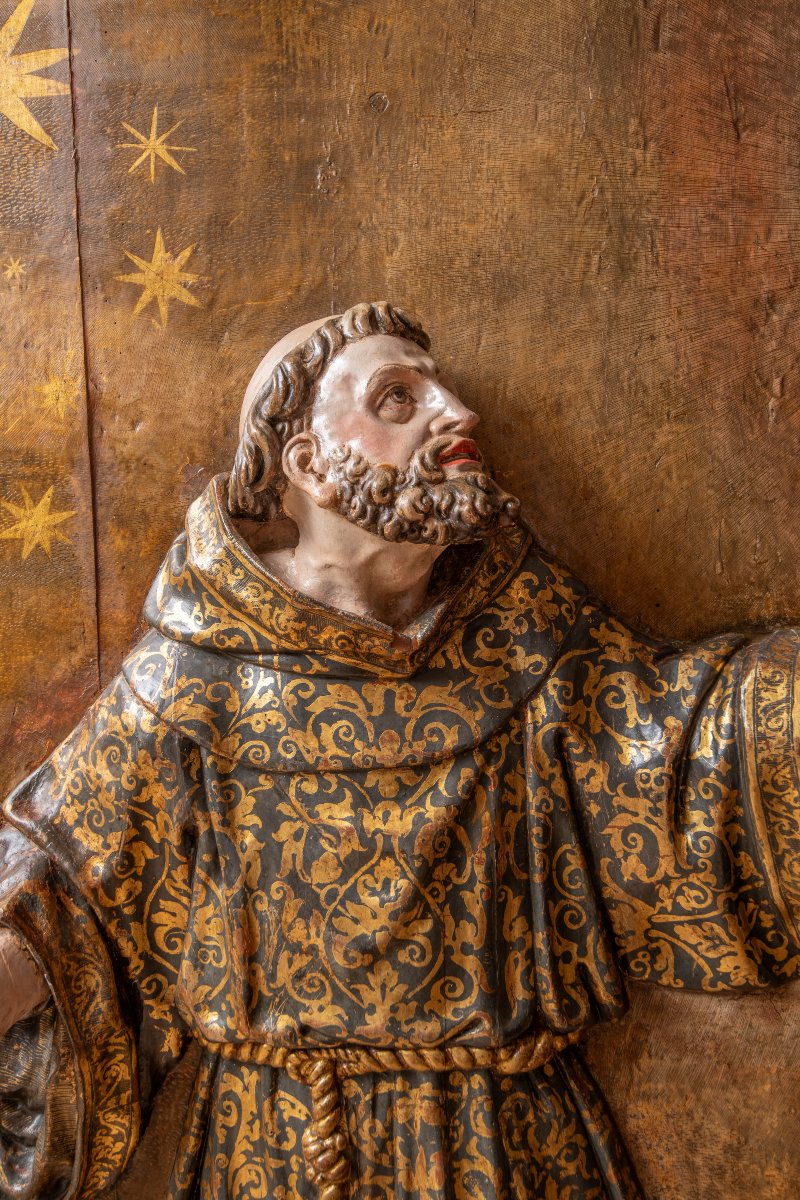
Beside the seraph, a majestic high relief of SaintFrancis, rendered with meticulous realism, in which even his hands,marked by the stigmata of the Franciscan tradition, seem to want tostep out of the image. The saint’s face, representative of the 17th-century Andalusianschool, is sculpted with meticulous attention to detail and greatexpressiveness.
The tension of the scene is fully evident in theprotruding veins of the saint’s neck, the tension in the muscles of his wrist, and hisposture, which focuses all his attention on the angel.
Saint Francis wears a delicately decorated tunic,polychrome and gilded, characterized by wide sleeves which, according to the accountof Brother Leon, he would later use to cover the wounds thatcaused him intense pain.
The saint’s garment is also a clear exampleof 17th-century Andalusian polychromy, as it features“roleos”—a decorative element in the shape of a spiral or volute—as well aspolychrome and gilded foliage motifs, characteristic of17th-century Andalusian sculpture.
This entire vision, as tradition holds, is attested toby Brother Leon, at the feet of Saint Francis, who would later tend to hiswounds and recount this mystical apparition.
Seventeenth-century Spanish sculpture brought together, inmost of its iconography, religious imagery, always striving for thegreatest possible realism, drama, and emotion in order to foster the devotionthat prevailed during that era.
This work exceptionally illustrates therealism and expressiveness characteristic of that era. The saint’s faceconveys, with fervor and devotion, the devotion and expressiveness that areunique to him. Furthermore, the size of the relief makes the creation of this pieceall the more labor-intensive.
The bestowal of the stigmata upon Saint Francis of Assisi isone of the most significant episodes in the Franciscan tradition. It tookplace on September 17, 1224, in Italy, on Mount Alverna, a remoteand rocky mountain in the Apennines that Saint Francis had chosen for its solitude andnatural beauty.
According to tradition, Saint Francis had withdrawn toMount Alverna to observe a forty-day fast in preparation for thefeast of Saint Michael the Archangel. He sought to unite himself fully with the suffering ofChrist’s Passion and to feel an extreme love for God.
During one of his intense prayers, Saint Francis hada vision in which a seraph—the highest heavenly spirit known tosurround the throne of God—was holding up a crucified man. During thisapparition, the rays of light emanating from the seraph marked the body ofSaint Francis.
Brother Leo was on Mount La Verna at that time andwitnessed not only the prayer but also the marks of SaintFrancis; he then took care of the saint. Brother Leo is the most famous ofSt. Francis’s brothers. He was a priest, and because of the purity of his souland his simplicity, St. Francis chose him as his companion and confidant. Healso gave him the name “Lamb of God.”
This event made Francis the first recognized stigmatized saintin the history of the Church, having received the five wounds of Christ (hands,feet, and side).
In the work before us, the figuresmentioned—St. Francis and Brother Leo—are depicted in a rocky landscapethat alludes to Mount Alverne. This place, characterized by itssolitude and steep cliffs, is the perfect illustration of the site wherethis mystical event took place.
We also see the rays of light that markedthe saint. They burst forth from the cloud in which the six-wingedseraph appears, lending movement and radiance to the composition. As one of thehighest figures in the celestial hierarchy, the seraph is depicted withcharacteristic polychromy on its wings, in shades of yellow, red, andblue.
Beside the seraph, a majestic high relief of SaintFrancis, rendered with meticulous realism, in which even his hands,marked by the stigmata of the Franciscan tradition, seem to want tostep out of the image. The saint’s face, representative of the 17th-century Andalusianschool, is sculpted with meticulous attention to detail and greatexpressiveness.
The tension of the scene is fully evident in theprotruding veins of the saint’s neck, the tension in the muscles of his wrist, and hisposture, which focuses all his attention on the angel.
Saint Francis wears a delicately decorated tunic,polychrome and gilded, characterized by wide sleeves which, according to the accountof Brother Leon, he would later use to cover the wounds thatcaused him intense pain.
The saint’s garment is also a clear exampleof 17th-century Andalusian polychromy, as it features“roleos”—a decorative element in the shape of a spiral or volute—as well aspolychrome and gilded foliage motifs, characteristic of17th-century Andalusian sculpture.
This entire vision, as tradition holds, is attested toby Brother Leon, at the feet of Saint Francis, who would later tend to hiswounds and recount this mystical apparition.
Seventeenth-century Spanish sculpture brought together, inmost of its iconography, religious imagery, always striving for thegreatest possible realism, drama, and emotion in order to foster the devotionthat prevailed during that era.
This work exceptionally illustrates therealism and expressiveness characteristic of that era. The saint’s faceconveys, with fervor and devotion, the devotion and expressiveness that areunique to him. Furthermore, the size of the relief makes the creation of this pieceall the more labor-intensive.
12 000 €
Period: 17th century
Style: Other Style
Condition: En l'etat
Material: Painted wood
Width: 161
Height: 200
Depth: 19
Reference (ID): 1799024
Availability: In stock
Print