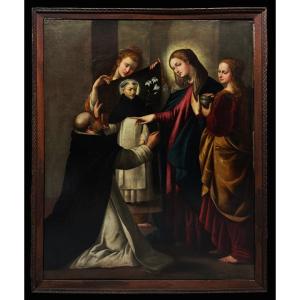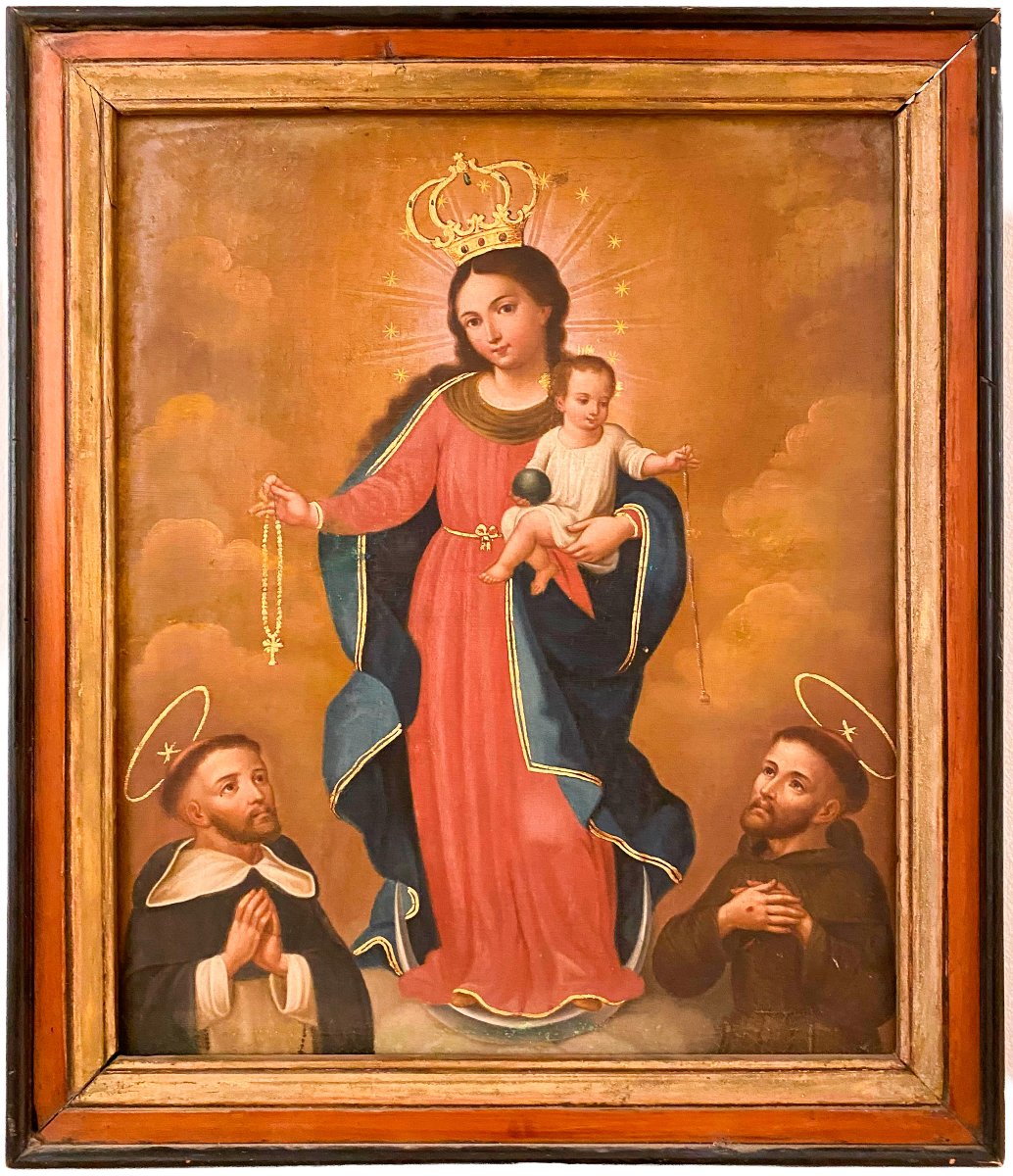
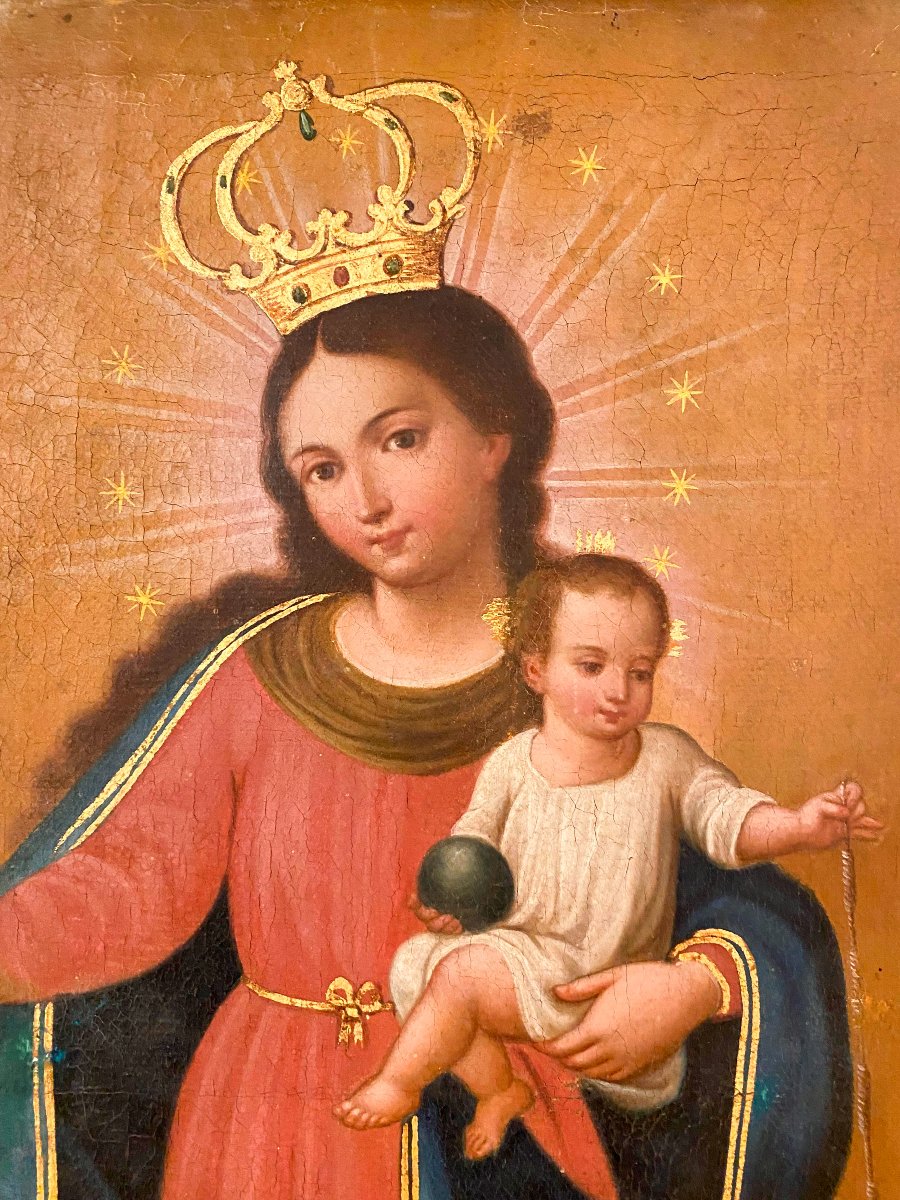
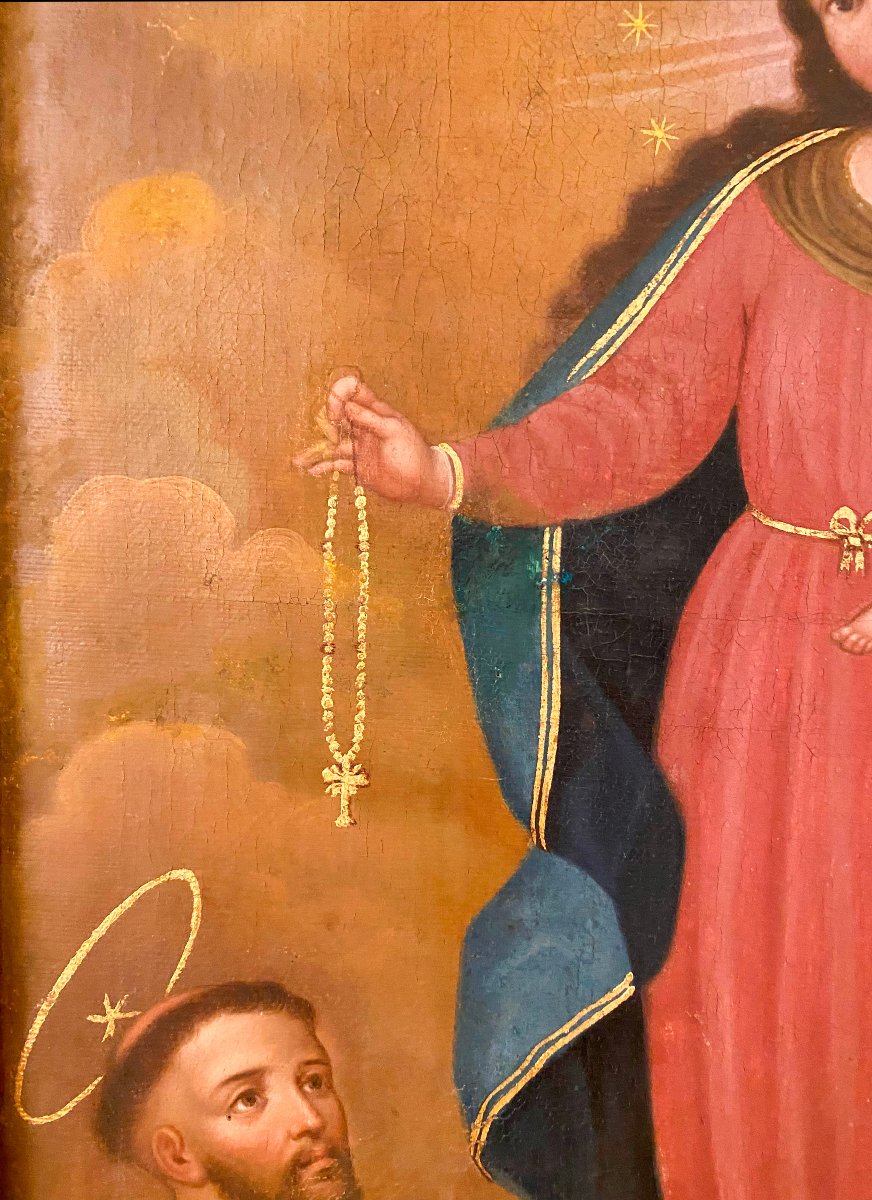
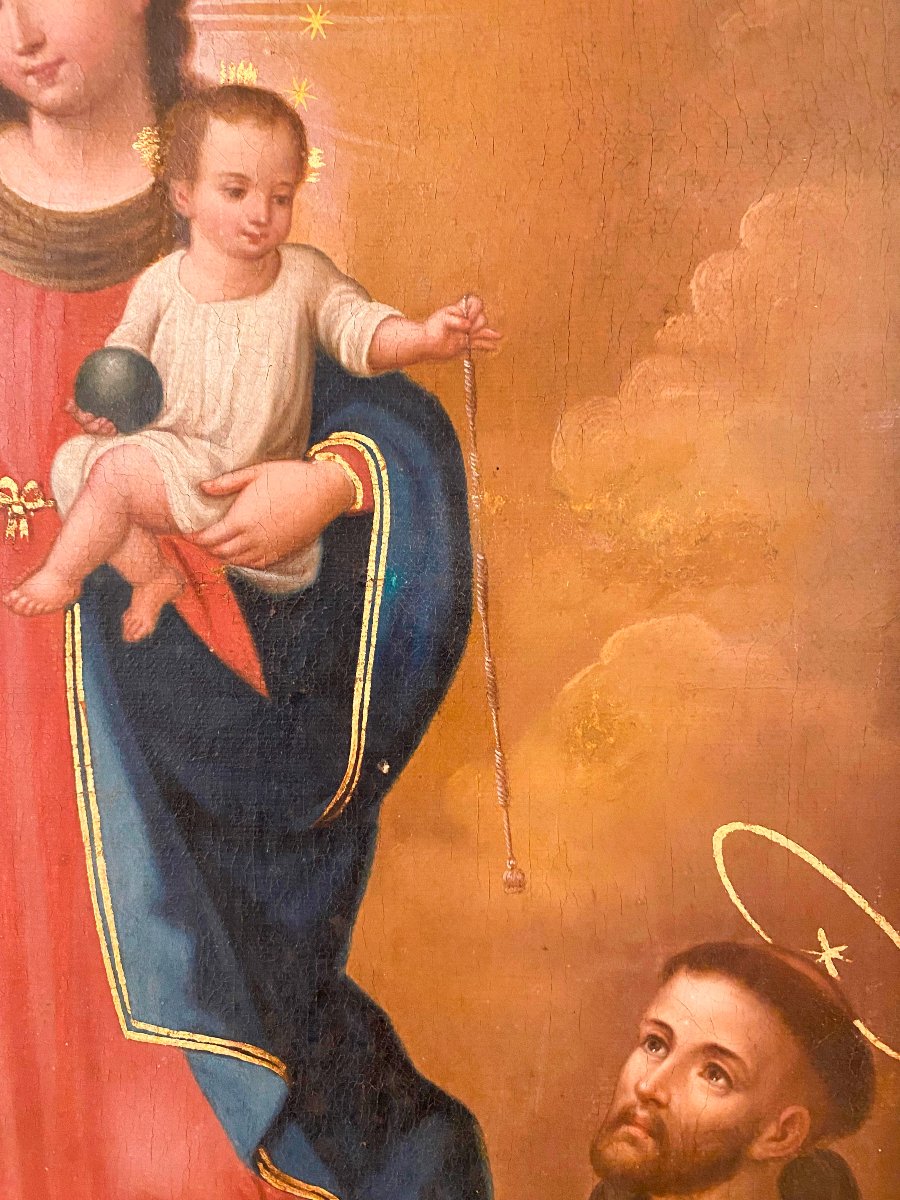
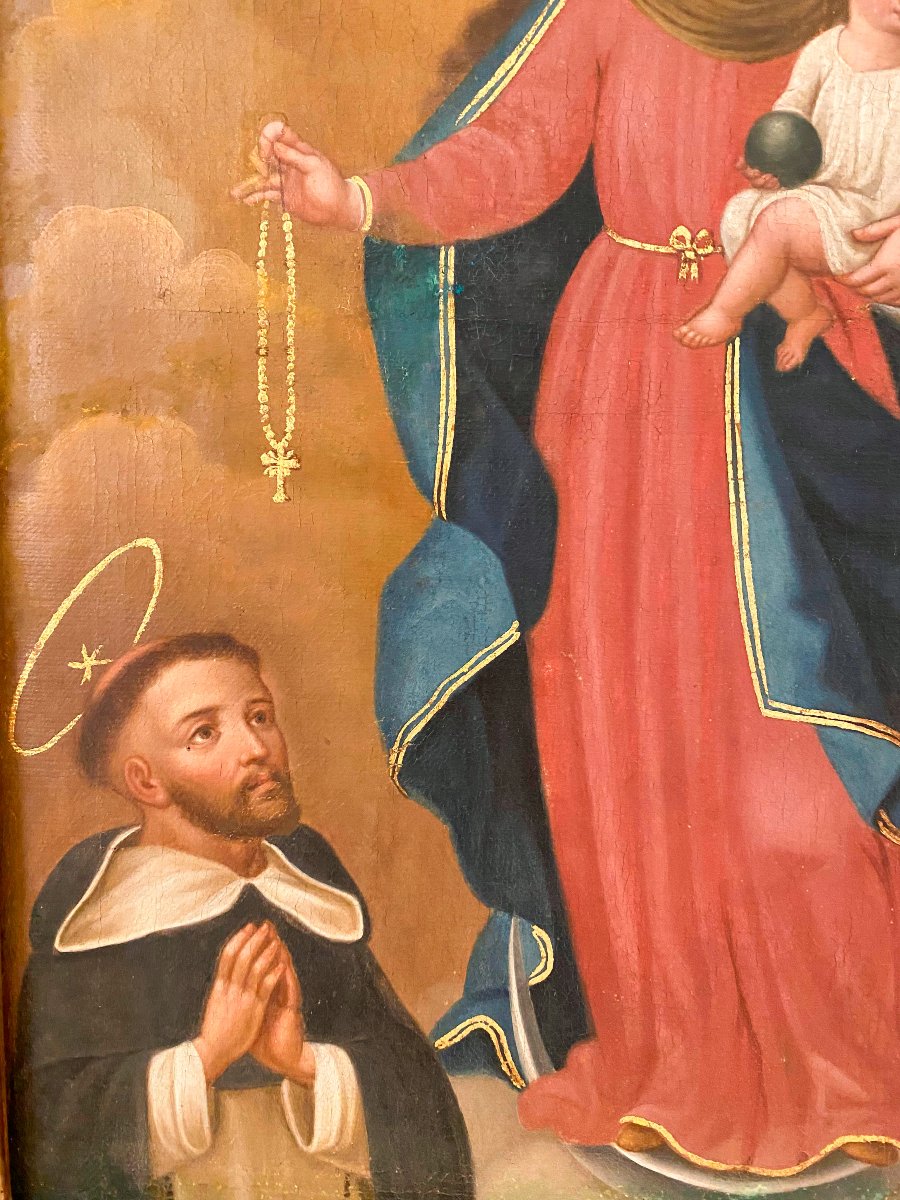


Virgin Of The Rosary. Oil On Canvas. Mexican School. 18th Century
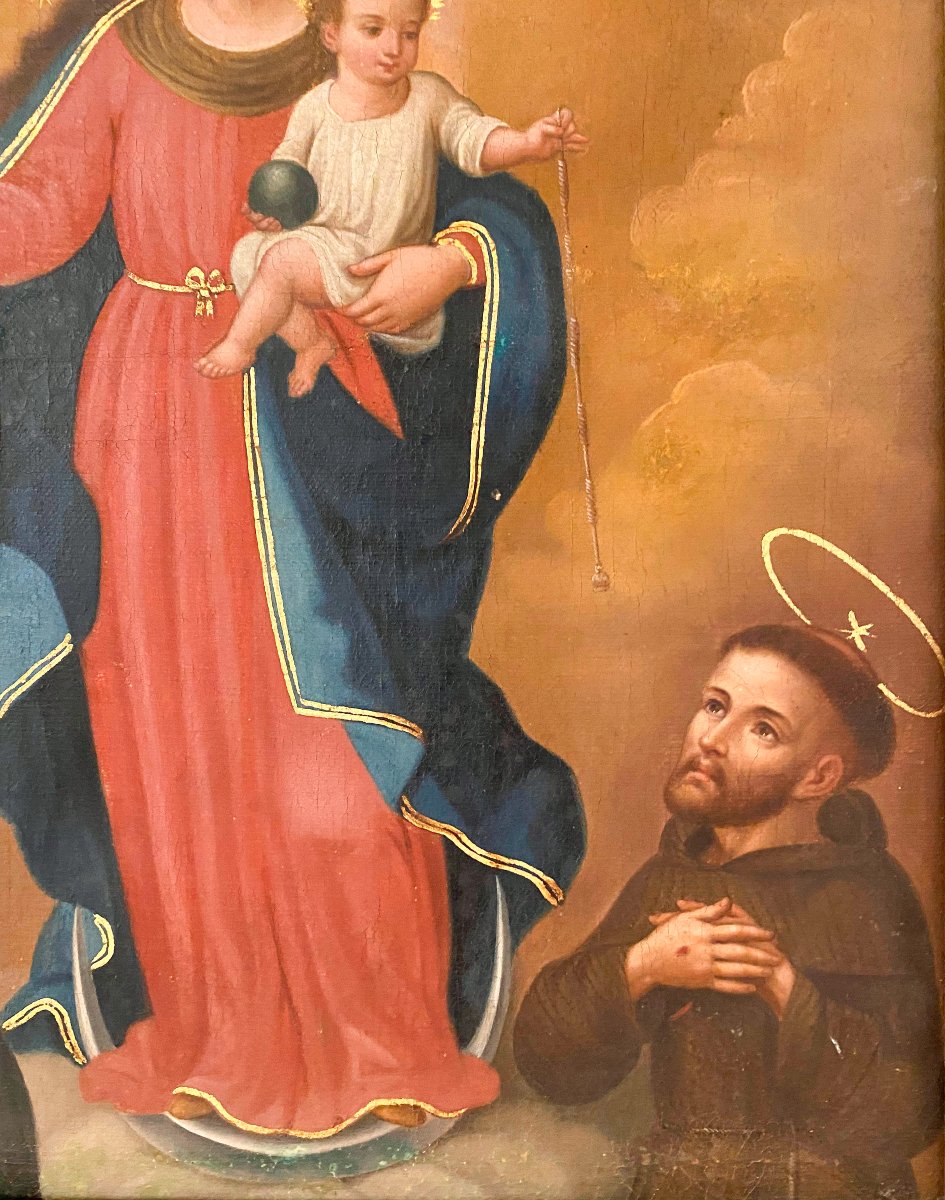
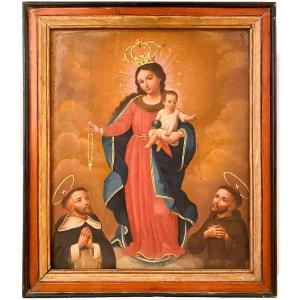
Dimensions with frame: 53.5 cm high x 45 cm wideThe work depicts the Virgin of the Rosary, accompanied bySaint Dominic de Guzmán and Saint Francis of Assisi, in a compositionset against a background of clouds that reinforces the heavenly nature of thescene. The Virgin occupies the center of the composition and turns her gaze towardthe saints kneeling at her feet. In her right hand, she holds the rosarywhich she extends to Saint Dominic, while in her left hand she holdsthe Infant Jesus. He turns his body to the right and reaches out tohand the rosary to Saint Francis, thus establishing a visual dialoguebetween the three figures.The presence of Saint Dominic de Guzmán is in keeping with thetradition that the Virgin appeared to him in Toulouse in 1214 andentrusted him with spreading devotion to the Rosary. This is why the saintis generally depicted receiving the Rosary from the Virgin’s hands. At hisside stands Saint Francis of Assisi, whose presence in the scene holdssymbolic significance: the joint depiction of the two saints alludesalludes to the union of the two great mendicant orders, the Dominicans and the Franciscans,in the defense, transmission, and practice of the Christian faith.The Virgin appears richly adorned in a blue tunicembroidered with brocade, while various elements of the composition are highlightedby the use of gold leaf. Of particular note arethe saints’ halos, the Virgin’s crown, the rosary, and thenumerous stars that radiate around her silhouette—all elements thathelp emphasize her sacred and heavenly nature.The iconography of the Virgin of the Rosary took onparticular significance following the Battle of Lepanto, fought on October 7,1571 between the fleet of the Holy League and the Ottoman Empire. Beforethe battle, the Christian troops had commended themselves to the Virgin andhad prayed the Rosary; the victory was therefore interpreted as the result ofher intercession. Consequently, Pope Pius V instituted the feast of the Virginof Victories, which was later associated with the title Our Lady of the Rosaryby Gregory XIII. Over time, this celebration and devotionspread throughout the Western Church, and October 7 was established asthe date of her feast.The devotion to Our Lady of the Rosary spread widelythroughout the Spanish territories, and particularly in the Americas. InPeru, this devotion took on particular significance as early as the firstyears of the viceregal period. Tradition holds that the first image waspresented by King Charles V and that in 1643, Viceroy Pedro de Toledoy Leiva proclaimed her the patroness and protector of the Kingdom of Peru. Thiswidespread popularity explains the frequent presence of this iconography in thereligious art of the Americas, where the Virgin of theRosary has become one of the most deeply rooted Marian invocations.
2 300 €
Period: 18th century
Style: Other Style
Condition: Condition of use
Material: Oil painting
Width: 45
Height: 53,5
Reference (ID): 1823231
Availability: In stock
Print