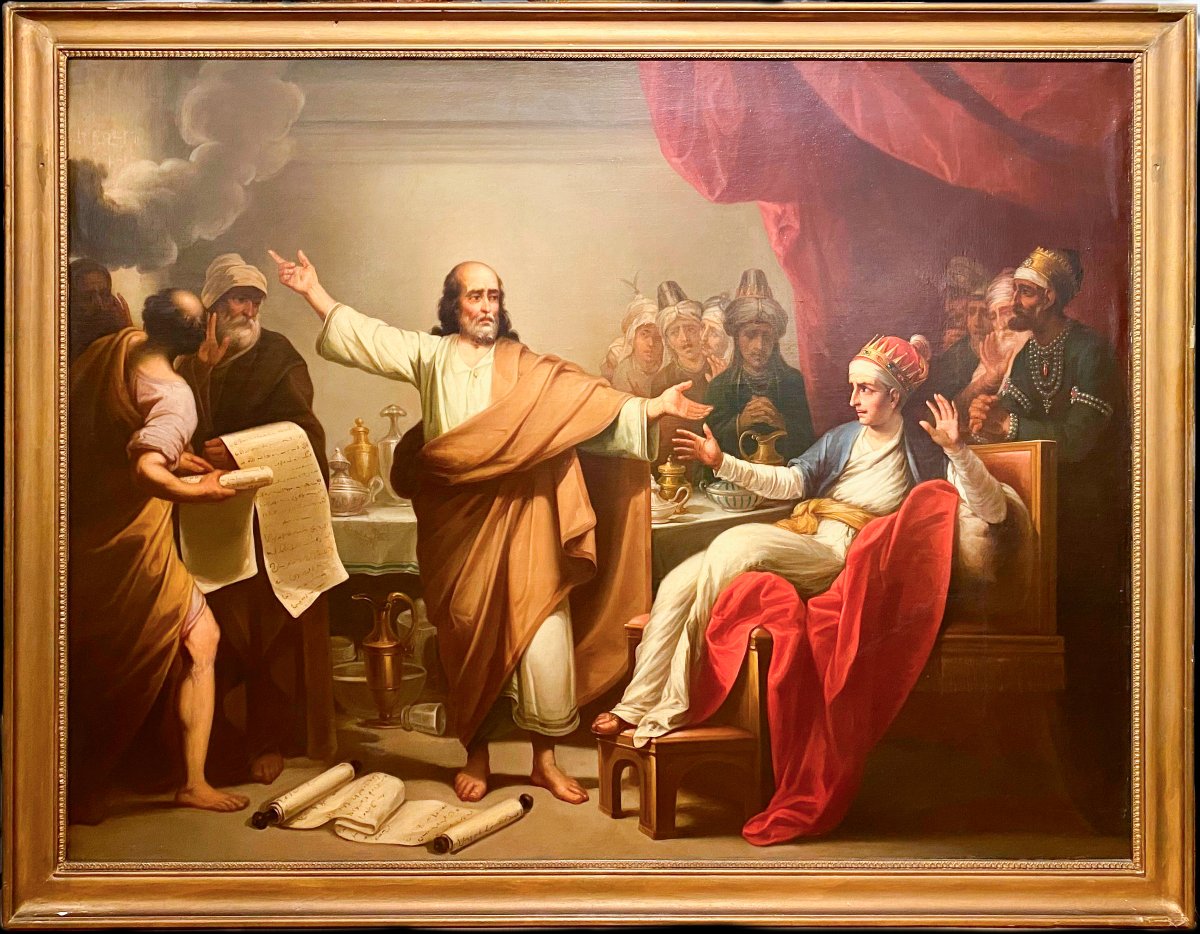
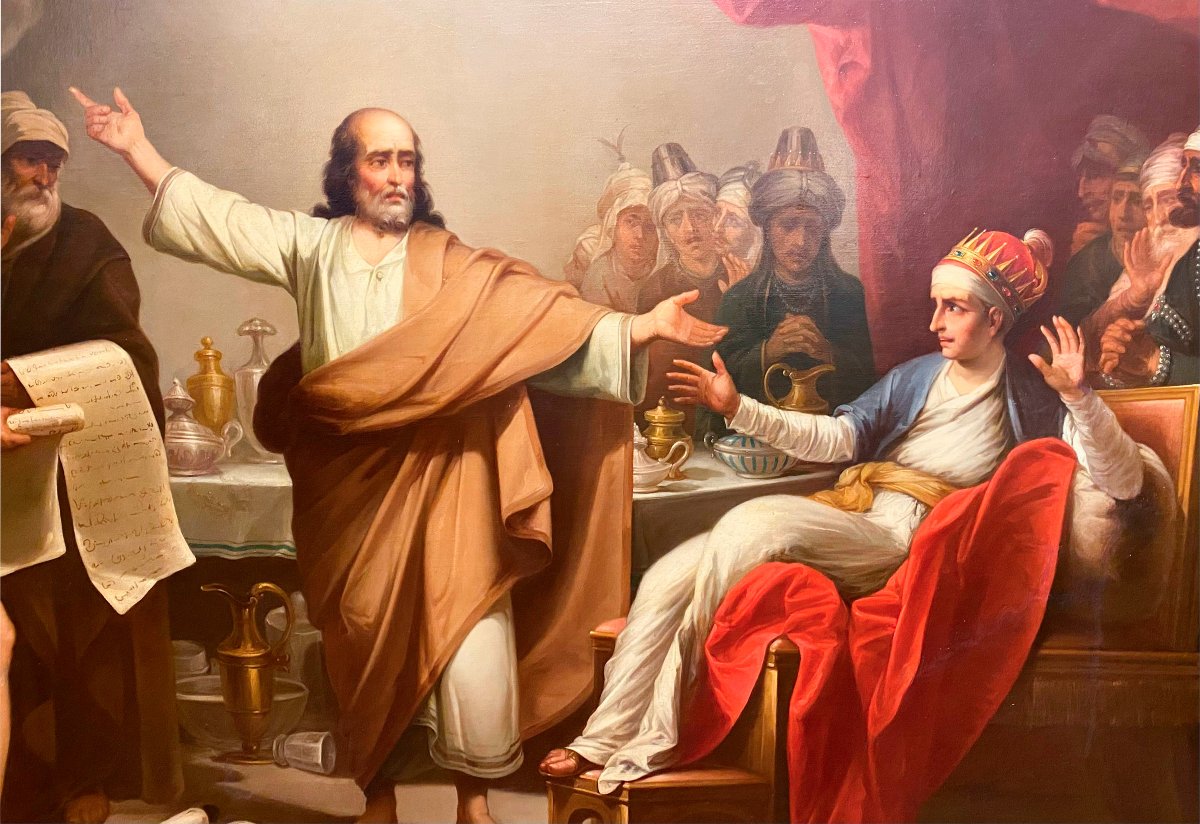
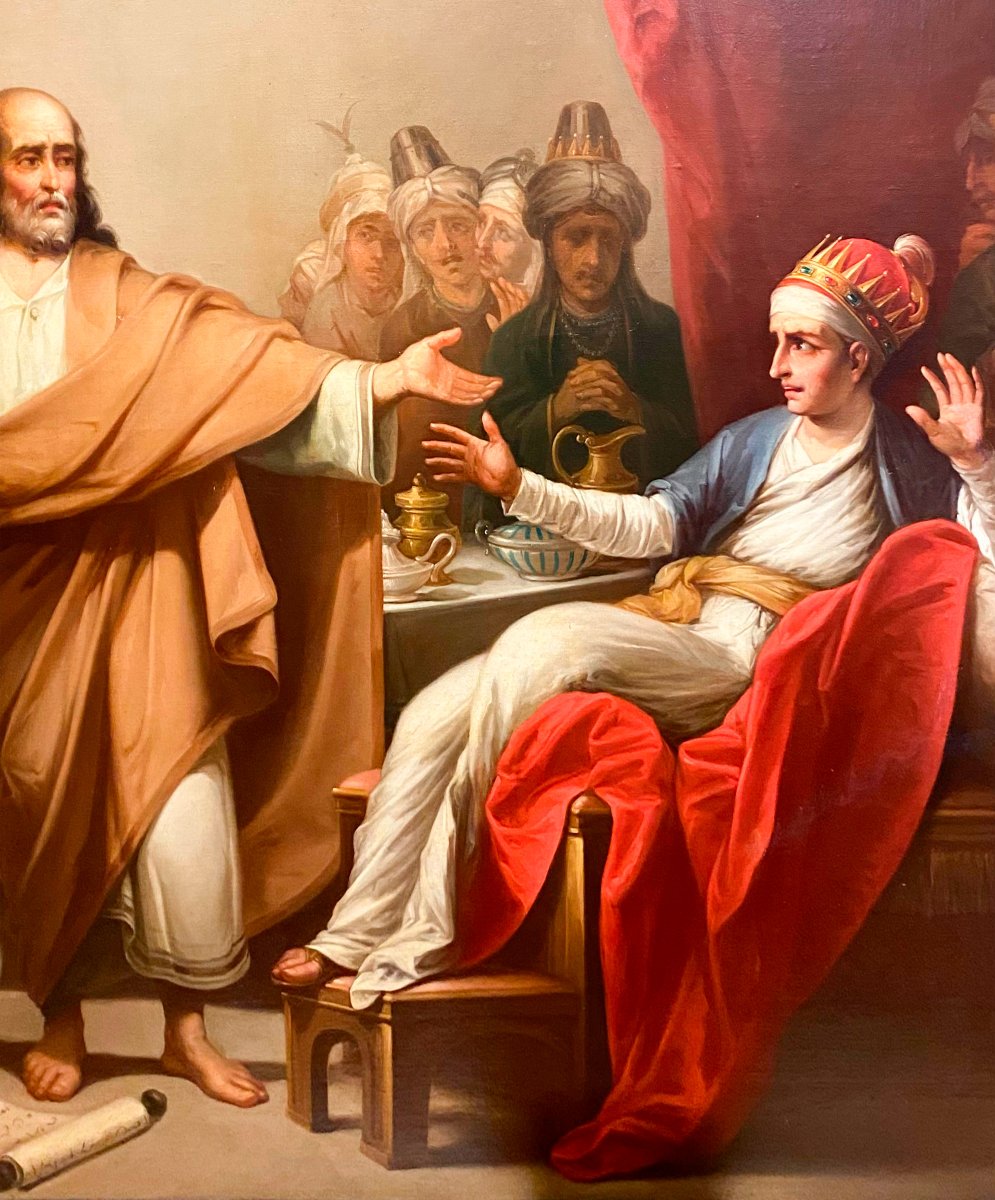
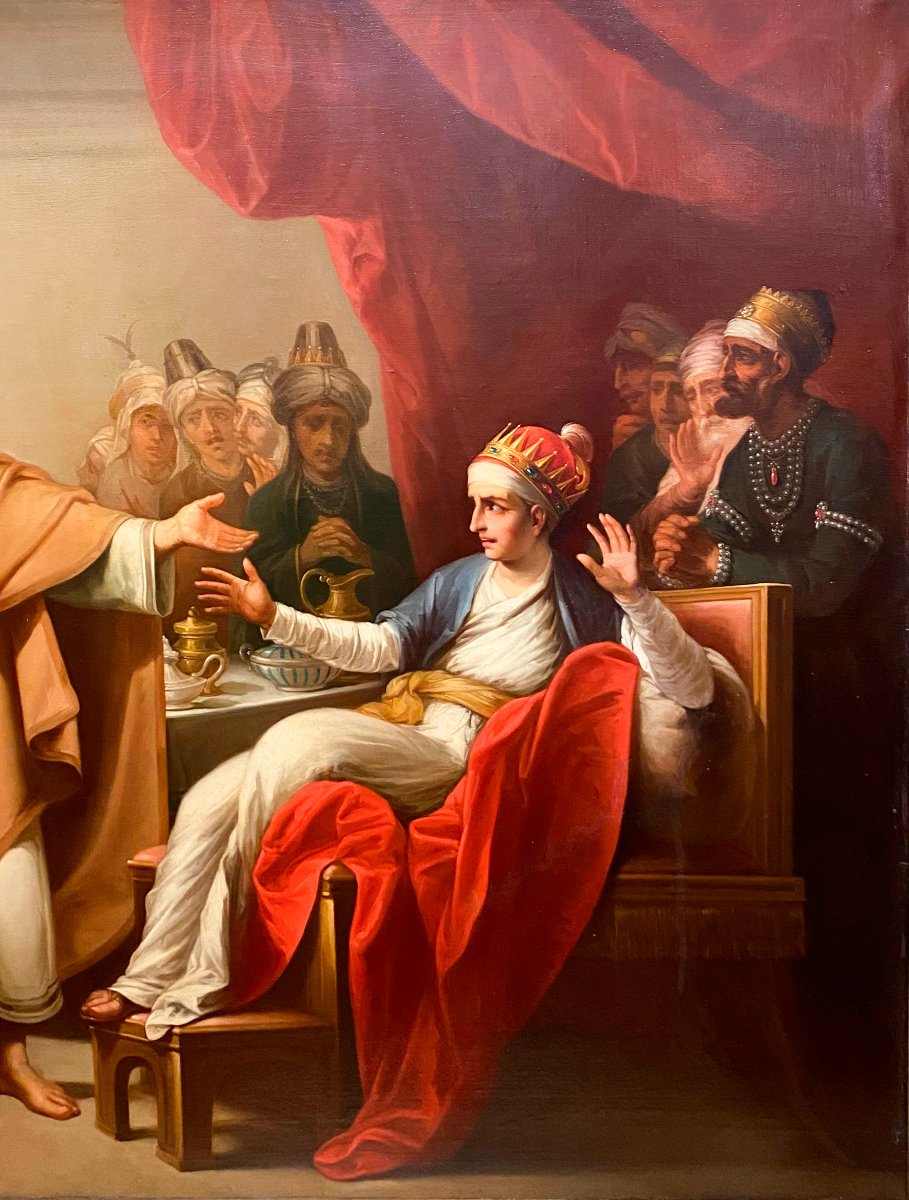
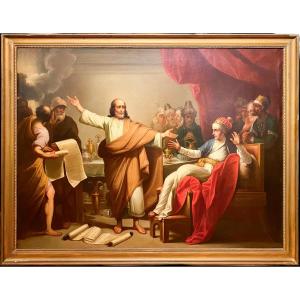


King Balthazar's Feast, Oil On Canvas, French School, 19th Century
Dimensions with frame: 124.5 cm high x 160 cm wide
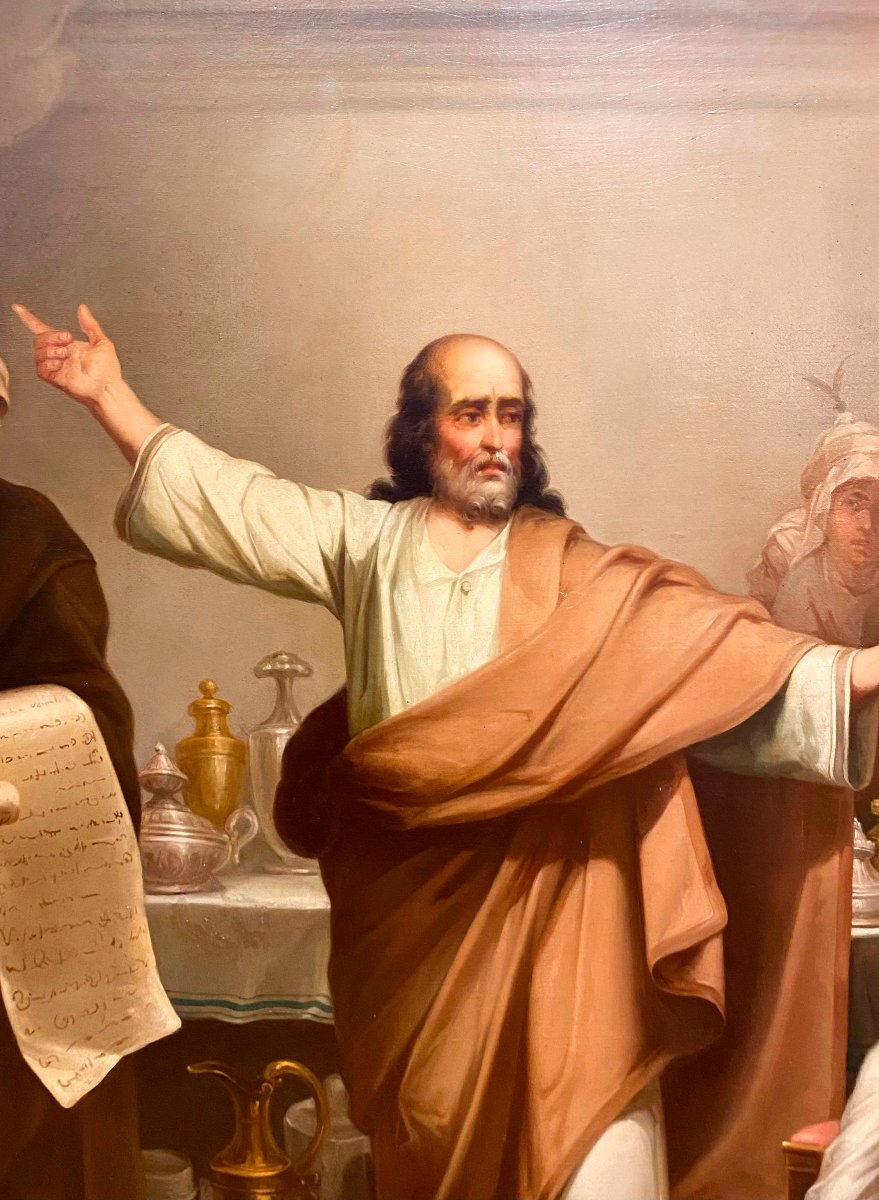
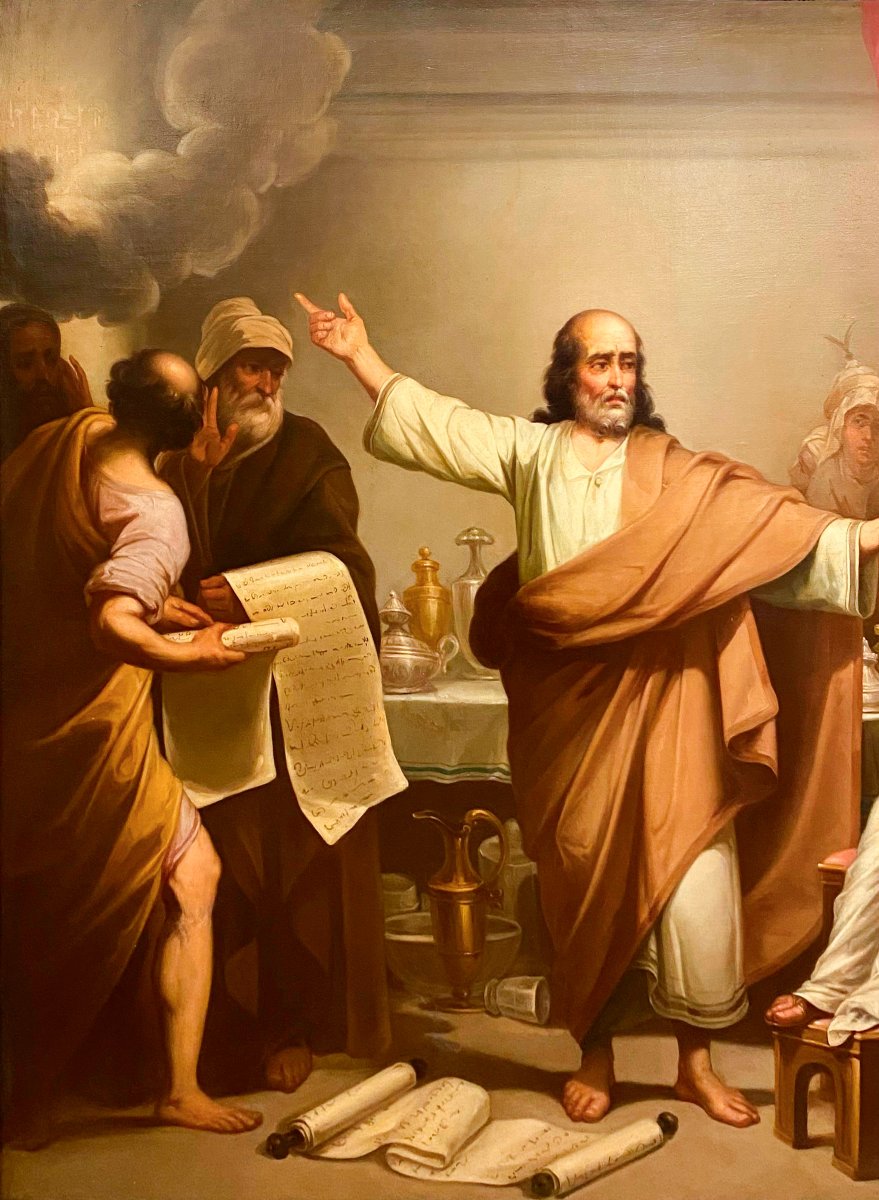
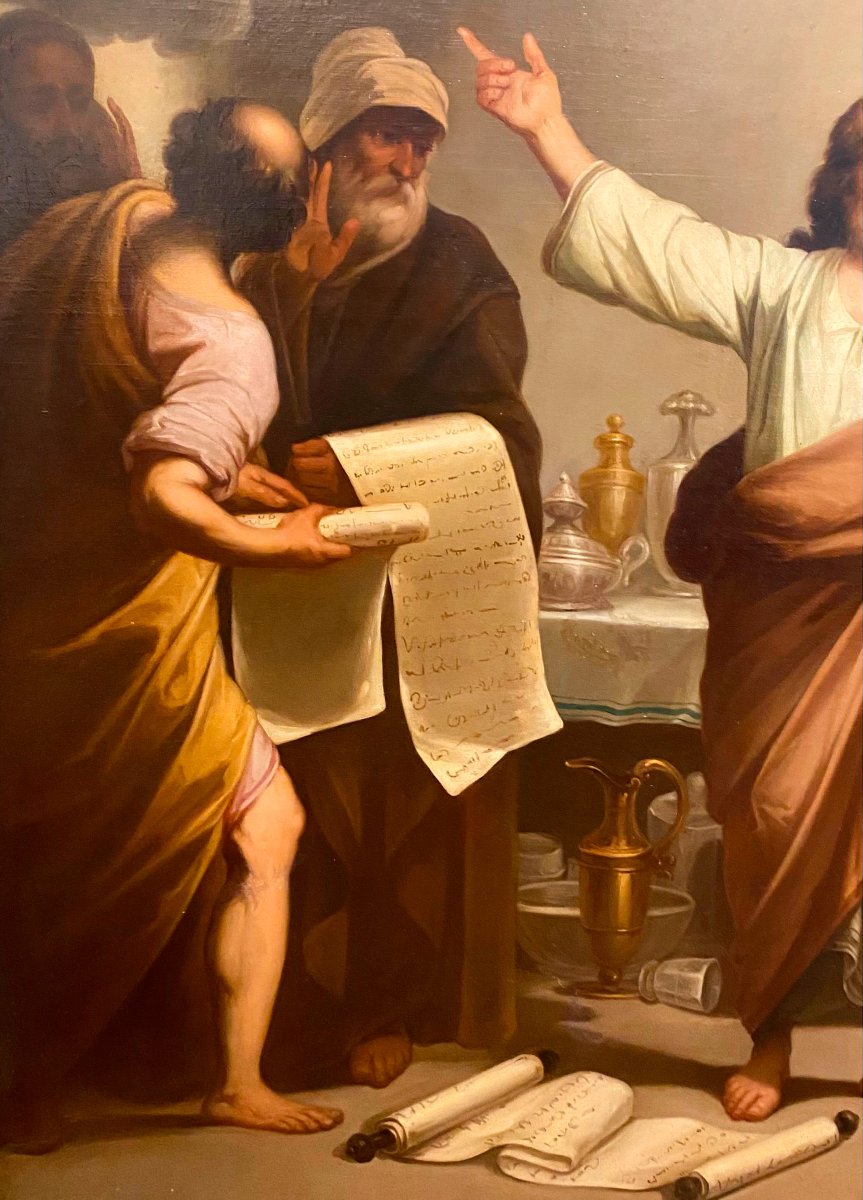
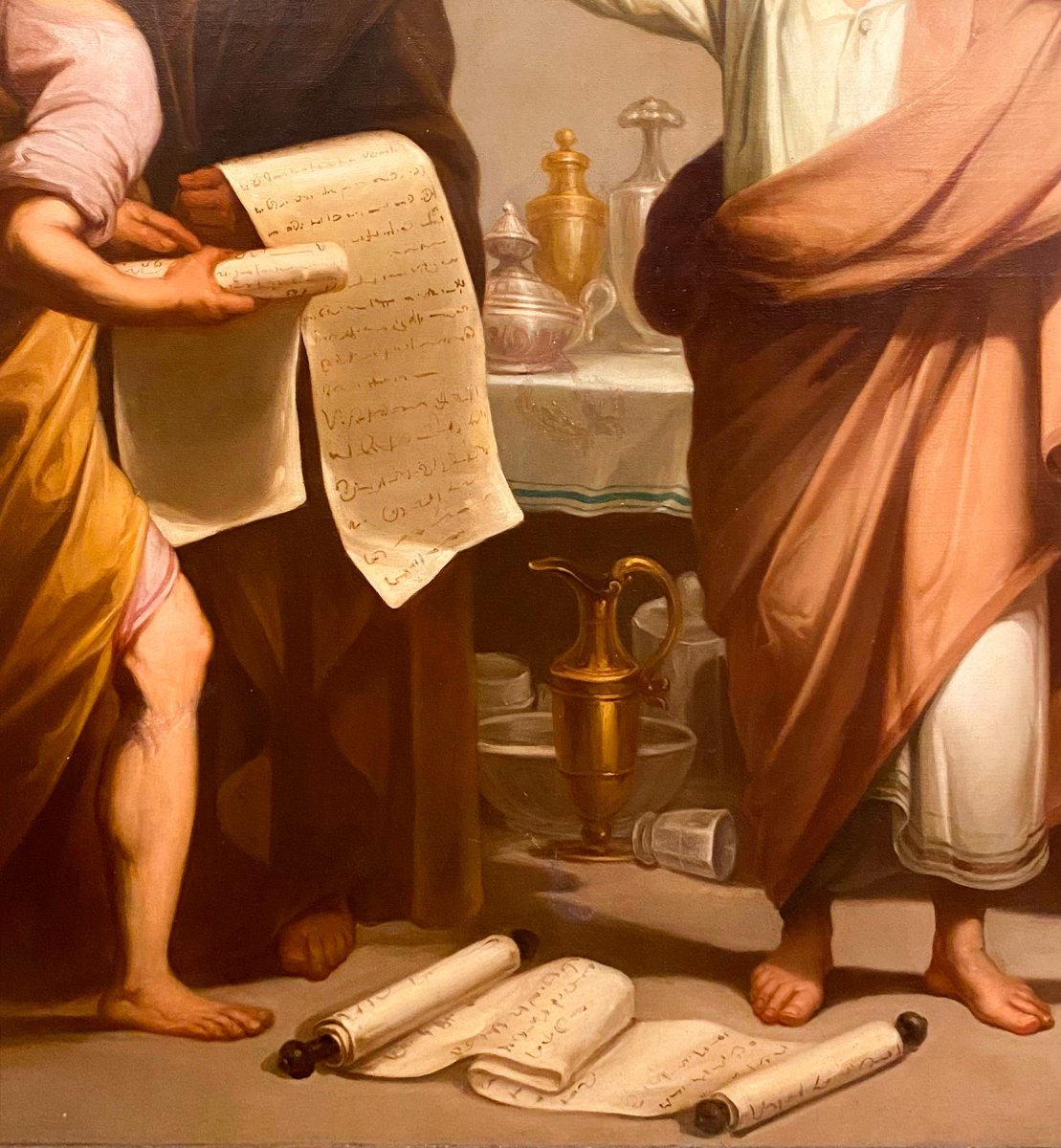
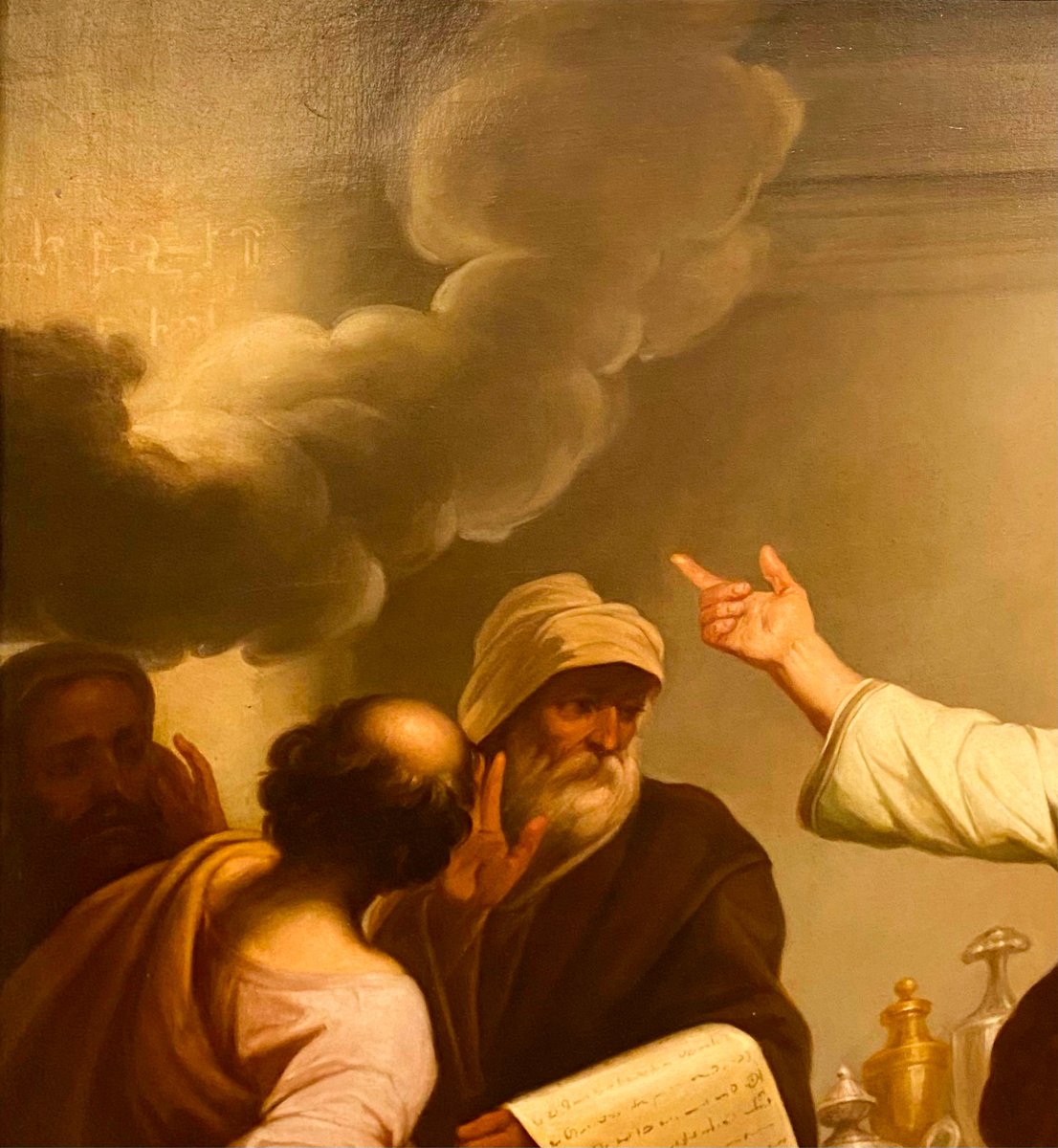
The Feast of Belshazzar is one of the best-known episodesin the Old Testament, recounted in the Book of Daniel (chapter 5), whichthe divine punishment inflicted upon King Belshazzar for his pride and for thedesecration of the sacred objects of the Temple of Jerusalem is recounted.According to the biblical account, Belshazzar organized a grand banquetfor a thousand of his nobles. During the feast, intoxicated by wine, heordered that the gold and silver cups be brought to him—the very ones his father,Nebuchadnezzar, had plundered from the Temple in Jerusalem. The king and hisguests drank from them while praising their gods.In the middle of the feast, a supernatural event occurred:a hand suddenly appeared and wrote on the wall the words “Mene, Mene,Tekel, Upharsin.” Seized with terror, Belshazzar summoned his wise men and divinersto interpret this mysterious message, but none of them was able todecipher it. Finally, they called upon the prophet Daniel, who revealed itsmeaning:“God has numbered the days of your reign and brought it to an end.You have been weighed on the scales and found wanting.Your kingdom has been divided and given to the Medes and the Persians. ”The prophecy was fulfilled that very night: Belshazzar wasassassinated, and the Babylonian Empire fell into the hands of Darius the Mede.The painting before us depicts with greatfidelity the climax of the story, when Daniel interprets the divine inscriptionbefore a visibly impressed Belshazzar, who is fully aware of the gravityof the announcement. In the upper portion, the heavenly message can be glimpsed amidthe clouds, reinforcing the supernatural nature of the scene.On the left is a group of figures holdingtexts, identifiable as the wise men, who had previously attempted, withoutsuccess, to decipher the mysterious inscription. Behind the king’s figure,courtiers and members of his entourage have gathered; their expressionsof astonishment, anxiety, and supplication reflect the dramatic tensionof the moment and the fear in the face of the imminent execution of divine judgment.On the table are depicted the gold andsilver vessels and chalices from the Temple of Jerusalem, elements essential to understandingthe reason for Belshazzar’s condemnation and which constitute one of the mainiconographic attributes of this biblical episode.Given its formal and compositional characteristics,the work appears to belong to the academic tradition; it may have been anexercise created for one of the competitions organized by the Academies ofFine Arts. In such competitions, a historical, religious, ormythological theme was proposed, which participants were required to interpretfreely, demonstrating their technical and narrative skills.This circumstance would explain the absence of a signature, asworks submitted to the competition had to remain anonymous until thejury rendered its verdict, thereby ensuring the impartiality of theselection process.
The Feast of Belshazzar is one of the best-known episodesin the Old Testament, recounted in the Book of Daniel (chapter 5), whichthe divine punishment inflicted upon King Belshazzar for his pride and for thedesecration of the sacred objects of the Temple of Jerusalem is recounted.According to the biblical account, Belshazzar organized a grand banquetfor a thousand of his nobles. During the feast, intoxicated by wine, heordered that the gold and silver cups be brought to him—the very ones his father,Nebuchadnezzar, had plundered from the Temple in Jerusalem. The king and hisguests drank from them while praising their gods.In the middle of the feast, a supernatural event occurred:a hand suddenly appeared and wrote on the wall the words “Mene, Mene,Tekel, Upharsin.” Seized with terror, Belshazzar summoned his wise men and divinersto interpret this mysterious message, but none of them was able todecipher it. Finally, they called upon the prophet Daniel, who revealed itsmeaning:“God has numbered the days of your reign and brought it to an end.You have been weighed on the scales and found wanting.Your kingdom has been divided and given to the Medes and the Persians. ”The prophecy was fulfilled that very night: Belshazzar wasassassinated, and the Babylonian Empire fell into the hands of Darius the Mede.The painting before us depicts with greatfidelity the climax of the story, when Daniel interprets the divine inscriptionbefore a visibly impressed Belshazzar, who is fully aware of the gravityof the announcement. In the upper portion, the heavenly message can be glimpsed amidthe clouds, reinforcing the supernatural nature of the scene.On the left is a group of figures holdingtexts, identifiable as the wise men, who had previously attempted, withoutsuccess, to decipher the mysterious inscription. Behind the king’s figure,courtiers and members of his entourage have gathered; their expressionsof astonishment, anxiety, and supplication reflect the dramatic tensionof the moment and the fear in the face of the imminent execution of divine judgment.On the table are depicted the gold andsilver vessels and chalices from the Temple of Jerusalem, elements essential to understandingthe reason for Belshazzar’s condemnation and which constitute one of the mainiconographic attributes of this biblical episode.Given its formal and compositional characteristics,the work appears to belong to the academic tradition; it may have been anexercise created for one of the competitions organized by the Academies ofFine Arts. In such competitions, a historical, religious, ormythological theme was proposed, which participants were required to interpretfreely, demonstrating their technical and narrative skills.This circumstance would explain the absence of a signature, asworks submitted to the competition had to remain anonymous until thejury rendered its verdict, thereby ensuring the impartiality of theselection process.
2 000 €
Period: 19th century
Style: Other Style
Condition: Good condition
Material: Oil painting
Width: 160
Height: 124,5
Reference (ID): 1796842
Availability: In stock
Print