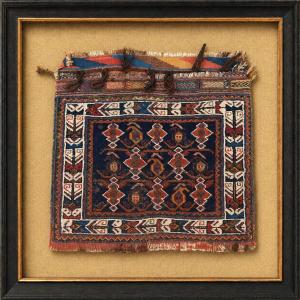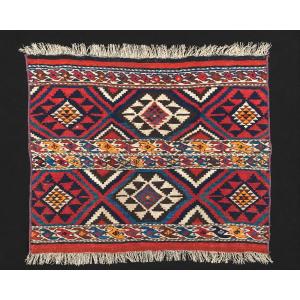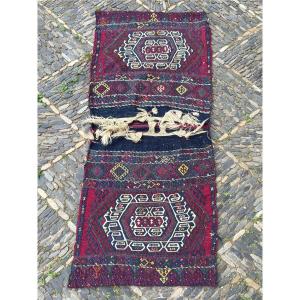


Double Satchel (heybe). Malatya - Sinanlı. Anatolia. Circa 1870. 160 X 72 Cm
"The colors, the colors, the colors!"
Those were the exact, repeated words of my friend and collector Cavid, who lives in the Milan area.
He’s an expert; his collection includes approximately 80,000 antique pieces.
I acquired this double satchel during a brief courtesy visit that also resulted in the purchase of nine 19th-century Caucasian rugs. Might as well.
Cavid is like a child—hyperactive, restless, and driven by a passion for antique textiles. He is also a professor at the University of Milan, where he teaches ancient Persian literature, among other subjects.
As he showed me this extraordinary piece, he kept repeating, “The colors, the colors, the colors!”
Using examples to illustrate his point, his goal was to help me understand the importance of colors in aesthetics as well as in dating a piece.
“Each shade corresponds to a specific period!”
One could write a book based on this double-compartment bag. I’ll focus on its shades.
In a word, the weaving is a work of art.
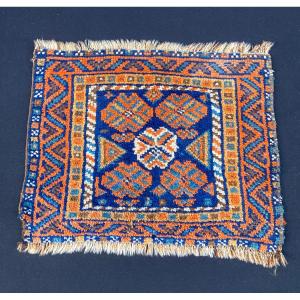
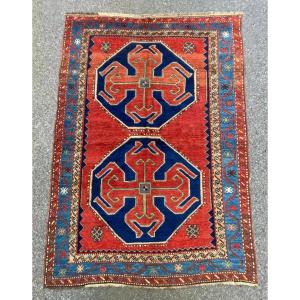
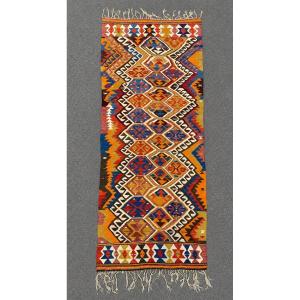
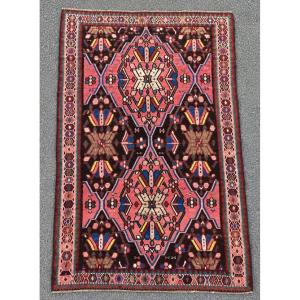
The color palette is exceptional, featuring deep, vibrant hues achieved using traditional dyes. It features an intense madder red, a ruby burgundy, a deep indigo blue, a midnight blue, shades of petrol blue, a natural undyed ivory, a slightly golden saffron yellow, ochre accents, as well as subtle touches of walnut brown and black-brown that give structure to the pattern. The juxtaposition of these hues creates a remarkable visual depth that unfolds in perfect harmony.
To the eye, it feels as though light is bursting forth from the sparkling fibers.
The ruby field is dense and saturated, forming the foundation and narrative structure of the entire piece. To achieve all these hues, considerable quantities of various plants in all their forms were required.
The durability of the colors can be measured in centuries.
The piece is a perfect example of the finest tribal weaves from Malatya–Sinanlı, sought after both for its ethnographic interest and its strong decorative presence.
Wool on wool, hand-spun.
Braided mesh fringes.
Circa 1870 or earlier
Dimensions: 160 x 72 cm
Laurent
Beauty of Kilims
Those were the exact, repeated words of my friend and collector Cavid, who lives in the Milan area.
He’s an expert; his collection includes approximately 80,000 antique pieces.
I acquired this double satchel during a brief courtesy visit that also resulted in the purchase of nine 19th-century Caucasian rugs. Might as well.
Cavid is like a child—hyperactive, restless, and driven by a passion for antique textiles. He is also a professor at the University of Milan, where he teaches ancient Persian literature, among other subjects.
As he showed me this extraordinary piece, he kept repeating, “The colors, the colors, the colors!”
Using examples to illustrate his point, his goal was to help me understand the importance of colors in aesthetics as well as in dating a piece.
“Each shade corresponds to a specific period!”
One could write a book based on this double-compartment bag. I’ll focus on its shades.
In a word, the weaving is a work of art.
The color palette is exceptional, featuring deep, vibrant hues achieved using traditional dyes. It features an intense madder red, a ruby burgundy, a deep indigo blue, a midnight blue, shades of petrol blue, a natural undyed ivory, a slightly golden saffron yellow, ochre accents, as well as subtle touches of walnut brown and black-brown that give structure to the pattern. The juxtaposition of these hues creates a remarkable visual depth that unfolds in perfect harmony.
To the eye, it feels as though light is bursting forth from the sparkling fibers.
The ruby field is dense and saturated, forming the foundation and narrative structure of the entire piece. To achieve all these hues, considerable quantities of various plants in all their forms were required.
The durability of the colors can be measured in centuries.
The piece is a perfect example of the finest tribal weaves from Malatya–Sinanlı, sought after both for its ethnographic interest and its strong decorative presence.
Wool on wool, hand-spun.
Braided mesh fringes.
Circa 1870 or earlier
Dimensions: 160 x 72 cm
Laurent
Beauty of Kilims
1 800 €
Period: 19th century
Style: Orientalism
Condition: Excellent condition
Material: Wool
Length: 160 cm
Width: 72 cm
Reference (ID): 1801492
Availability: In stock
Print