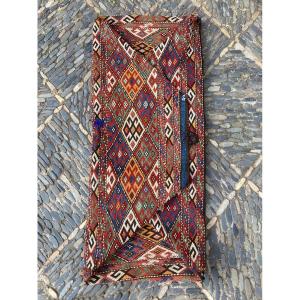
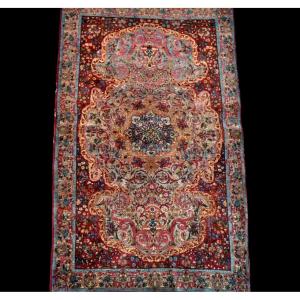
Open Double Camel Saddle Bag. Bathiyari—persia. Circa 1900. 185 X 110 Cm
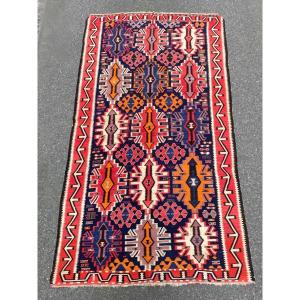
This piece is iconic, as rare as it is unusual. It is an open Bathiyari double camel saddle bag originating from Persia.
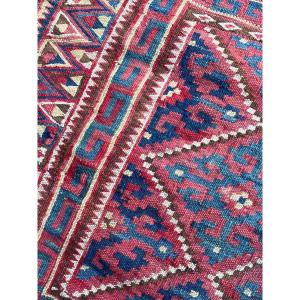
Usually, this type of piece is found in later productions from around the mid-20th century. This one is remarkable in every way and dates from the very end of the 19th century or, more conservatively, the very early 20th century. There is relatively little information about this object in specialized literature, yet it is instantly recognizable. Importantly, this is by no means a patchwork piece in which different elements have been assembled and sewn together. On the contrary, every part and every technique is woven onto the same warp. Thus, all the different weaving, knotted stitch, and embroidery techniques can be observed on a single surface. The central section is made using the sumak technique, while the ends are woven and embroidered. Two other distinct sections are executed using knotted stitch with velvet. These two sections correspond exactly to the folds at the bottom of each bag. The use of knotted stitch on the most fragile parts of the bags—their bottoms—is ingenious and contributes to the object’s sturdiness.
On the central section, one can make out scorpions enclosed in their cages.
Wool on wool.
Mixed media.
Exclusively plant-based dyes in perfect harmony. The indigo blues are ravishing.
The piece is in a state of preservation that borders on a miracle.
Circa 1900
Dimensions: 185 x 110 cm
Laurent
Beauty of Kilims
Usually, this type of piece is found in later productions from around the mid-20th century. This one is remarkable in every way and dates from the very end of the 19th century or, more conservatively, the very early 20th century. There is relatively little information about this object in specialized literature, yet it is instantly recognizable. Importantly, this is by no means a patchwork piece in which different elements have been assembled and sewn together. On the contrary, every part and every technique is woven onto the same warp. Thus, all the different weaving, knotted stitch, and embroidery techniques can be observed on a single surface. The central section is made using the sumak technique, while the ends are woven and embroidered. Two other distinct sections are executed using knotted stitch with velvet. These two sections correspond exactly to the folds at the bottom of each bag. The use of knotted stitch on the most fragile parts of the bags—their bottoms—is ingenious and contributes to the object’s sturdiness.
On the central section, one can make out scorpions enclosed in their cages.
Wool on wool.
Mixed media.
Exclusively plant-based dyes in perfect harmony. The indigo blues are ravishing.
The piece is in a state of preservation that borders on a miracle.
Circa 1900
Dimensions: 185 x 110 cm
Laurent
Beauty of Kilims
1 300 €
Period: 20th century
Style: Orientalism
Condition: Excellent condition
Material: Wool
Length: 185 cm
Width: 110 cm
Reference (ID): 1787647
Availability: In stock
Print