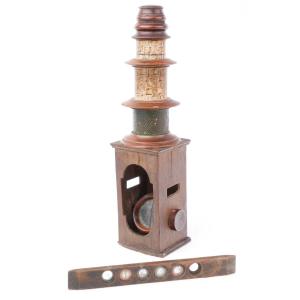
A Nuremberg-type microscope with three sliding tubes, accompanied by several microscopic views mounted on wooden rods. The instrument is made of wood and cardboard, materials characteristic of this ty[...]
An uncommon model of an obstetric perforator after Mauriceau, unsigned, but 18th century. This instrument is described in the Encyclopedia as a "Lance for piercing the head of the fetus in the womb." [...]
A two hinged arms with engraved scales — classic sector design.Engravings like “Guides”, “Polygones”, and degree markings are mathematical/engineering scales.The decorative pivot at the joint is typic[...]
A brass surveying circle with six pinnules, two of which are mounted on a rotating alidade. The circle measures 15 cm in diameter. It is signed "Baradelle à Paris" and dates to around 1730-1750. The i[...]
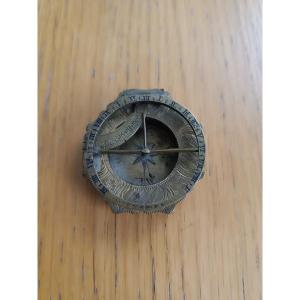
This wooden pocket sundial dates from the late 18th century. The back is covered with paper listing the main cities of Europe, and inside is a sundial with a compass. It shows signs of wear consistent[...]
A simple, uncommon French-made microscope, whose general design and construction follow the forms introduced in the early 18th century by Joblot (see the two images from his 1718 work) and is similar [...]
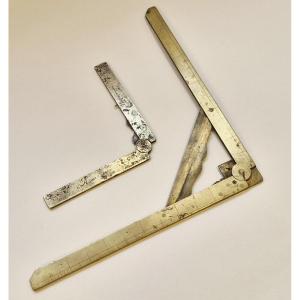
A set of two 18th-century brass folding rulers: - A six-inch (half-foot) folding ruler by Baradelle in Paris, circa 1740. This is almost certainly by Nicolas Jacques Baradelle. The instrument measures[...]
An 18th-century small surgical set comprising six scalpels with various blades and a snuffbox. The handles are made of bone or ivory. Three of the scalpels bear the mark of the heart, likely by Weber [...]
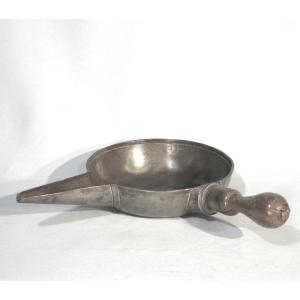
Very rare circular pewter syrup container with a long spout and a turned wooden handle with a beaded socket. Control mark: crowned C / AVALLON. Mark of Etienne SERGENT, master craftsman in 1769: crown[...]
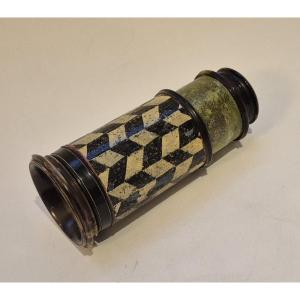
A spyglass constructed of horn and cardboard, lined with wallpaper featuring a typically Italian, perhaps Florentine, checkered pattern, and green vellum on which the remains of small silver tools are[...]
A spyglass constructed of white and brown horn and cardboard lined with white-dyed fish skin (ray or shark) and green vellum. The spyglass is unsigned but French, dating from the 18th century. The ori[...]
Antique brass folding rule/square – Butterfield Paris – “Pied de Roy”, “Pied du Rhin” scales – 18th century
Rare antique brass folding rule and square, signed Butterfield Paris, dating from the lat[...]
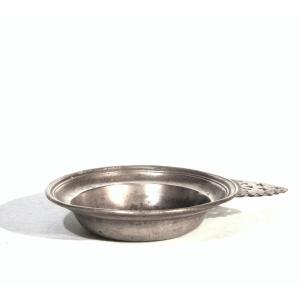
Pewter bleeding palette, circular with a molded, rounded rim, with an openwork bracket decorated with stars and a flamed heart.Control mark: "PARIS", used from 1780.Mark of Louis Nicolas Boicervoise, [...]
18th-Century English Brass Sector, Signed “R. Glynne Fecit”, c. 1750–1775
Length (closed): 16 cm — Width: 3.8 cm — Material: Solid brass
A fine mid-18th-century English brass sector, clearly signed [...]
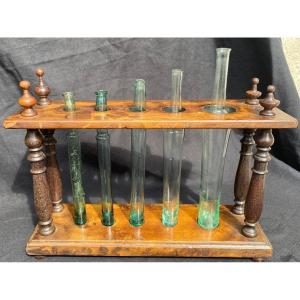
Five blown glass test tubes and their walnut stand, dating from the 18th century. Stand dimensions: 33.3 cm x 10 cm x 24.5 cm high. Height of the tallest test tube: 25 cm
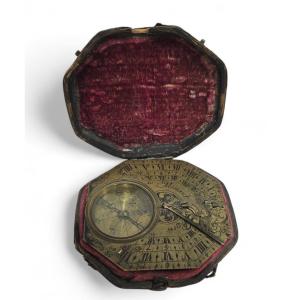
An exceptional 18th-century octagonal brass sundial, signed "Johan Schrettegger, Augsburg," featuring a blued steel pointer, a folding latitude arc engraved from 10° to 90°, and an engraved equinoctia[...]
An exceptional German portable sundial, finely engraved and made of gilt brass, signed "J. Vogler," and preserved in its original case. Made in the 18th century, this exquisite instrument testifies to[...]
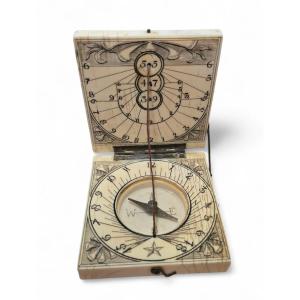
An exceptional portable sundial in engraved ivory, a fine example of 18th-century German craftsmanship, likely made in Nuremberg, one of Europe's historic centers for the manufacture of scientific ins[...]
An elegant, portable brass sundial, finely engraved and signed "Menant à Paris," testifying to the precision and expertise of French artisans specializing in scientific instruments. This compact and e[...]
18 th - century bronze graphomètre with sighting vanes , made by renard , ParisGeodeticvand topographic instrumentCompass diamètre : 4,7 cmHeight with ball joint and base : 15 cmWidth : 18 cmComplete [...]
A set of three compasses made of brass and bearing the mark, a wheel, of the German weights and measures instrument maker Adolf Deinert working in Nuremberg. We can date the compasses to the years 174[...]
Beautiful engraved brass navigation instrument forming a compass-sundial in its original box, stamped JF André, with a label from the last owner underneath, in good condition but the bottom of the box[...]
Early and beautiful Zograscope dating from the end of the 18th century in turned wood with wood inlays of different colors. Also note the decorative elements around the lens frame in brass and bone. A[...]
Cardboard hourglass covered with blue, red and orange tinted paper decorated with waves, with circular bases of the same decoration. An opening in the frame reveals the vial made up of two clear "bubb[...]
Large precision sundial, for the latitude of 49 degrees, used for setting watches and clocks. It is signed: "Invented by Julien Le Roy of the Society of Arts / made by Jacques Le Maire of the Society [...]
18th-Century French Coin Scale by Jecker à Paris
A Rare Precision Instrument from the Golden Age of Parisian Scientific Craftsmanship
A rare and finely preserved French steelyard coin balance, da[...]
Horizontal sundial in chiseled brass, signed Johan Schrettegger* Augsburg (Germany), in its original case, from the 18th century. This dial is in good condition. The compass works and it is signed und[...]
Shipping is free for mainland France via La Poste or Mondial Relay****************Pewter syrup jug in a flared shape with a short straight foot, long curved spout, fitted with a turned wooden handle. [...]
Unsigned, Late 18th century - Early 19th century - Early 19th century. The instrument, also called a salon telescope, is installed on a folding tripod baluster stand for astronomical observations made[...]
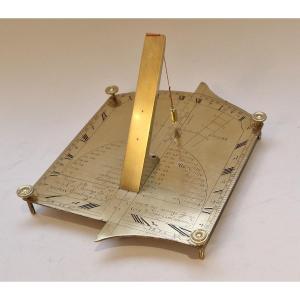
Octagonal equinoctial sundial. 18th century. The dial is not signed. Several cities are engraved on and below the plate: London, St. Petersburg, Paris, Rome, Antwerp, Berlin, Havana, Santo Domingo, Ne[...]
I cannot provide explanations on the use and origin of these two ancient measuring instruments, one of them is equipped with a small foldable steel blade.
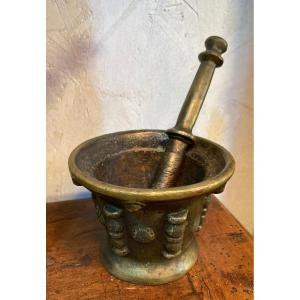
Bronze mortar, 17th or 18th century, mortar with 6 fluted reinforcements, Top diameter 12 cm, base 8 cm, height 8.5 cm, the pestle is 17.5 cm long. For France, Chronopost shop to shop shipping: 10 Eur[...]
Rectangular brass protractor signed "F. Watkins London". The protractor measures 15.7cmx4.8cm. On one side are engraved a double scale from 0 to 180 degrees and a conversion scale, and on the other si[...]
Large sundial signed Le Maire, likely for Pierre Le Maire (1717-1785), a manufacturer in Paris. The sundial features a compass. On the back, the latitudes of various European cities. Retractable bird [...]
Portable, oblong-shaped urinal with a handle: "This container was initially used by ladies for "imperious urination", under the crinoline, during the endless sermons of the abbot of the same name" (G.[...]
A perfectly functional opera lorgnette. There are minor dents and tarnishing on the brass rings. The floral wallpaper is worn in places. Note the pretty green tint of the inner tube. The glass lenses [...]
A perfectly functional opera lorgnette. There is a crack and other minor damage to the wood-effect resin surrounding the front lens. Some signs of wear on the outer morocco. Do take note of the attrac[...]
Rare full circle, called a planchette, with four pinnules, two of which are movable, mounted on a rotating alidade. The instrument is made of walnut and brass. The large brass circle is divided into t[...]
A round bedpan with rounded edges and cushion attachments. Hallmarked by Allègre in Angers, 18th century. 26cm in diameter, 17.3cm in interior diameter and 28cm in length. (An example with attachment [...]
This is an engraved brass measuring instrument from the 18th century.
Regarding its condition, please note signs of wear due to use.
Our photos allow you to appreciate the quality of the item.
[...]
This is an engraved brass measuring instrument from the 18th century.Regarding its condition, please note signs of wear due to use.Our photos allow you to appreciate the quality of the item.For condit[...]
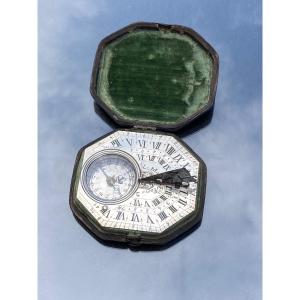
Sundial also serving as a compass signed Le Maire et Fils. Work carried out between 1722 and 1727. Very good condition, in its original shagreen case. 18th century hallmark Dimensions: 6 - 6.5cm
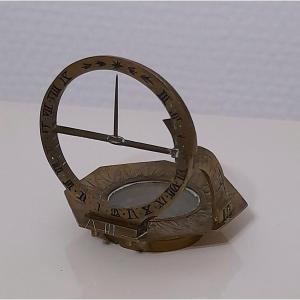
Portable equinoctial sundial
Jean-Baptiste DELURE (active in Paris from 1695 to 1736)
Paris, France, circa 1700-1720
Silver and glass
H. 3.2; L. 6; L. 6.9 cm
(restoration to the foot)
Portable[...]
Rare oval-shaped pewter basin of 18thy C., intended for childbirth, sometimes called a birthing basin but more likely a placenta basin. Equipped with six loops placed under the rim and intended to hol[...]
Dental key, called Garengeot, used for tooth extraction. This model can be dated to the end of the 18th century. Very good example of classical style from the second half of the 18th century with a sh[...]
Large gray marble apothecary mortar, with four ears, with its wooden (oak) and alabaster pestle, from the 18th century. This mortar is in good condition and is of good quality. It has its pestle. Plea[...]
18th century masterpiece of steel used for experiments in experimental physics, electricity, medical magnetism or mesmerism. The instrument is kept in a case shaped in green morocco. Intriguing instru[...]
Free shipping for mainland France via La Poste or Mondial Relay
*********************************************
A circular pewter BLEEDING PALETTE with a raised and molded wing, fitted with a poly[...]
Shipping is free for mainland France via La Poste or Mondial Relay
*********************************************
CANARD DE MALADE pomiform in pewter, with long tubular spillway, acorn lid and mo[...]
Bronze mortar with a slightly frustoconical shape, with a flared neck with five buttresses framing relief motifs with fleur-de-lys. Large diameter: 19 cm Height: 12 cm
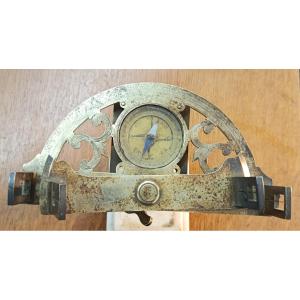
Large pinnule graphometer, signed:
This device consists of a semicircle and two pinnule alidades created to measure angles in the field.
Finely engraved compass with eight cardinal points.
Signatur[...]
Proantic uses a cookie to analyze traffic and improve its service by using Google Analytics. Data sent to Google Analytics (frequency of visits to the site and pages visited) are anonymous. No other cookie tracks your activity, your personal data is not collected. Thank you for helping us to have better understanding how Proantic is used.
























 Le Magazine de PROANTIC
 TRÉSORS Magazine
 Rivista Artiquariato