

Early 19th-century Silver-plated Brass Snuffbox With A Cameo On Glass Paste. Jupiter.
Glass paste imitating rock crystal, cast from an antique cameo
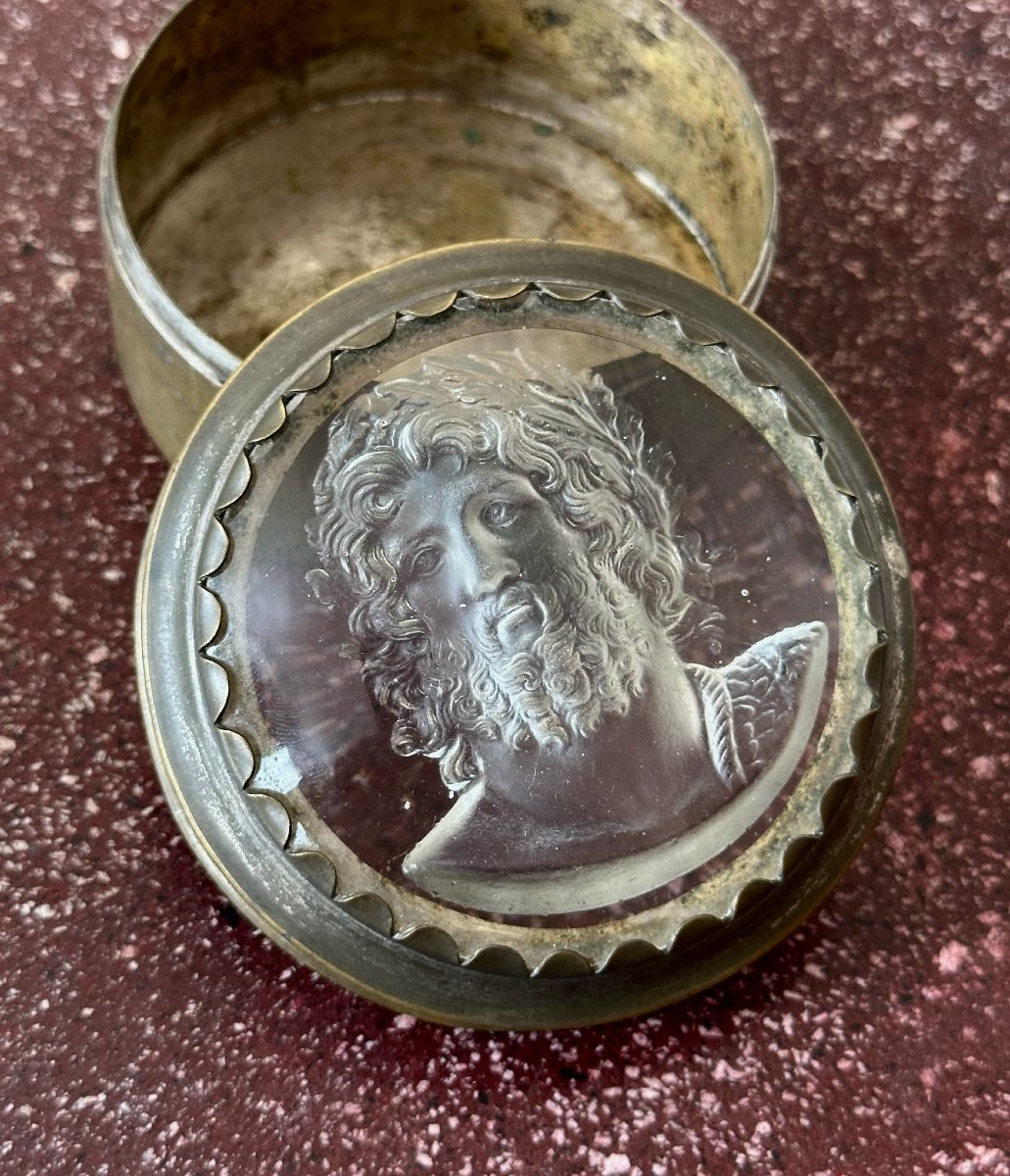
Original silver-plated brass mount with a scalloped rim.
Max. height: 56 mm; diameter: 90 mm.
Probably Italian or English, early 19th century.
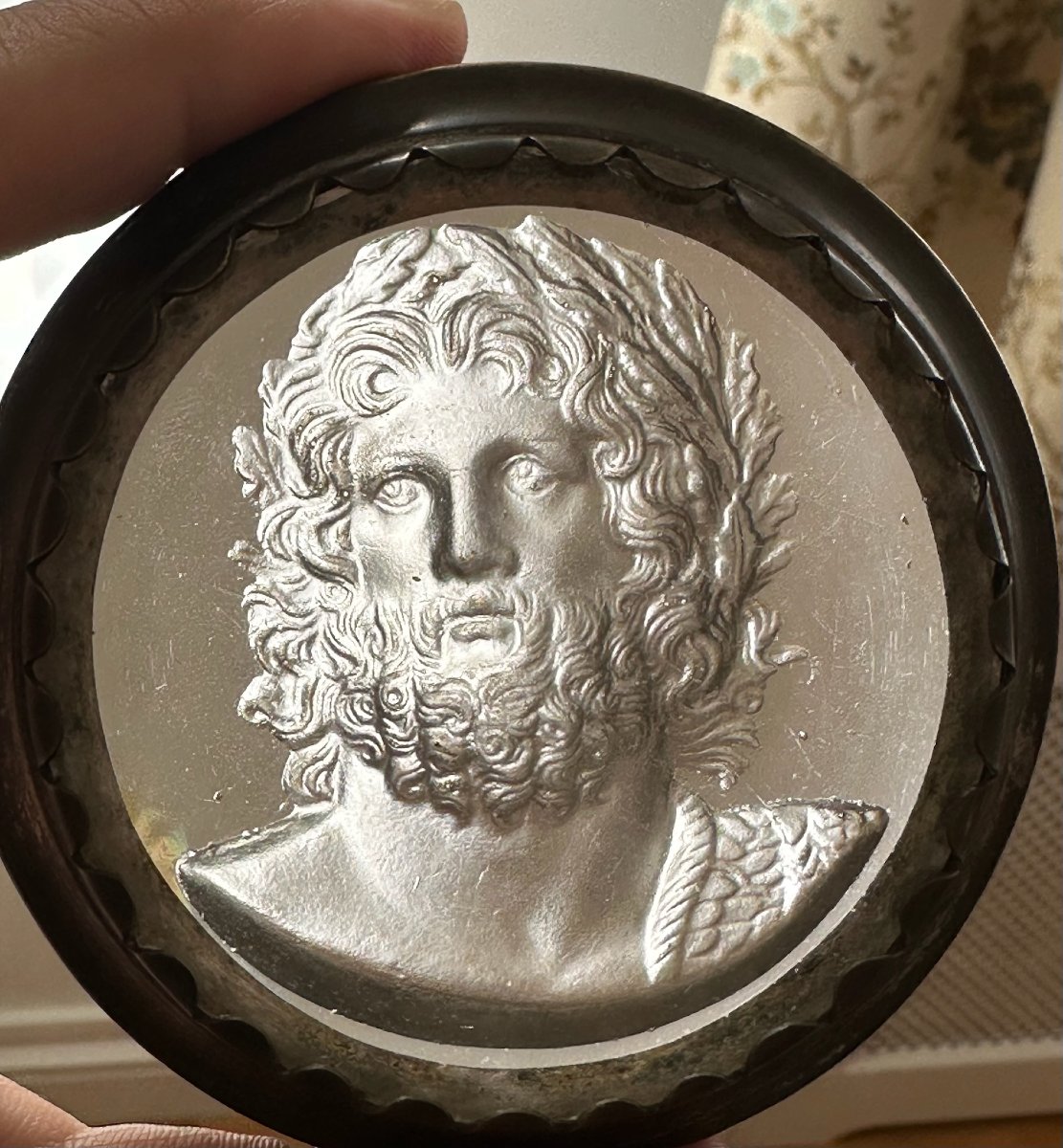
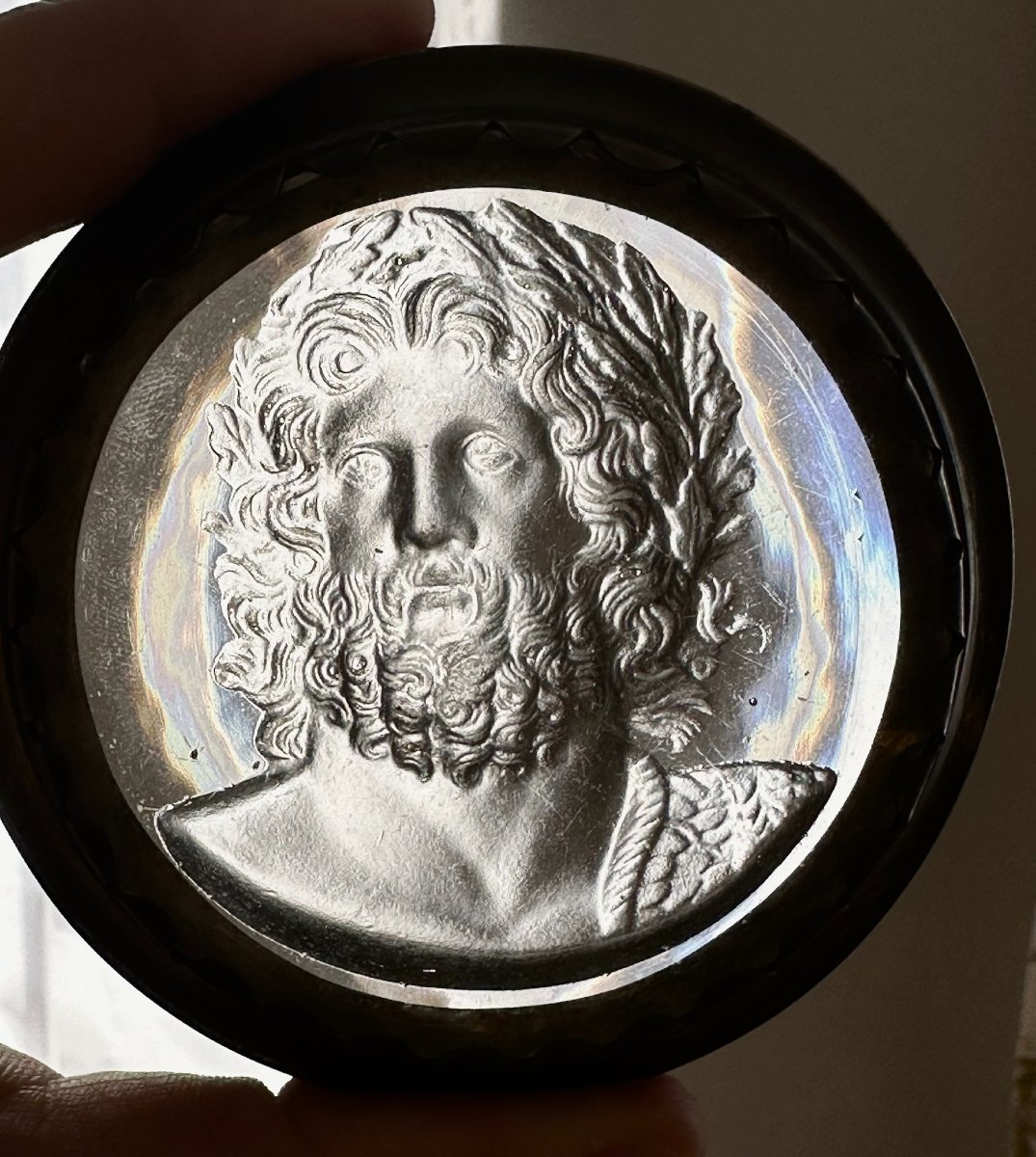
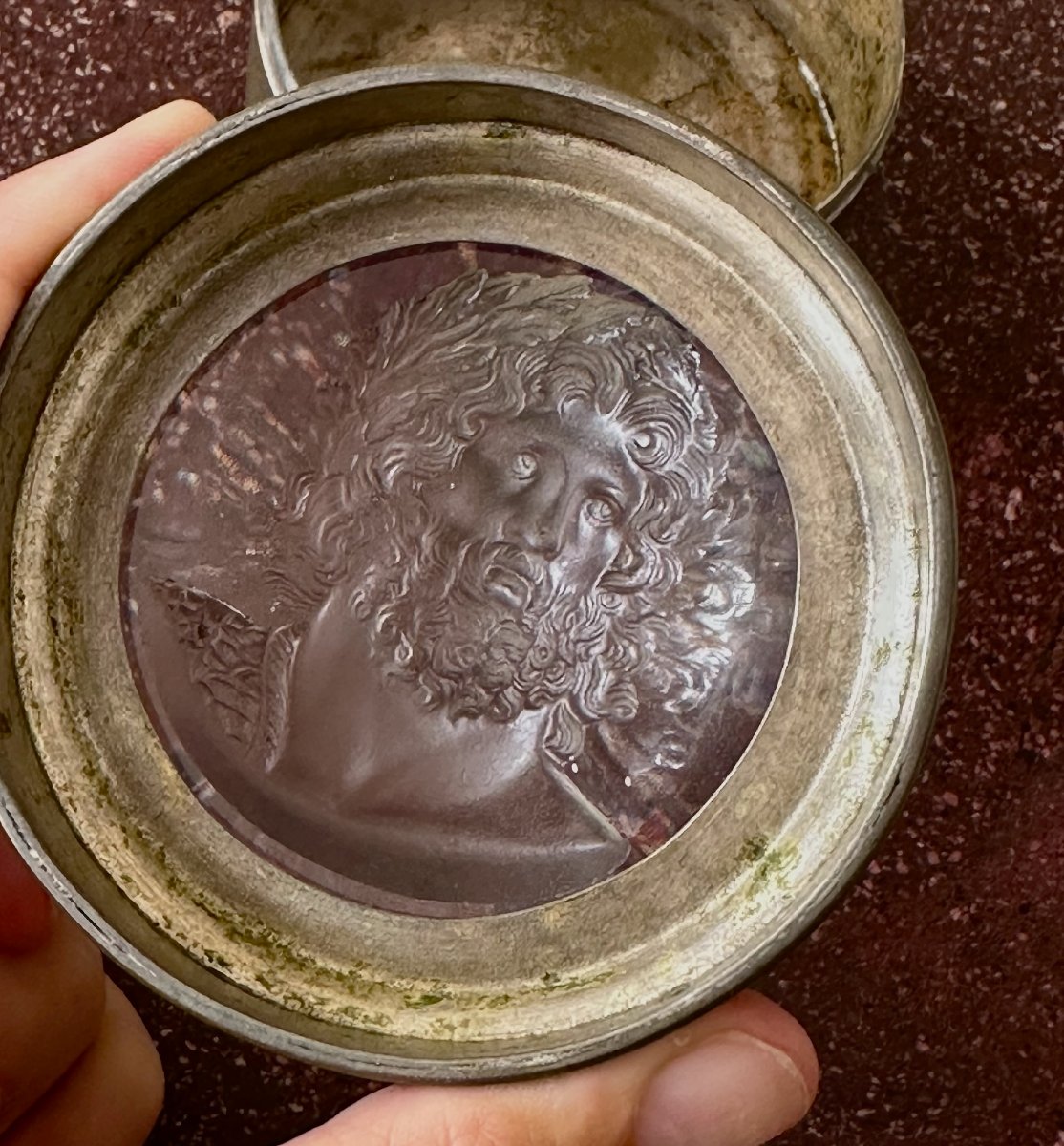
Circular snuff box in silver-plated brass, with a smooth body and a snap-on lid. The lid features a thick disc of colorless glass, molded on its underside and viewed through transparency, so that the bust appears in relief within the mass of the glass; it is held in place by its original scalloped bezel.
The subject is the bust of Jupiter Aegiochus, viewed from the front with his head slightly turned: the bearded god, with thick, flowing hair, crowned with oak leaves, the scaly aegis resting on his right shoulder. The casting is deep and sharp, with the curls of the hair and beard fully rendered—a cast of rare size and quality, made of glass imitating rock crystal.
Historical Context – The Zulian Cameo and Its Casts
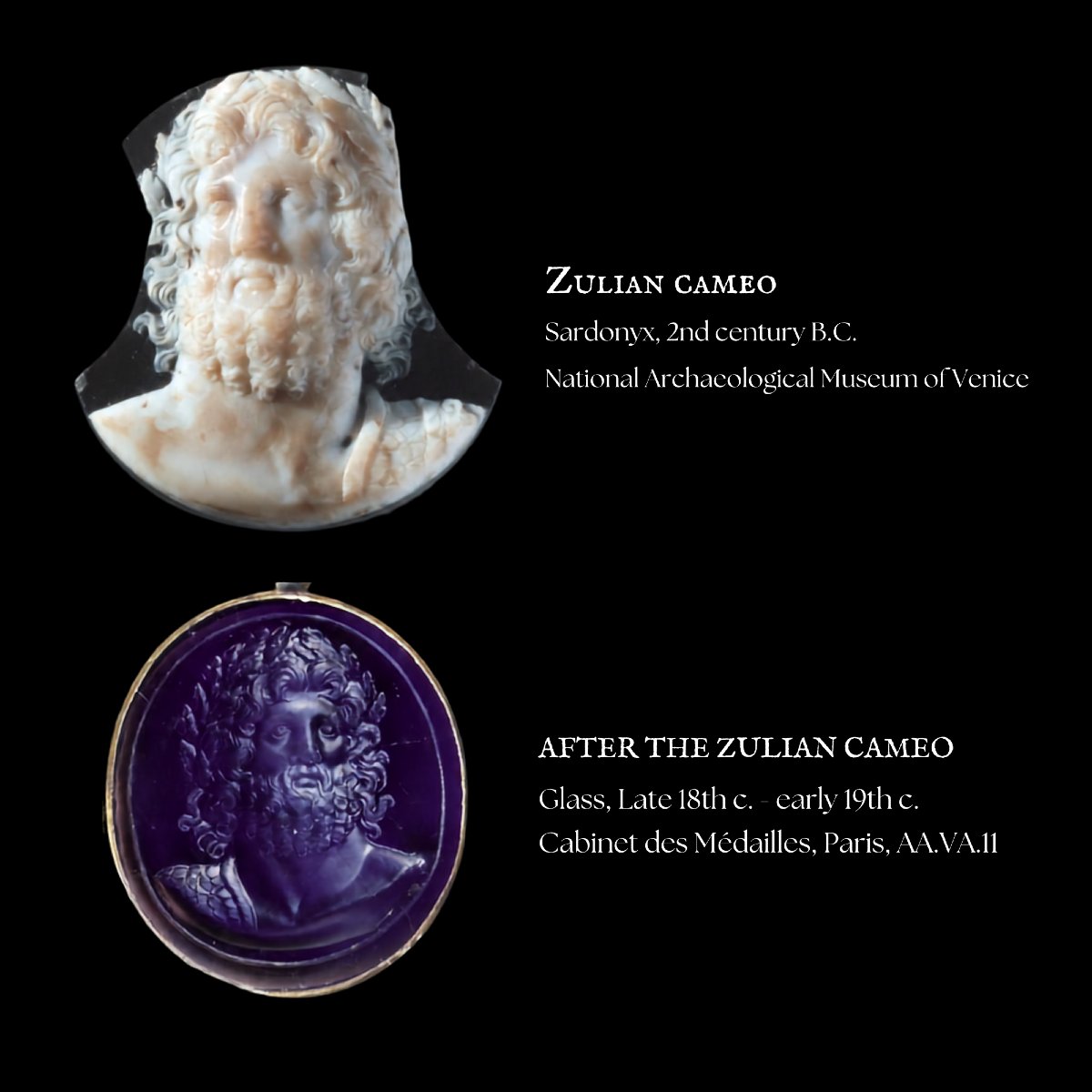
The model is the Zulian cameo, a 2nd-century B.C. sardonyx bust of Zeus Aegiochus, found in Ephesus and gifted to the Republic of Venice by Girolamo Zulian in 1795; now housed at the National Archaeological Museum of Venice, it was, from the moment of its arrival, one of the most admired ancient gems in Italy. Its plaster, sulfur, and glass paste casts circulated throughout Europe around 1800, and a comparable glass copy is held at the Cabinet des Médailles in Paris (AA.VA.11). Our box reflects this trend: an ancient masterpiece reproduced on a large scale and transformed into a pocket-sized object.
Iconography and Symbolism
Aegiochus—“bearer of the aegis”—is the Homeric epithet for Zeus, and the aegis is the goatskin he waves to calm the storm. The Zulian style does not depict the god with the calm demeanor of the Zeus of Olympia but rather with a dynamic face, his hair thrown back, his gaze raised—the Hellenistic god of storms rather than the seated lawgiver. For a collector during the Napoleonic era, opening a snuffbox featuring this head meant holding in one’s hand the father of the gods as imagined by the Greeks of Pergamon and Ephesus.
Original silver-plated brass mount with a scalloped rim.
Max. height: 56 mm; diameter: 90 mm.
Probably Italian or English, early 19th century.
Circular snuff box in silver-plated brass, with a smooth body and a snap-on lid. The lid features a thick disc of colorless glass, molded on its underside and viewed through transparency, so that the bust appears in relief within the mass of the glass; it is held in place by its original scalloped bezel.
The subject is the bust of Jupiter Aegiochus, viewed from the front with his head slightly turned: the bearded god, with thick, flowing hair, crowned with oak leaves, the scaly aegis resting on his right shoulder. The casting is deep and sharp, with the curls of the hair and beard fully rendered—a cast of rare size and quality, made of glass imitating rock crystal.
Historical Context – The Zulian Cameo and Its Casts
The model is the Zulian cameo, a 2nd-century B.C. sardonyx bust of Zeus Aegiochus, found in Ephesus and gifted to the Republic of Venice by Girolamo Zulian in 1795; now housed at the National Archaeological Museum of Venice, it was, from the moment of its arrival, one of the most admired ancient gems in Italy. Its plaster, sulfur, and glass paste casts circulated throughout Europe around 1800, and a comparable glass copy is held at the Cabinet des Médailles in Paris (AA.VA.11). Our box reflects this trend: an ancient masterpiece reproduced on a large scale and transformed into a pocket-sized object.
Iconography and Symbolism
Aegiochus—“bearer of the aegis”—is the Homeric epithet for Zeus, and the aegis is the goatskin he waves to calm the storm. The Zulian style does not depict the god with the calm demeanor of the Zeus of Olympia but rather with a dynamic face, his hair thrown back, his gaze raised—the Hellenistic god of storms rather than the seated lawgiver. For a collector during the Napoleonic era, opening a snuffbox featuring this head meant holding in one’s hand the father of the gods as imagined by the Greeks of Pergamon and Ephesus.
1 900 €
Period: 19th century
Style: Napoleon 3rd
Condition: Excellent condition
Reference (ID): 1819826
Availability: In stock
Print