





"Rare Pair Of Dueling Daggers, Spain, 19th Century "
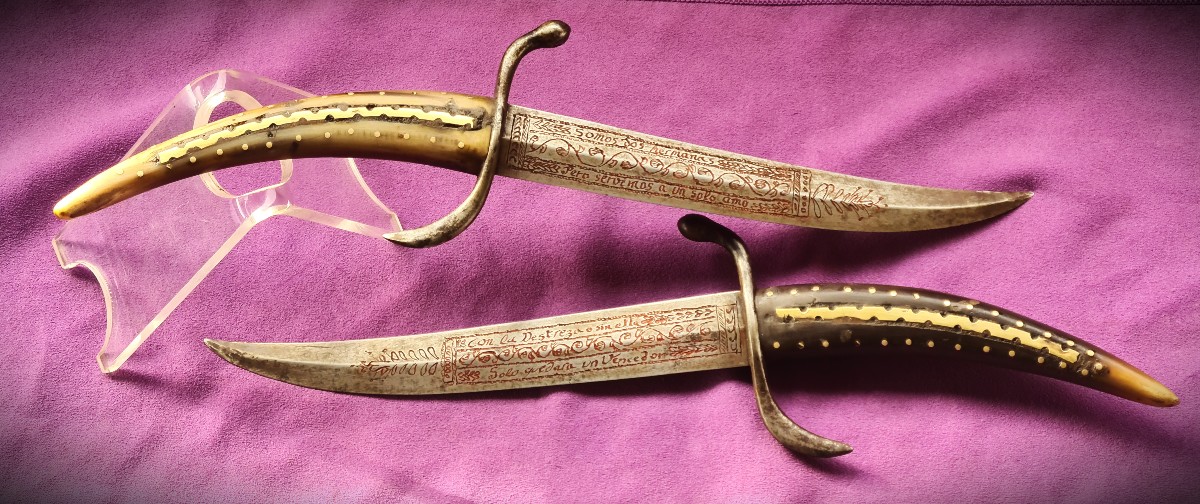
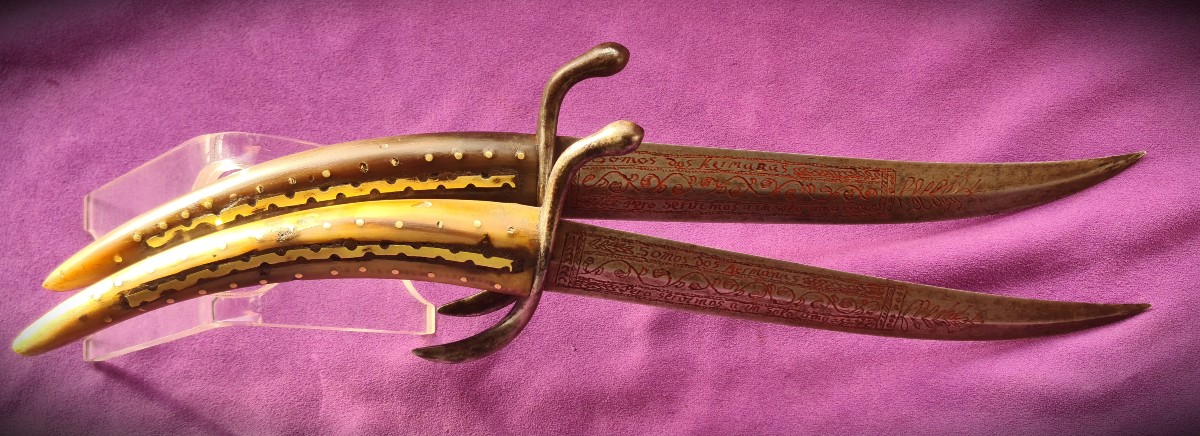
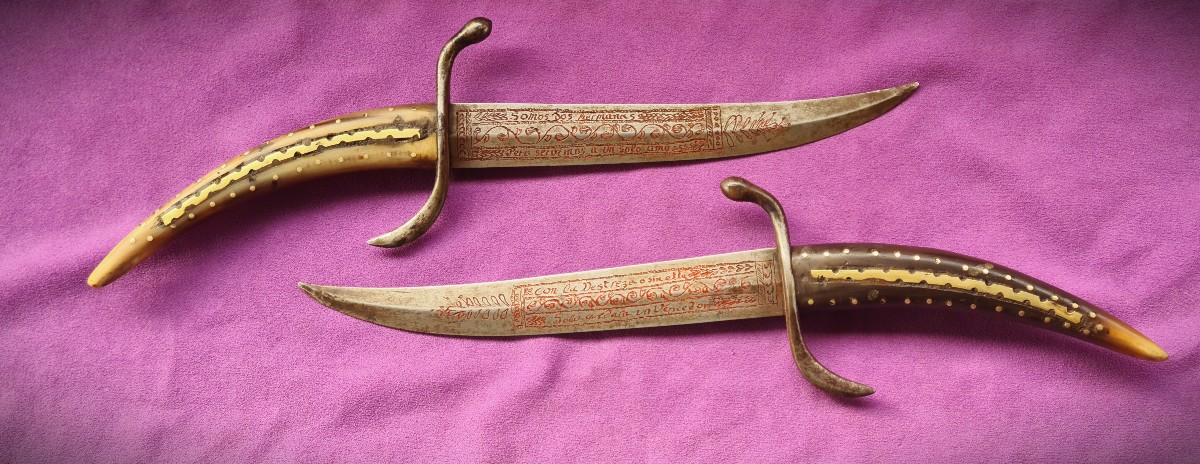
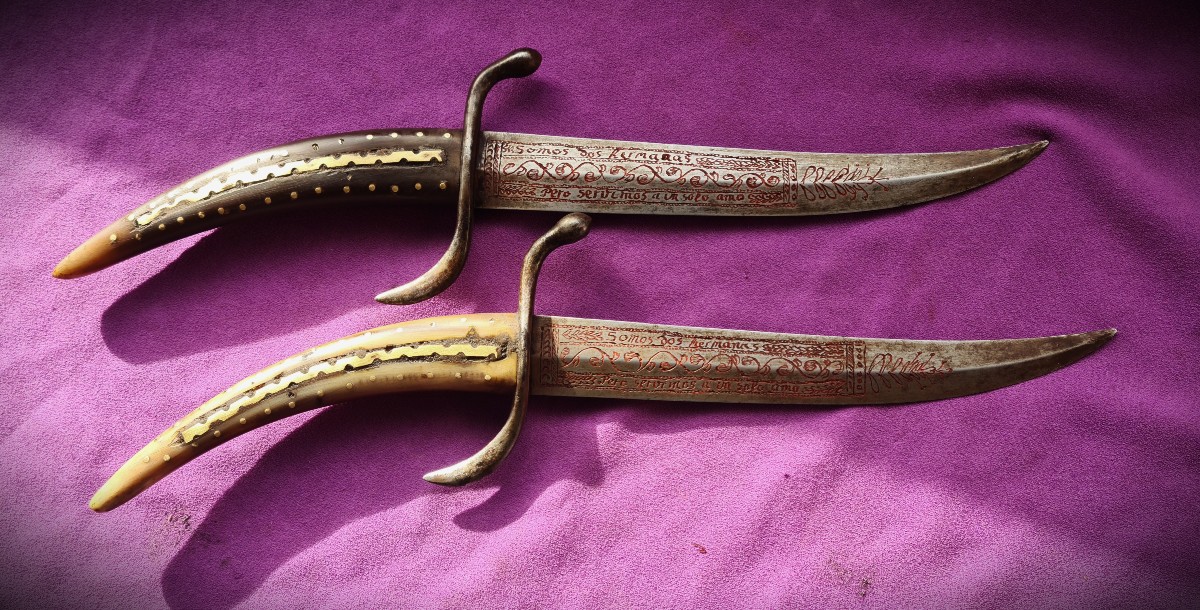
An extremely rare pair of dueling daggers. To my knowledge, this is the only known pair of dueling daggers originating from Spain that can be definitively identified as such. Indeed, the inscriptions on the blades leave no ambiguity on this point. These daggers were made in Albacete and can be dated to the first third of the 19th century. BLADES : They are double-edged, lozenge-shaped in cross-section, and described as "de punta relevada," meaning "with a raised point."
On the outer face, in addition to the typical engravings for this type of blade, one can read: "Somos dos hermanas, / pero servimos a un solo amo" "We are two sisters, / but we serve one master," an inscription which confirms that these daggers are a pair and not two identical daggers. The "two sisters" obviously refers to the two daggers.
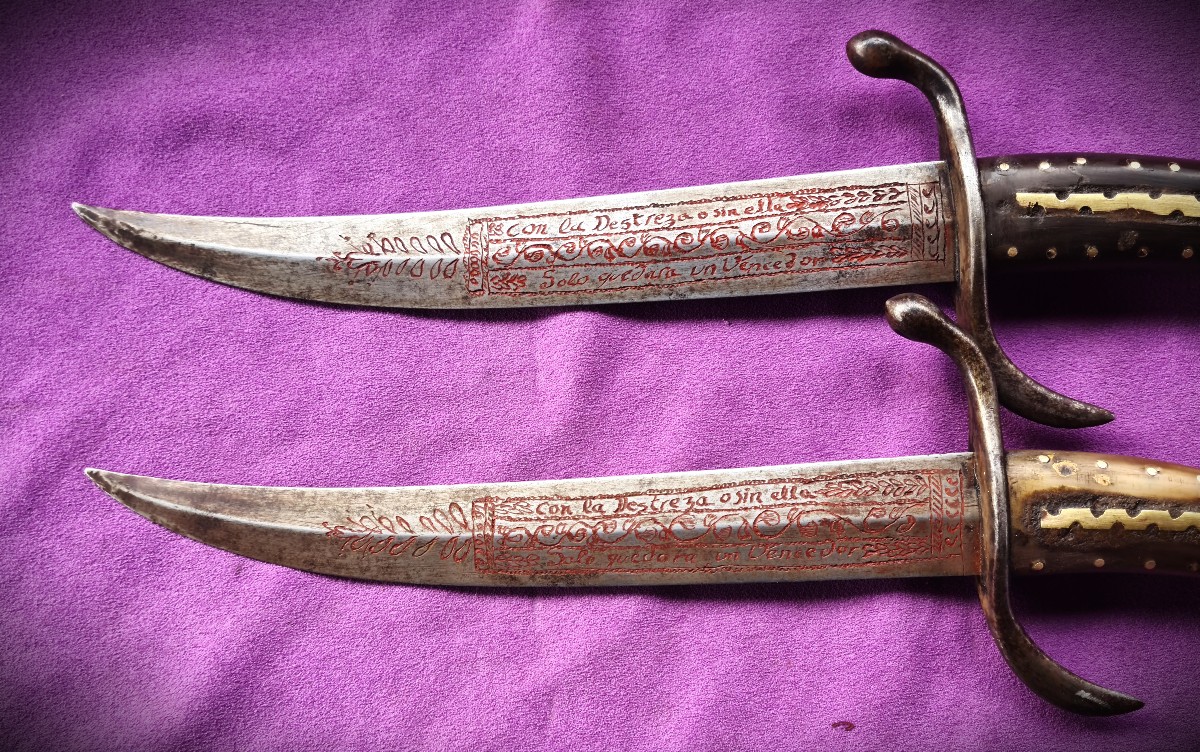
On the inner face, in addition to a design similar to that of the other side, are the inscriptions: "Con la Destreza o sin ella / Solo quedara un vencedor" "With or without Destreza / there will be only one victor." The term "Destreza," which can be translated as "dexterity/skill," refers to the technique of the same name, called "Verdadra Destreza" (true dexterity) or also "the magic wheel technique." This knife-fighting technique (but also one using other weapons) is uniquely Spanish and is based on principles different from those of Italian or other schools.
The Verdadera Destreza (True Fencing School) was founded in 1569 based on the work of Jeronimo Sanchez de Carranza, who published in 1582 the "Treatise on the Philosophy of Arms and Their Handling." This work was later taken up and expanded upon by his student Luis Pacheco de Narváes, who was the fencing master of King Philip IV.
This school of fencing was, in fact, reserved for an elite of noblemen, as it required a level of education beyond the reach of ordinary people and taught them to fight methodically, not impulsively, drawing on concepts of geometry and philosophy. It did not teach them how to fight, but how to fight WELL.
The inscription on our blades can therefore be understood as "with the elaborate technique of the Verdadera Destreza, or without it, only one of the two will be victorious," meaning that in any case, only one of the two combatants will survive the duel, whether they fight methodically or not.
Blade length = 20.5 cm, width near the guard = 2.8 cm, thickness near the guard = 4.8 mm.
GUARDS : They are made of iron and are counter-curved, with the upper quillon ending in a rounded tassel, and the lower quillon pointed in the shape of a claw, to allow the technique known as "la zarpa del jaguar" or "el rasgon del jaguar" (the Jaguar's claw strike), which consisted of a blow delivered by violently tearing the opponent's face.
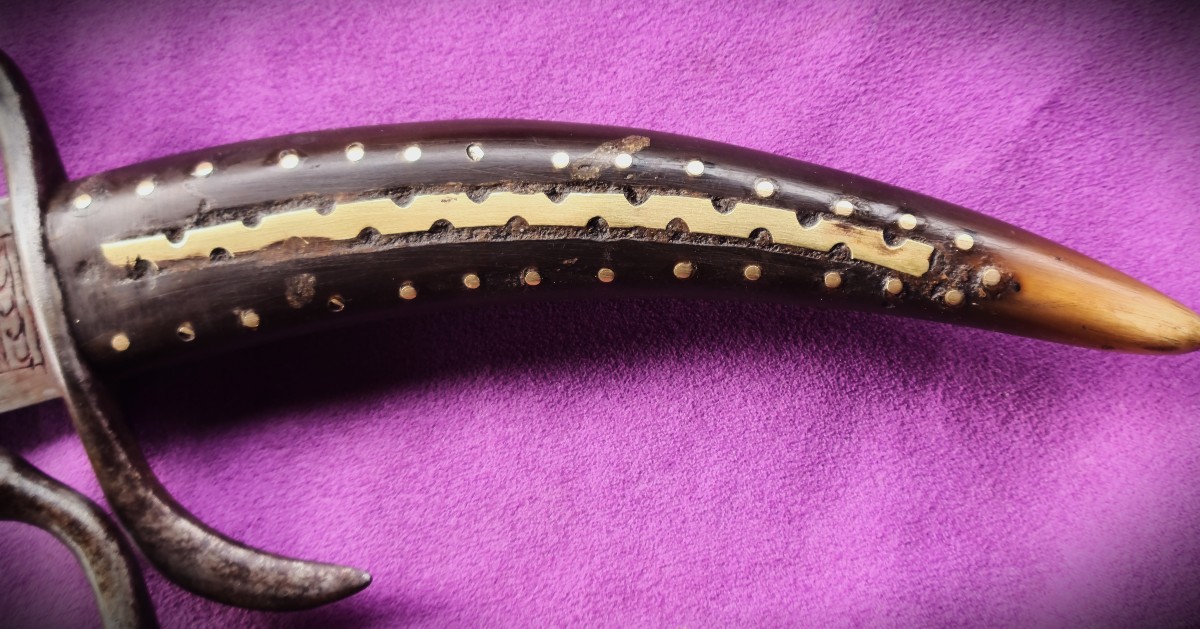
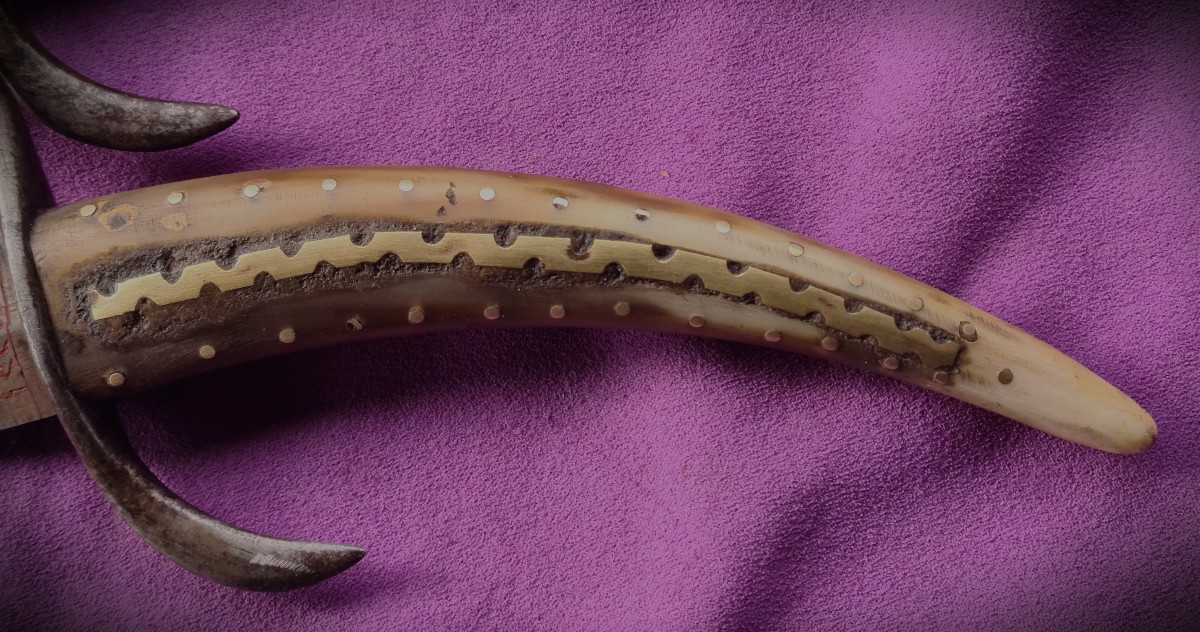
GRIPS : They are made of horn, one in light horn, the other in dark horn. Decorated with two lines of brass nails and a brass band in the center of each face, cut with arcs.
This pair of daggers was almost certainly commissioned. The inscriptions, free of the spelling errors usually found on 19th-century Spanish blades, as well as the reference to "La Destreza" (with a capital letter), demonstrate the high socio-cultural status of the owner, most likely a nobleman, who had this pair made by a cutler in southern Spain.
Ref A-2630.
Shipping costs: France €20, Europe €30












 Le Magazine de PROANTIC
 TRÉSORS Magazine
 Rivista Artiquariato