THIS OBJECT WAS SOLD
Greek Marbled-glass Amphoriskos – With Certificate Of Authenticity
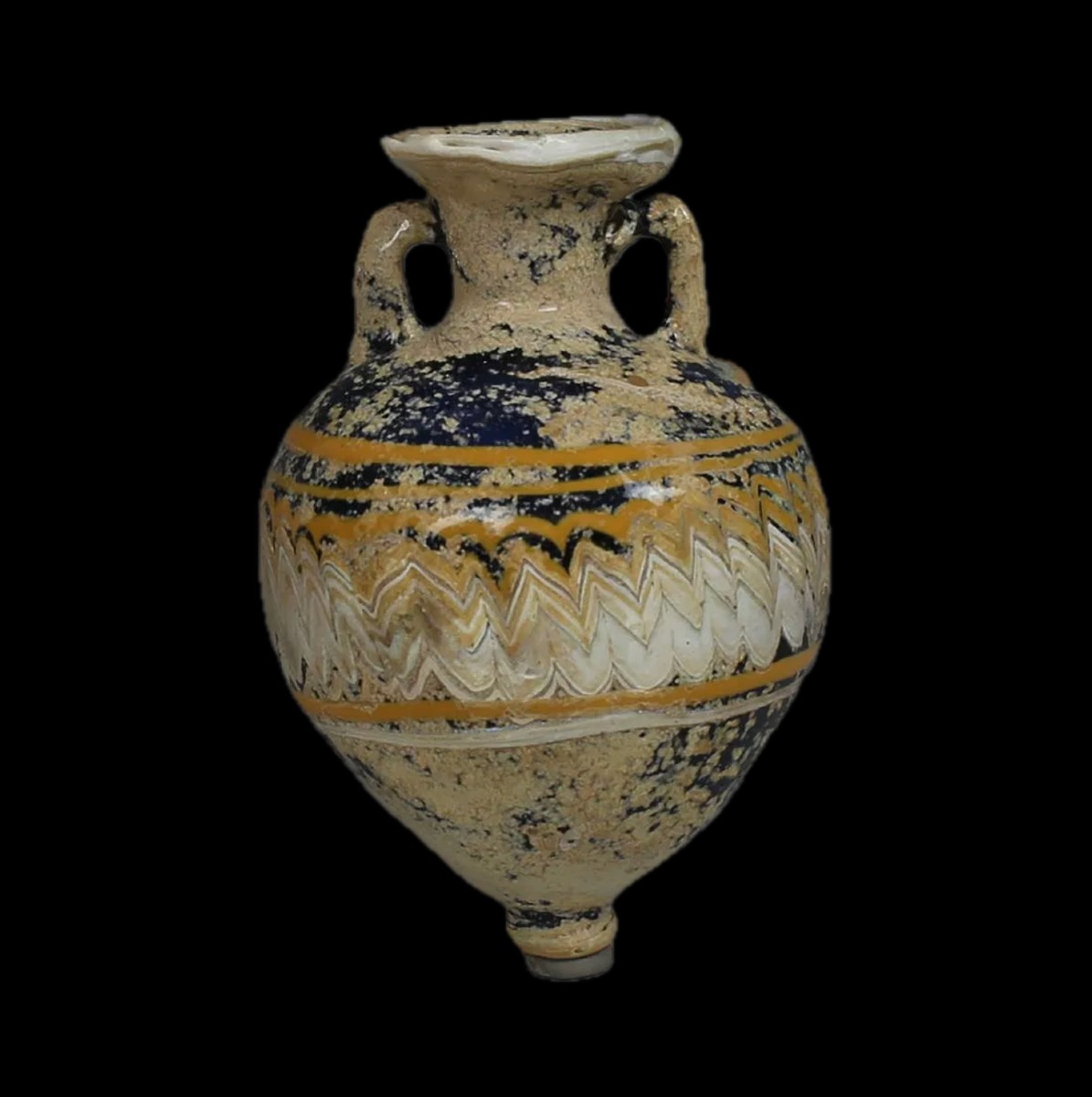
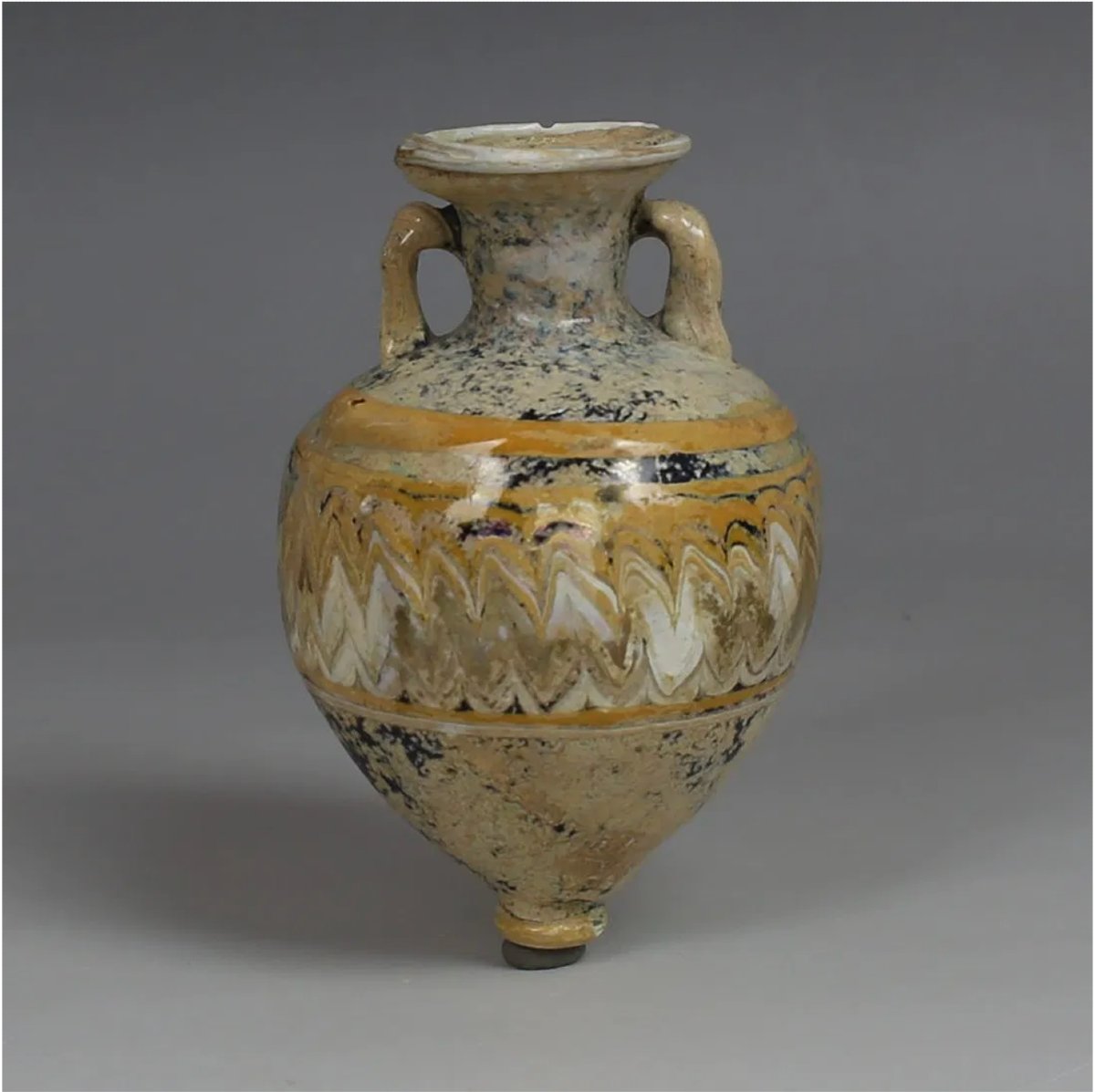
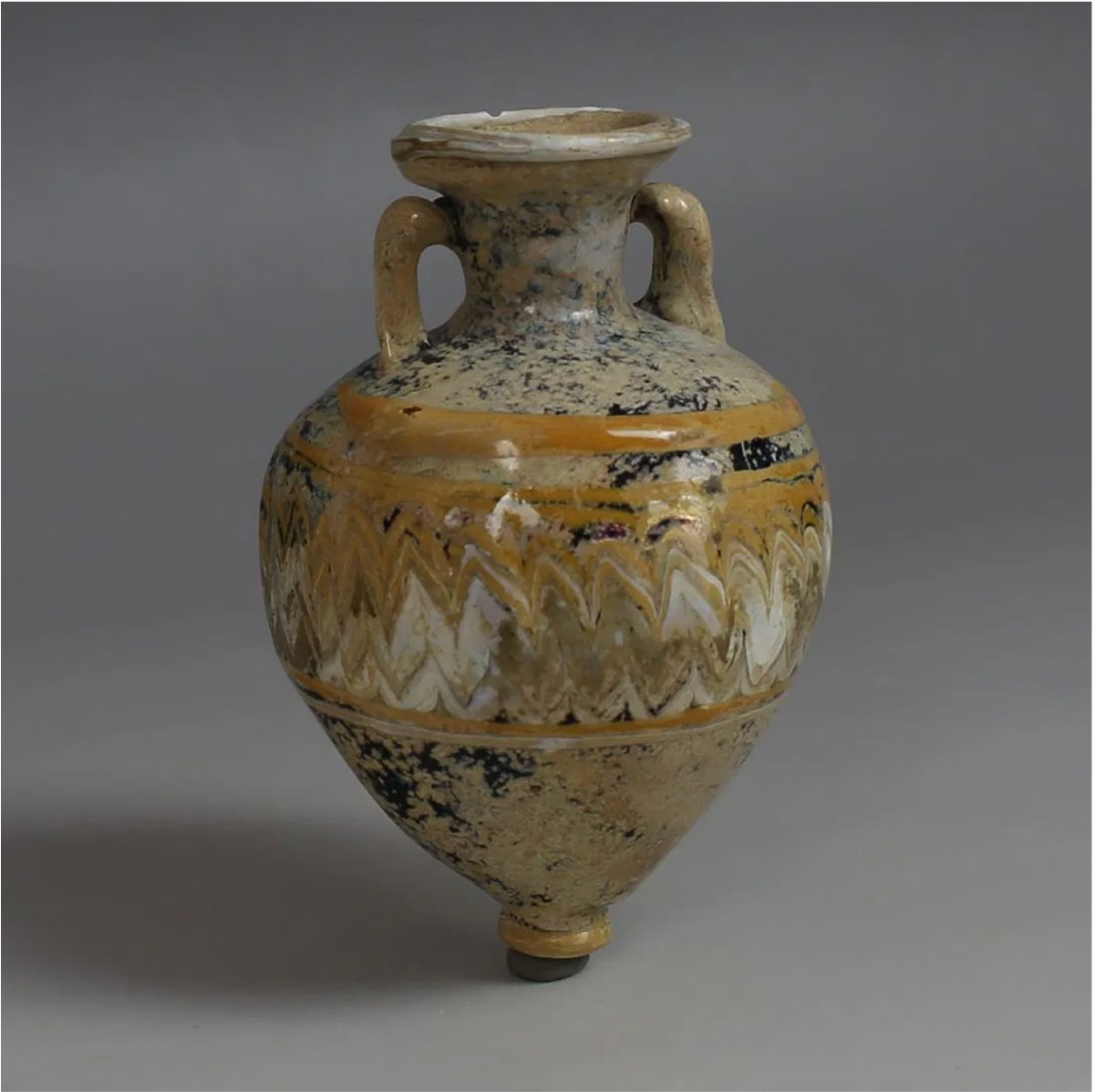
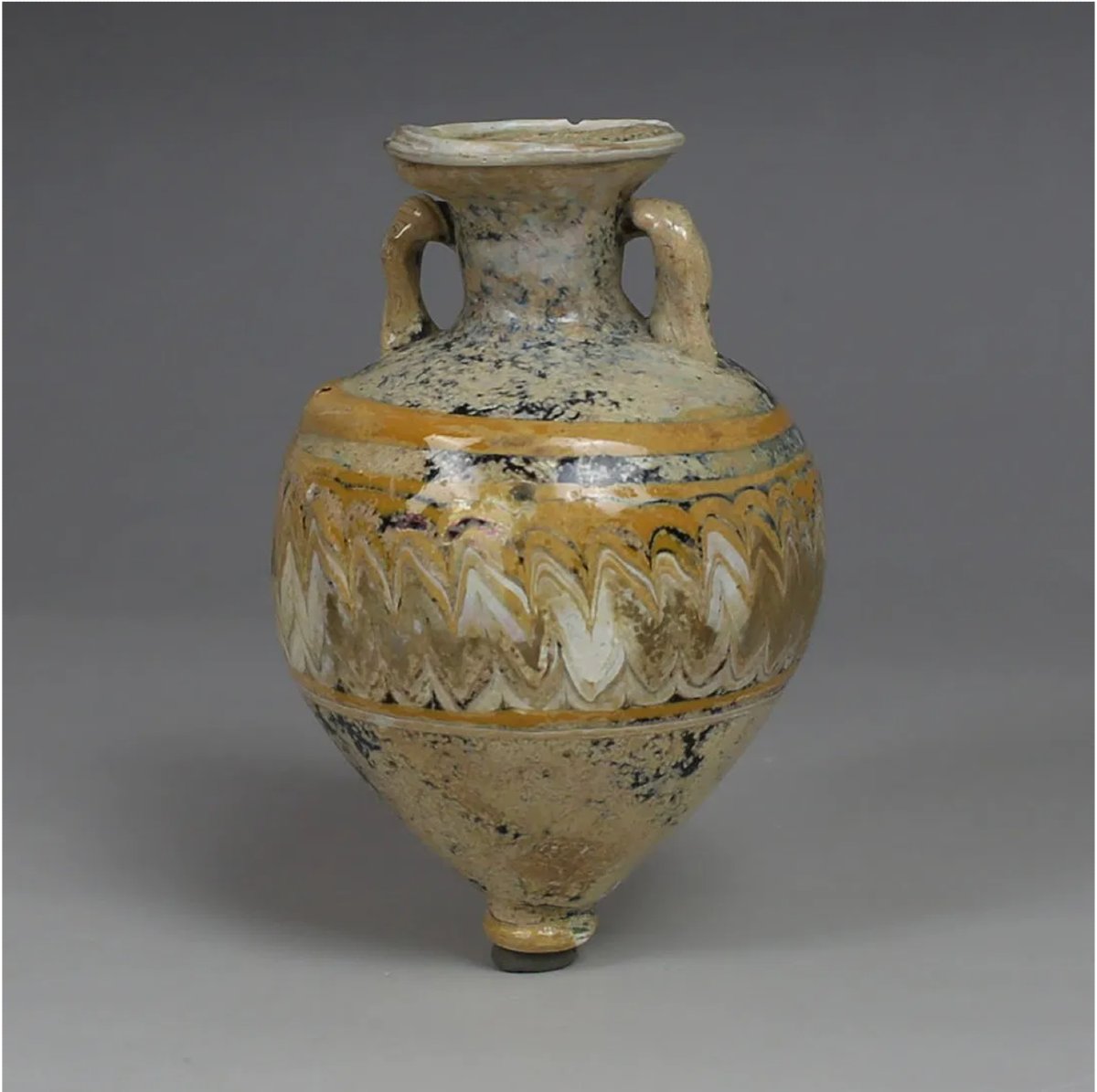


Elegant Greek core-formed glass amphoriskos with a well-defined piriform body, cylindrical neck with flared rim, and two vertical handles rising from the shoulder to the upper neck. The vessel is adorned with beautiful marbled yellow-ochre and white trailing, applied in wavy registers over what was originally a deep blue ground now softly toned by a sandy beige burial patina. The piece is structurally homogeneous, with no visible joins, and displays surface wear fully consistent with long archaeological burial: micro-pitting, softened lustre, mineral encrustations and light iridescence. None of the features suggest modern manufacture; all are perfectly consistent with a Greek core-formed amphoriskos of the late Classical to early Hellenistic period (5th–4th century BC).
CharacteristicsObject: Marbled glass amphoriskos with applied polychrome trailing
Material: Core-formed glass with yellow and white marbled trailing over deep blue ground
Culture: Greek, Eastern Mediterranean
Period: 5th – 4th century BC
Dimensions: approx. 77 mm (h) × 52 mm (max. diam.)
Condition: Good overall condition – ancient surface, stable patina, intact handles
Provenance: Former Dutch private collection, acquired from Helios Gallery (United Kingdom), before 2000
Authenticity: Supplied with a certificate of authenticity
Core-formed amphoriskoi with marbled trailing belong to the most refined category of pre-Roman Greek glass. Produced in the Eastern Mediterranean (Rhodes, Cyprus, the Syro-Palestinian coast), these vessels circulated widely throughout the Greek world during the 5th and 4th centuries BC.
They held perfumed oils, balms and ointments linked to grooming, athletics and ritual: daily toilette, gymnasium practices, sacred oils, and funerary offerings. Their deep opaque blue glass, enhanced with yellow and white trailing, consciously imitated the appearance of semi-precious stones such as lapis lazuli or banded agate, turning these small containers into genuine luxury objects.
Formal & Material Analysis Shape and proportions– Regular piriform body with broad rounded shoulder
– Full belly tapering to a slightly flattened button base
– Cylindrical neck with expanded, thickened, outward-turned rim
– Two symmetrical thick ribbon handles, carefully drawn and well-preserved
The decoration is arranged in three distinct registers:
– At the shoulder: a wide yellow-ochre trail encircling the vase, slightly irregular and clearly hand-applied
– On the body: a striking frieze of white and yellow marbled trails pulled into continuous zigzag or chevron waves over the dark ground, created by applying the trails in spiral form and then combing them while hot
– Toward the base: a second thinner yellow band marking the transition to the lower point
The deep blue ground is still visible beneath the patina, offering a refined contrast with the opaque yellow and white.
Surface, patina & burial traces– Sandy beige patina filling the depressions of the decoration
– Fine, regular micro-pitting characteristic of ancient glass corrosion
– Remnants of original glossy surface preserved on the raised yellow trails
– Discreet blue-violet iridescence in protected areas
– Mineral accretions and darker sediment deposits near the base and handle backs
– Minor ancient rim chips smoothed by age
– Handles completely intact, no breaks or reattachments
– Light circular wear on the button base consistent with ancient use
No modern fills, joins or restoration are detectable: the vessel is in a stable, authentic archaeological state.
Cultural & Aesthetic ValueThis amphoriskos encapsulates, on a miniature scale, the technical mastery and aesthetic sophistication of pre-Roman Greek glassmaking: elegant silhouette, virtuoso trailing decoration, harmonious colour palette and balanced proportions.
It offers several qualities prized by collectors:
– canonical typology of core-formed amphoriskoi
– well-preserved marbled chevron decoration
– intact handles (rare on the market)
– attractive, expressive ancient patina
– refined colour contrast (blue / yellow / white)
A highly decorative display piece and an important testimony to ancient glassworking techniques prior to the invention of glassblowing.
Provenance & GuaranteesSolid provenance: former Dutch private collection, acquired through Helios Gallery (UK), a recognised specialist in classical antiquities.
The amphoriskos is sold with a detailed certificate of authenticity (description, dating, cultural attribution, technique, provenance).
A full documentation file (photographs, comparative references, descriptive notes) accompanies the object.
Expert Report (Summary)This marbled-glass amphoriskos belongs to the highly sought-after category of Eastern Mediterranean core-formed vessels produced during the 5th–4th century BC. Its elegant silhouette, intact handles, well-preserved chevron trailing and nuanced archaeological patina make it a display-worthy piece fully comparable to examples in major museums such as the British Museum, the Louvre or the Metropolitan Museum.
Compact yet striking, historically significant yet immediately decorative, it is an ideal centrepiece for a private collection and a direct testimony to the refined luxury culture of the Greek Classical world.
Explore similar pieces and discover your ideal find:
archeology