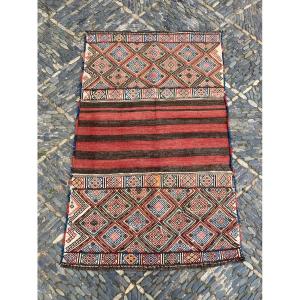
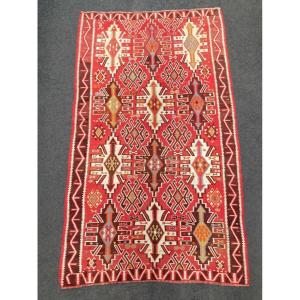
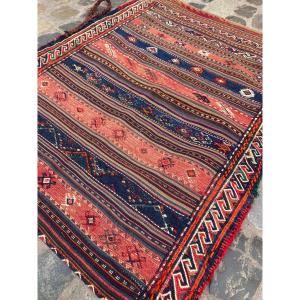
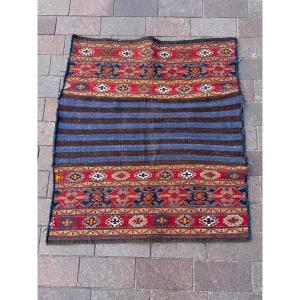
Lakai Embroidery. Central Asia. Circa 1930. Museum-quality Condition. 107 X 43 Cm
This magnificent Lakai embroidery, originating from Central Asia—likely Tajikistan—bears witness to the remarkable craftsmanship of these peoples and their penchant for geometric compositions in vibrant colors. Created using cross-stitch with cotton threads on fabric, it is highly decorative. It would look just as good hung on the wall as it would delicately draped over the arm of a sofa. In fact, it would take very little to turn it into a magnificent pillow. Its reverse side is protected by a silky, quilted fabric that preserves the embroidery while giving it a lovely thickness.
The composition centers on three imposing octagonal medallions, arranged vertically and based on the same design. At the heart of each unfolds a large cross with four curved arms, extended by hook-shaped motifs forming almost labyrinthine patterns. These designs evoke stylized ram’s horns, traditionally associated with strength, vitality, and sometimes protection. The three medallions echo one another with remarkable regularity, while their color variations give each a distinct personality.
The borders are equally fascinating. A succession of lozenges, hooked figures, and small geometric motifs unfolds on both sides in a perfectly controlled alternation. At the ends, delicate friezes of eight-pointed rosettes—resembling small stars or stylized flowers—complete the composition. Each motif contributes to the overall balance, framing the three medallions without ever detracting from their prominence.
The color palette is sumptuous. Deep, luminous reds stand alongside golden yellows, soft greens, grayish blues, and magnificent shades of ivory. Black precisely outlines the shapes and enhances the intensity of the colors. The luminosity of certain hues contrasts with the depth of others, creating a particularly successful interplay of complementary colors. It is precisely in this complementarity that harmony arises: each color asserts its presence while naturally finding its place alongside the others. A dazzling composition of astonishing modernity.
Lakai Embroidery – Central Asia, likely Tajikistan
Cross-stitched, cotton on cotton
Back protected by a silky, quilted fabric
Circa 1930
Dimensions: 107 × 43 cm
In perfect condition
Choosing an antique rug or textile is often a serendipitous encounter.
If one of our pieces catches your eye, or if you’d like more information or photos, I’d be happy to discuss it with you.
Laurent Consul
Beauty of Kilims
06 42 61 73 46
Period: 20th century
Style: Asian art
Condition: Perfect condition
Material: Other
Length: 107 cm
Width: 43 cm
Reference (ID): 1855083
Availability: In stock