Gallic Head Made Of Iron-bearing Sandstone – Iron Age Art, La Tène Period, Gallic Archaeology
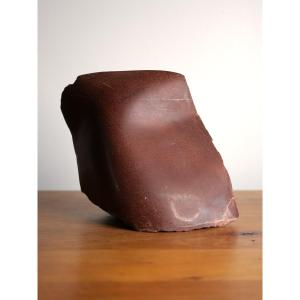
An exceptional and rare sculpted head in ferruginous sandstone, attributable to Iron Age art and, more specifically, to the La Tène period, circa 250 BC.
This striking representation of a male head displays a face deeply marked by the scars of violence. The sculptor has rendered the wounds inflicted upon the warrior with remarkable expressiveness: bruising and swelling across the face, particularly pronounced swelling near the lip, significant trauma to the left eyebrow ridge, as well as a deep incision between the eyes, on the forehead, suggesting the impact of a bladed weapon, possibly an axe.
Far from being an idealised representation, this sculpture depicts a battered face, almost brutally realistic, whose injuries contribute fully to the work's powerful visual impact and symbolic significance.
A particularly remarkable detail is the hairstyle. The figure wears a topknot, clearly secured with a fastening that may represent a cord or a braid of hair. This hairstyle, relatively rarely documented in representations of the Gauls, constitutes a particularly interesting iconographic feature.
Ancient sources and archaeological discoveries testify to the importance of head worship and practices associated with war trophies among certain peoples of ancient Gaul.
The site of Ribemont-sur-Ancre, in the Somme region of northern France, has yielded an exceptional archaeological complex associated with conflicts at the end of the Iron Age, containing numerous human remains and evidence of warrior practices and post-mortem treatment of the dead.
Further south, the site of Entremont, near Aix-en-Provence, is renowned for its sculptures of human heads and warriors, created in the context of Salyan sanctuaries during the 3rd and 2nd centuries BC.
These archaeological discoveries shed light on a world in which the human head could hold considerable symbolic and religious significance, associated with victory, martial prestige and the memory of armed conflicts.
Through its highly expressive character and the emphasis placed on its injuries, this sculpture may be associated with this symbolic tradition. Its interpretation as the representation of an enemy's severed head or a war trophy nevertheless remains a hypothesis, to be considered in light of its archaeological context, which is currently unknown.
The head is previously unpublished on the art market and comes from an old collection assembled by a French ambassador originally from northern France.
The nature of the stone is consistent with sandstones found in northern France, although this alone does not make it possible to establish a precise geographical origin. An original provenance from the Hauts-de-France region, Belgium or southern England may be considered.
With its distinctive iconography, remarkable hairstyle and powerful expression, this head constitutes a particularly interesting testament to the warrior imagery and sculptural traditions of the Iron Age.
A rare and compelling archaeological work, intended for collectors of Celtic art, ancient sculpture and the history of the peoples of ancient Gaul.
Dimensions: 26 cm in total height, including the base (21 cm for the head alone).
Price excludes shipping costs.
Police Register Reference: A263
Professional Antiquarian – Guarantee & Peace of MindAs a professional antiquarian, I undertake to offer only authentic objects, carefully selected and legally available for sale. Each piece is chosen for its historical, aesthetic or collectible interest and undergoes careful verification of its provenance.
Invoice and Traceability: Every purchase is accompanied by a detailed invoice and a certificate of authenticity, providing information on the object's provenance and ensuring complete transparency.
Legal Compliance: All objects comply with current French and European legislation. Any archaeological objects are offered for sale in accordance with the French Heritage Code (Articles L.542-1 et seq.).Objects that may fall under specific regulations (cultural property, antiquities or particular materials) are sold within a strictly lawful framework.
International Buyers: Buyers outside France are advised to check the regulations applicable in their own country regarding the importation of cultural property and antiques.
Right of Withdrawal: In accordance with French law (Article L.221-18 of the French Consumer Code), you have 14 days from receipt of the item to exercise your right of withdrawal and return the purchase.
Return shipping costs remain the responsibility of the buyer. The item must be returned in its original condition.
Commitment to Quality
Buying from a professional antiquarian means benefiting from security, transparency and reliability.
I remain entirely at your disposal should you require any further information before purchasing.
Period: Before 16th century
Style: Other Style
Condition: Excellent condition
Material: Stone
Height: 26 cm
Reference (ID): 1849413
Availability: In stock