
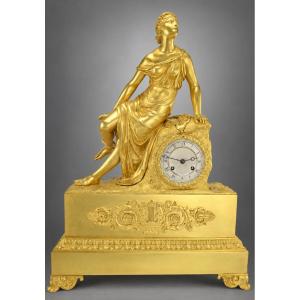


Large Clock Mythological “eurydice And The Serpent” – Clockmaker: Cailly, Circa 1840
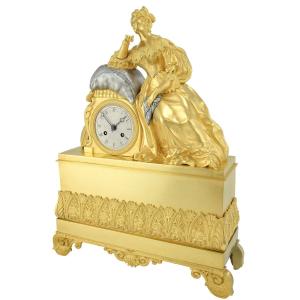
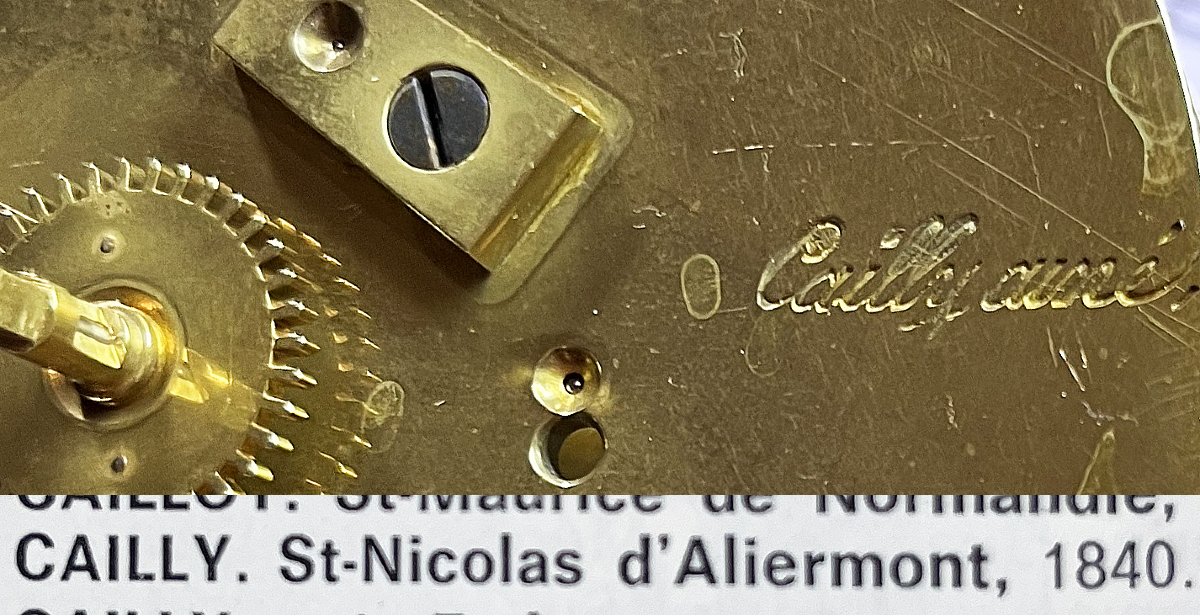
A magnificentmythological mantel clock dating from the Louis-Philippe period, circa1840, distinguished by the exquisite finesse of its chasing and thebrilliant lustre of its mercury gilding with gold. The compositiondepicts an elegant nymph from classical mythology, whose sculpturalgrace and melancholy demeanour lend the piece a particularly expressivepresence. The movement bears the signature of Caillyaîné engraved inside the movement plate. Thisclockmaker is listed in the Tardy Dictionary of Clockmakers under theyear 1840, providing a valuable element of identification for thishorological work of art.
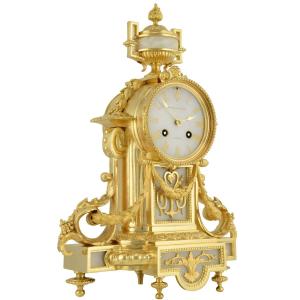
Thecomposition is dominated by a young woman of idealised beauty, drapedin classical robes whose flowing folds are sculpted with remarkableskill and delicacy. Seated in an attitude that is both graceful anddramatic, she tilts her head towards the heavens, while her half-closedeyes and slightly parted lips appear to convey distress and surrender.A finely chased serpent coils around her ankle, an essential attributein identifying the mythological scene as that of Eurydice, the wife ofOrpheus. According to the ancient legend, Eurydice is bitten by aserpent and succumbs to her injury while fleeing from Aristaeus on herwedding day. Inconsolable, Orpheus enchants the gods with his singingand lyre, obtaining permission to descend into the Underworld in anattempt to bring his wife back among the living. The sculpturesensitively captures this tragic episode, in which feminine beautyconfronts the inexorable force of fate. The figure rests upon agilt-bronze architectural base, adorned with rich chased ornamentationand friezes inspired by the Neoclassical style. At the centre, thecircular silvered-bronze dial, featuring Roman numerals, isharmoniously integrated into a finely worked ornamental surround. Thefront of the base is embellished with an elegant lyre motif framed byscrolling foliage, directly evoking the musical world of Orpheus. Apalmette frieze and richly ornamented feet complete this composition ofremarkable decorative coherence.
By virtue ofits outstanding craftsmanship, sumptuous gilding and evocative subjectmatter, this mantel clock stands as a remarkable testament to theFrench decorative arts of the Restoration period. The combination of anexceptionally expressive figural sculpture and a horological structuredefined by balanced lines gives the piece a character that is bothmonumental and refined. The serpent, the delicately sculpted draperyand the allusion to the lyre of Orpheus come together to create apoetic mythological composition that transcends its purely horologicalfunction. The signature of Cailly aîné, found onthe movement plate, further enhances the historical and documentaryinterest of this piece. An authentic decorative object steeped inhistory, this clock will appeal to collectors of antique clocks,gilt-bronze objects and enthusiasts of classical mythology alike,thanks to its timeless elegance and unmistakable sculptural presence.
Originalmovement, intact and unmodified, with a suspension spring. Strikes thehours and half-hours on an antique bell, producing a clear, authenticsound.
Period: 19th century
Style: Louis Philippe, Charles 10th
Condition: Fully restored in our whorkshop
Material: Bronze
Width: 39 cm
Height: 55 cm
Depth: 13 cm
Reference (ID): 1844348
Availability: In stock