

Clock Portico Watchmaker : Contreau 1850
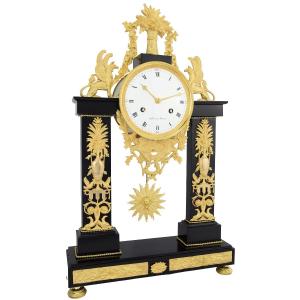
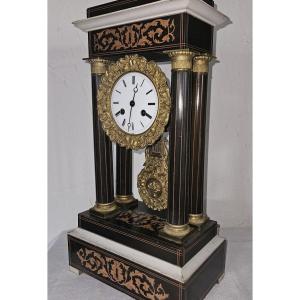
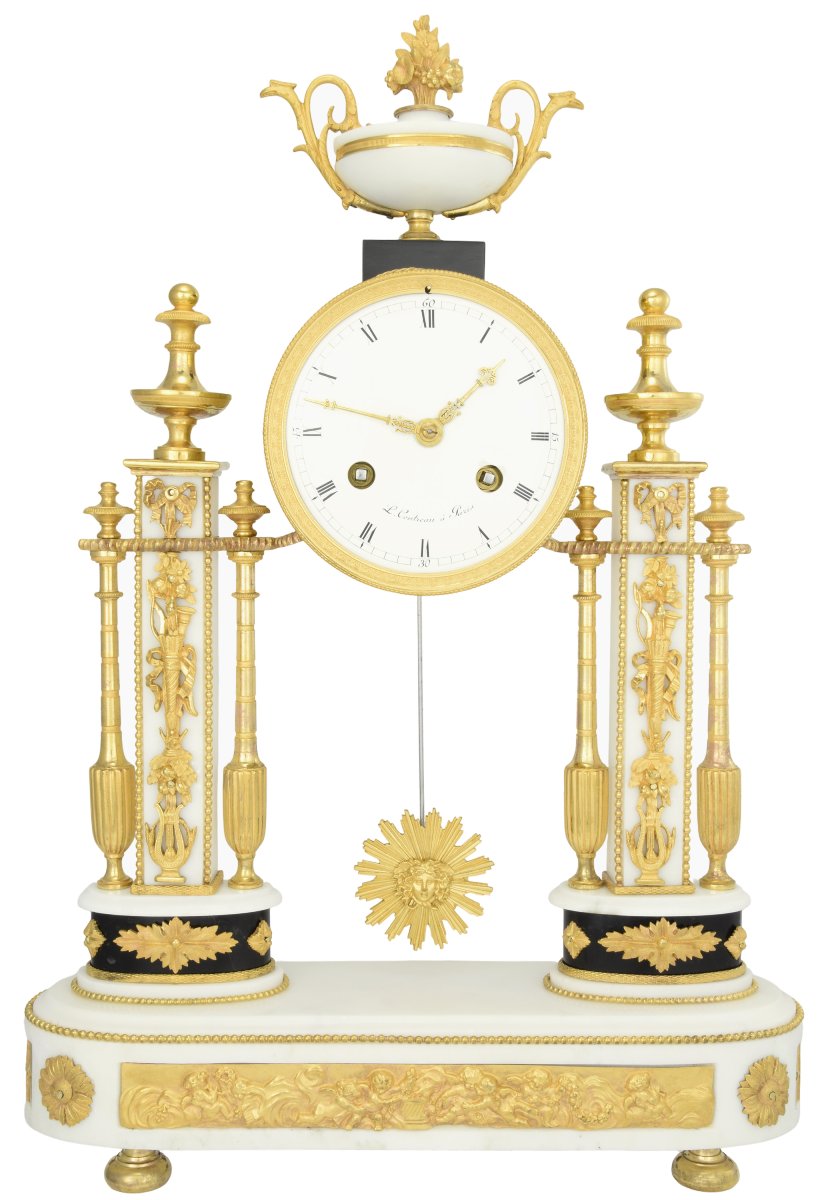
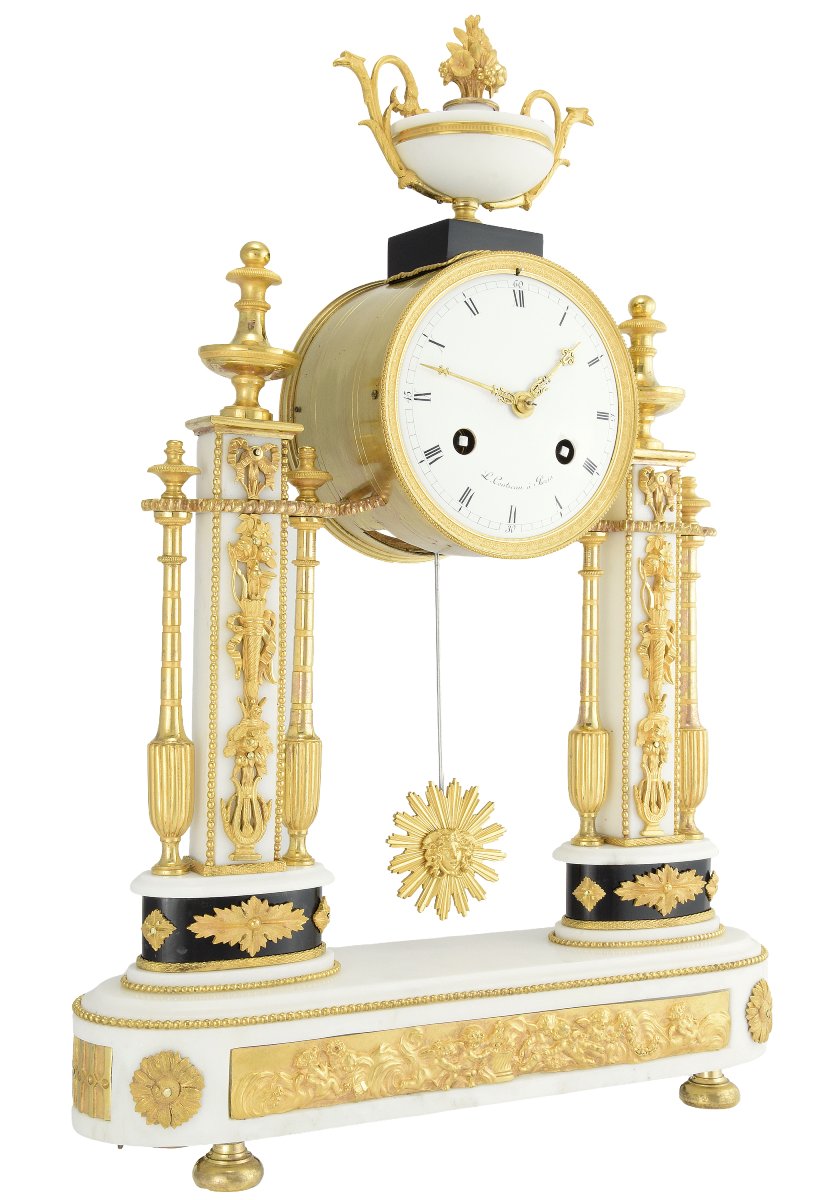
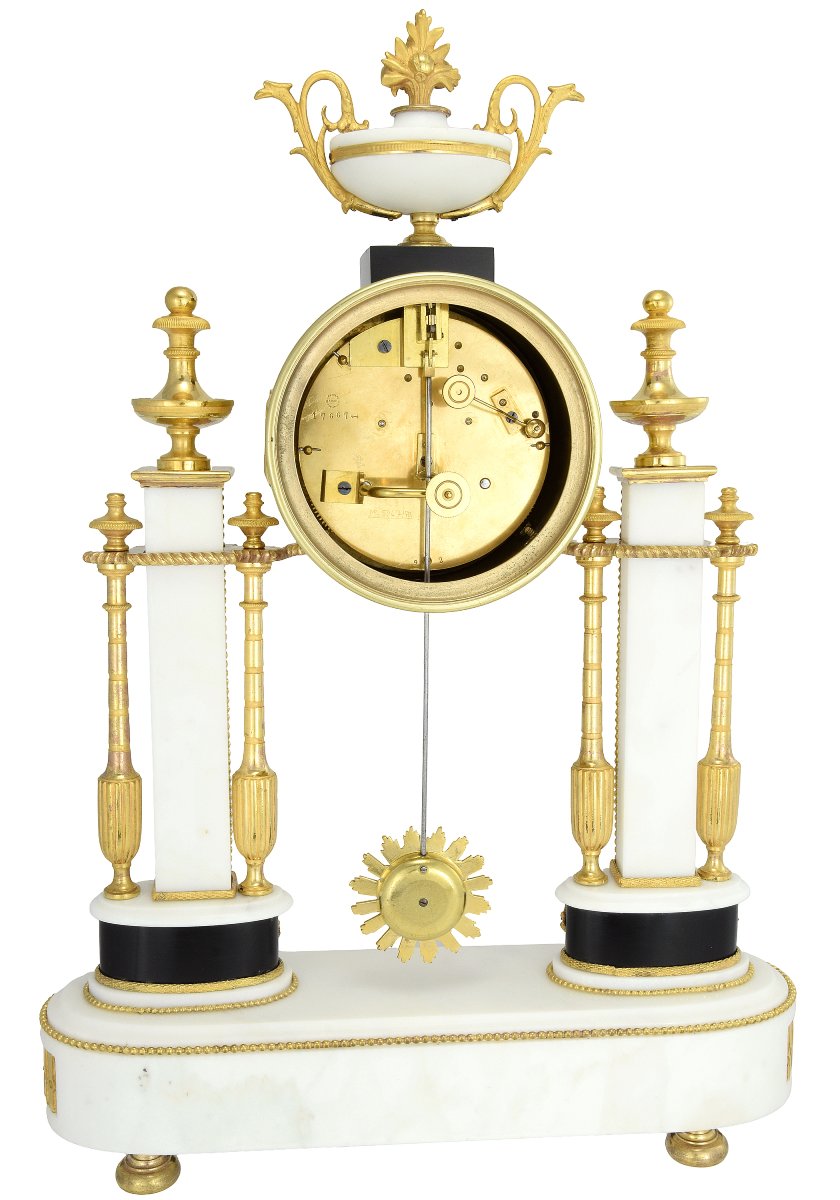
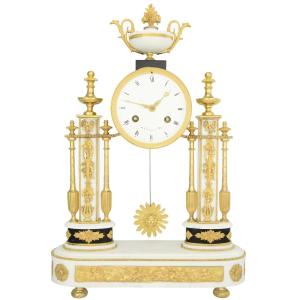
This elegant, highly decorative, and high-quality portico clock
perfectly exemplifies the refined French Neoclassical taste of the
Louis-Philippe era (first half of the 19th century). Its notably airy
and balanced architectural design features two symmetrical porticoes
supporting a substantial suspended cylindrical movement—an
arrangement that lends the piece remarkable visual lightness while
highlighting the rich mercury-gilt bronze ornamentation. The clock
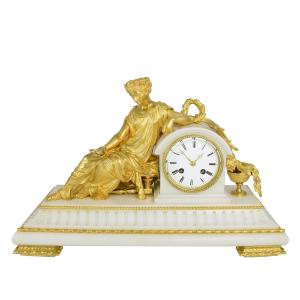
rests on a large, generously proportioned rectangular white marble base
with softened corners.
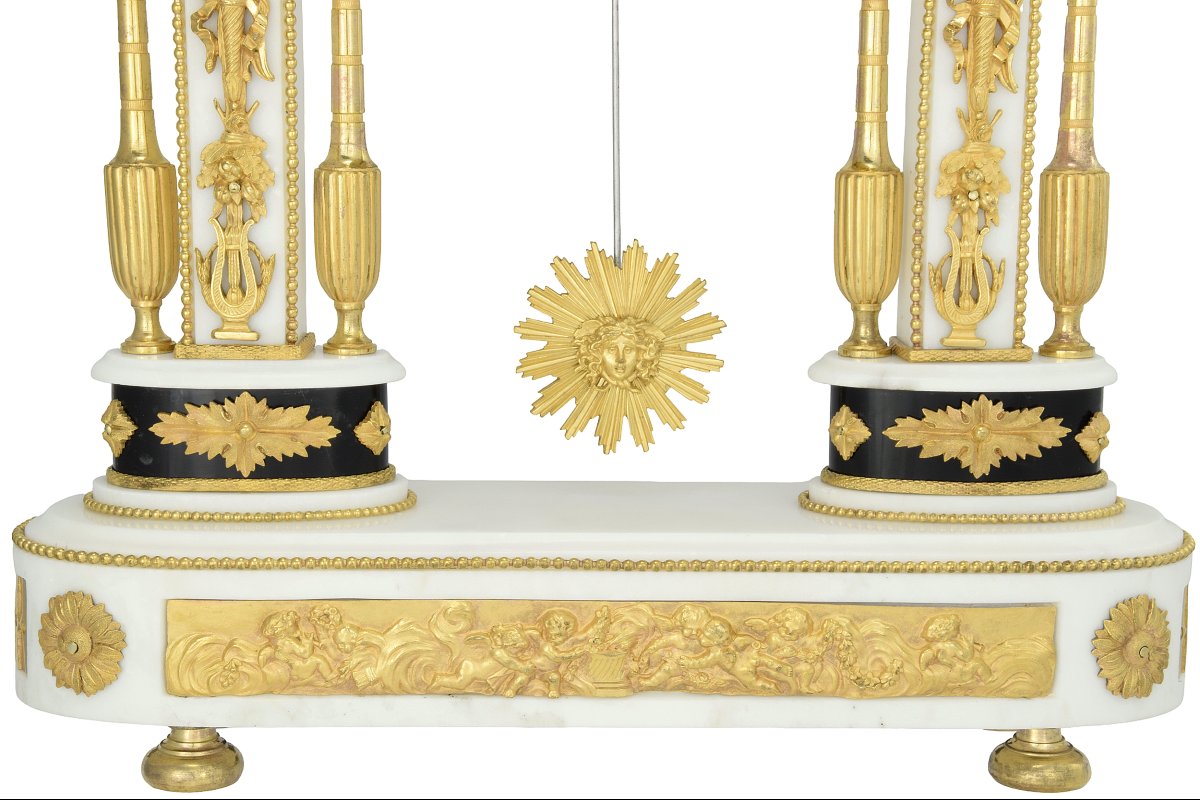
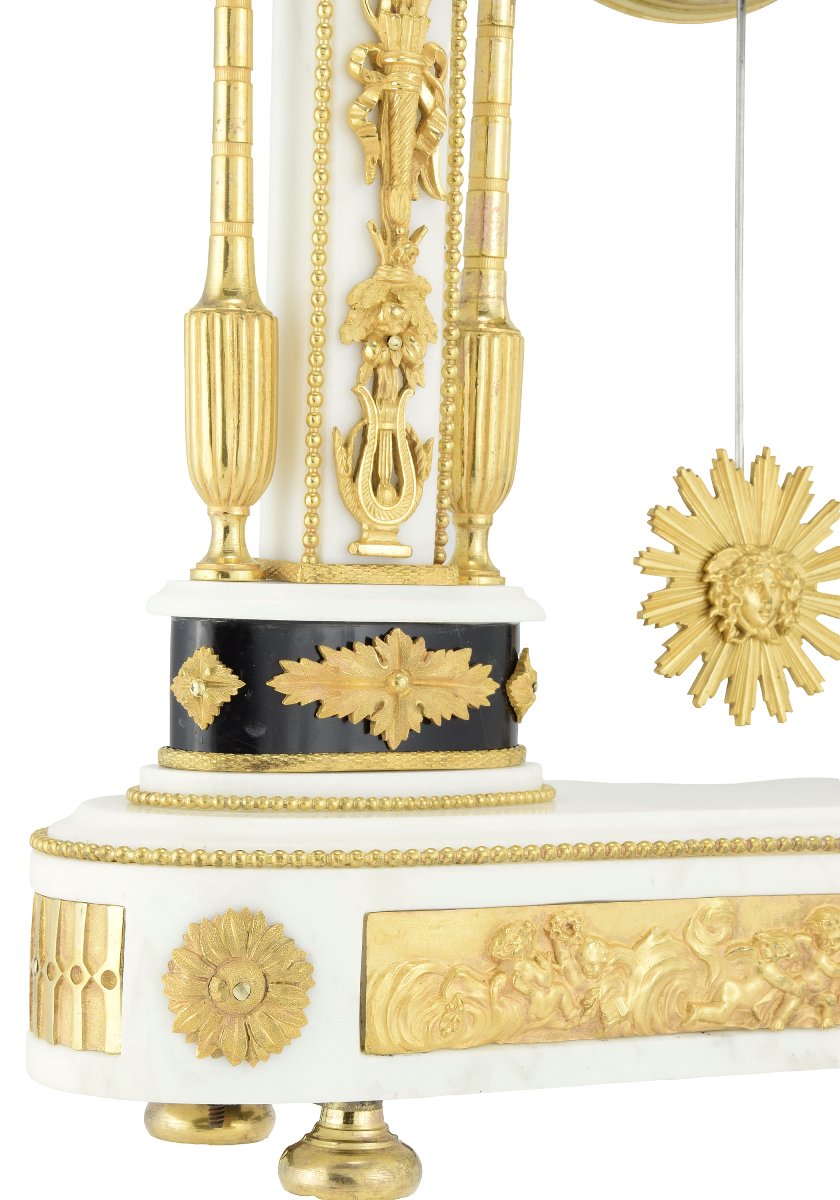
The lower section of the base is accented by a delicate gilt-bronze beaded frieze running along its entire perimeter. The front face is enlivened by a remarkable bas-relief panel depicting a procession of *putti* amidst clouds and scrolling foliage; some carry garlands, while others play the lyre or engage in allegorical games evoking the arts, love, and pleasure. The quality of the modeling, the fine detailing of the faces, and the fluid drapery demonstrate exceptional chasing. Large radiating rosettes and fluted geometric motifs at either end provide a harmonious rhythm to the composition.
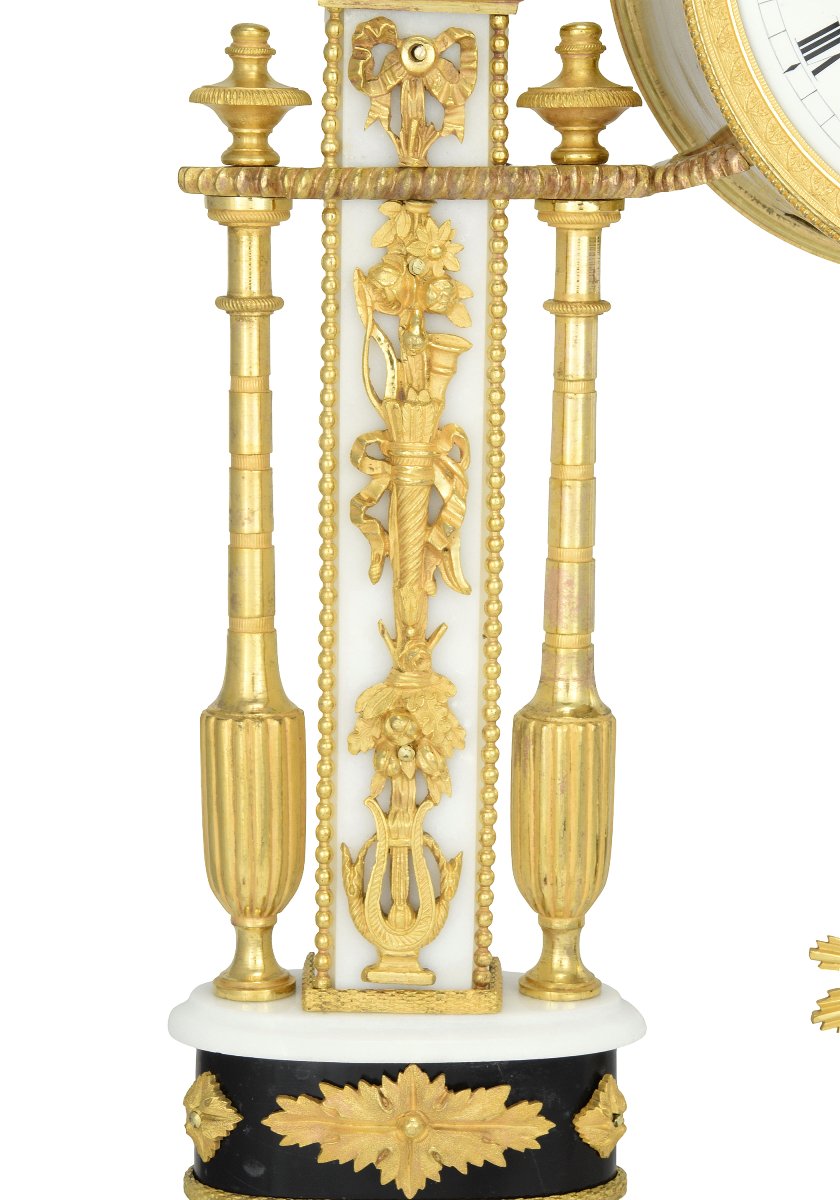
Atop the base sit two circular pedestals clad in black marble, creating a striking and elegant contrast with the white marble of the main body. Each pedestal is adorned with large, finely chased gilt-bronze mounts featuring foliate motifs. These pedestals support the two lateral porticoes, the architecture of which warrants special attention. Each portico consists of four slender, delicately turned, free-standing gilt-bronze columns. Their lower sections feature deep fluting, while the upper shafts are divided into successive bands reminiscent of antique columns. Tall white marble panels, framed by gilt beaded chains, are set between these columns. At the center of each panel unfolds a remarkable gilt-bronze sculptural motif depicting a musical trophy. It features an antique lyre surmounted by clusters of grapes, vine leaves, blossoms, and tied ribbons. These ornaments celebrate the arts and pleasures—themes highly favored during the Empire and Restoration periods. At the top of the panels sits an elegant ribbon bow ending in floral swags; the chasing reveals remarkable precision, extending even to the veins of the leaves and the petals of the flowers. The columns are joined by a horizontal gilt-bronze crossbar featuring a twisted design; this element connects the two porticoes and contributes to the visual effect of the movement appearing suspended.
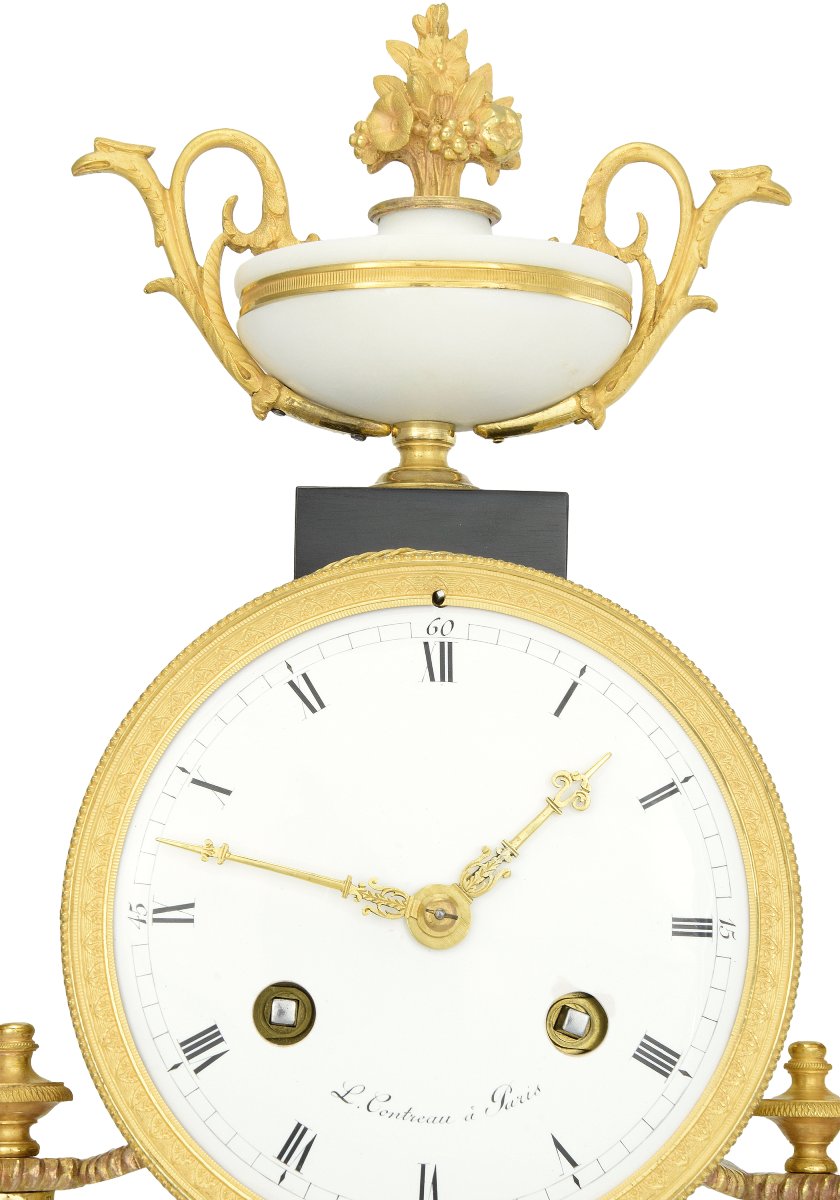
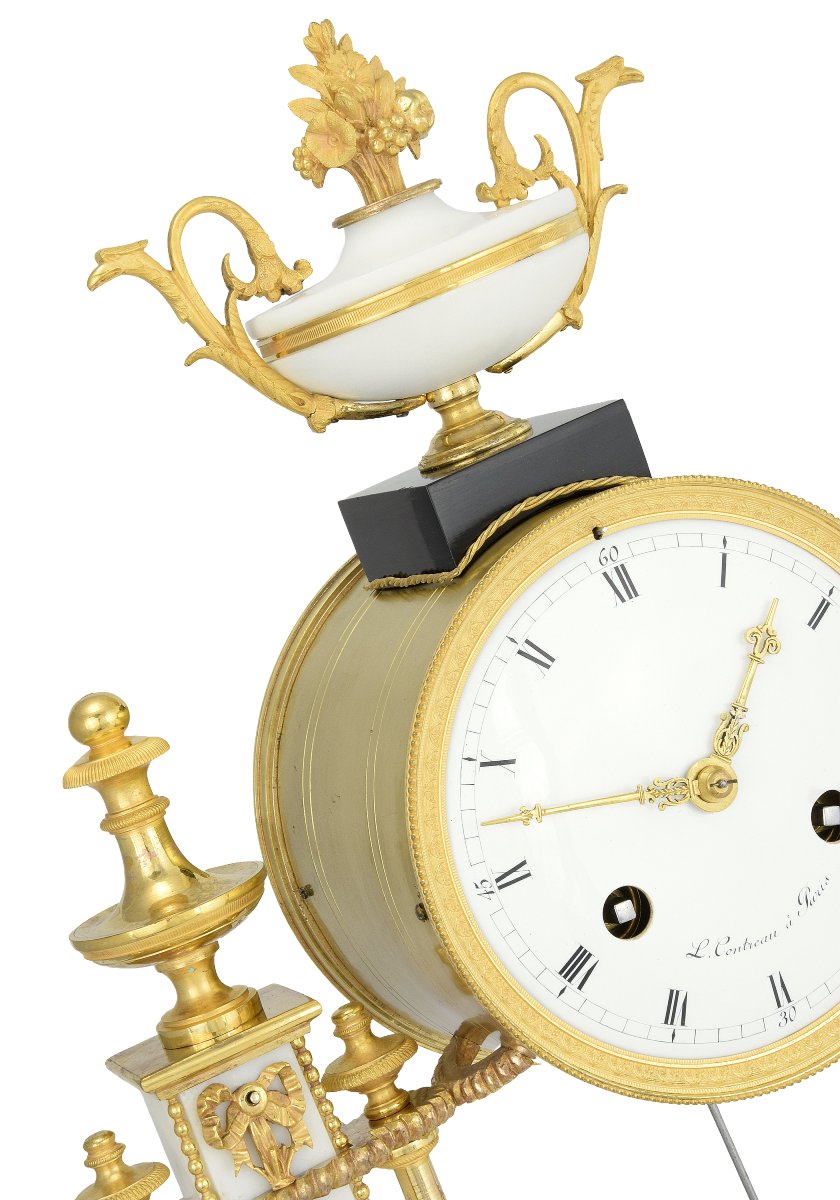
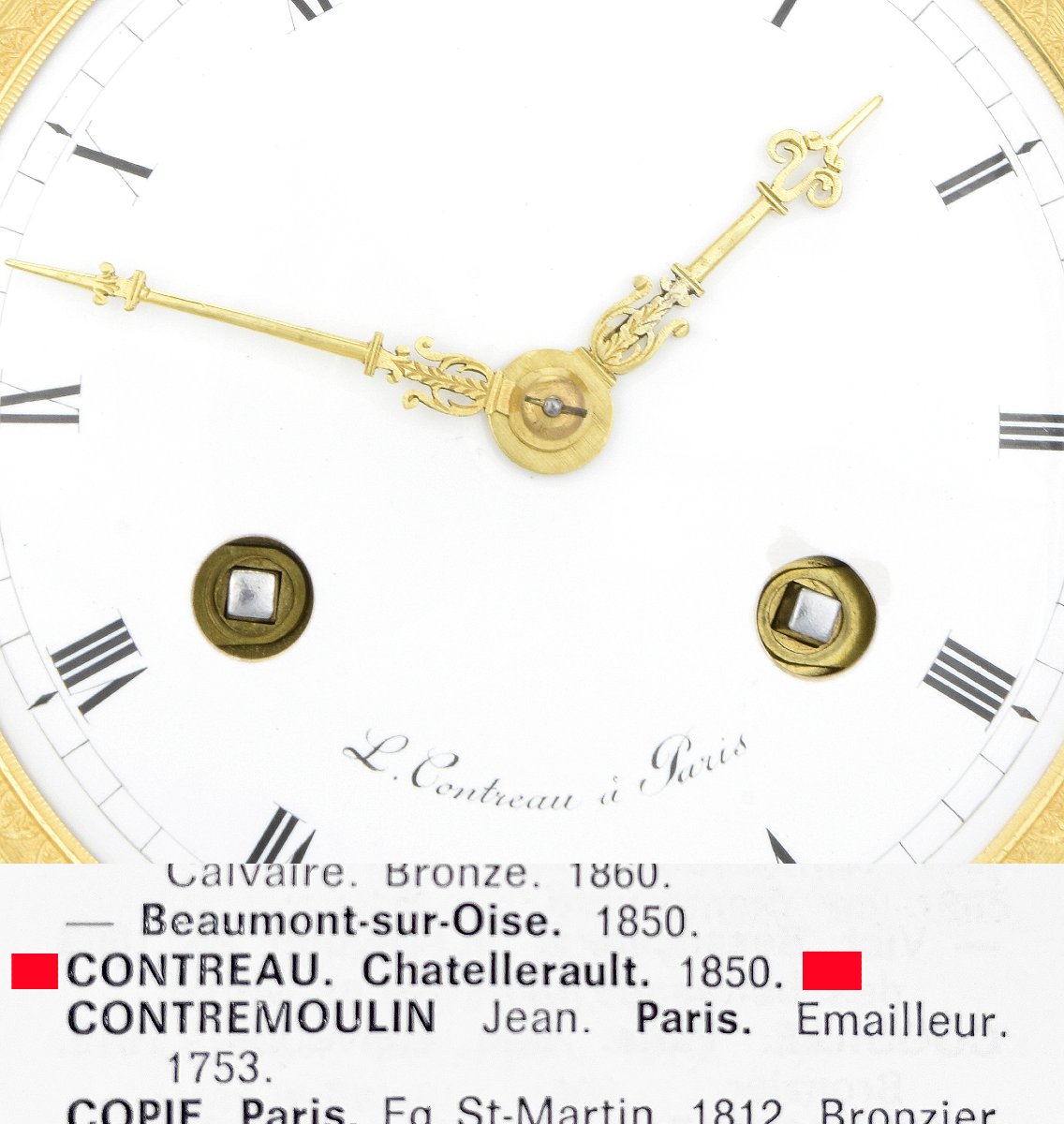
Above, the structure is topped by turned finials shaped like lidded vases and small balusters, drawing on the vocabulary of classical architecture. Their profiles are perfectly balanced, and their gilding highlights the intricate moldings. Suspended at the center of the composition is a spectacular cylindrical movement housing a very large white enamel dial—a key feature of the clock. Its substantial size enhances the monumental quality of the piece. The dial is framed by an ornate gilt-bronze bezel featuring a finely engraved and beaded frieze. The hours are marked in black Roman numerals, while the openwork, finely cut hands echo the neoclassical decorative style. The clockmaker’s signature, "Contreau à Paris," appears at the bottom of the dial. This maker is listed in Tardy’s *Dictionnaire des Horlogers* under the year 1850—a detail of interest for the documentation and attribution of the work.
Beneath the dial swings a remarkable lenticular pendulum depicting a radiant sun. At its center appears an idealized female face surrounded by a halo of radiating rays. This sunburst motif lends movement and radiance to the composition while creating a highly decorative focal point in the open space between the two porticoes. The upper section is crowned by an imposing hemispherical white marble antique-style bowl, resting on a turned pedestal base. This vessel is flanked by two gilt-bronze handles shaped like stylized plant stems that terminate in swan heads; their fluid lines and naturalistic modeling attest to the excellence of the craftsmanship. The lid is topped with a finely chased cluster of fruit, berries, flowers, and foliage—traditional symbols of abundance and prosperity.
The piece is distinguished by the purity of its architecture, the elegance of its proportions, the richness of its allegorical ornamentation, the exceptional quality of its chasing, and the brilliance of its mercury gilding. The harmonious combination of white marble, black marble, and gilt bronze lends this portico clock a particularly.
ORDERING AND ADDITIONAL INFORMATION FROM OUR WEBSITE
The lower section of the base is accented by a delicate gilt-bronze beaded frieze running along its entire perimeter. The front face is enlivened by a remarkable bas-relief panel depicting a procession of *putti* amidst clouds and scrolling foliage; some carry garlands, while others play the lyre or engage in allegorical games evoking the arts, love, and pleasure. The quality of the modeling, the fine detailing of the faces, and the fluid drapery demonstrate exceptional chasing. Large radiating rosettes and fluted geometric motifs at either end provide a harmonious rhythm to the composition.
Atop the base sit two circular pedestals clad in black marble, creating a striking and elegant contrast with the white marble of the main body. Each pedestal is adorned with large, finely chased gilt-bronze mounts featuring foliate motifs. These pedestals support the two lateral porticoes, the architecture of which warrants special attention. Each portico consists of four slender, delicately turned, free-standing gilt-bronze columns. Their lower sections feature deep fluting, while the upper shafts are divided into successive bands reminiscent of antique columns. Tall white marble panels, framed by gilt beaded chains, are set between these columns. At the center of each panel unfolds a remarkable gilt-bronze sculptural motif depicting a musical trophy. It features an antique lyre surmounted by clusters of grapes, vine leaves, blossoms, and tied ribbons. These ornaments celebrate the arts and pleasures—themes highly favored during the Empire and Restoration periods. At the top of the panels sits an elegant ribbon bow ending in floral swags; the chasing reveals remarkable precision, extending even to the veins of the leaves and the petals of the flowers. The columns are joined by a horizontal gilt-bronze crossbar featuring a twisted design; this element connects the two porticoes and contributes to the visual effect of the movement appearing suspended.
Above, the structure is topped by turned finials shaped like lidded vases and small balusters, drawing on the vocabulary of classical architecture. Their profiles are perfectly balanced, and their gilding highlights the intricate moldings. Suspended at the center of the composition is a spectacular cylindrical movement housing a very large white enamel dial—a key feature of the clock. Its substantial size enhances the monumental quality of the piece. The dial is framed by an ornate gilt-bronze bezel featuring a finely engraved and beaded frieze. The hours are marked in black Roman numerals, while the openwork, finely cut hands echo the neoclassical decorative style. The clockmaker’s signature, "Contreau à Paris," appears at the bottom of the dial. This maker is listed in Tardy’s *Dictionnaire des Horlogers* under the year 1850—a detail of interest for the documentation and attribution of the work.
Beneath the dial swings a remarkable lenticular pendulum depicting a radiant sun. At its center appears an idealized female face surrounded by a halo of radiating rays. This sunburst motif lends movement and radiance to the composition while creating a highly decorative focal point in the open space between the two porticoes. The upper section is crowned by an imposing hemispherical white marble antique-style bowl, resting on a turned pedestal base. This vessel is flanked by two gilt-bronze handles shaped like stylized plant stems that terminate in swan heads; their fluid lines and naturalistic modeling attest to the excellence of the craftsmanship. The lid is topped with a finely chased cluster of fruit, berries, flowers, and foliage—traditional symbols of abundance and prosperity.
The piece is distinguished by the purity of its architecture, the elegance of its proportions, the richness of its allegorical ornamentation, the exceptional quality of its chasing, and the brilliance of its mercury gilding. The harmonious combination of white marble, black marble, and gilt bronze lends this portico clock a particularly.
ORDERING AND ADDITIONAL INFORMATION FROM OUR WEBSITE
1 500 €
Period: 19th century
Style: Louis Philippe, Charles 10th
Condition: Fully restored in our whorkshop
Material: Bronze
Width: 31 cm
Height: 51 cm
Depth: 10 cm
Reference (ID): 1787691
Availability: In stock
Print