


Clock Farcot Precision Clock With Visible Brocot Escapement
ORDERING AND ADDITIONAL INFORMATION FROM OUR WEBSITE
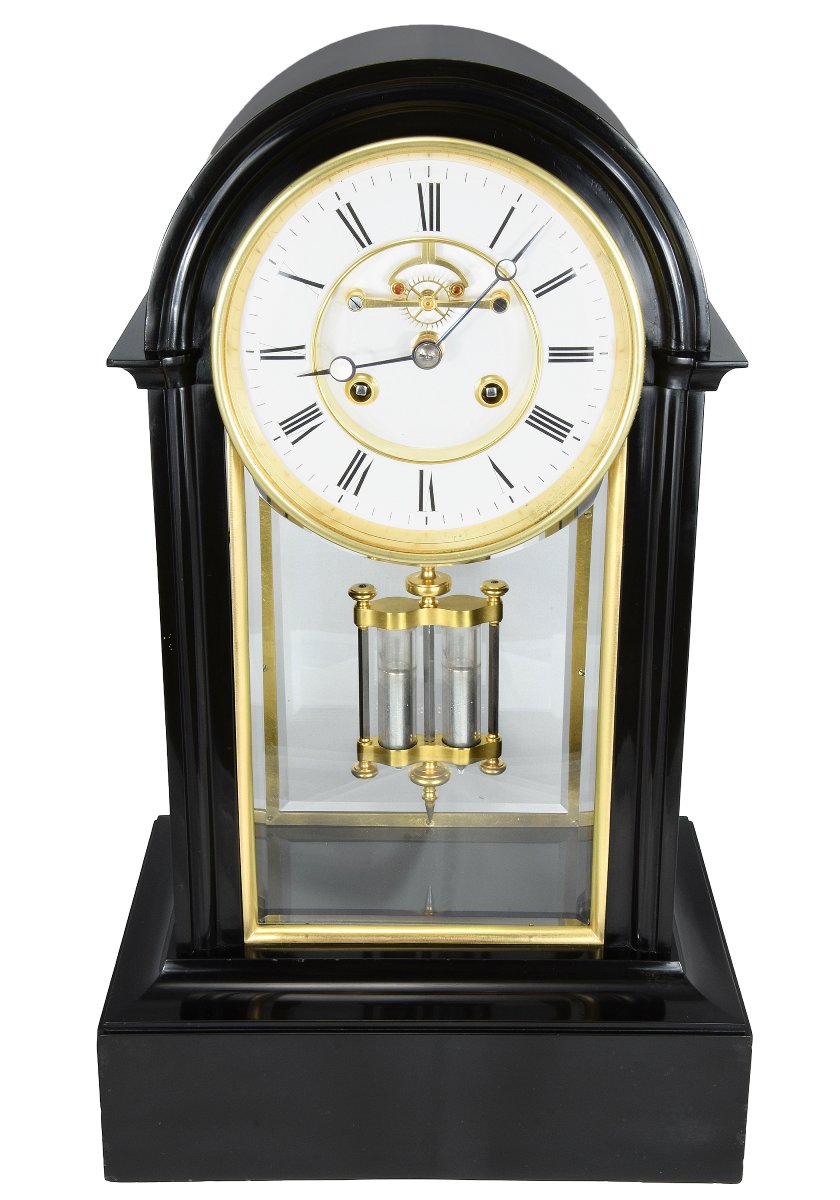
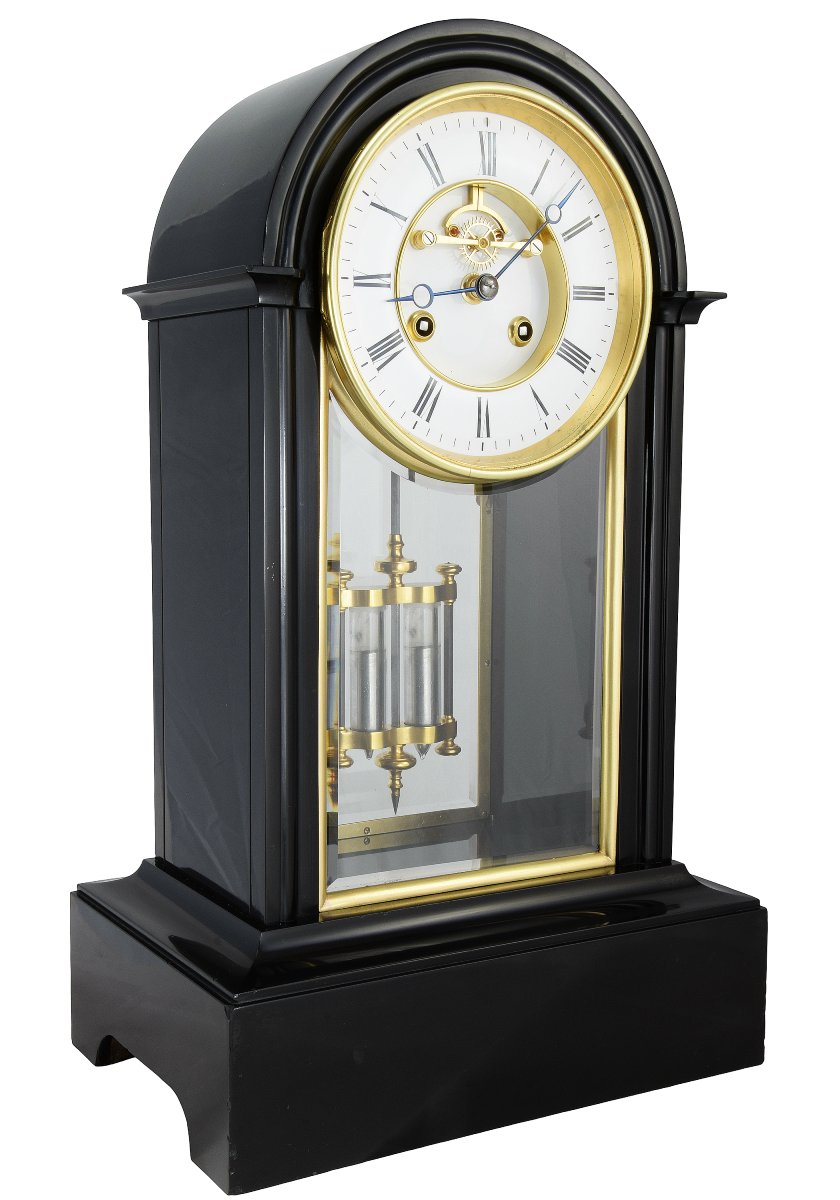
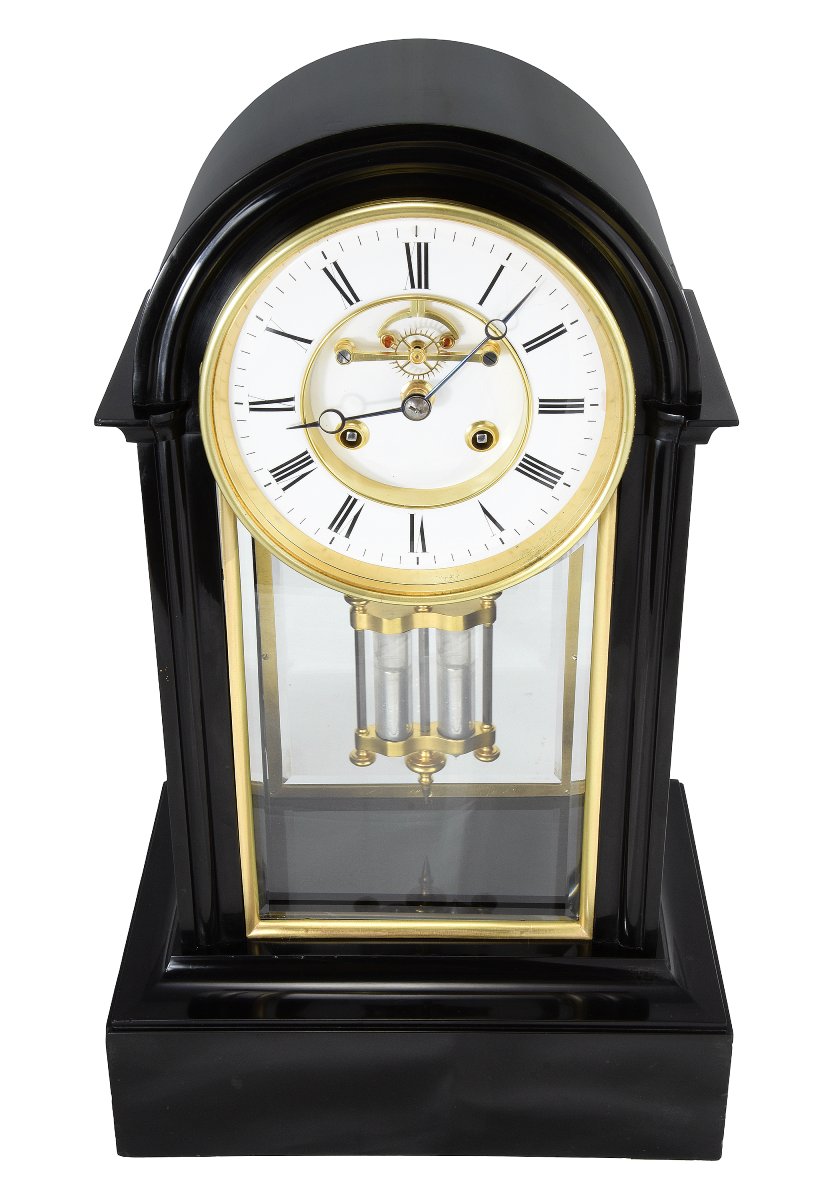
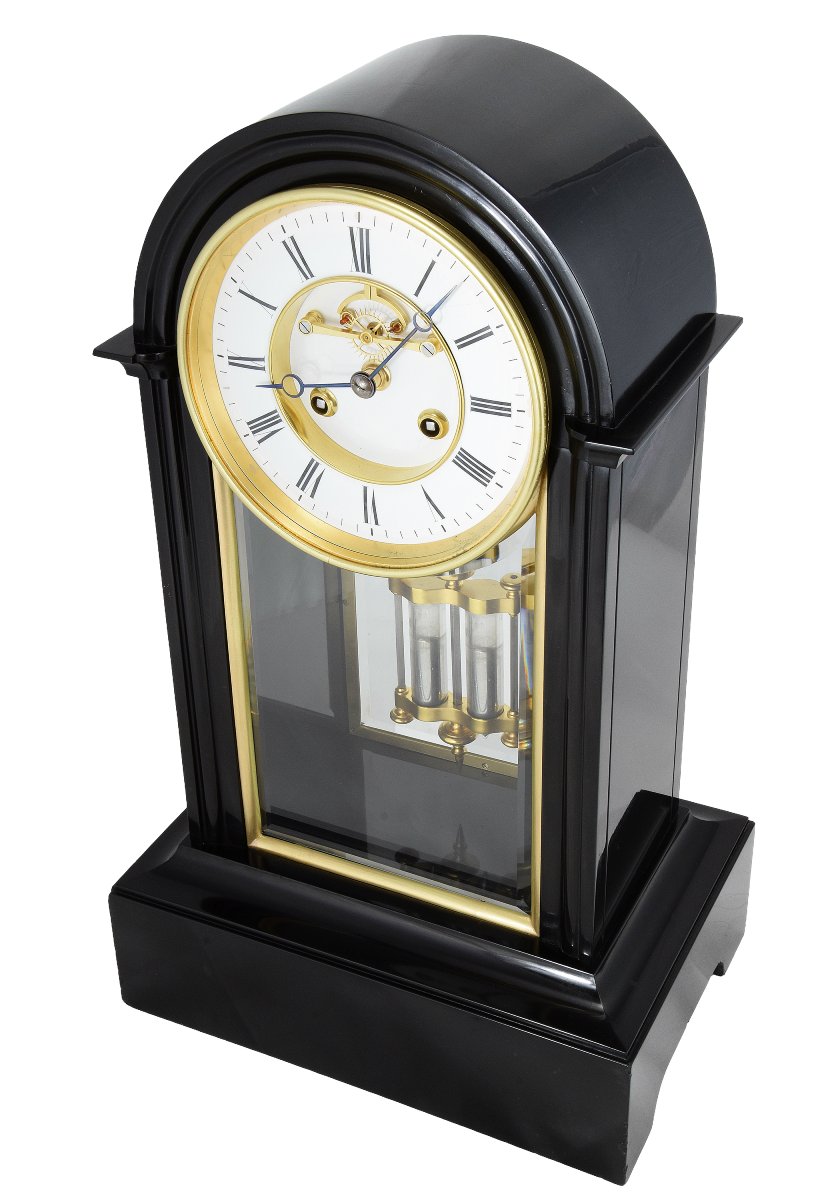
This remarkable precision clock in black marble stands as a testament to the excellence of French scientific clockmaking during the second half of the 19th century. Its aesthetic—at once understated, architectural, and elegant—prioritizes purity of line to showcase the movement and its compensating pendulum. The structure takes the form of an arched *borne* (or pillar-style case) with particularly harmonious proportions. The body is crafted entirely from polished black marble, offering a deep, lustrous surface where the quality of the polish reveals the stone's full natural richness. The vertical uprights feature subtle fluting, while the top is crowned by an imposing semicircular arch; its successive moldings reinforce the piece's monumental presence.
The wide, projecting base rests on a molded plinth that lends balance and visual stability to the composition. The front is largely open to showcase the movement. A substantial glazed door—featuring thick, beveled glass set within a gilt-bronze frame—protects the mechanism while offering a clear view of the pendulum. The glass's generous bevels catch the light and create subtle reflections, enhancing the clock's luxurious character.
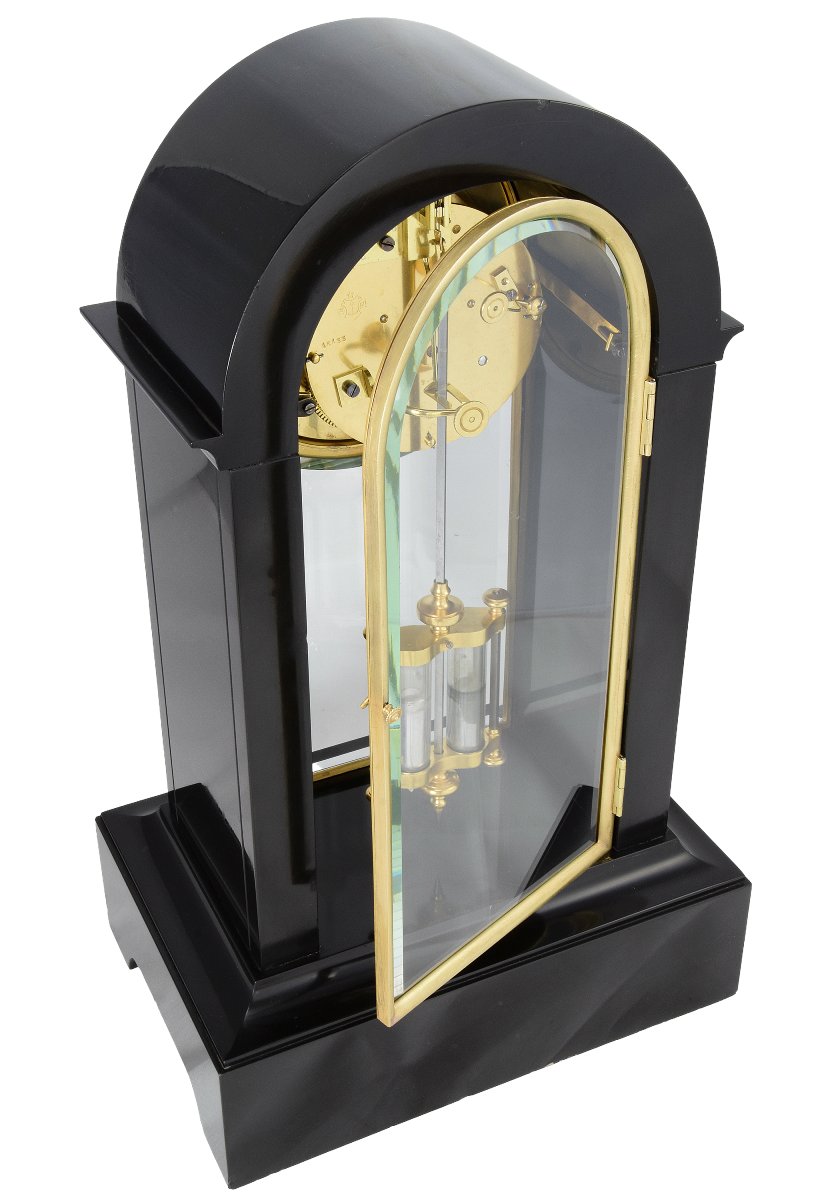
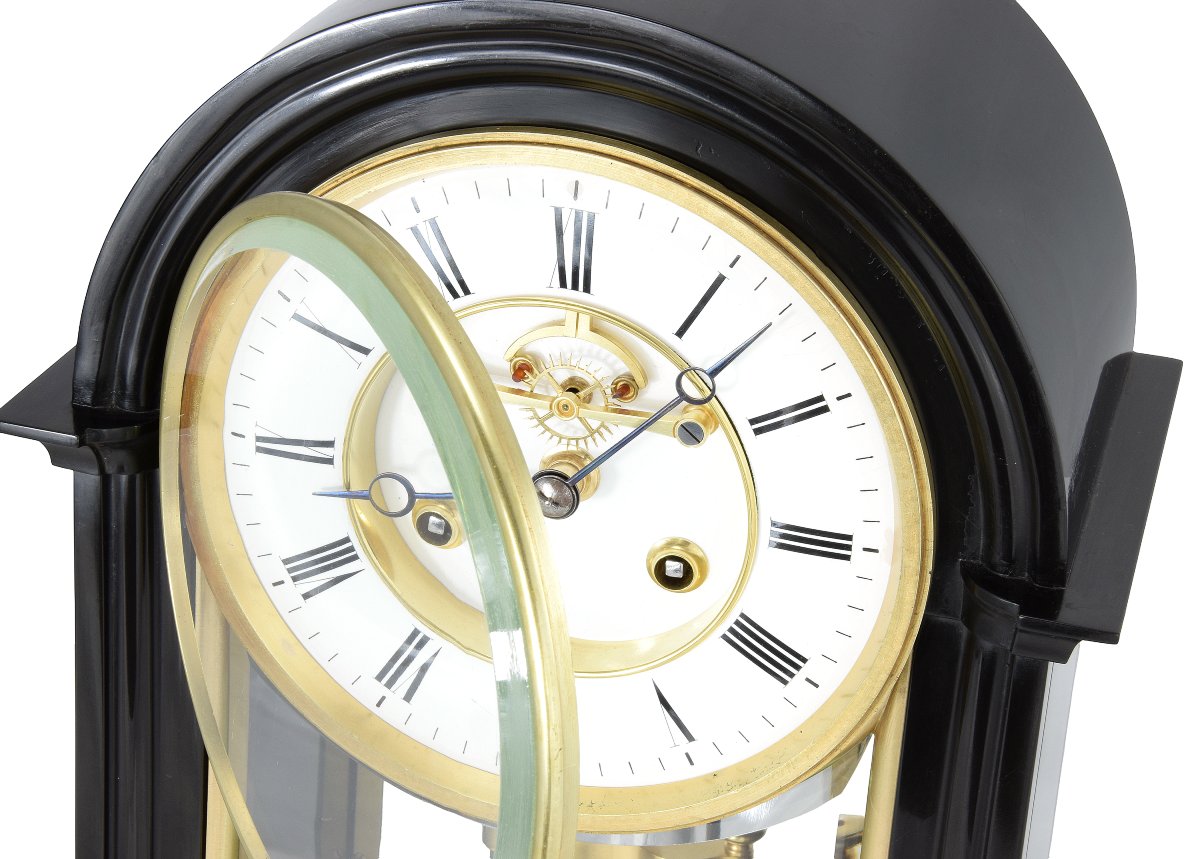
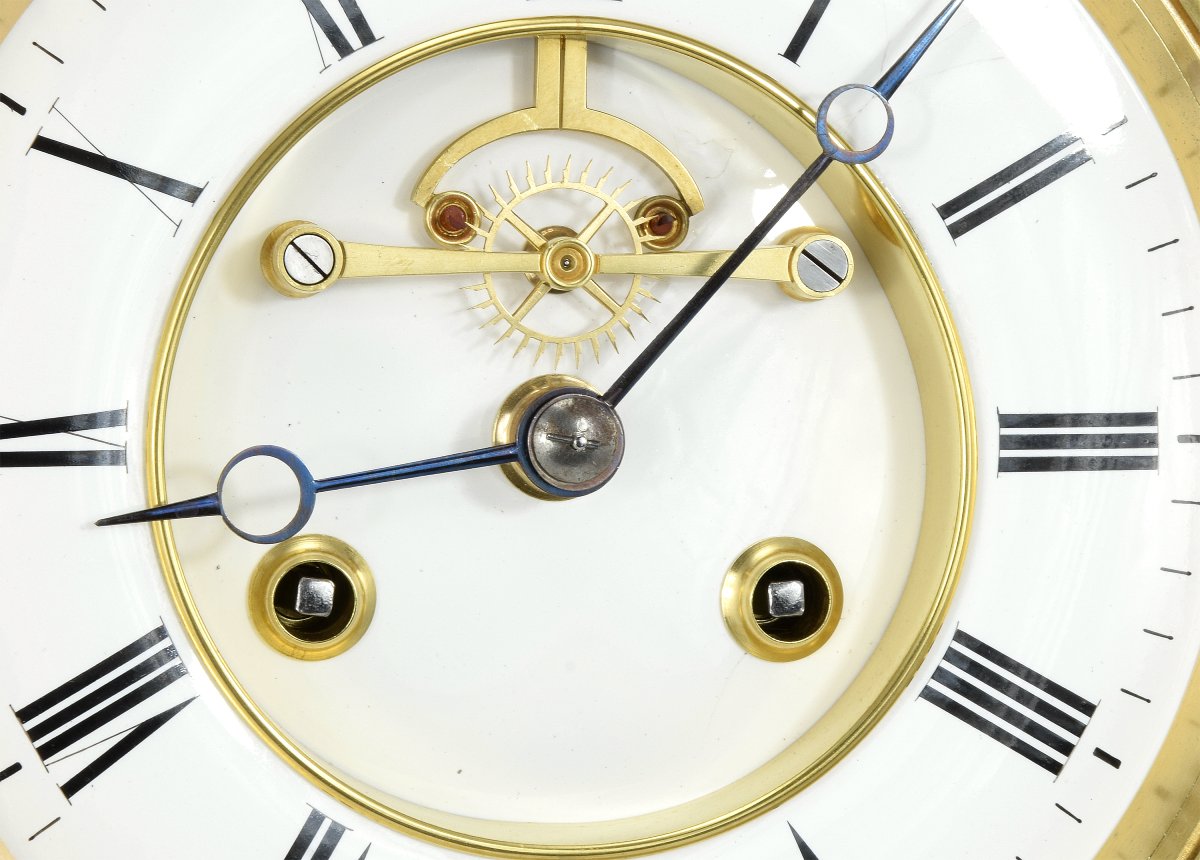
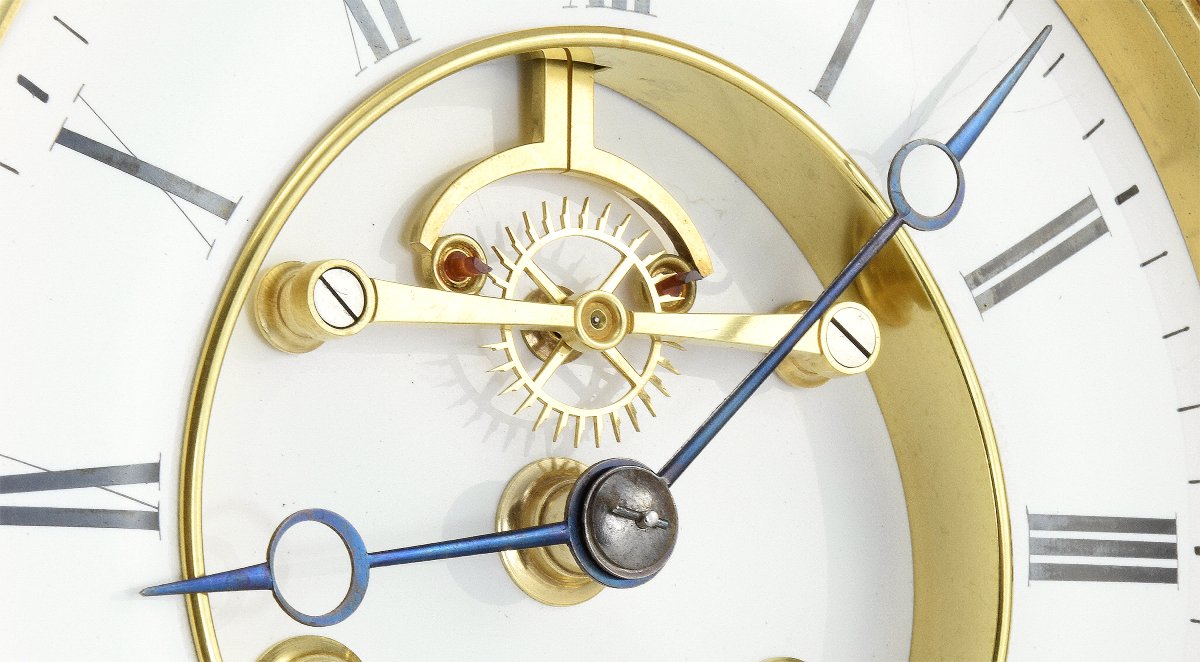
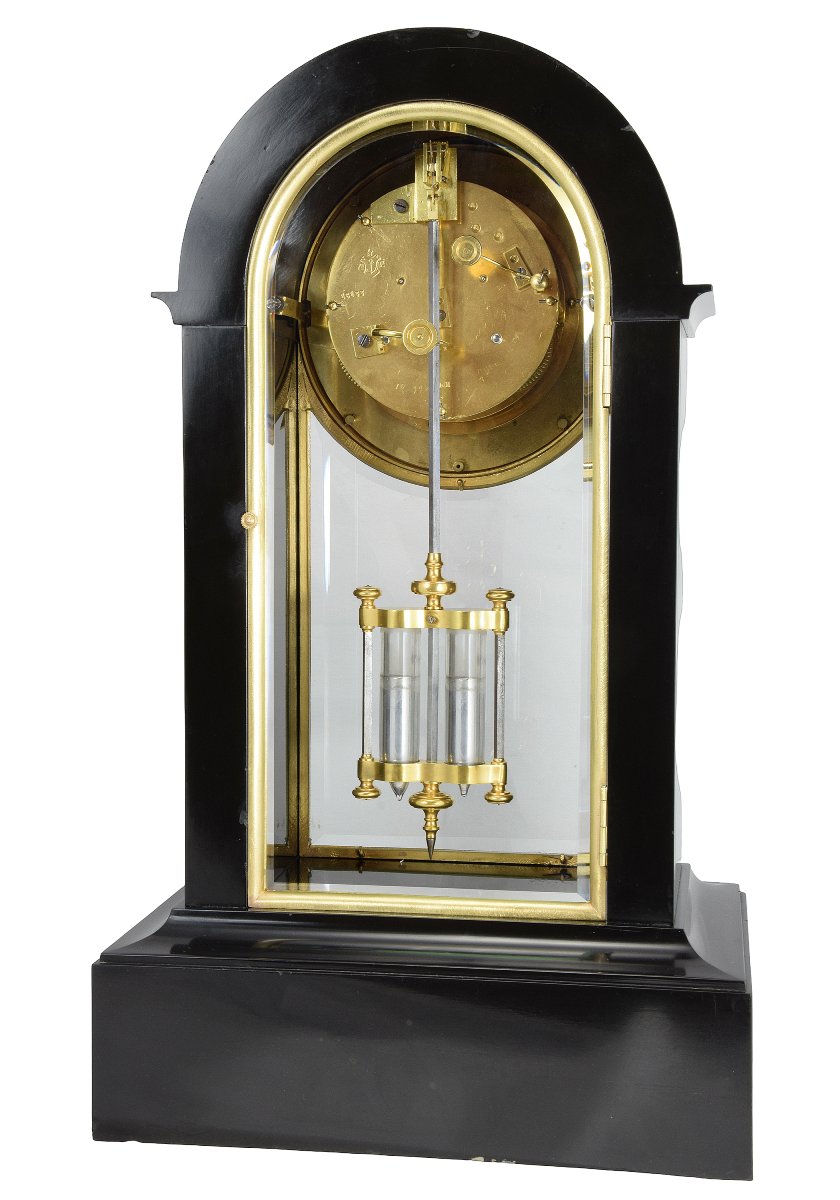
A hinged rear glass door allows for easy access to the movement. This dual-access design is characteristic of high-quality clocks intended for regular observation and maintenance. The circular white enamel dial is of remarkable craftsmanship. It features elegant, perfectly balanced black Roman numerals and a finely detailed railway-style minute track. A wide gilt-bronze bezel accentuates the whiteness of the enamel, creating a refined contrast with the deep black marble. The hands, made of fire-blued steel, feature a particularly elegant openwork design. Their slender profile contributes to the overall aesthetic balance while ensuring excellent legibility. The upper section of the dial is generously open-worked to reveal the visible Brocot escapement—a true hallmark of French precision clocks from that era. This arrangement allows the operation of the regulating mechanism to be observed directly without opening the case.
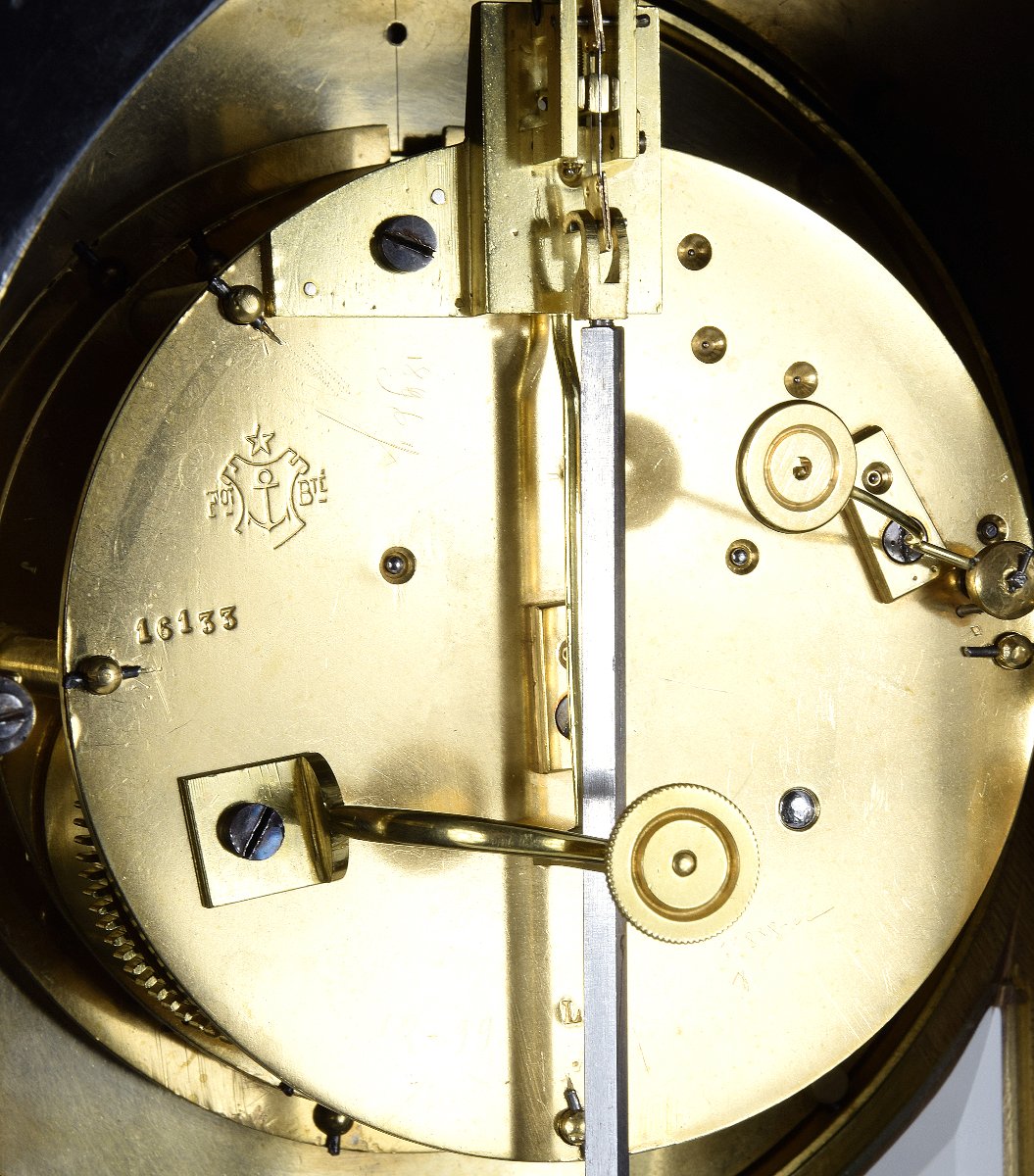
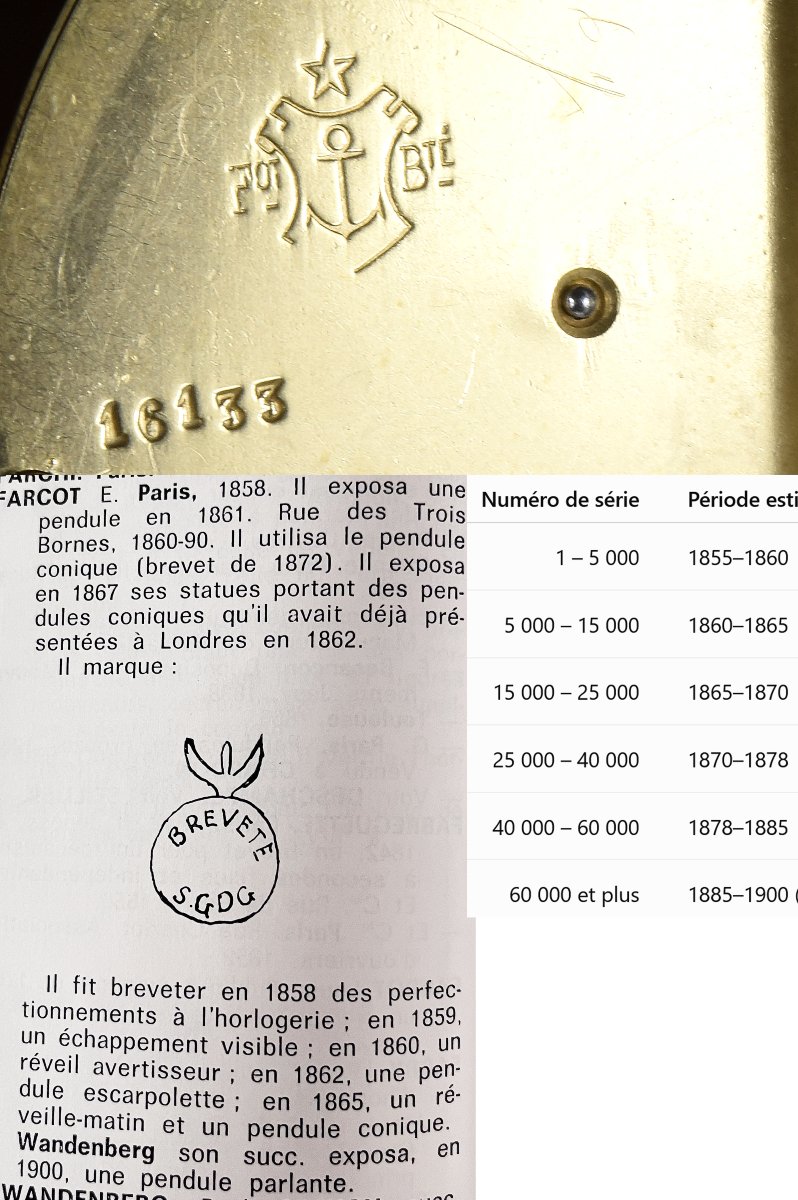
The back of the movement plate bears the famous hallmark featuring a star above an anchor, accompanied by the letters "FOT" and the inscription "Bté." This mark identifies the workshop of Henri-Eugène-Adrien Farcot, one of the most important French makers of precision clocks during the Second Empire and the early Third Republic. Star + Anchor: the registered trademark of the Farcot workshop. FOT: a stylized abbreviation for Farcot. Bté: an abbreviation for *Breveté* (Patented), indicating the use of a patented system. The movement bears the serial number 16133, allowing for a particularly precise date estimate. Based on the stylistic evolution of Farcot movements and the period during which this hallmark was used, the clock can be dated with high probability to between 1865 and 1875, with manufacture most likely occurring around 1870.
The escapement features pallets mounted with agates (often referred to as "traveling agates"), extremely hard stones selected for their exceptional wear resistance and ability to significantly reduce friction. The use of these technical gemstones improves operational consistency, reduces lubrication requirements, and substantially enhances long-term timekeeping precision. This design, devised by Achille Brocot, represents one of the major innovations in 19th-century French horology and was widely adopted in high-end clocks. The movement is a remarkable circular gilt-brass mechanism of superior build quality. Its execution reflects meticulous attention to finish, featuring carefully polished plates, perfectly fitted pivots, and an assembly of remarkable precision.
The pendulum is one of the most remarkable features of this clock. It features a mercury-compensated pendulum, consisting of two cylindrical glass reservoirs filled with mercury and held within an elegant gilt-bronze mount. This system relies on a particularly ingenious physical principle. Temperature fluctuations normally alter the length of the pendulum rod, thereby affecting the clock's rate. However, the expansion of the mercury within the cylindrical reservoirs causes the pendulum's center of gravity to shift in the opposite direction to the rod's expansion, effectively compensating for temperature-induced changes. This process ensures far more consistent timekeeping regardless of climatic conditions, transforming the clock into a true precision instrument rather than a mere decorative object.
The combination of polished black marble, gilt bronze, thick beveled glass panels, a visible Brocot escapement with agate pallets, a mercury-compensated pendulum, and a movement signed by Henri-Eugène-Adrien Farcot places this clock among the finest examples of French horology from its era. Serving as both a decorative work of art and a scientific instrument, it perfectly exemplifies the craftsmanship of great 19th-century Parisian workshops, where the pursuit of chronometric precision went hand in hand with exceptional aesthetic standards. Today, this type of clock remains highly sought after by collectors for its build quality, technical and historical significance, and the renown of Farcot, whose creations stand as benchmarks in the field of French precision horology.
Original mechanism, intact and unmodified. Strikes the hours and half-hours on an antique bell with a clear, authentic tone.
This remarkable precision clock in black marble stands as a testament to the excellence of French scientific clockmaking during the second half of the 19th century. Its aesthetic—at once understated, architectural, and elegant—prioritizes purity of line to showcase the movement and its compensating pendulum. The structure takes the form of an arched *borne* (or pillar-style case) with particularly harmonious proportions. The body is crafted entirely from polished black marble, offering a deep, lustrous surface where the quality of the polish reveals the stone's full natural richness. The vertical uprights feature subtle fluting, while the top is crowned by an imposing semicircular arch; its successive moldings reinforce the piece's monumental presence.
The wide, projecting base rests on a molded plinth that lends balance and visual stability to the composition. The front is largely open to showcase the movement. A substantial glazed door—featuring thick, beveled glass set within a gilt-bronze frame—protects the mechanism while offering a clear view of the pendulum. The glass's generous bevels catch the light and create subtle reflections, enhancing the clock's luxurious character.
A hinged rear glass door allows for easy access to the movement. This dual-access design is characteristic of high-quality clocks intended for regular observation and maintenance. The circular white enamel dial is of remarkable craftsmanship. It features elegant, perfectly balanced black Roman numerals and a finely detailed railway-style minute track. A wide gilt-bronze bezel accentuates the whiteness of the enamel, creating a refined contrast with the deep black marble. The hands, made of fire-blued steel, feature a particularly elegant openwork design. Their slender profile contributes to the overall aesthetic balance while ensuring excellent legibility. The upper section of the dial is generously open-worked to reveal the visible Brocot escapement—a true hallmark of French precision clocks from that era. This arrangement allows the operation of the regulating mechanism to be observed directly without opening the case.
The back of the movement plate bears the famous hallmark featuring a star above an anchor, accompanied by the letters "FOT" and the inscription "Bté." This mark identifies the workshop of Henri-Eugène-Adrien Farcot, one of the most important French makers of precision clocks during the Second Empire and the early Third Republic. Star + Anchor: the registered trademark of the Farcot workshop. FOT: a stylized abbreviation for Farcot. Bté: an abbreviation for *Breveté* (Patented), indicating the use of a patented system. The movement bears the serial number 16133, allowing for a particularly precise date estimate. Based on the stylistic evolution of Farcot movements and the period during which this hallmark was used, the clock can be dated with high probability to between 1865 and 1875, with manufacture most likely occurring around 1870.
The escapement features pallets mounted with agates (often referred to as "traveling agates"), extremely hard stones selected for their exceptional wear resistance and ability to significantly reduce friction. The use of these technical gemstones improves operational consistency, reduces lubrication requirements, and substantially enhances long-term timekeeping precision. This design, devised by Achille Brocot, represents one of the major innovations in 19th-century French horology and was widely adopted in high-end clocks. The movement is a remarkable circular gilt-brass mechanism of superior build quality. Its execution reflects meticulous attention to finish, featuring carefully polished plates, perfectly fitted pivots, and an assembly of remarkable precision.
The pendulum is one of the most remarkable features of this clock. It features a mercury-compensated pendulum, consisting of two cylindrical glass reservoirs filled with mercury and held within an elegant gilt-bronze mount. This system relies on a particularly ingenious physical principle. Temperature fluctuations normally alter the length of the pendulum rod, thereby affecting the clock's rate. However, the expansion of the mercury within the cylindrical reservoirs causes the pendulum's center of gravity to shift in the opposite direction to the rod's expansion, effectively compensating for temperature-induced changes. This process ensures far more consistent timekeeping regardless of climatic conditions, transforming the clock into a true precision instrument rather than a mere decorative object.
The combination of polished black marble, gilt bronze, thick beveled glass panels, a visible Brocot escapement with agate pallets, a mercury-compensated pendulum, and a movement signed by Henri-Eugène-Adrien Farcot places this clock among the finest examples of French horology from its era. Serving as both a decorative work of art and a scientific instrument, it perfectly exemplifies the craftsmanship of great 19th-century Parisian workshops, where the pursuit of chronometric precision went hand in hand with exceptional aesthetic standards. Today, this type of clock remains highly sought after by collectors for its build quality, technical and historical significance, and the renown of Farcot, whose creations stand as benchmarks in the field of French precision horology.
Original mechanism, intact and unmodified. Strikes the hours and half-hours on an antique bell with a clear, authentic tone.
1 600 €
Period: 19th century
Style: Napoleon 3rd
Condition: Fully restored in our whorkshop
Material: Marble
Width: 29 cm
Height: 48 cm
Depth: 20 cm
Reference (ID): 1798340
Availability: In stock
Print