

Clock With Ram's Heads And Paris Porcelain
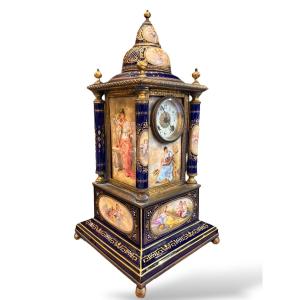
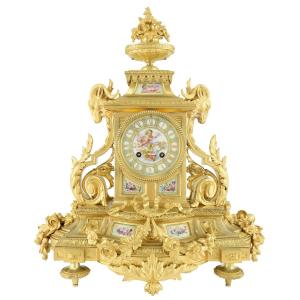
This remarkable clock, crafted from finely chased and gilt bronze
during the Napoleon III period (circa 1860), is distinguished by its
monumental and perfectly symmetrical architecture. It elegantly blends
Louis XVI and Renaissance decorative styles, reflecting the eclectic
taste characteristic of the Second Empire. Its rich ornamentation,
enhanced by delicate Paris porcelain plaques, demonstrates an
exceptional level of craftsmanship in both the quality of the chasing
and the finesse of the painting.
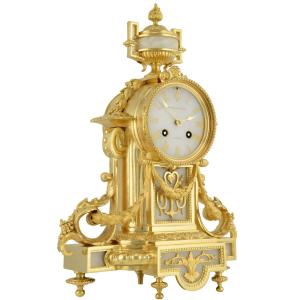
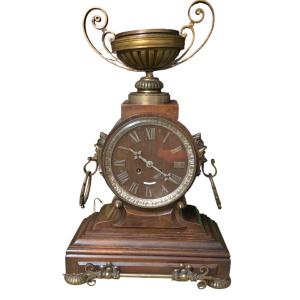
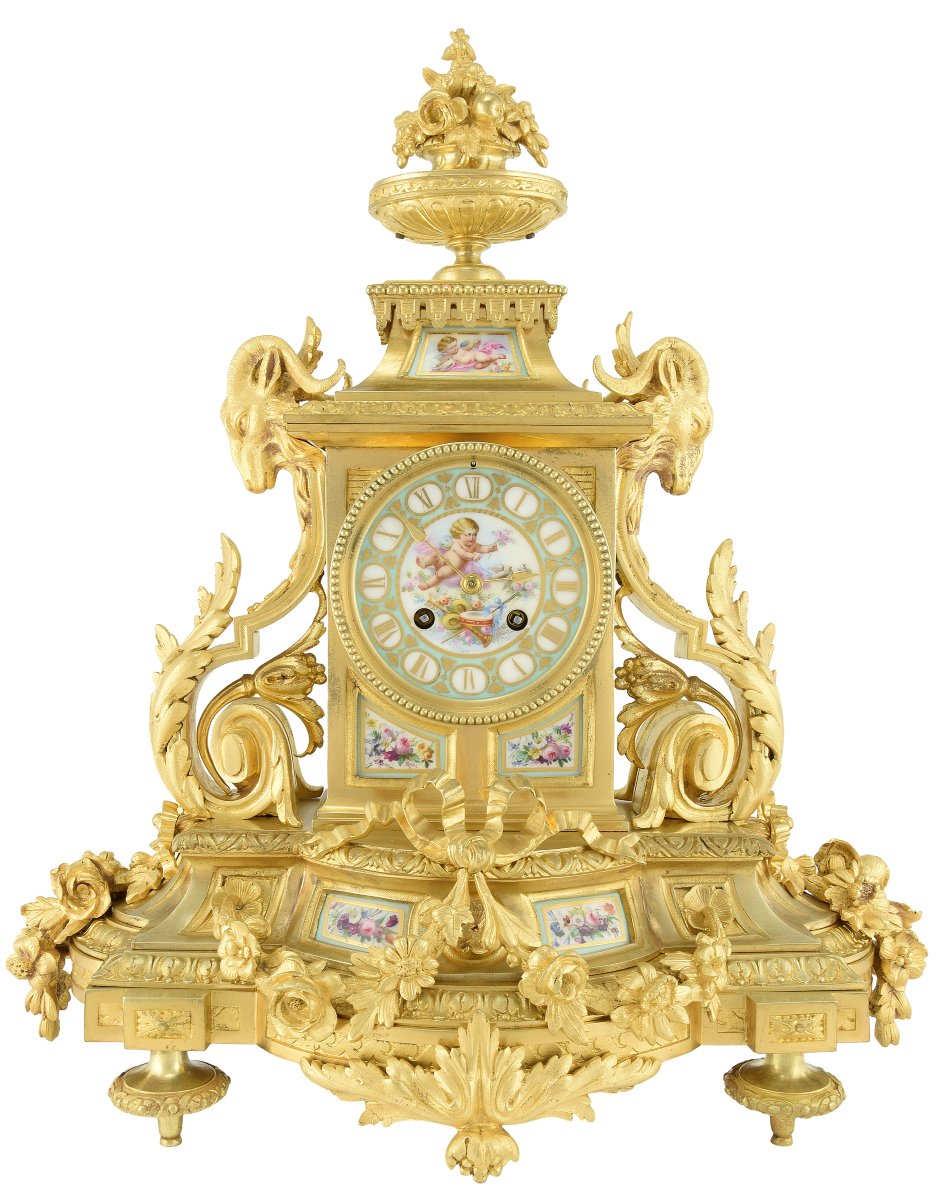
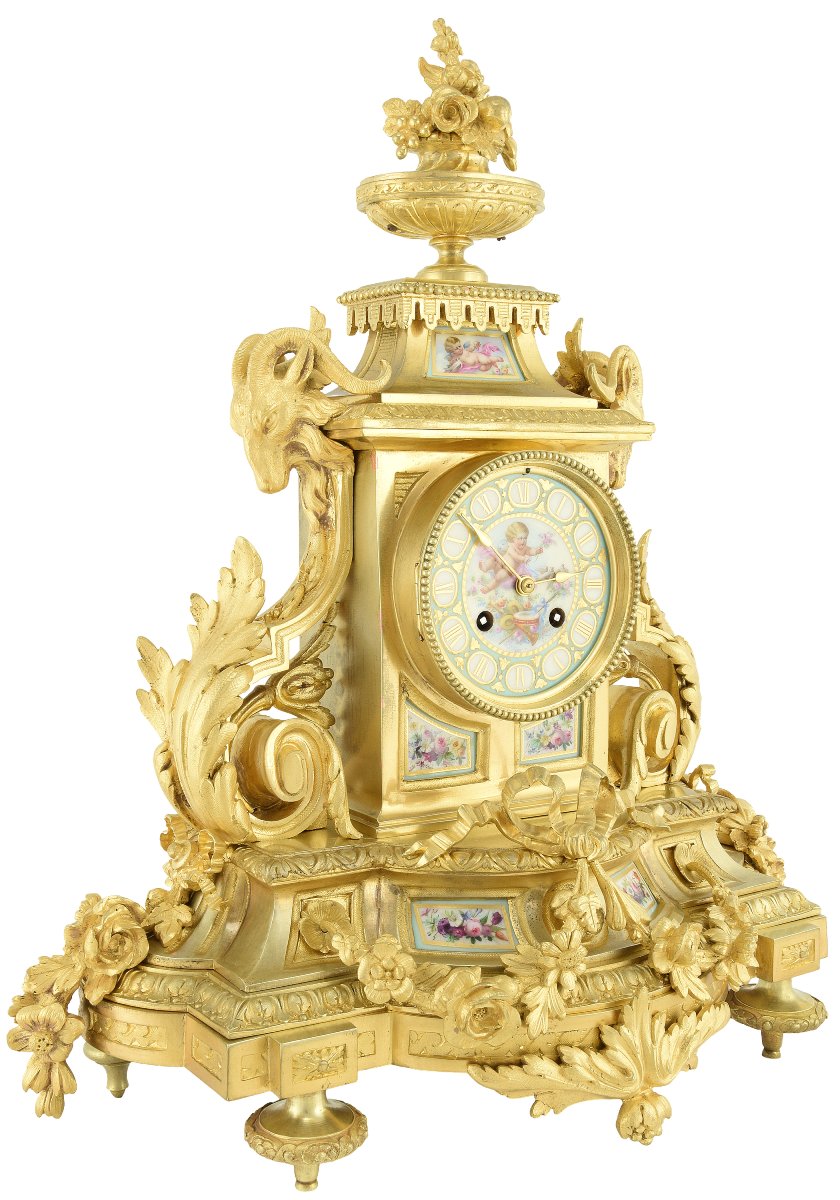
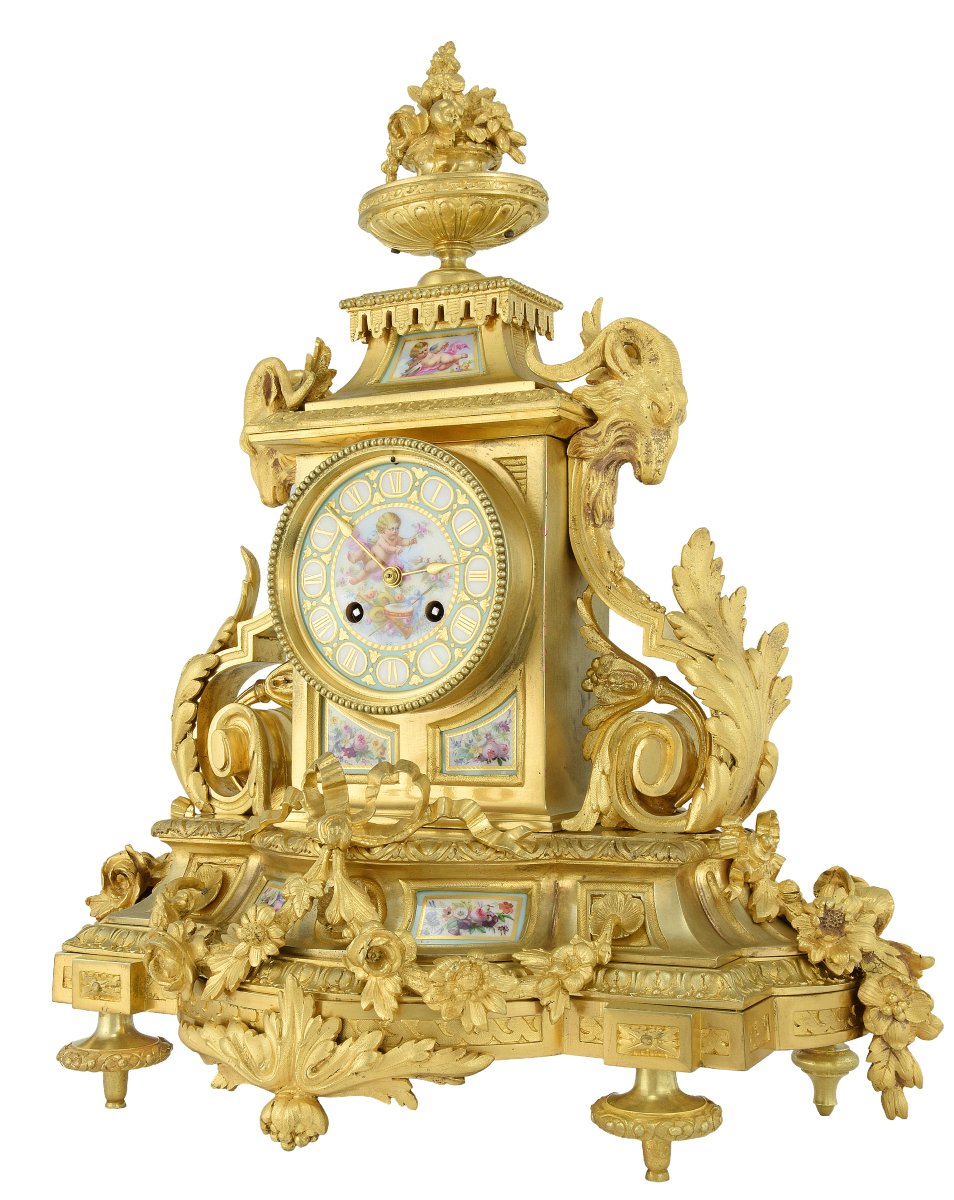
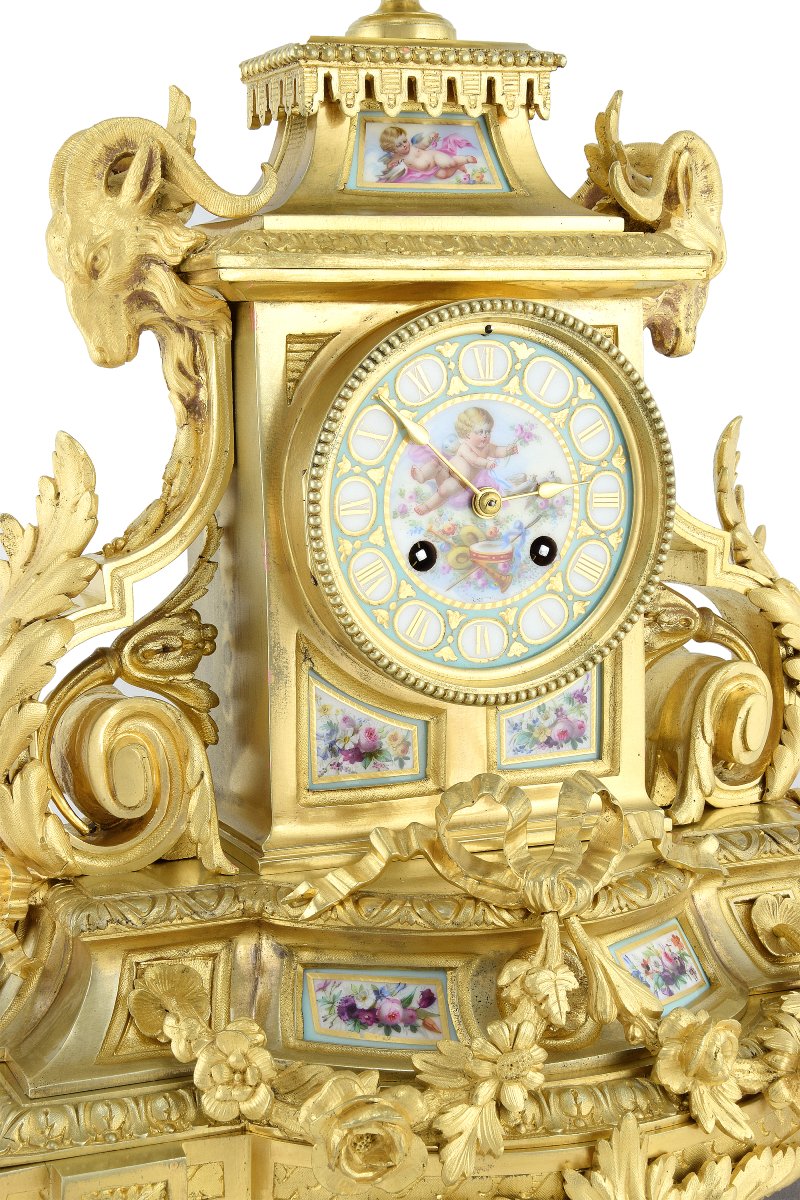
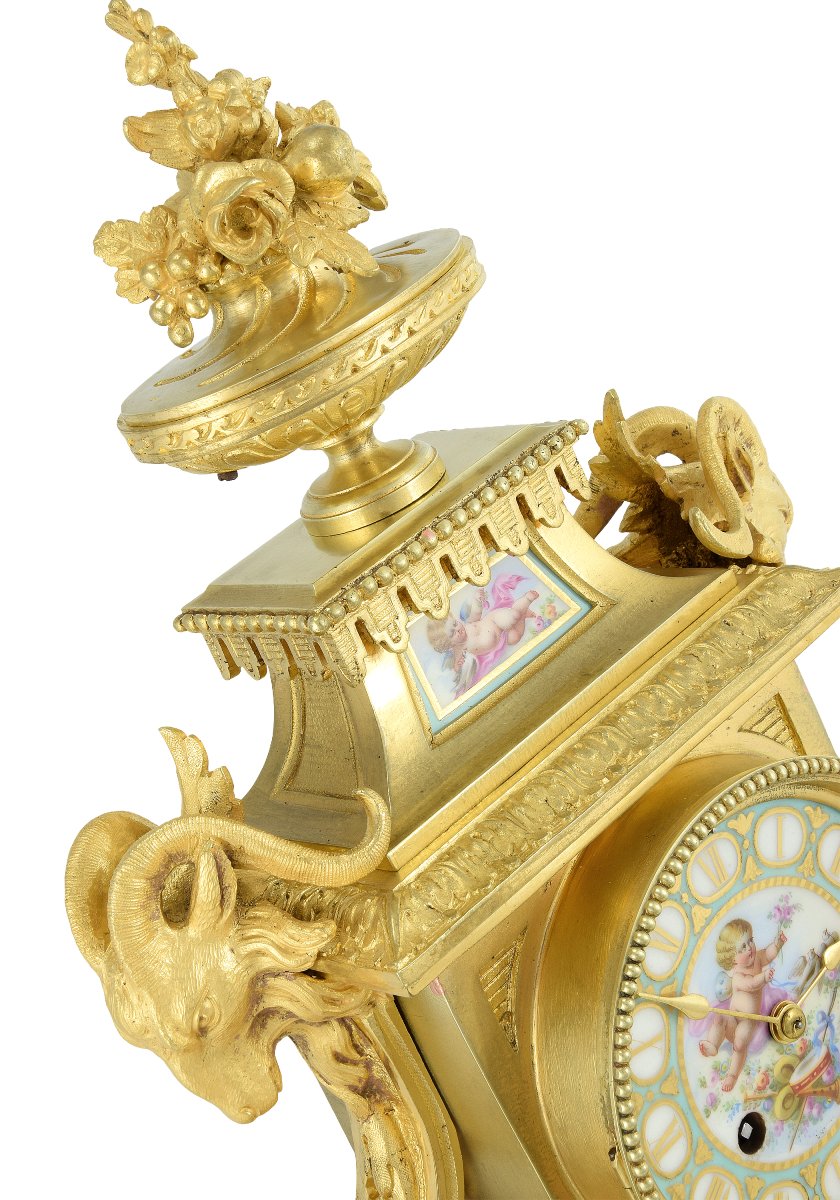
At the summit rises a substantial gadrooned urn, resting on a circular pedestal foot. The bowl is adorned with a water-leaf frieze and holds an abundant gilt-bronze floral arrangement featuring full-blown roses, buds, foliage, and clusters of berries. This urn sits upon a truncated conical base with sloping sides, encircled at the top by an elegant gallery featuring dentil and bead moldings. The front face depicts a charming winged putto reclining amidst flowers, rendered with remarkable painterly finesse.
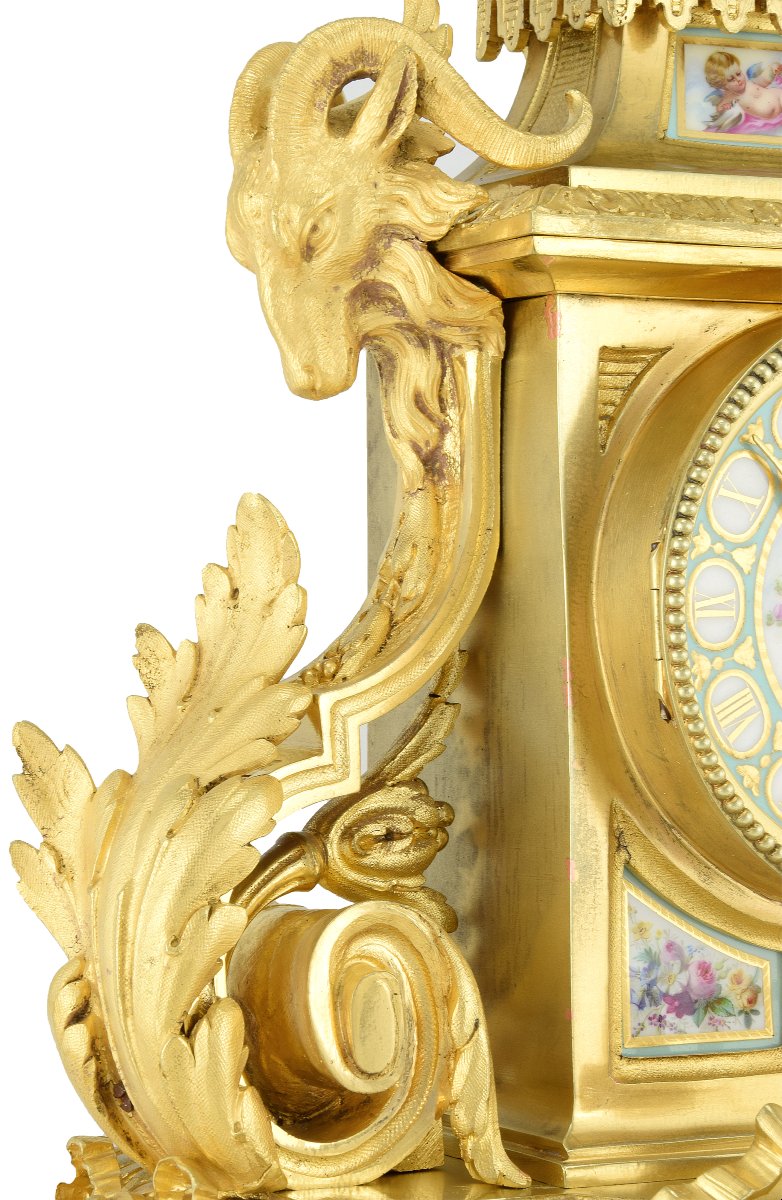
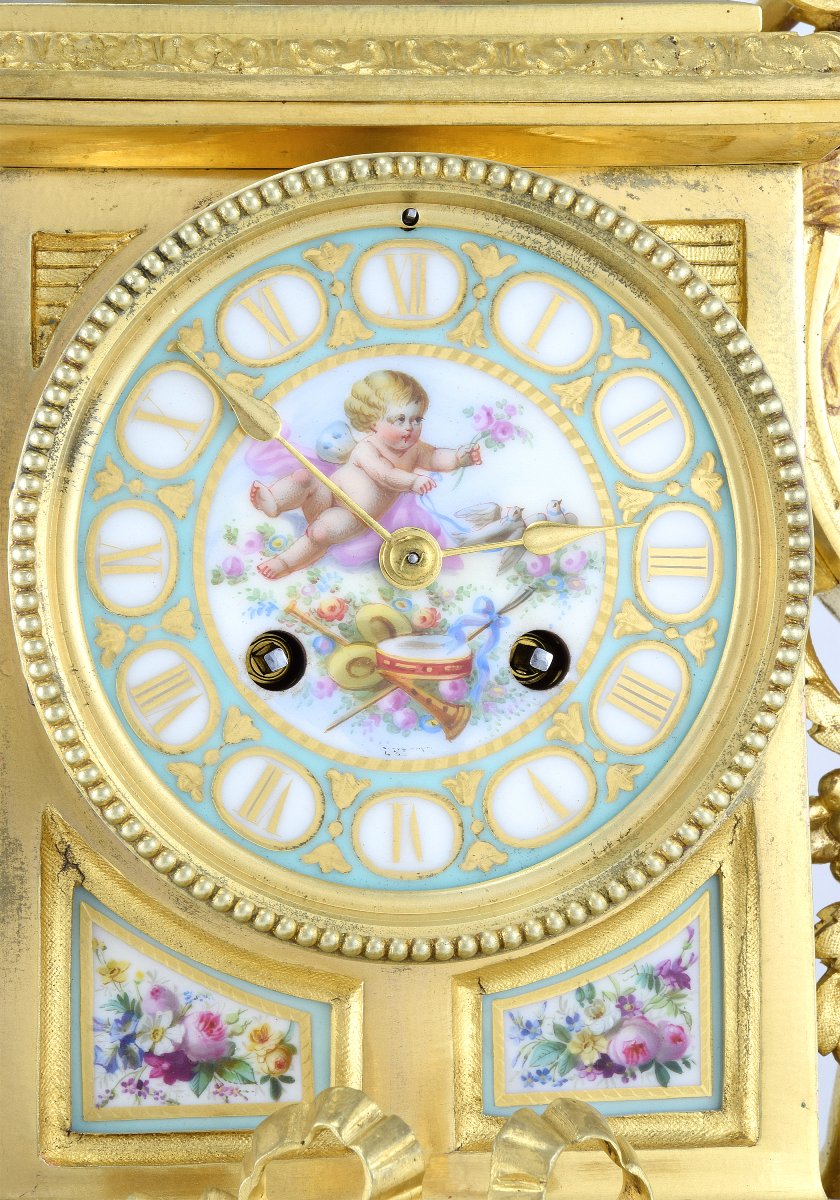
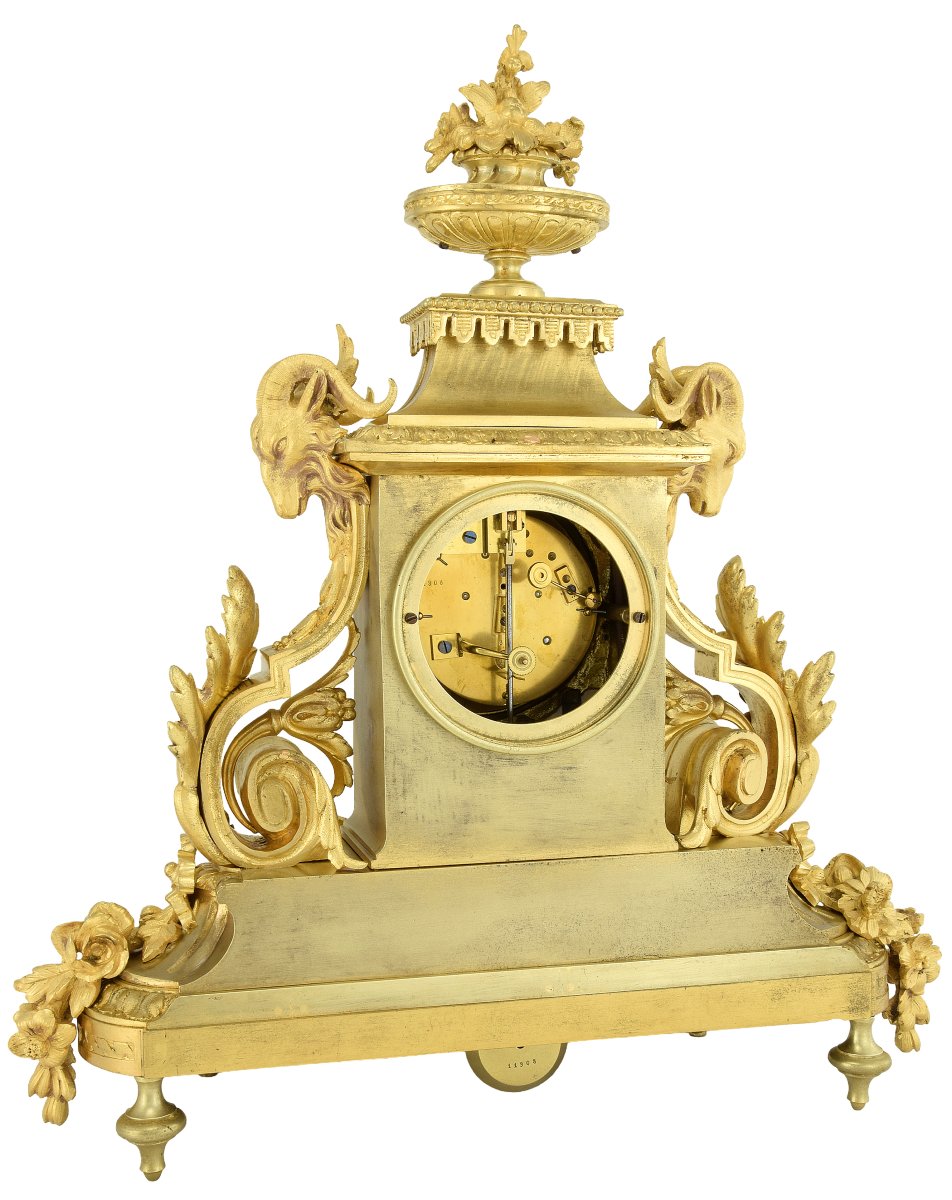
The circular dial is set within a gilt-bronze bezel accented by a beaded frieze. It features elegant Paris porcelain decoration against a celestial blue background. Twelve white enamel cartouches display gilt Roman numerals, separated by delicate, stylized gilt floral motifs. At the center of the dial, a delightful painted scene unfolds, depicting Cupid amidst a floral arrangement, accompanied by a dove and the attributes of Love. The lower section of the design features a tambourine, a flower-adorned hat, ribbons, and polychrome flowers, lending a gentle quality to the whole. Elegant openwork gilt-bronze hands harmoniously complete this refined composition. Beneath the dial sit two trapezoidal Paris porcelain plaques, decorated with hand-painted polychrome floral bouquets on a white ground—framed by a gilt line and a broad *bleu céleste* (sky-blue) background—creating a pleasing transition to the base. Flanking the central body are bold, scrolling volutes reminiscent of architectural consoles. They are embellished with large, deeply veined acanthus leaf sprays that sweep elegantly upward toward the top corners. The upper terminals are crowned by spectacular, masterfully sculpted ram's heads with sweeping, curled horns; the quality of their modeling perfectly exemplifies the craftsmanship of Parisian bronze-makers of the period.
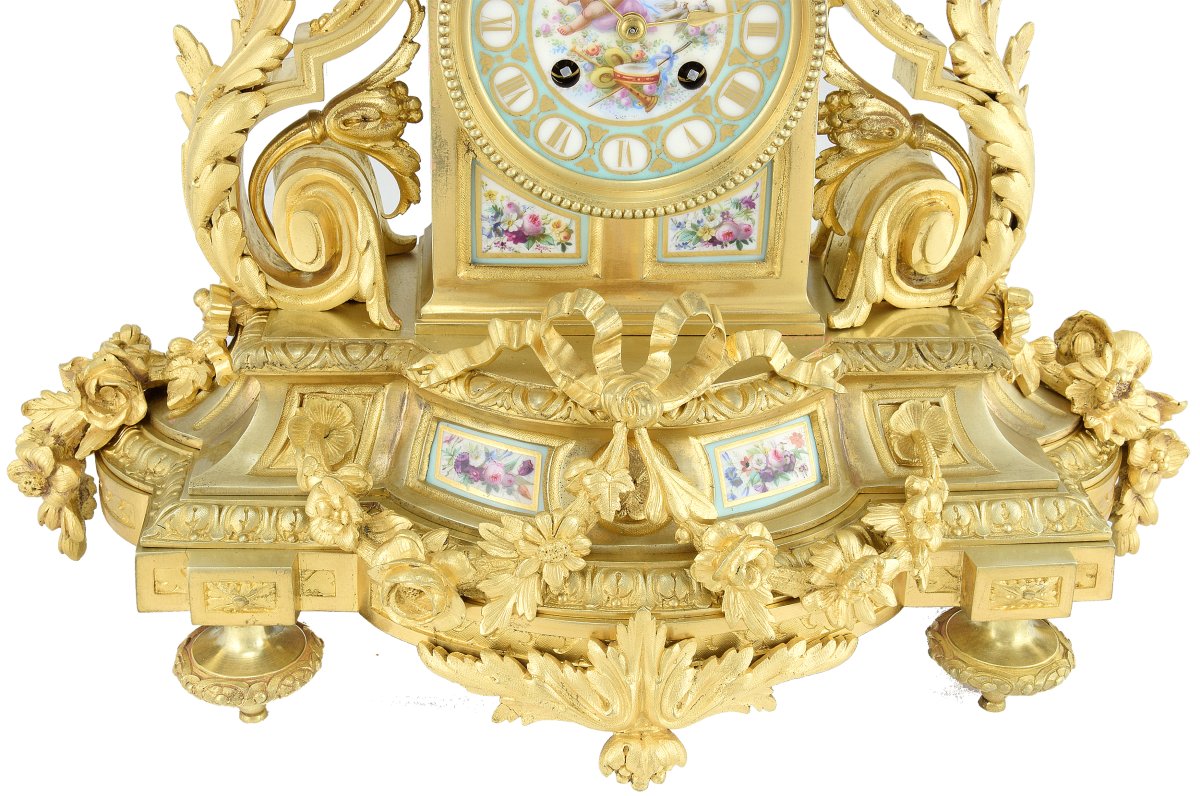
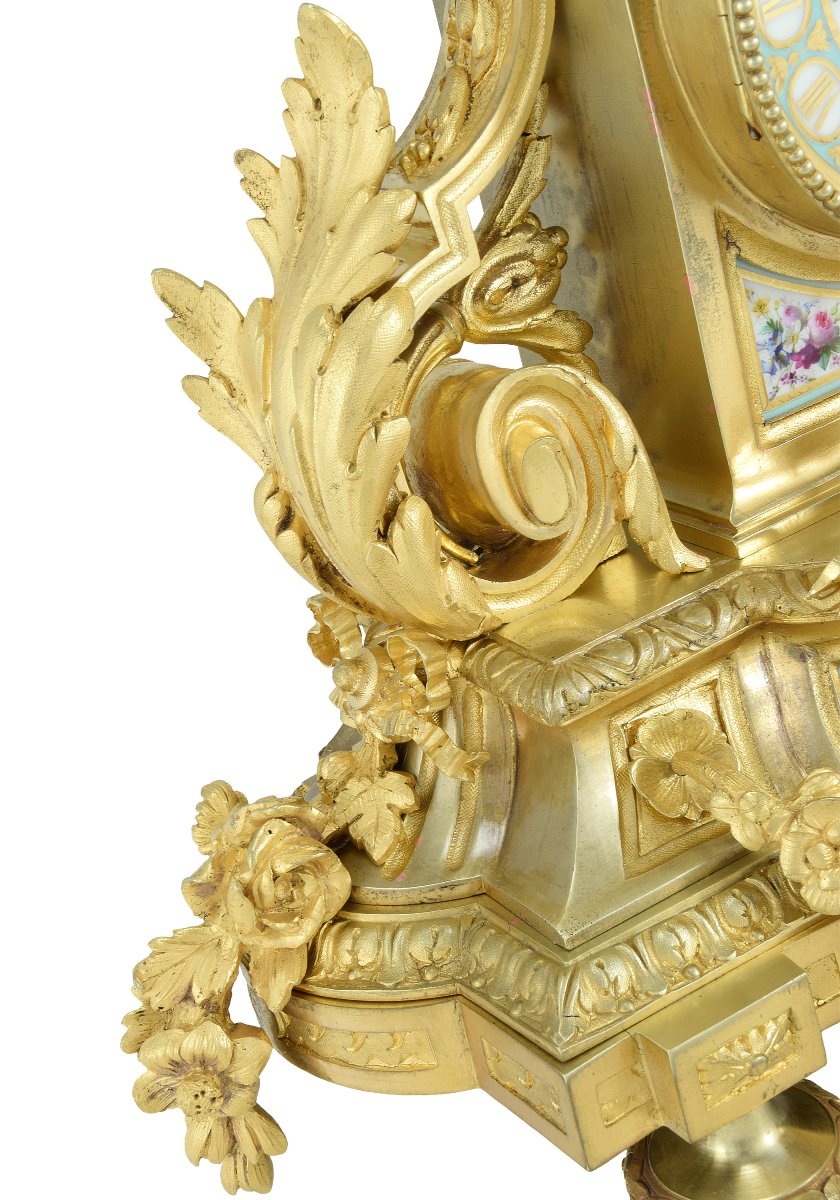
The clock rests on a substantial, complexly shaped base featuring multiple projections and alternating inclined planes, moldings, and curved surfaces. At the center, a spectacular Louis XVI-style bow with wide, flowing ribbons serves as the primary decorative motif. Suspended from a central rosette, it allows two long swags of drapery to fall, ending in stylized tassels. The base is richly adorned with numerous Paris porcelain plaques painted with bouquets of roses, peonies, pansies, and wildflowers in shades of pink, mauve, blue, and yellow—each framed by gilt lines against a *bleu céleste* ground. Their symmetrical arrangement brings a harmonious liveliness to the entire façade.
The piece is lavishly decorated with a spectacular gilt-bronze floral garland spanning the full width of the base. Open roses, buds, daisies, wildflowers, and foliage intertwine naturally in a remarkably dynamic composition, showcasing exceptional chasing and matte finishing. The base moldings feature a succession of delicately chased friezes—including egg-and-dart, water leaves, ribbons, beadwork, and foliate motifs—that enhance the overall decorative richness. At the lower center, an imposing, deeply carved fan-shaped acanthus mount unfolds, visually balancing the composition and emphasizing the monumental quality of the base. The piece rests on four elegant, turned circular feet—adorned with gadrooning and beaded friezes—which ensure perfect stability while maintaining a sense of visual lightness.
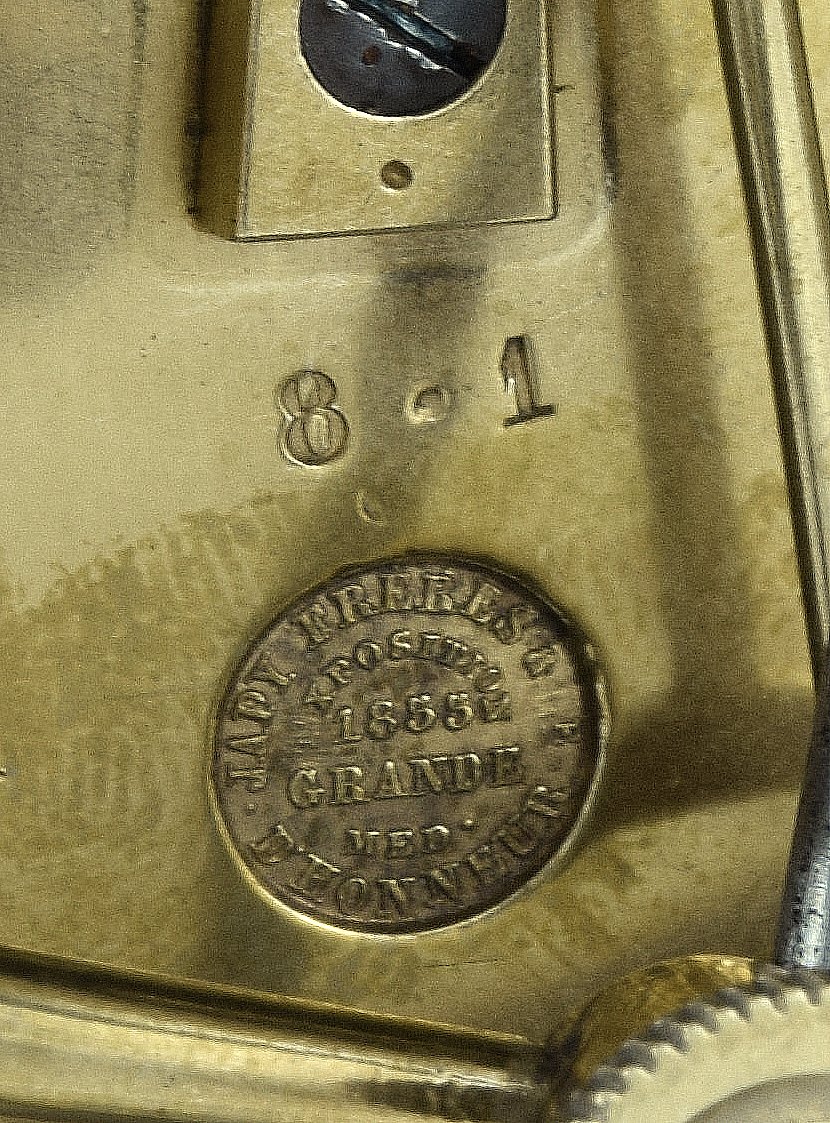
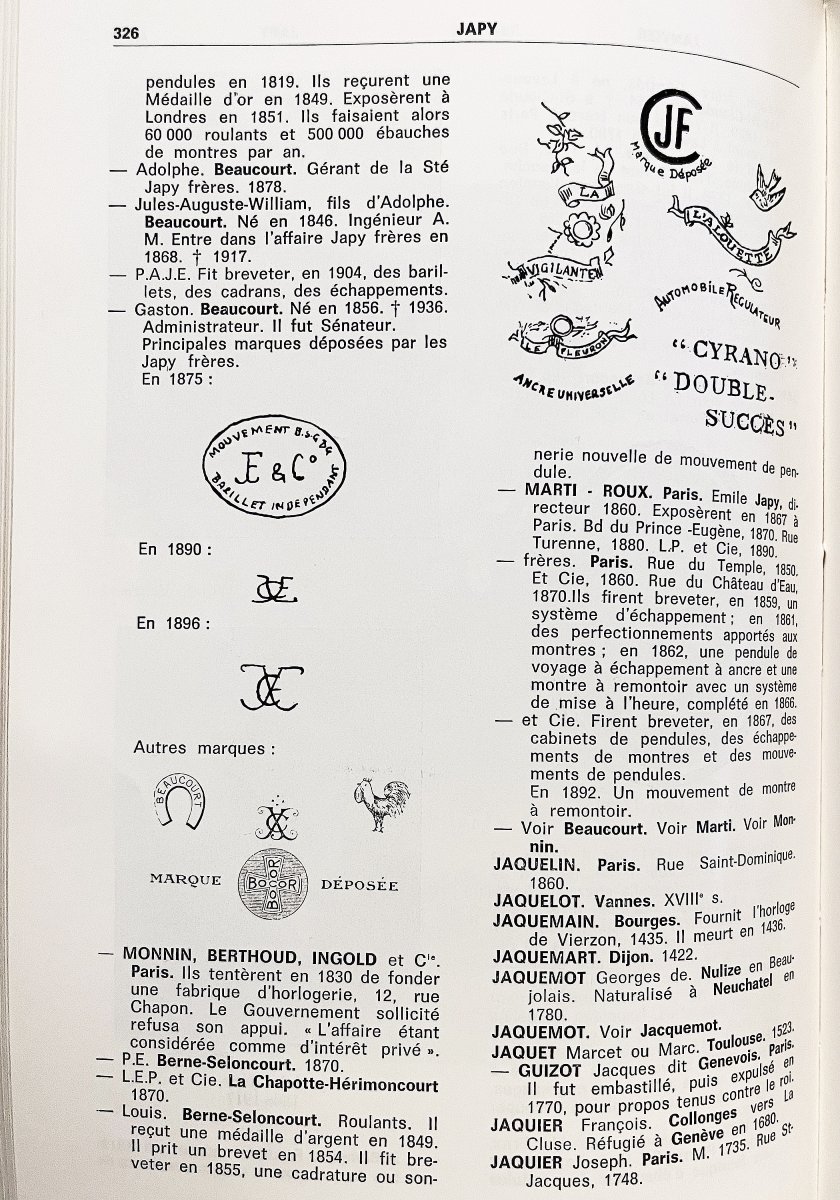
The high-quality mechanical movement bears the stamp of Japy Frères—an iconic 19th-century French clockmaking firm—guaranteeing excellent precision and craftsmanship that meets the standards of the era's leading Parisian houses.
With its extraordinarily rich ornamentation, finely chased details, high-quality gilding, abundance of hand-painted Paris porcelain plaques, and highly elaborate architecture, this impressive clock stands as a remarkable testament to the decorative luxury of the Second Empire (Napoleon III) period, perfectly exemplifying the refined taste of fine Parisian craftsmanship from the 1860s.
Original mechanism, intact and unmodified. Strikes the hours and half-hours on an antique bell with a clear, authentic tone.
ORDERING AND ADDITIONAL INFORMATION FROM OUR WEBSITE
At the summit rises a substantial gadrooned urn, resting on a circular pedestal foot. The bowl is adorned with a water-leaf frieze and holds an abundant gilt-bronze floral arrangement featuring full-blown roses, buds, foliage, and clusters of berries. This urn sits upon a truncated conical base with sloping sides, encircled at the top by an elegant gallery featuring dentil and bead moldings. The front face depicts a charming winged putto reclining amidst flowers, rendered with remarkable painterly finesse.
The circular dial is set within a gilt-bronze bezel accented by a beaded frieze. It features elegant Paris porcelain decoration against a celestial blue background. Twelve white enamel cartouches display gilt Roman numerals, separated by delicate, stylized gilt floral motifs. At the center of the dial, a delightful painted scene unfolds, depicting Cupid amidst a floral arrangement, accompanied by a dove and the attributes of Love. The lower section of the design features a tambourine, a flower-adorned hat, ribbons, and polychrome flowers, lending a gentle quality to the whole. Elegant openwork gilt-bronze hands harmoniously complete this refined composition. Beneath the dial sit two trapezoidal Paris porcelain plaques, decorated with hand-painted polychrome floral bouquets on a white ground—framed by a gilt line and a broad *bleu céleste* (sky-blue) background—creating a pleasing transition to the base. Flanking the central body are bold, scrolling volutes reminiscent of architectural consoles. They are embellished with large, deeply veined acanthus leaf sprays that sweep elegantly upward toward the top corners. The upper terminals are crowned by spectacular, masterfully sculpted ram's heads with sweeping, curled horns; the quality of their modeling perfectly exemplifies the craftsmanship of Parisian bronze-makers of the period.
The clock rests on a substantial, complexly shaped base featuring multiple projections and alternating inclined planes, moldings, and curved surfaces. At the center, a spectacular Louis XVI-style bow with wide, flowing ribbons serves as the primary decorative motif. Suspended from a central rosette, it allows two long swags of drapery to fall, ending in stylized tassels. The base is richly adorned with numerous Paris porcelain plaques painted with bouquets of roses, peonies, pansies, and wildflowers in shades of pink, mauve, blue, and yellow—each framed by gilt lines against a *bleu céleste* ground. Their symmetrical arrangement brings a harmonious liveliness to the entire façade.
The piece is lavishly decorated with a spectacular gilt-bronze floral garland spanning the full width of the base. Open roses, buds, daisies, wildflowers, and foliage intertwine naturally in a remarkably dynamic composition, showcasing exceptional chasing and matte finishing. The base moldings feature a succession of delicately chased friezes—including egg-and-dart, water leaves, ribbons, beadwork, and foliate motifs—that enhance the overall decorative richness. At the lower center, an imposing, deeply carved fan-shaped acanthus mount unfolds, visually balancing the composition and emphasizing the monumental quality of the base. The piece rests on four elegant, turned circular feet—adorned with gadrooning and beaded friezes—which ensure perfect stability while maintaining a sense of visual lightness.
The high-quality mechanical movement bears the stamp of Japy Frères—an iconic 19th-century French clockmaking firm—guaranteeing excellent precision and craftsmanship that meets the standards of the era's leading Parisian houses.
With its extraordinarily rich ornamentation, finely chased details, high-quality gilding, abundance of hand-painted Paris porcelain plaques, and highly elaborate architecture, this impressive clock stands as a remarkable testament to the decorative luxury of the Second Empire (Napoleon III) period, perfectly exemplifying the refined taste of fine Parisian craftsmanship from the 1860s.
Original mechanism, intact and unmodified. Strikes the hours and half-hours on an antique bell with a clear, authentic tone.
ORDERING AND ADDITIONAL INFORMATION FROM OUR WEBSITE
1 300 €
Period: 19th century
Style: Napoleon 3rd
Condition: Fully restored in our whorkshop
Material: Bronze
Width: 40 cm
Height: 46 cm
Depth: 18 cm
Reference (ID): 1788813
Availability: In stock
Print