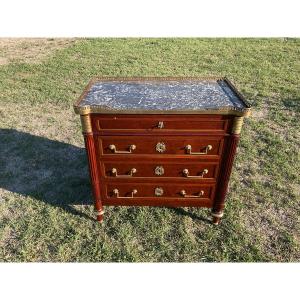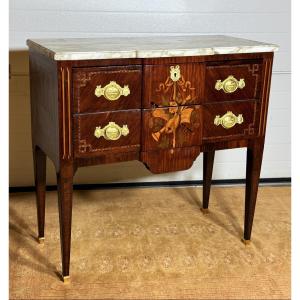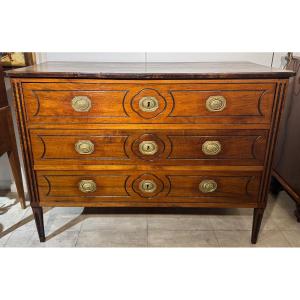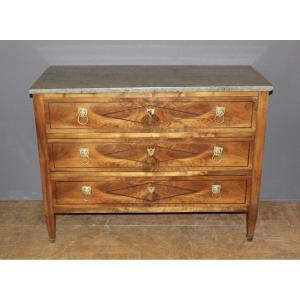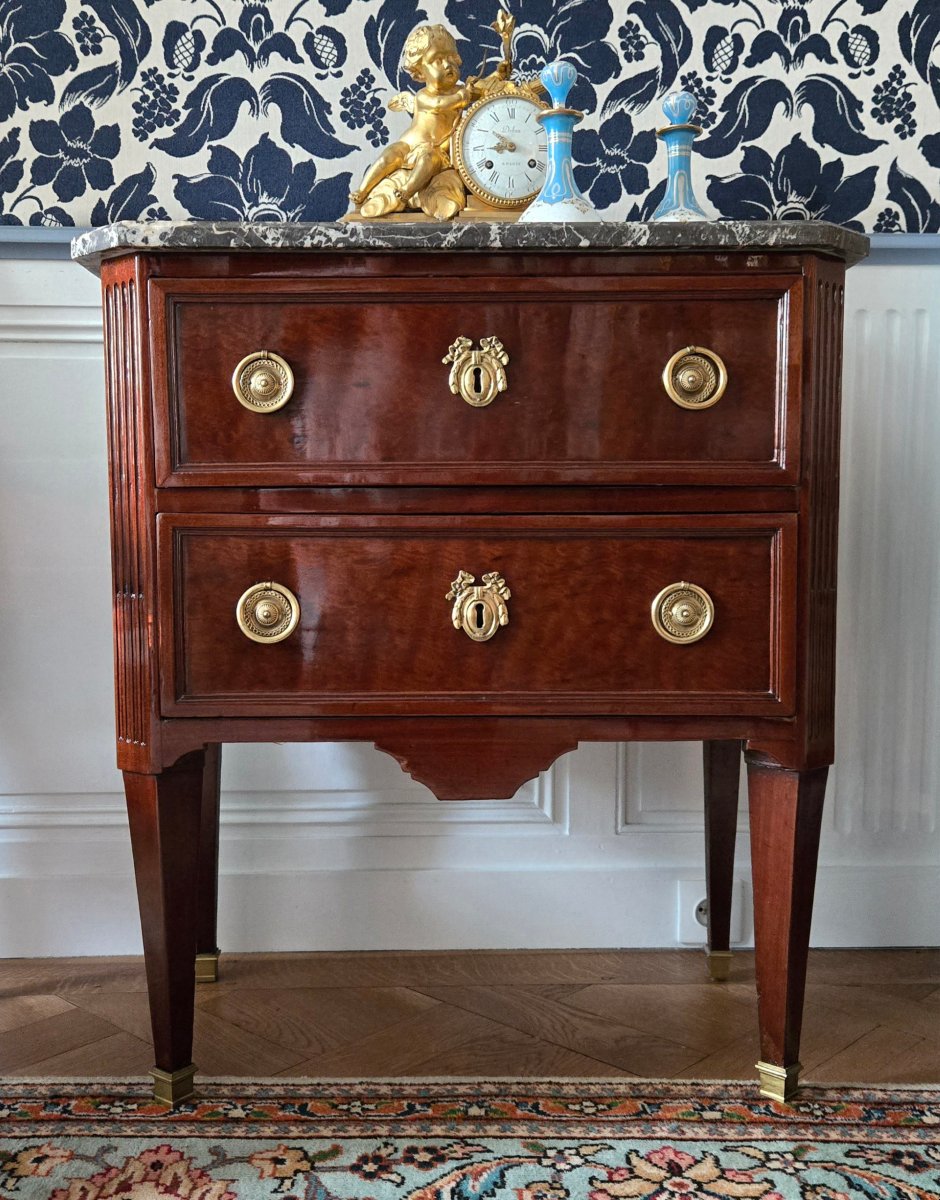
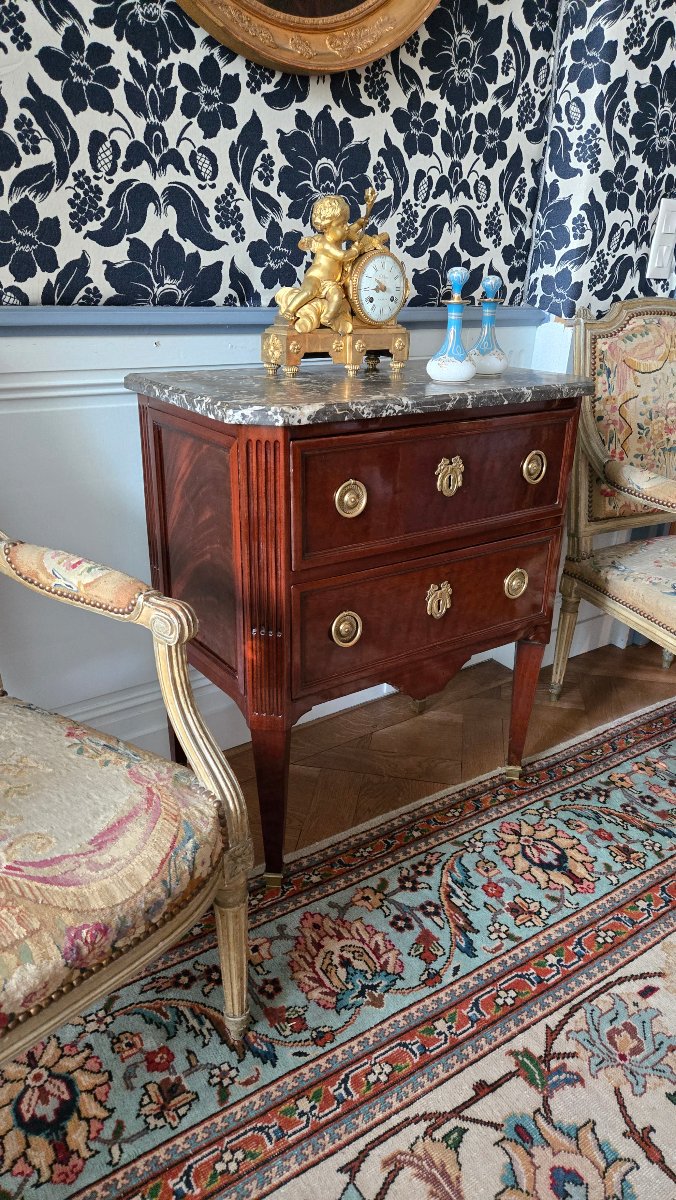


Small Louis XVI-period Chest Of Drawers Made Of Mottled And Flamed Mahogany, Circa 1780.
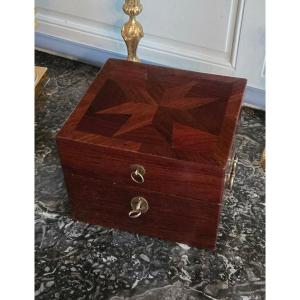
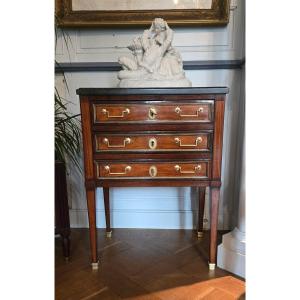
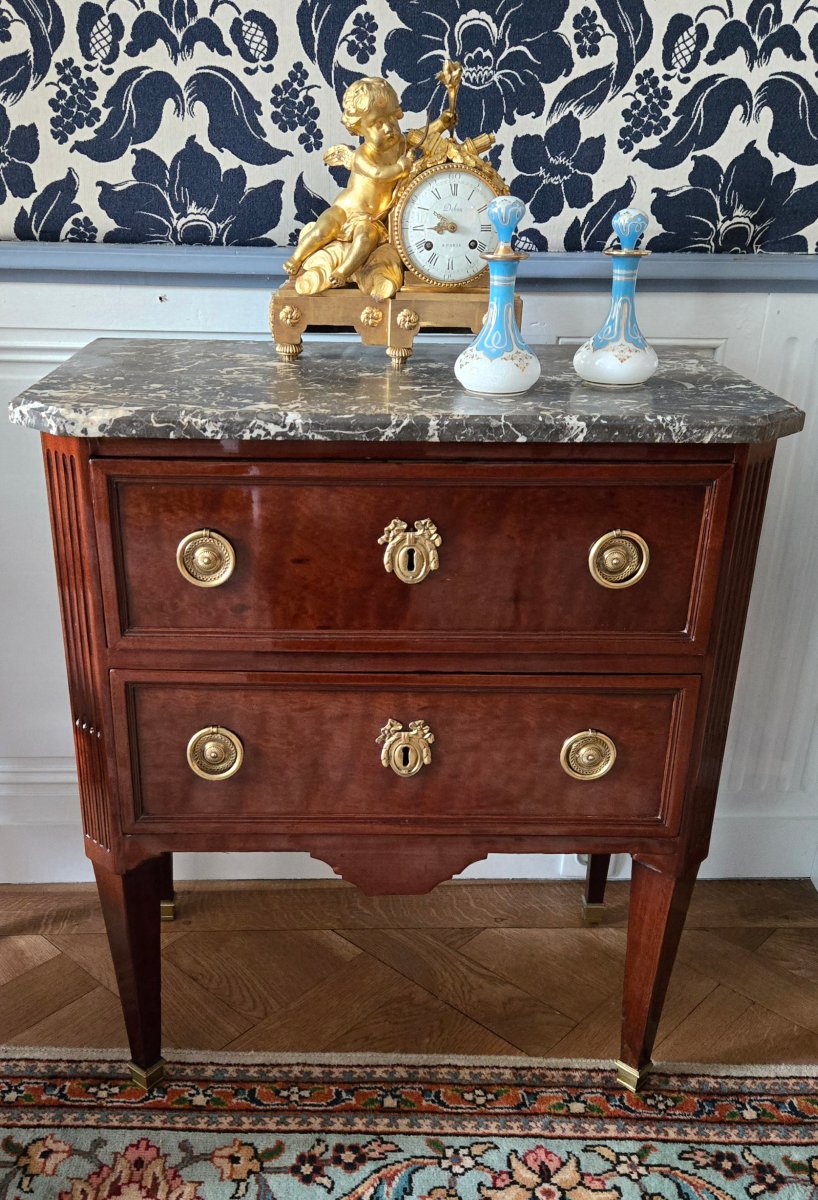
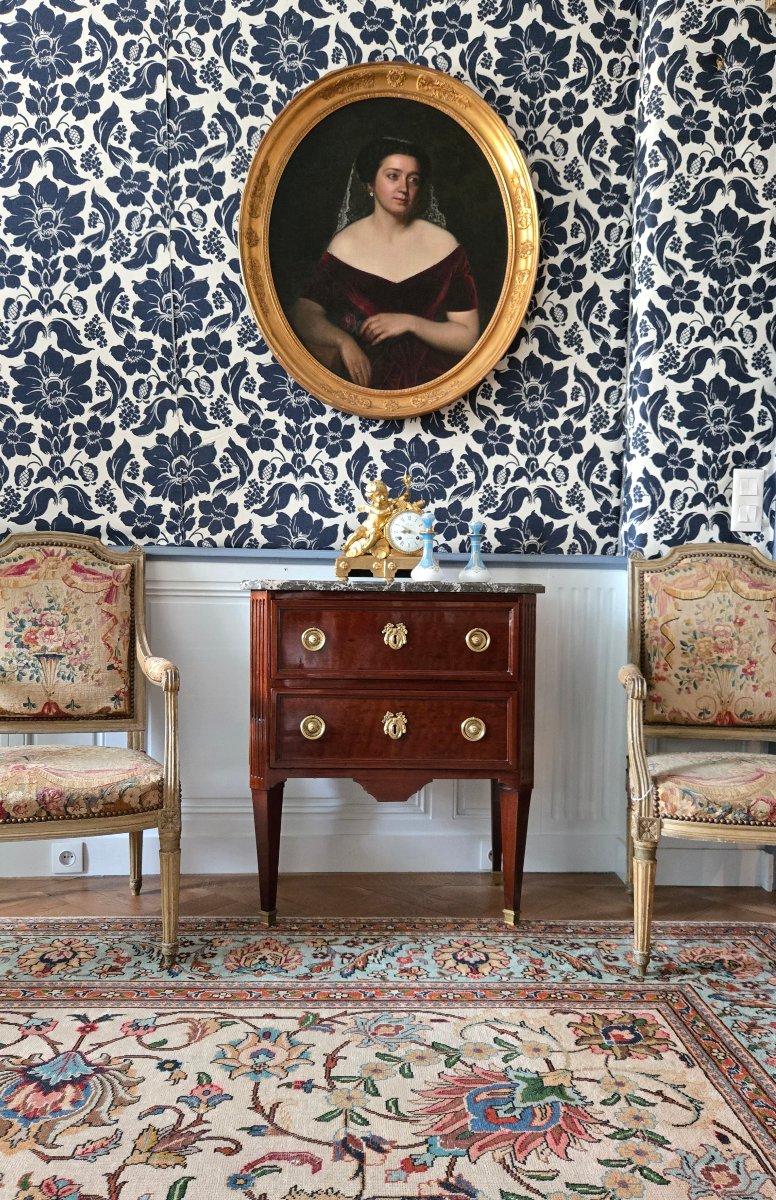
An elegant small Louis XVI-era chest of drawers, made of mahogany and mahogany veneer, featuring harmonious proportions and refined design, characteristic of the neoclassical style of the second half of the 18th century.
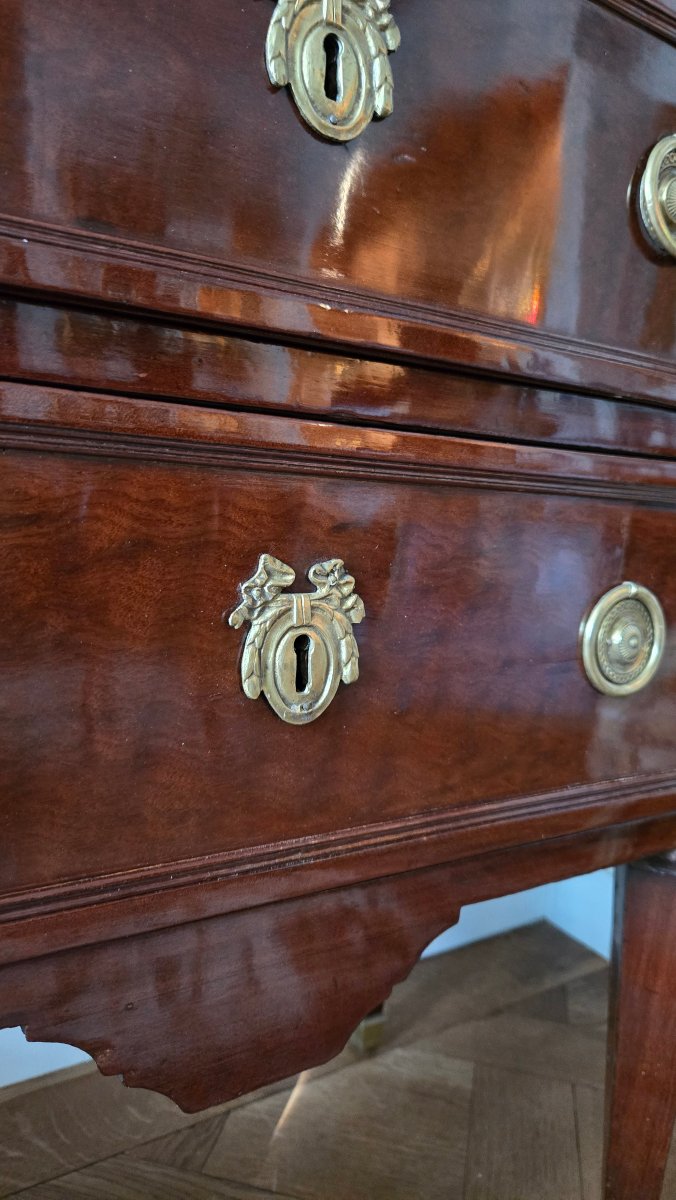
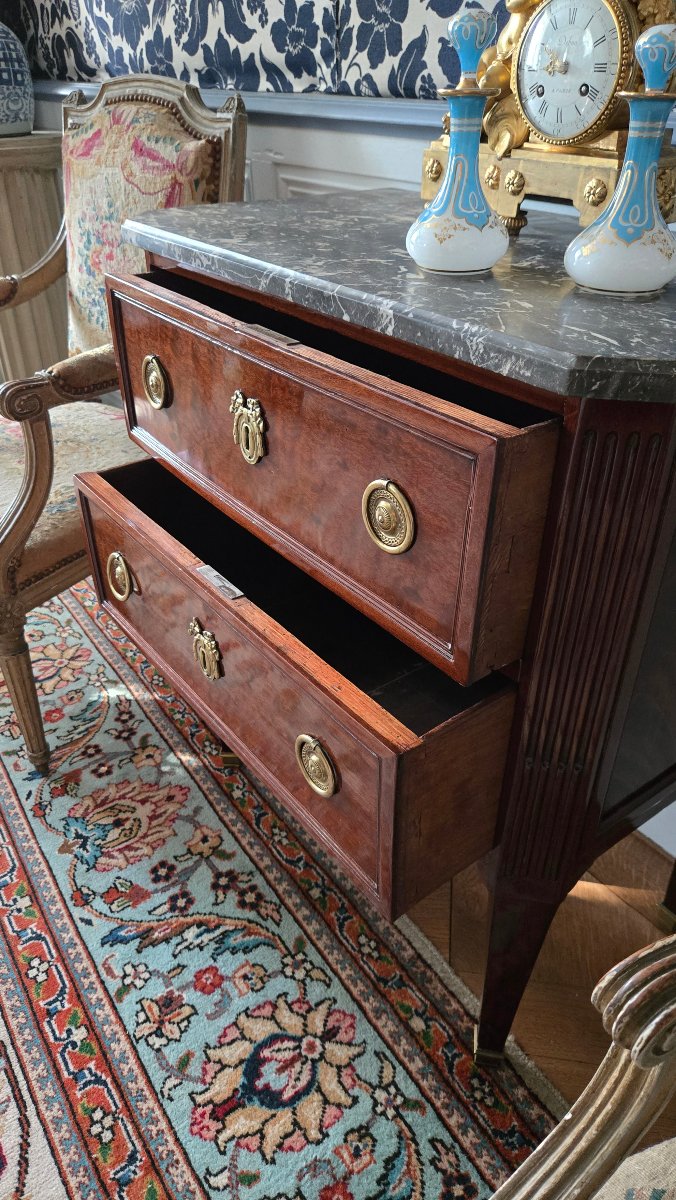
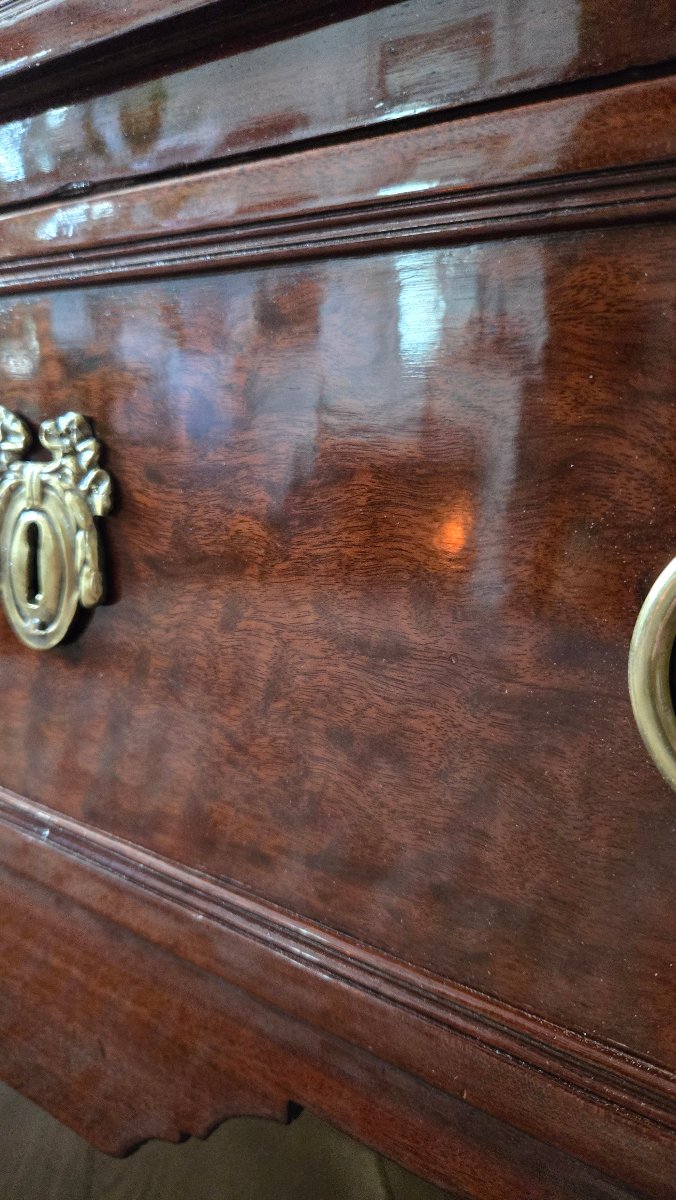
The front features two stacked drawers, veneered with speckled mahogany with a dense, undulating grain in beautiful reddish-brown hues. Each drawer front is highlighted by a slightly projecting, molded framing strip.
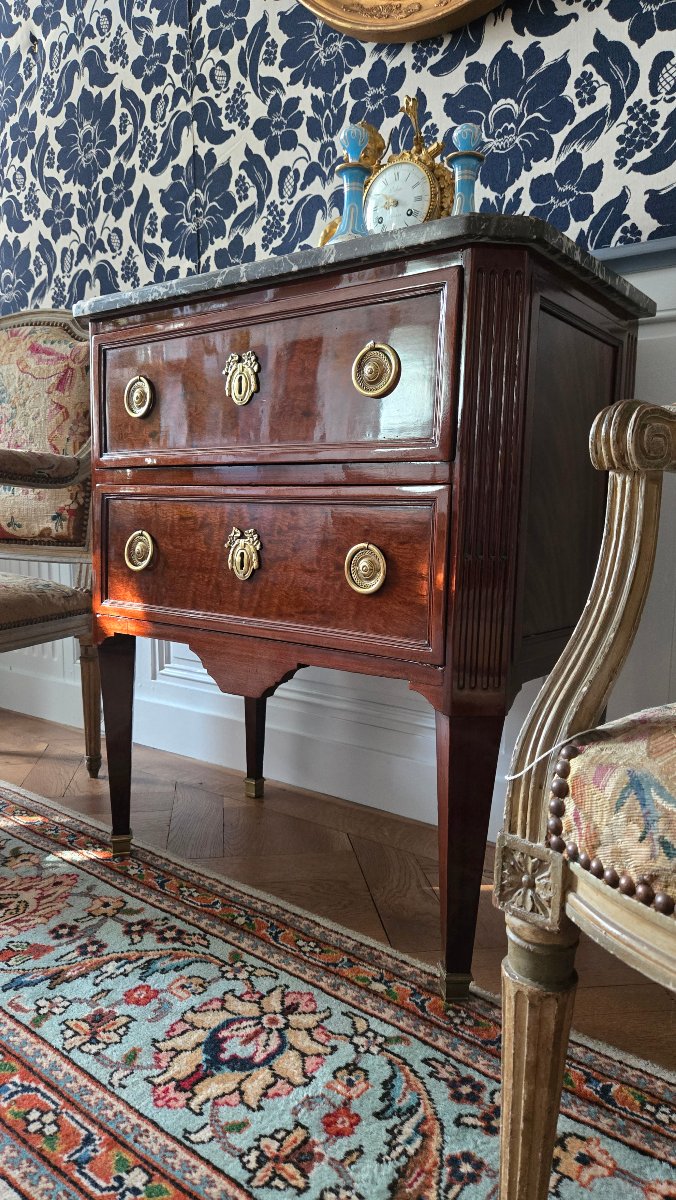
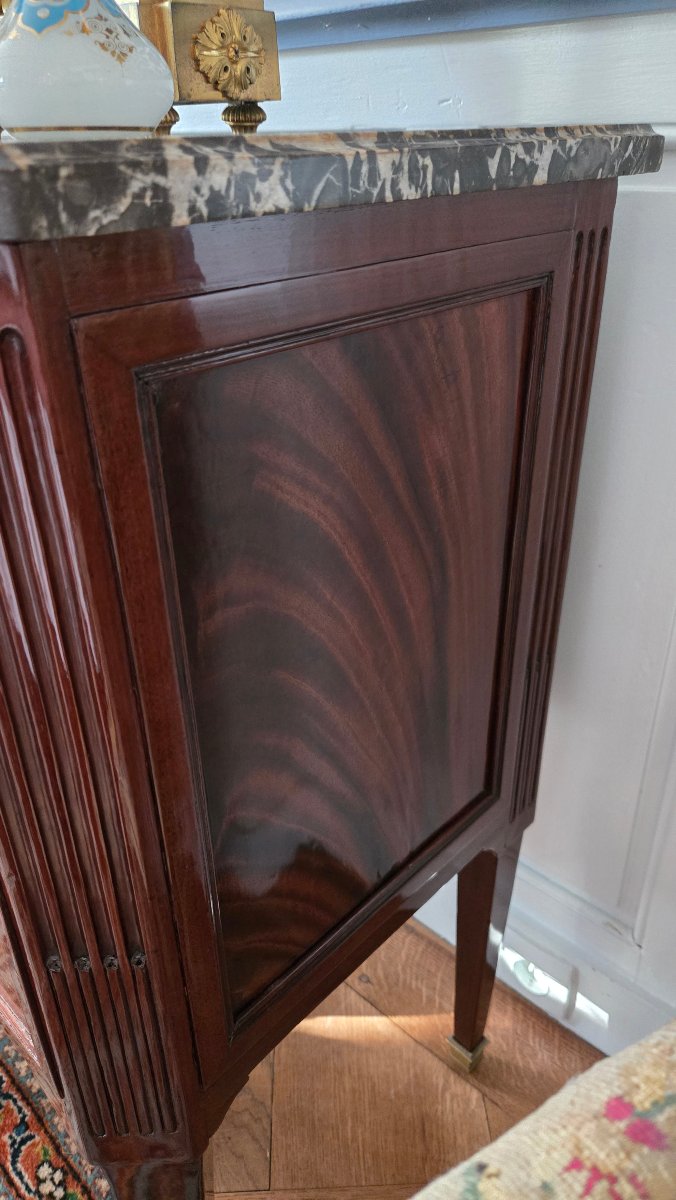
The sides are paneled and feature flamed mahogany veneers with widely fanning grain patterns, also highlighted by molded framing moldings.
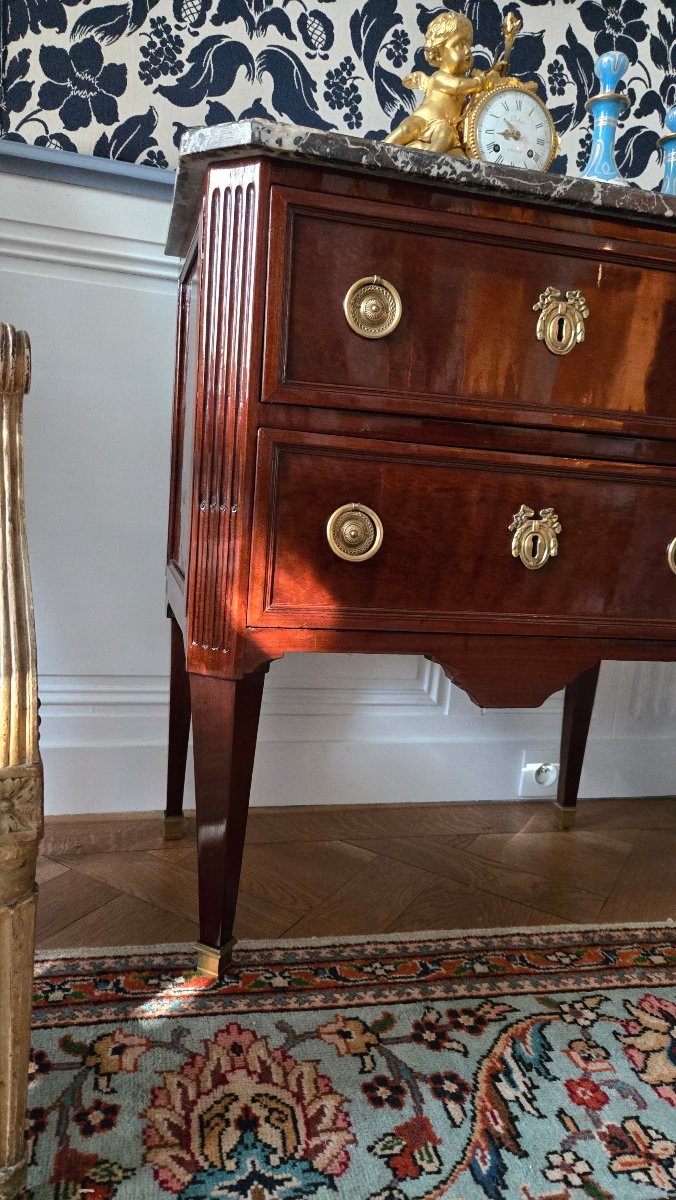
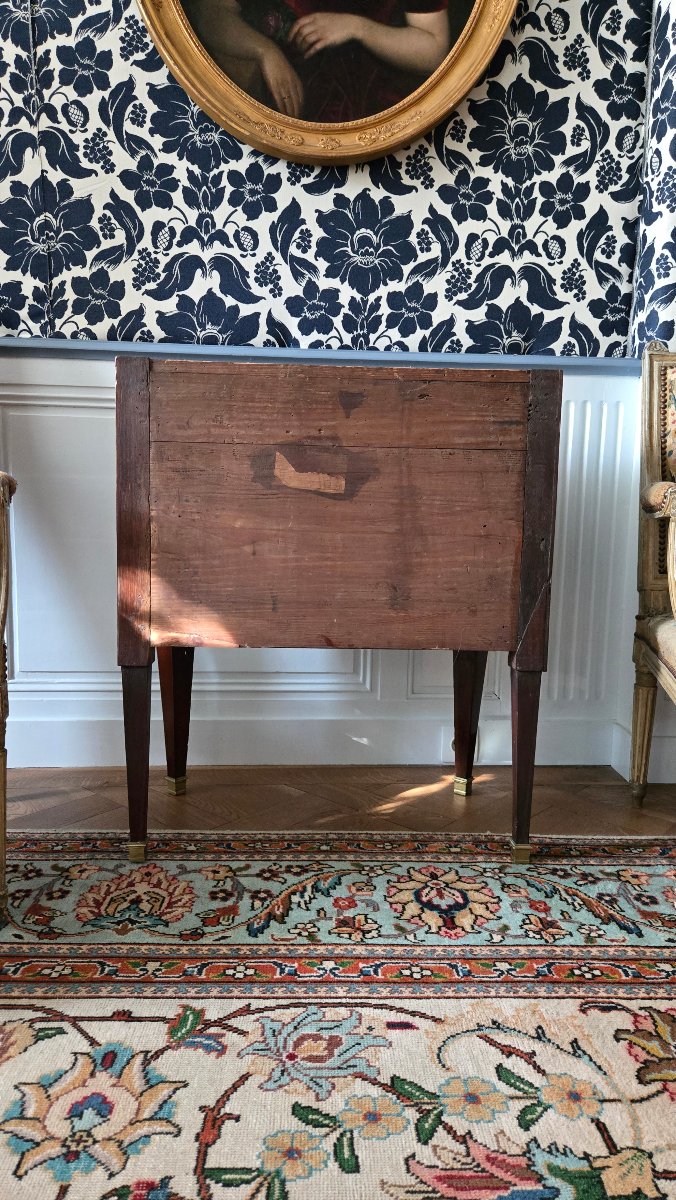
The four beveled posts, treated as pilasters, are adorned with fluted bands of reeds carved from solid mahogany. Particular care was taken in their execution: the end of each reed, slightly hollowed out and pierced at its center, replicates the natural cross-section of a reed stalk. This decoration appears on both the front and back posts.
The chest of drawers rests on four tapered, square-sectioned legs, ending in bronze feet. The lower front crossbar features a scroll-cutout forming a small central apron.
It retains its original metal ornamentation, consisting of drop-style ring handles set on circular repoussé copper rosettes adorned with radiating motifs, two medallion-shaped lock plates decorated with ribbon knots, as well as the feet on all four legs.
The two locks are later additions.
It is topped with a gray Sainte-Anne marble slab, with cut-off front corners and a quarter-round fillet.
The construction of this chest of drawers is also of particular interest.
Its frame combines oak—used for the four uprights—with fir, which makes up the bulk of the body. The legs are clad with solid mahogany veneers approximately 6 mm thick, into which the fluting and its carved ridges are carved.
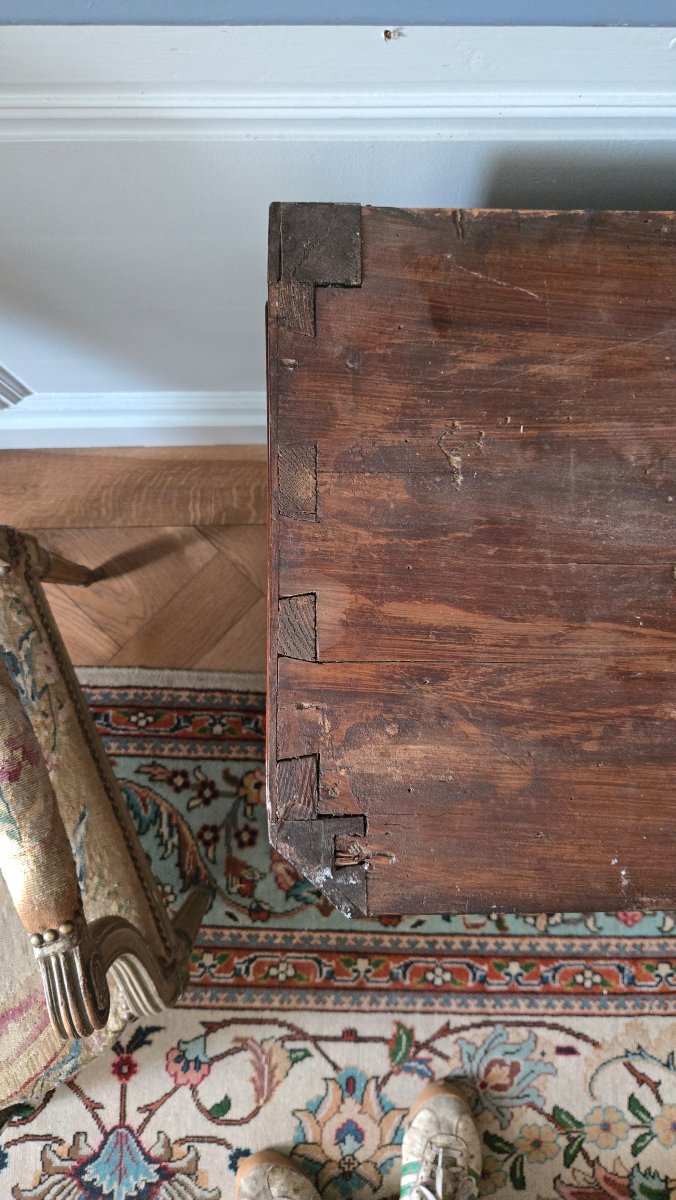
The top, made of wide fir planks, is directly joined to the side panels—also made of softwood—using sturdy, exposed dovetail joints, forming a true box structure.
This construction method is part of an ancient tradition in French cabinetmaking, already present during the reign of Louis XIV and the Regency, particularly in certain regional productions. It is also found in the great Parisian cabinetmaking of the second half of the 18th century, among masters such as Jean-François Leleu and Jean-Henri Riesener, who used this method of assembly to join the tops directly to the sides of the furniture.
The drawers feature traditional construction, with softwood fronts veneered in mahogany, oak sides and backs joined with dovetail joints, and bottoms that slide into grooves.
The chest of drawers has been thoroughly cleaned and refinished using a buffing technique, highlighting the depth of the mahogany’s hues and its varied grain patterns.
With its compact dimensions, the quality of its veneers, and the care taken in its construction, this small chest of drawers is a fascinating example of French cabinetmaking from the Louis XVI period.
Dimensions measured on a drawing board:
- Height: 80 cm
- Width: 70.5 cm
- Depth: 40.5 cm
2 400 €
Period: 18th century
Style: Louis 16th, Directory
Condition: Fully restored
Material: Mahogany
Reference (ID): 1840604
Availability: In stock
Print