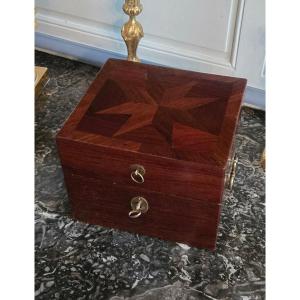


Atole Veneer Toiletries Set – Pais, Regency Period, Circa 1720–1730.
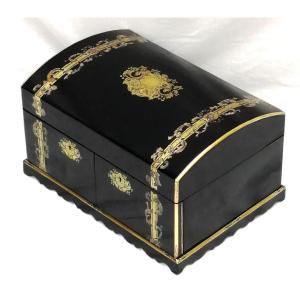
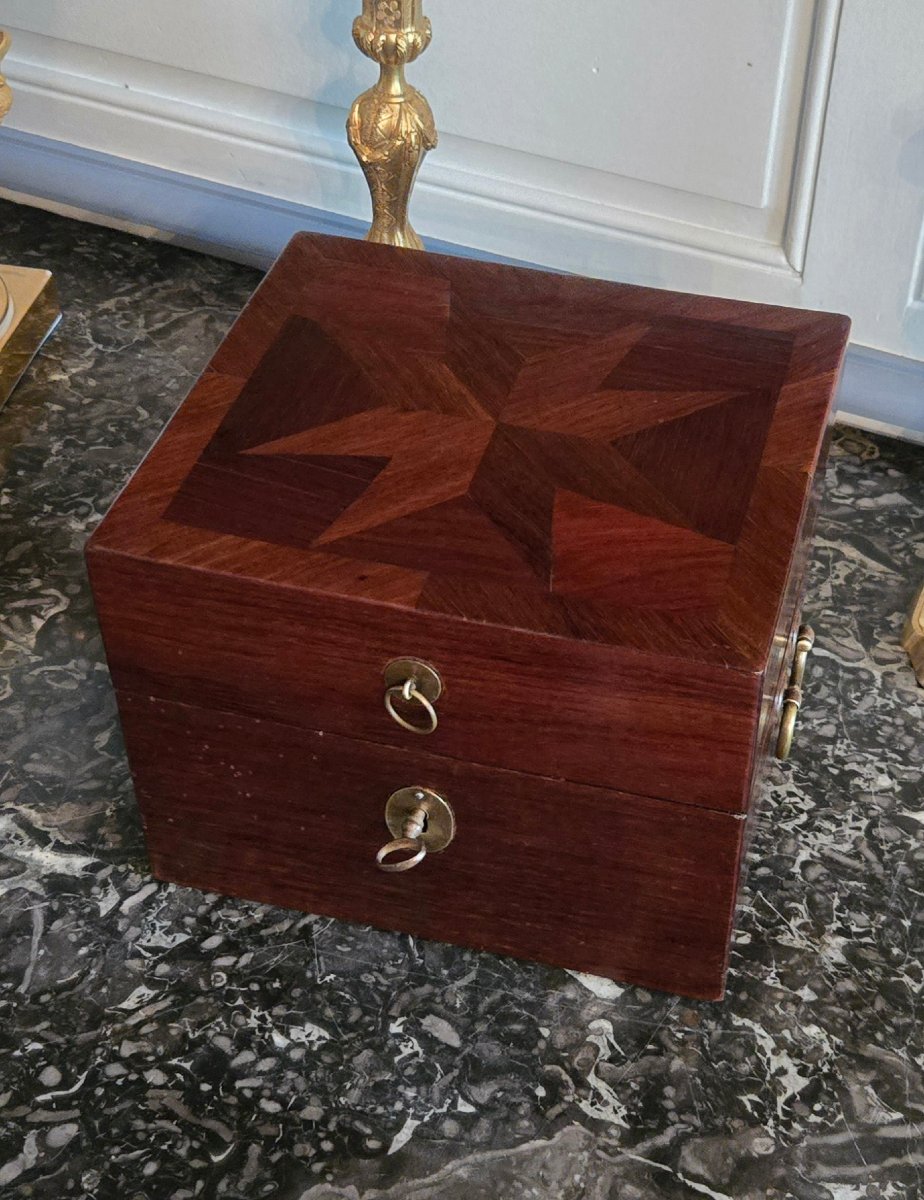
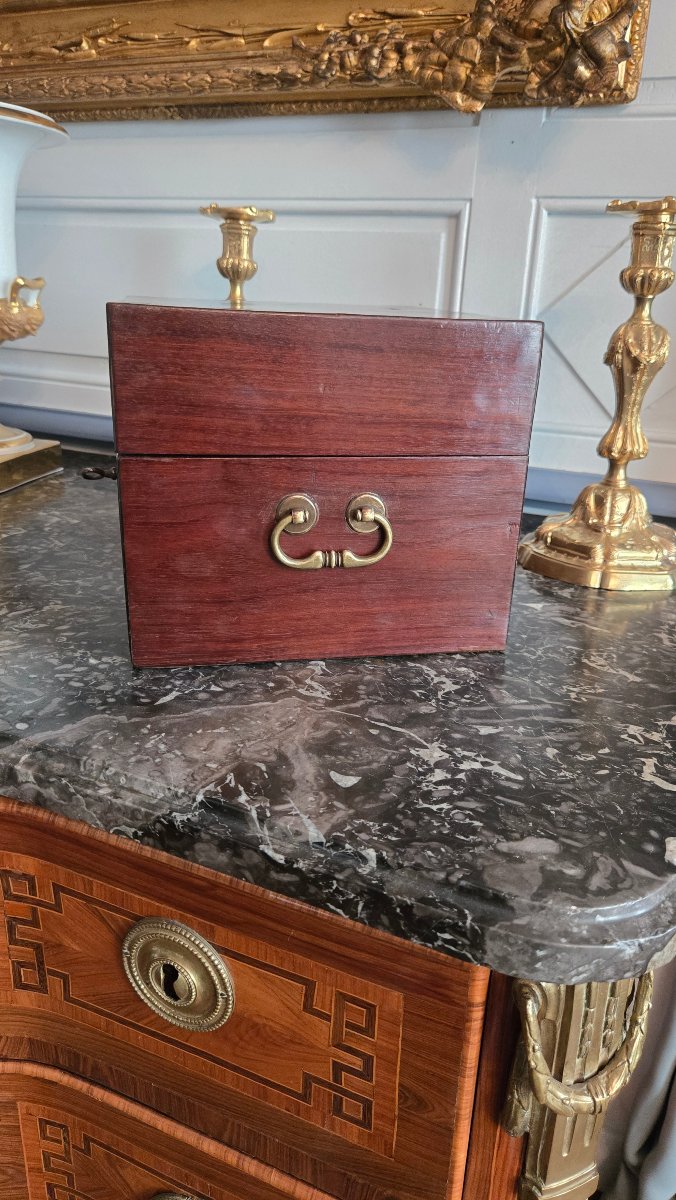
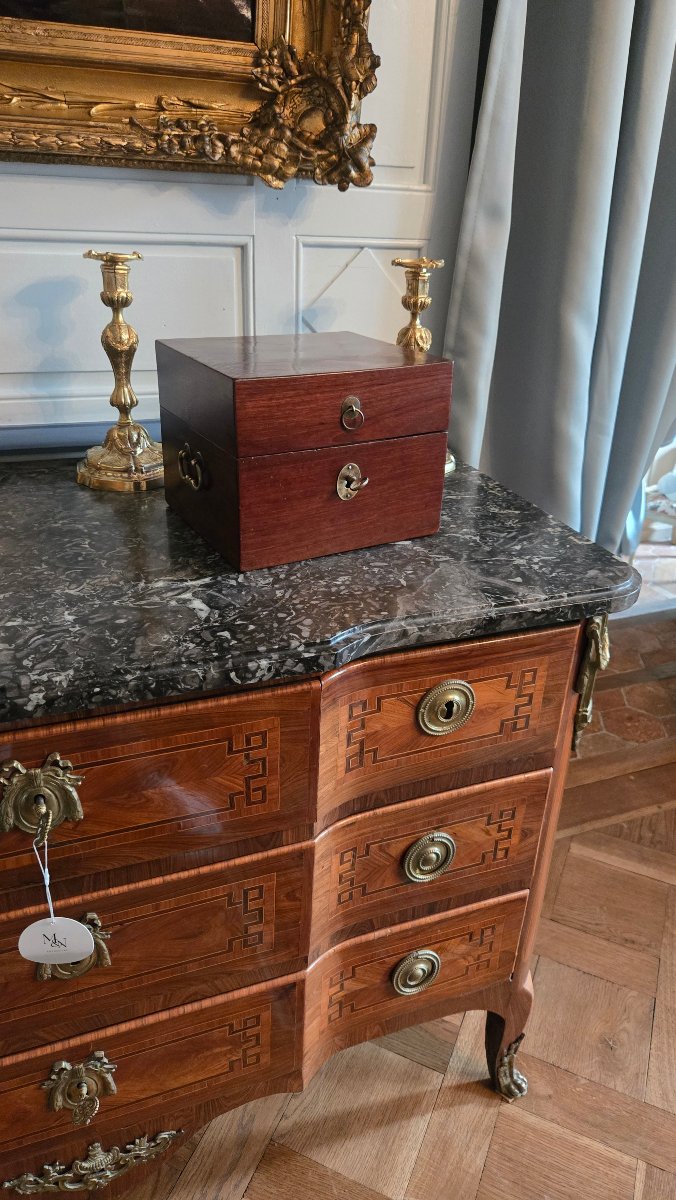
An almost cubic chest with an oak frame entirely veneered with amaranth, a Parisian piece from the Regency period, circa 1720–1730.
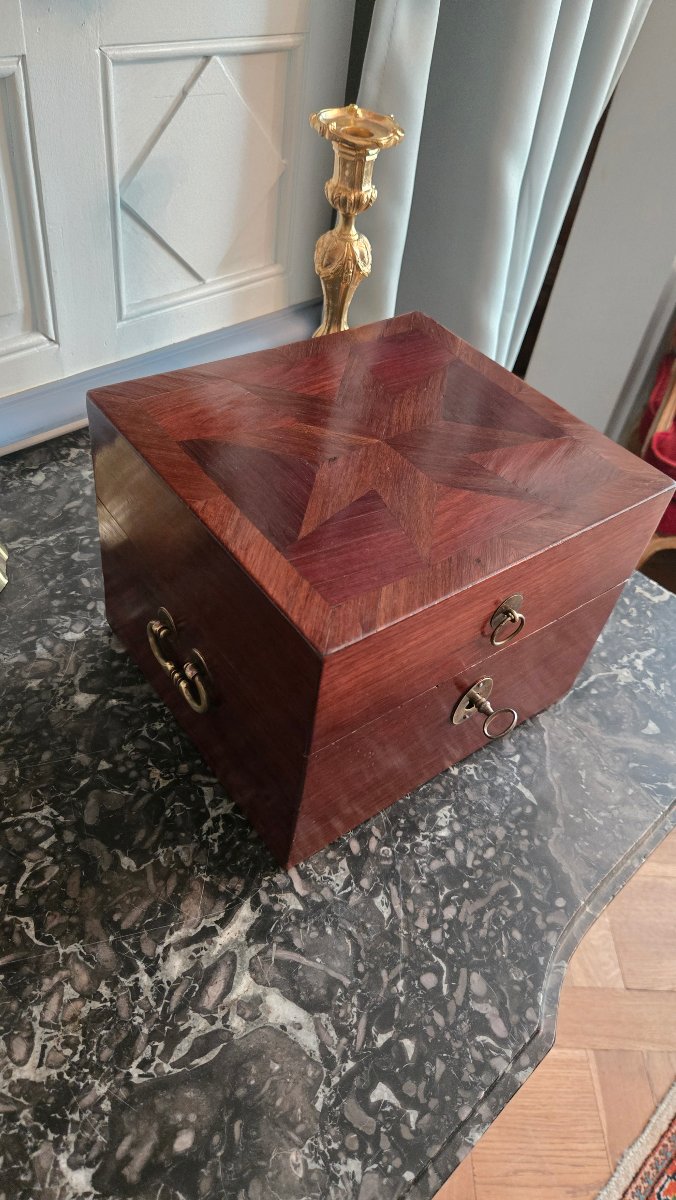
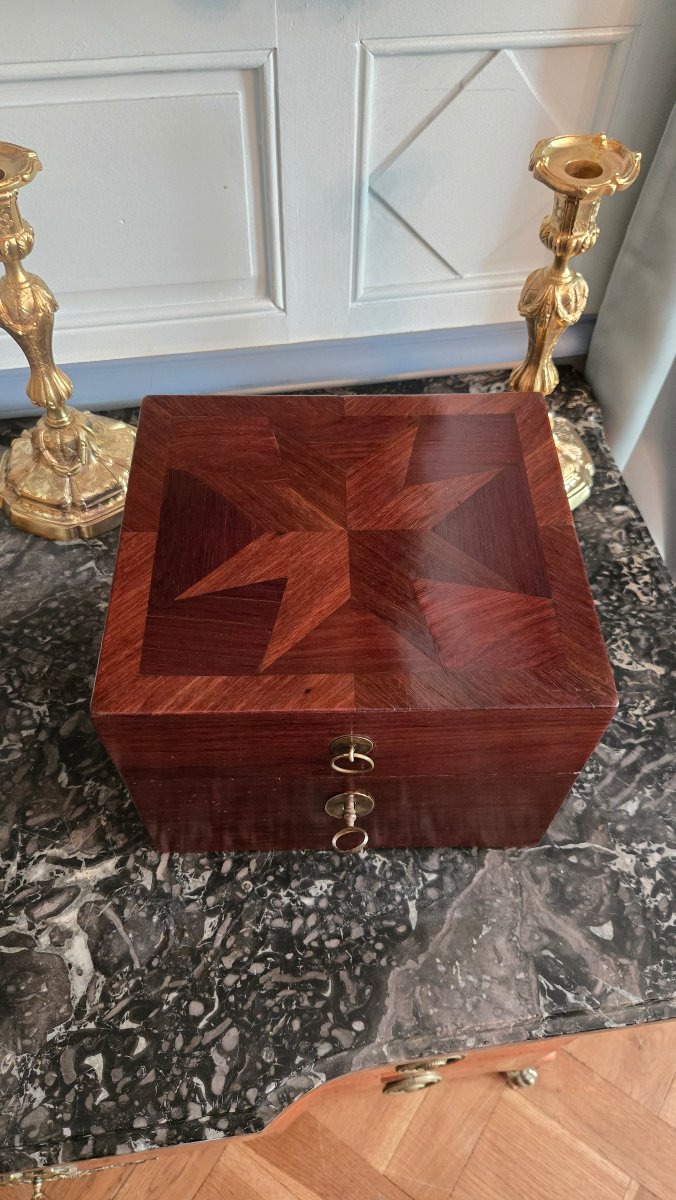
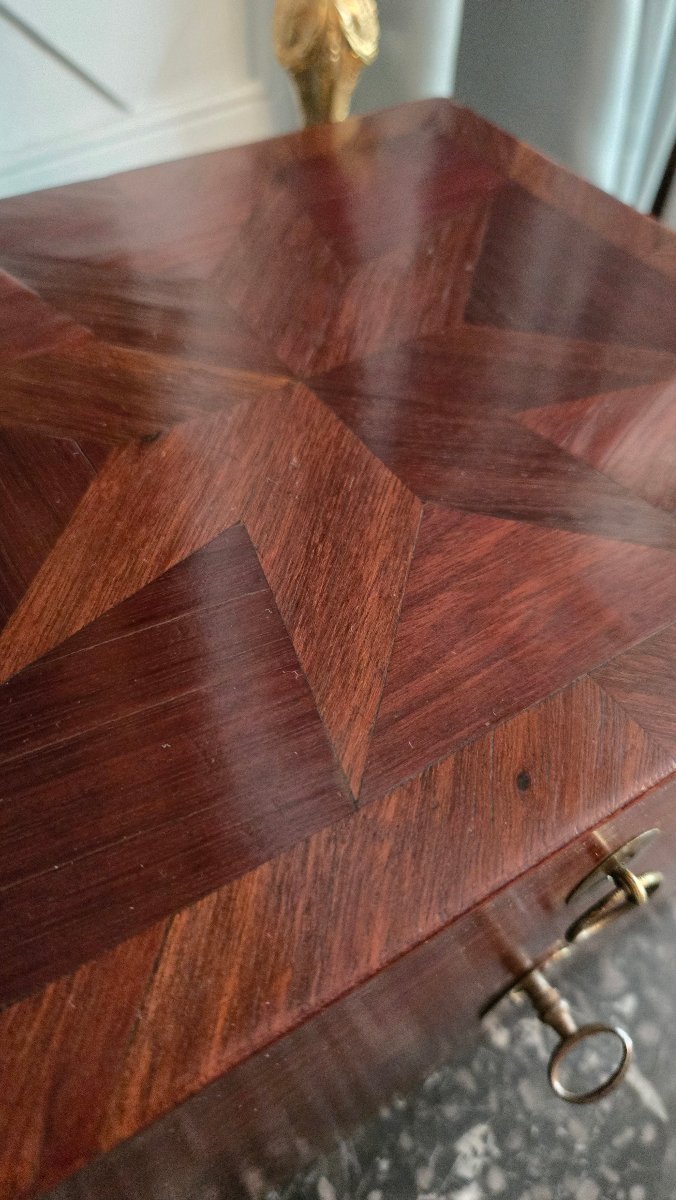
The body features a simply arranged amaranth veneer on its various sides, while the lid is decorated with a geometric scroll pattern organized around an eight-pointed star.
This piece is crafted entirely from a single type of wood. The design is achieved through the cutting and alternating orientation of the amaranth veneer sheets: the changes in the grain direction vary the wood’s reflections and tones, allowing the star and the various geometric compartments surrounding it to emerge, without the use of a second type of veneer.
The exclusive use of amaranth is one of the most interesting features of this box. This exotic wood was particularly popular in Parisian cabinetmaking during the Regency period and at the beginning of the reign of Louis XV, especially for fluted decorative motifs.
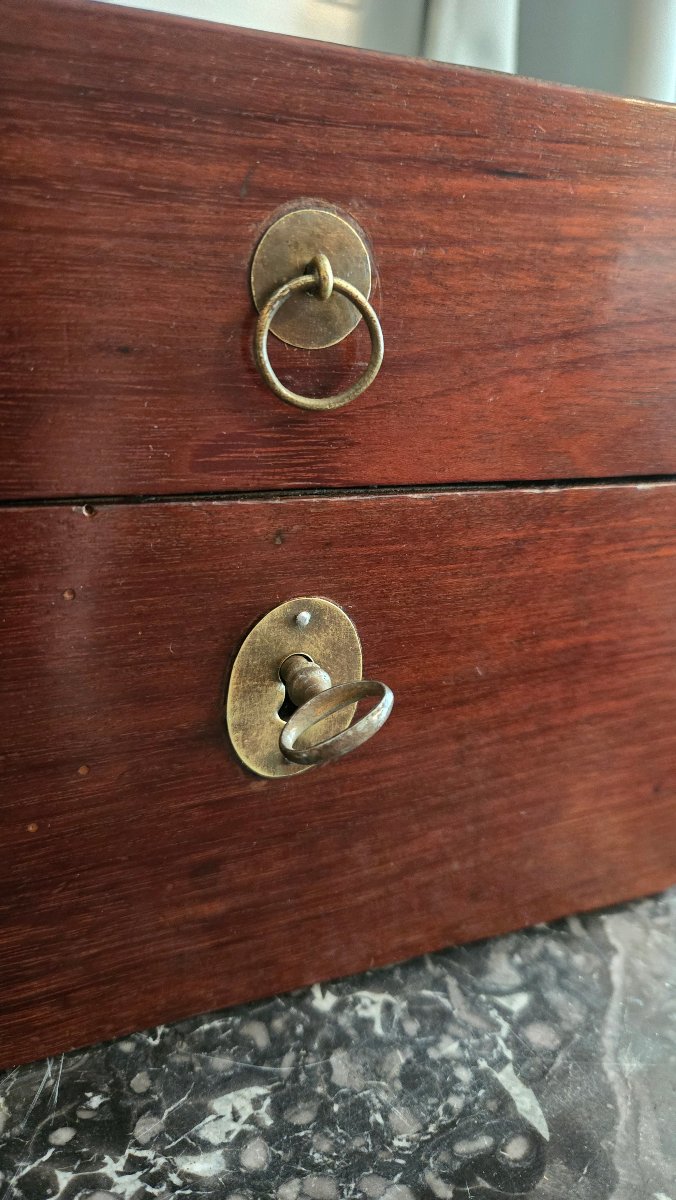
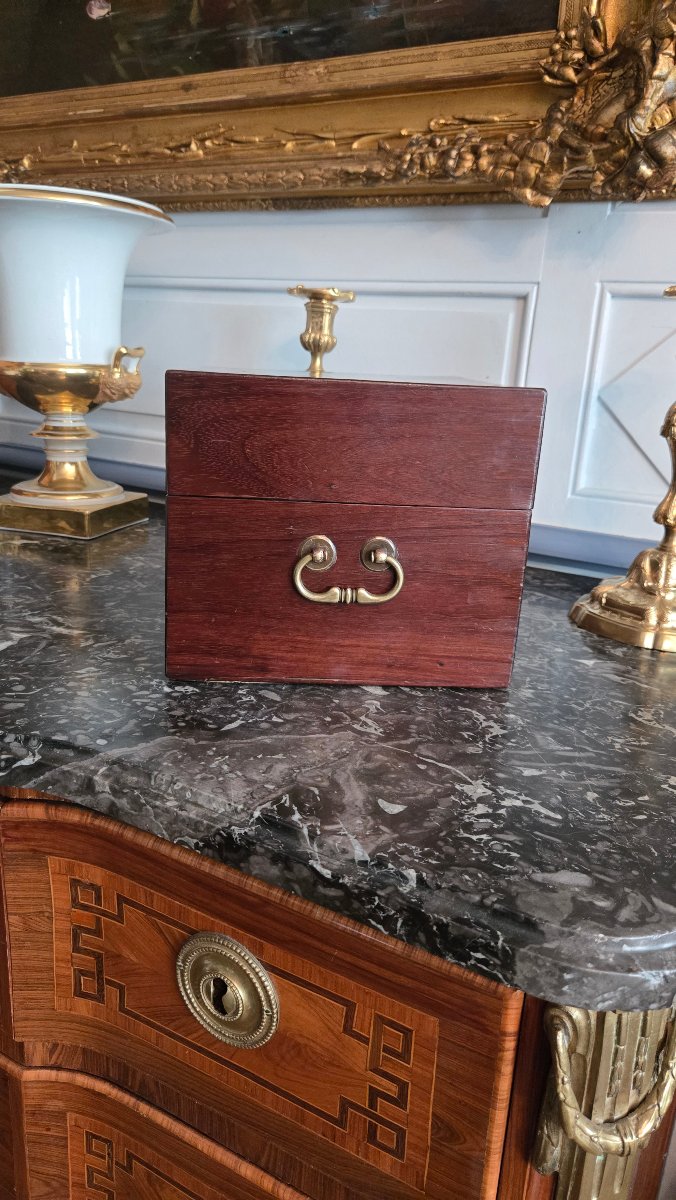
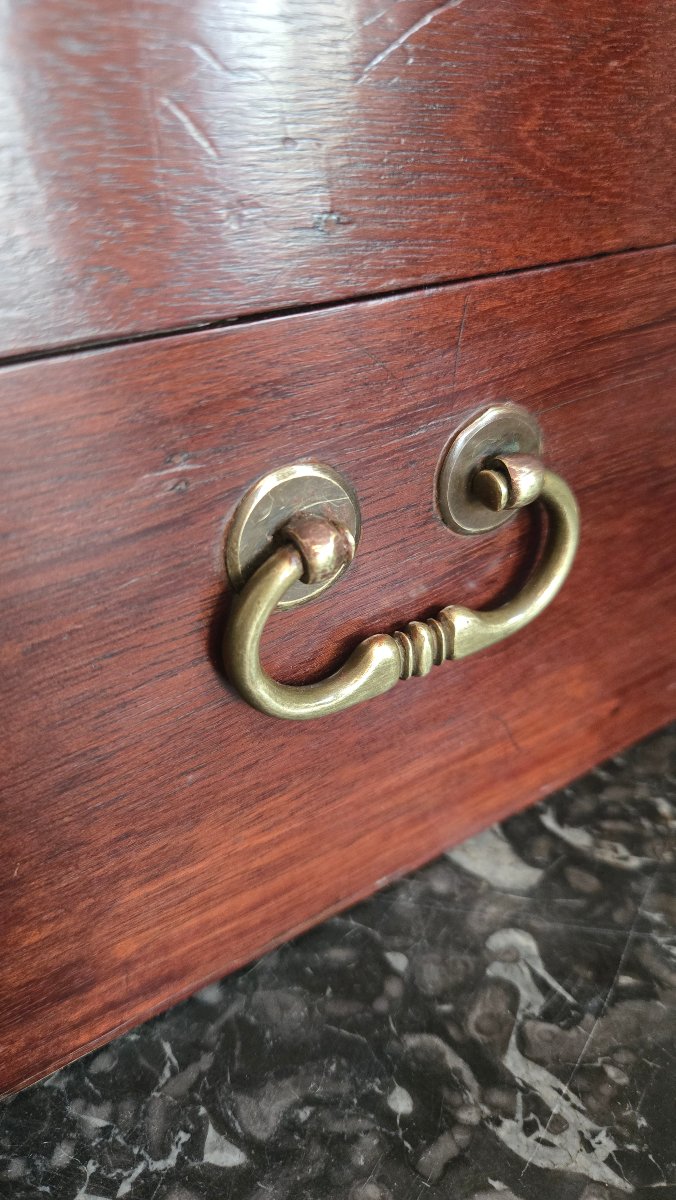
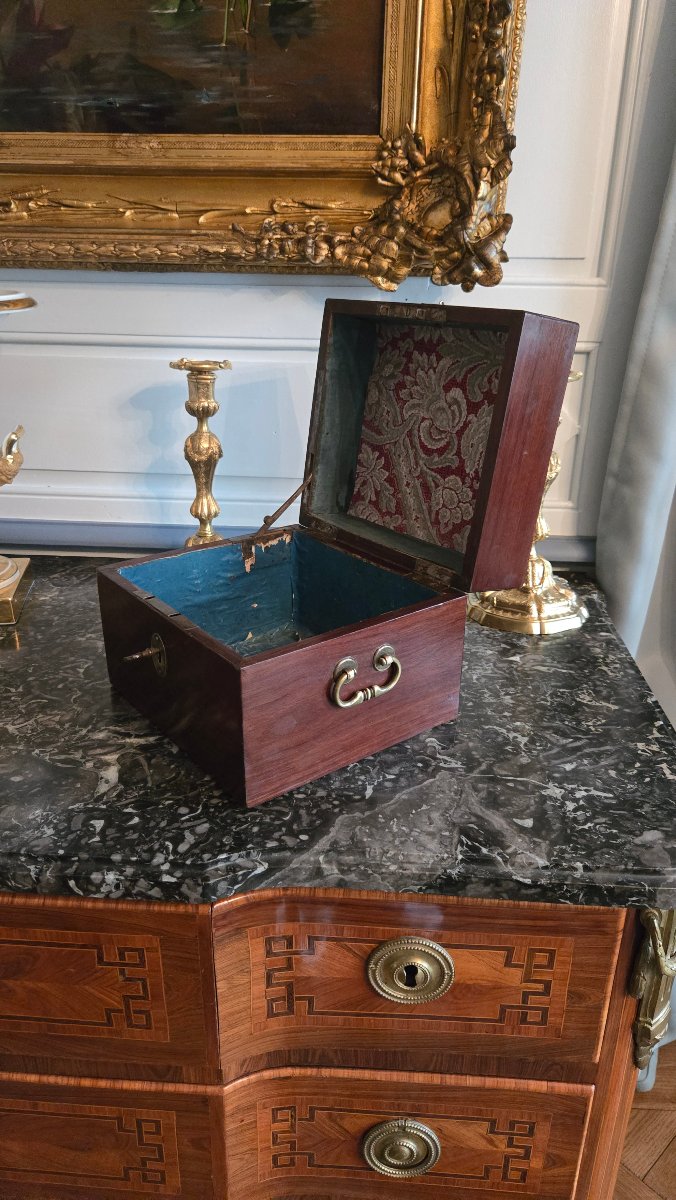
The two side panels are fitted with movable brass carrying handles, attached to small rosettes. On the front, the lid features a small movable brass ring used to lift it. Beneath this ring is the lock plate, also made of brass.
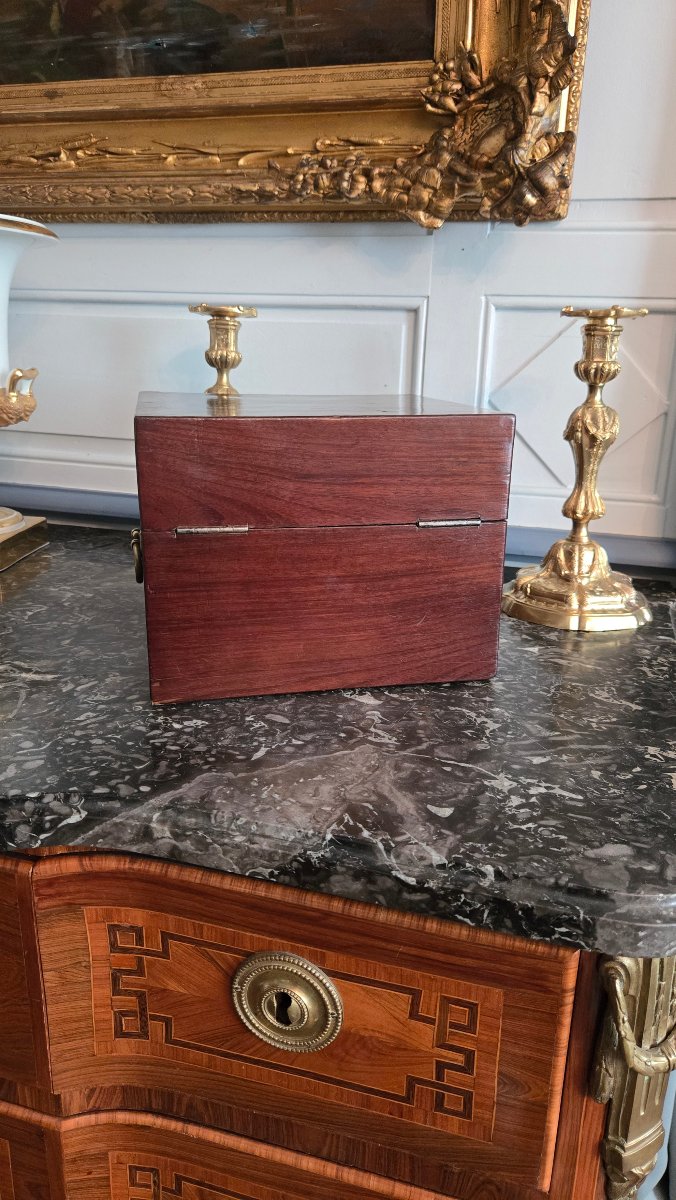
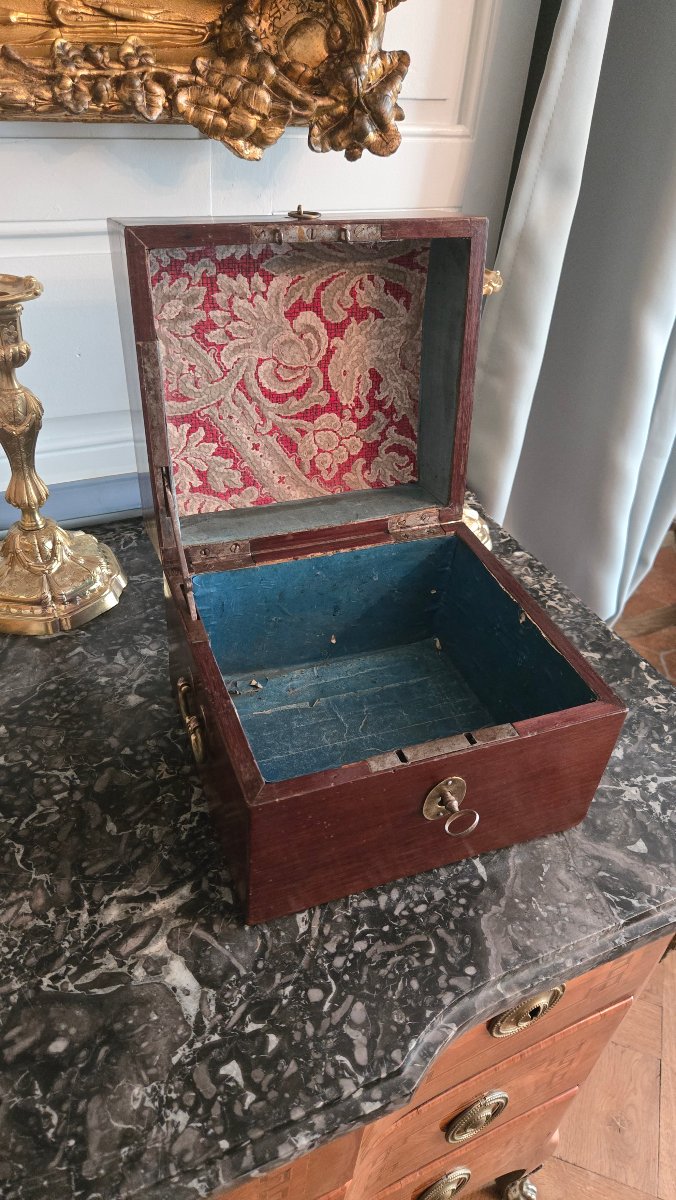
The box retains its original iron lock as well as a key; the lock is in working condition. The lid is hinged with its original period hinges, which still have their original screws. Its original iron clasp is also present and holds the lid in the open position.
The interior now offers a large open space, lined with an antique blue fabric. The underside of the lid also retains an antique fabric lining decorated with foliage scrolls on a red background.
Given its proportions, depth, two side carrying handles, and lined interior, this box was likely intended to hold a set of personal accessories. Its original interior layout—probably consisting of compartments or recesses tailored to hold various items—has since been lost. In the absence of this interior layout, it is no longer possible to determine its precise purpose: a toiletries set, a perfume set, a beverage set, or another set of accessories.
The design is comparable to those of toiletries boxes made in Paris during the first decades of the 18th century. The Louvre Museum, in particular, houses Queen Marie Leszczynska’s set, dated around 1729–1730, comprising twenty-eight pieces intended for coffee, tea, and chocolate, and whose case is described as an oak box veneered with amaranth.
This similarity—the combination of an oak frame and amaranth veneer from a similar period—provides an interesting point of technical and chronological comparison, though it does not allow us to attribute this case to a specific workshop.
The box shows some signs of use and very minor, isolated repairs to the veneer. It has been cleaned and polished in our workshop.
H. 19.5 × W. 25 × D. 22.5 cm
The body features a simply arranged amaranth veneer on its various sides, while the lid is decorated with a geometric scroll pattern organized around an eight-pointed star.
This piece is crafted entirely from a single type of wood. The design is achieved through the cutting and alternating orientation of the amaranth veneer sheets: the changes in the grain direction vary the wood’s reflections and tones, allowing the star and the various geometric compartments surrounding it to emerge, without the use of a second type of veneer.
The exclusive use of amaranth is one of the most interesting features of this box. This exotic wood was particularly popular in Parisian cabinetmaking during the Regency period and at the beginning of the reign of Louis XV, especially for fluted decorative motifs.
The two side panels are fitted with movable brass carrying handles, attached to small rosettes. On the front, the lid features a small movable brass ring used to lift it. Beneath this ring is the lock plate, also made of brass.
The box retains its original iron lock as well as a key; the lock is in working condition. The lid is hinged with its original period hinges, which still have their original screws. Its original iron clasp is also present and holds the lid in the open position.
The interior now offers a large open space, lined with an antique blue fabric. The underside of the lid also retains an antique fabric lining decorated with foliage scrolls on a red background.
Given its proportions, depth, two side carrying handles, and lined interior, this box was likely intended to hold a set of personal accessories. Its original interior layout—probably consisting of compartments or recesses tailored to hold various items—has since been lost. In the absence of this interior layout, it is no longer possible to determine its precise purpose: a toiletries set, a perfume set, a beverage set, or another set of accessories.
The design is comparable to those of toiletries boxes made in Paris during the first decades of the 18th century. The Louvre Museum, in particular, houses Queen Marie Leszczynska’s set, dated around 1729–1730, comprising twenty-eight pieces intended for coffee, tea, and chocolate, and whose case is described as an oak box veneered with amaranth.
This similarity—the combination of an oak frame and amaranth veneer from a similar period—provides an interesting point of technical and chronological comparison, though it does not allow us to attribute this case to a specific workshop.
The box shows some signs of use and very minor, isolated repairs to the veneer. It has been cleaned and polished in our workshop.
H. 19.5 × W. 25 × D. 22.5 cm
850 €
Period: 18th century
Style: Louis 14th, Regency
Condition: Condition of use
Material: Wood marquetry
Reference (ID): 1820847
Availability: In stock
Print