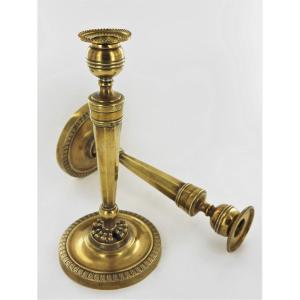


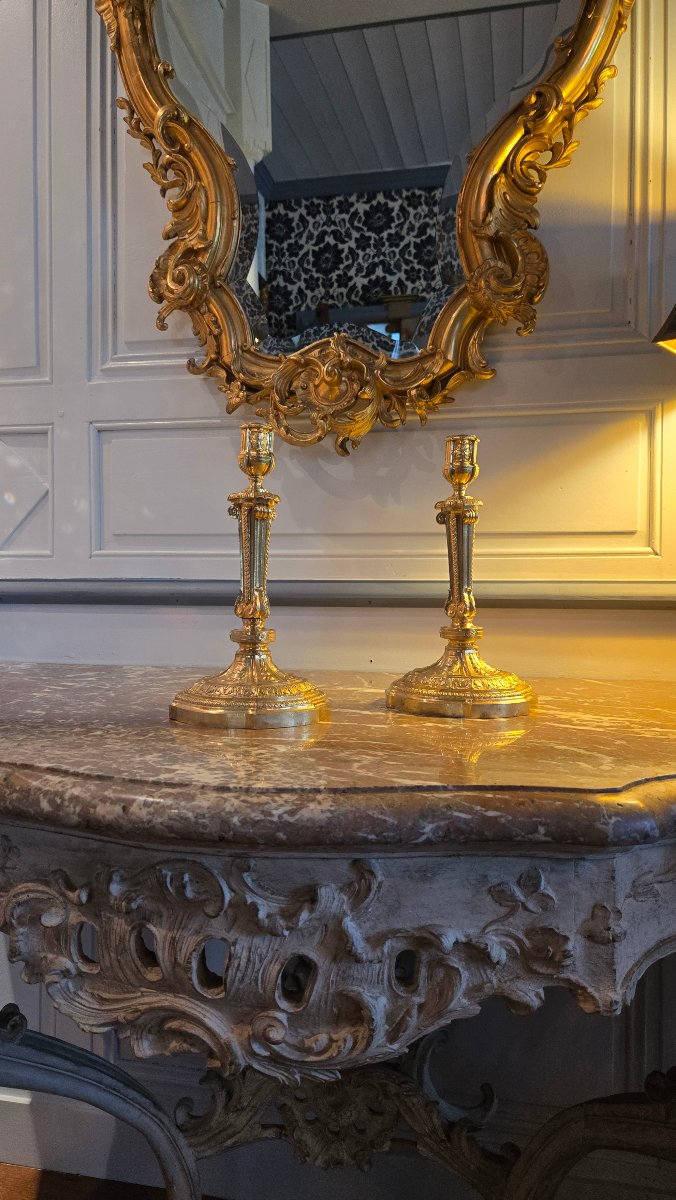
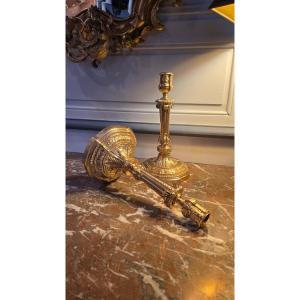


An Important Pair Of Neoclassical Candlesticks In Chiseled And Gilded Bronze. Restoration Period
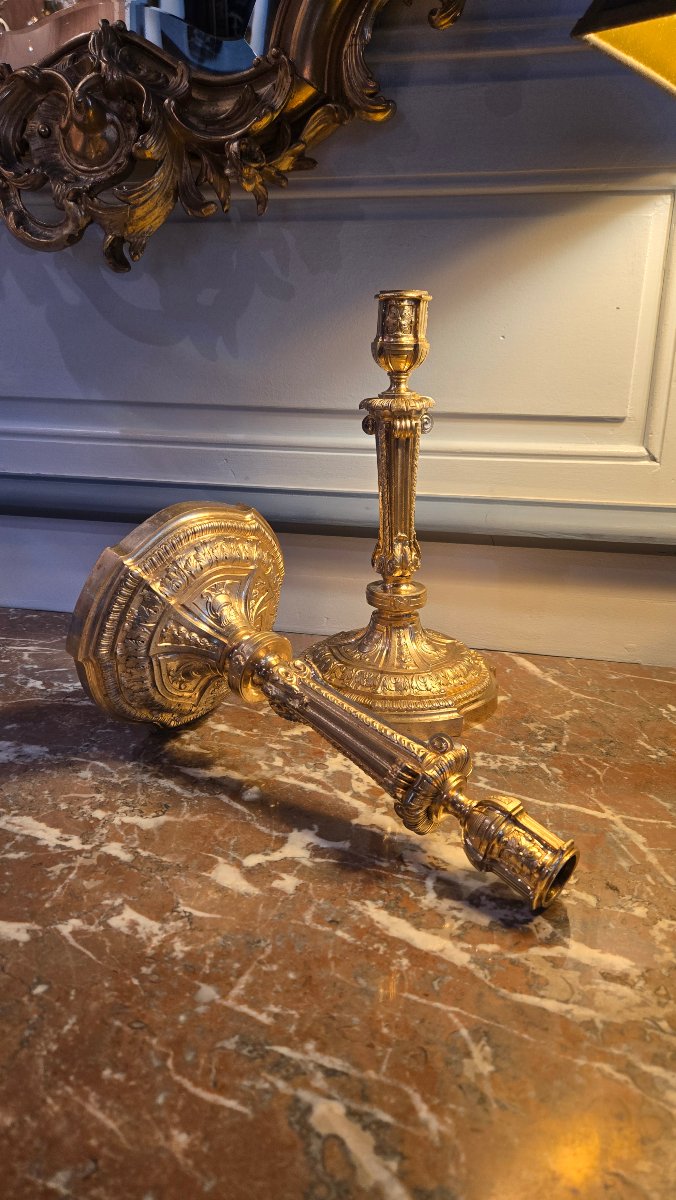
This important pair of chiseled and gilded bronze candelabra exemplifies the revival of classical design that characterized the early decades of the 19th century. Their design does not seek to replicate a particular reign’s style; rather, it is part of the broad neoclassical movement that drew its inspiration from the architecture and ornamentation of antiquity, reinterpreted by French architects, ornamentalists, and bronze casters beginning in the 18th century and revitalized during the Restoration.
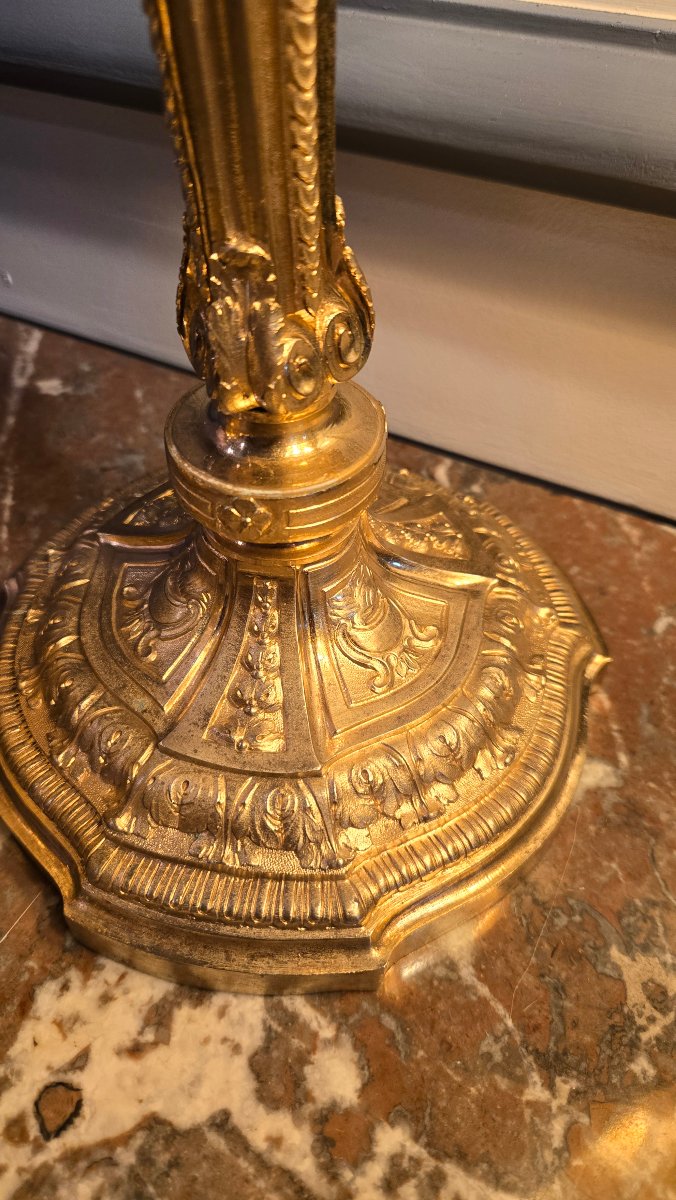
With a striking presence, they rest on broad, jagged-edged bases whose proportions contribute to the monumental balance of the whole. Their carefully constructed architecture evokes veritable small monuments, in which each element contributes to a composition of great coherence.
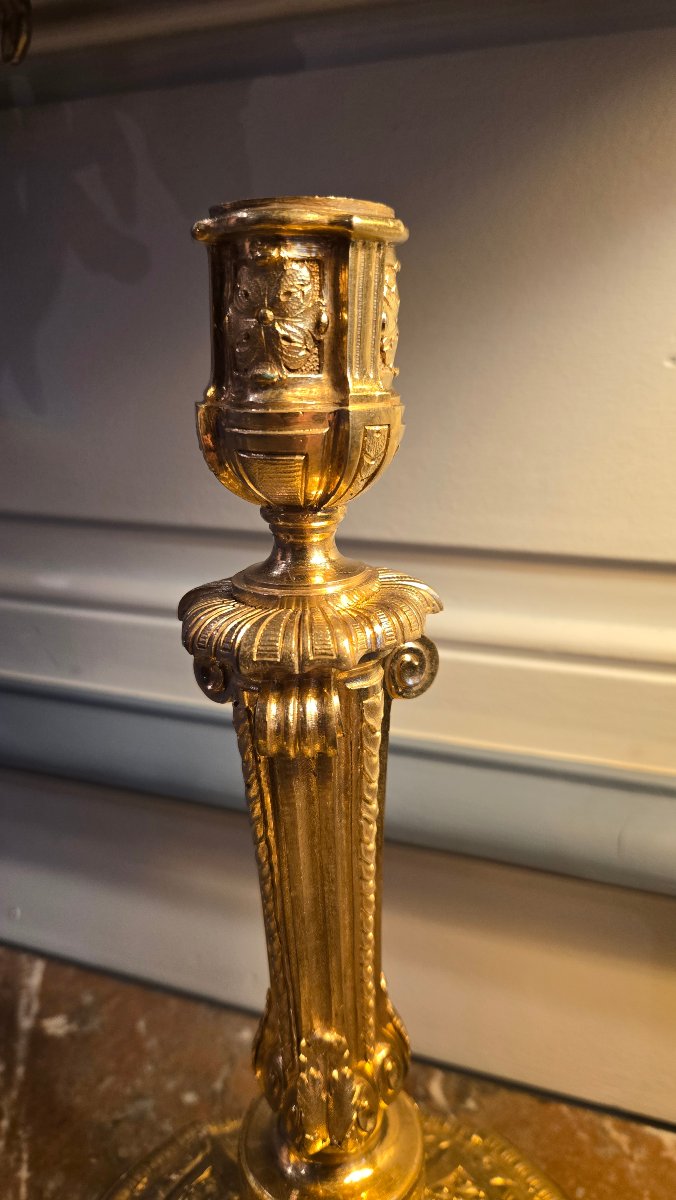
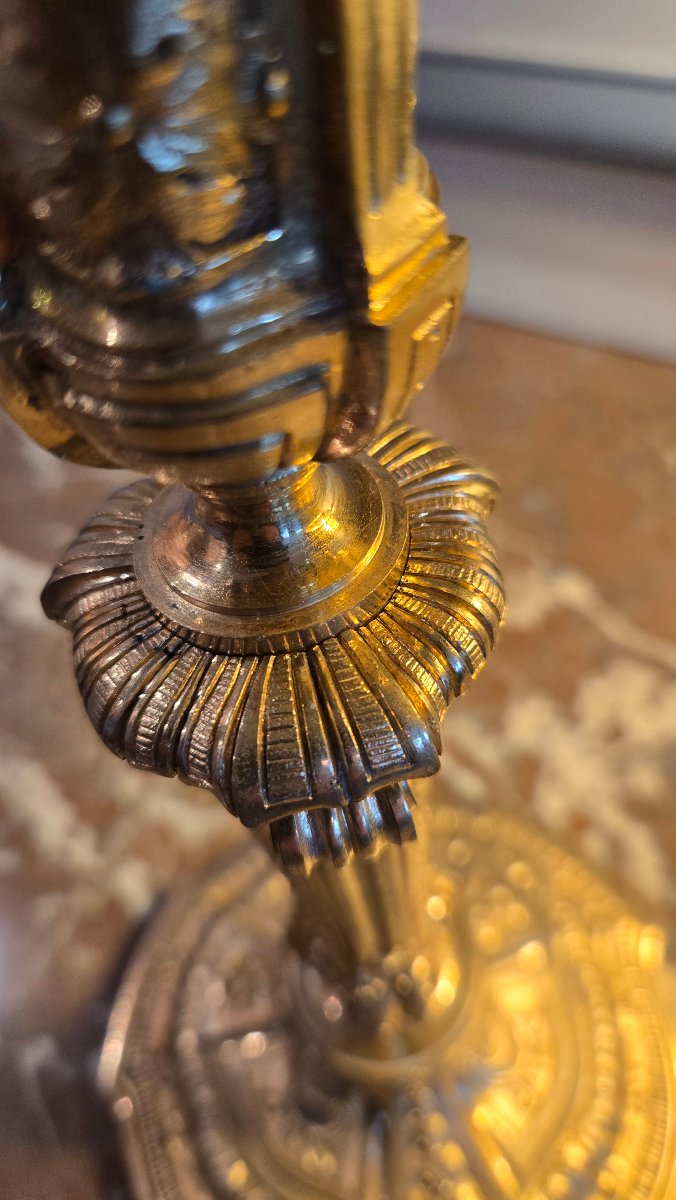
The particularly rich decoration fully embodies the vocabulary of Neoclassical style. The bases are adorned with friezes of flutes, rows of godrons, a string of acanthus leaf capitals, cartouches with striated backgrounds enclosing stylized fire pots, rosettes, four-leaf motifs, and finely chiseled pilasters. The alternation of burnished surfaces, amati backgrounds, and reliefs lends depth and clarity to the whole.
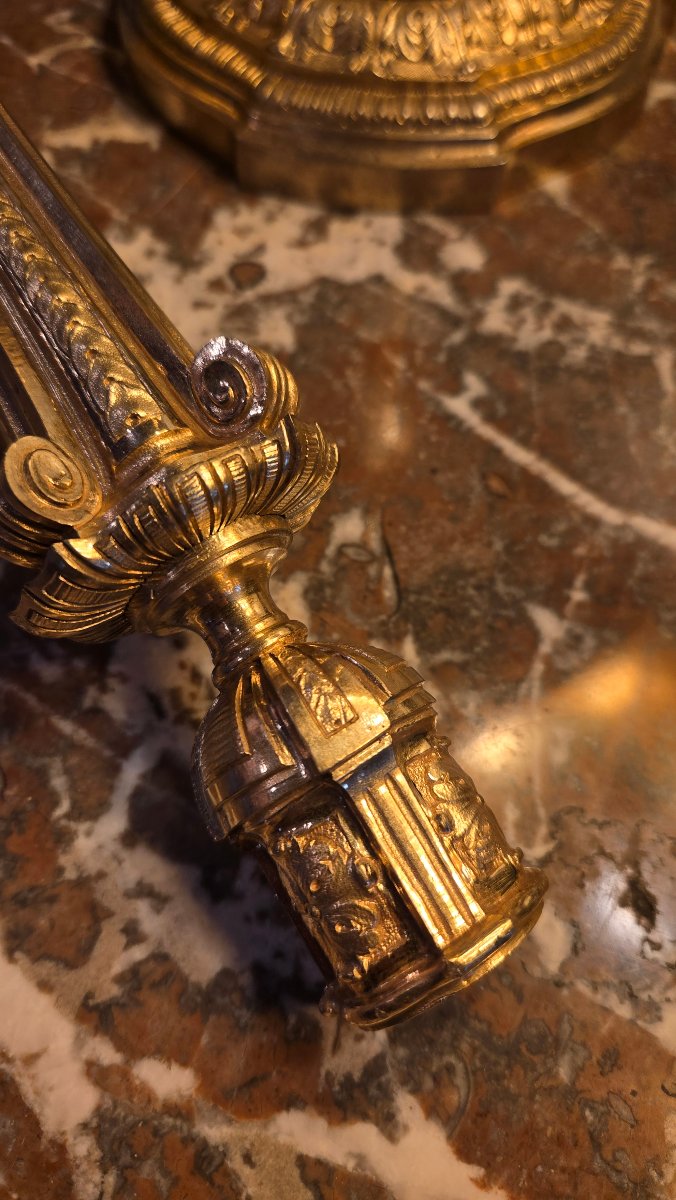
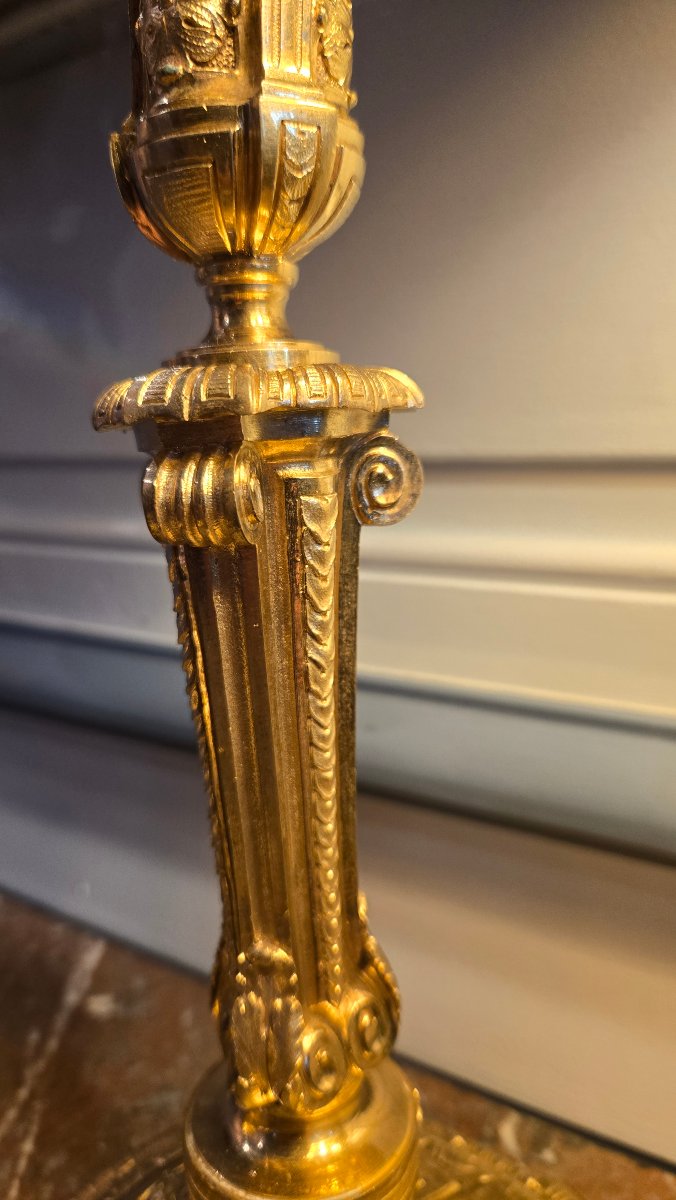
The shaft is undoubtedly the most remarkable element of this pair. With a particularly architectural design, it is punctuated by powerful scrolls that originate at the base and accompany its slender form all the way to the top, where they evoke stylized capitals. This construction gives the candelabra a dynamic and perfectly balanced silhouette, reinforcing their monumental character.
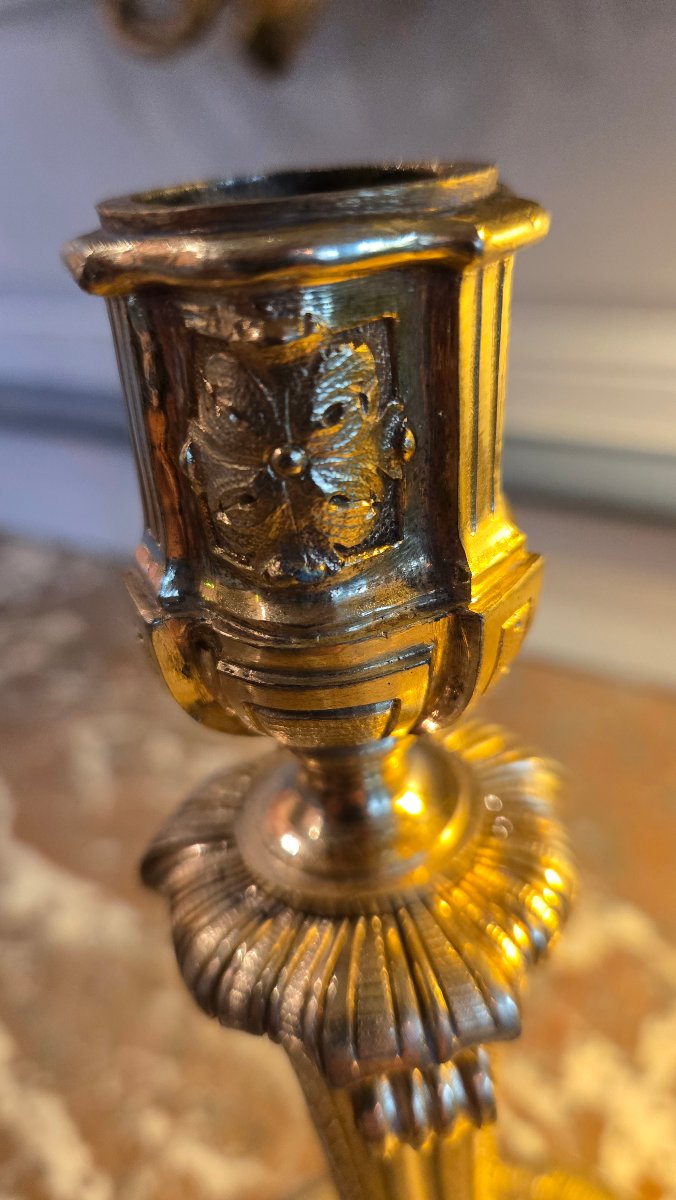
The polygonal finial echoes this same decorative richness through rosettes, four-leaf motifs, fluting, and godrons, ensuring perfect continuity with the composition as a whole.
Through its decorative vocabulary and construction, this pair follows in the tradition of the great neoclassical models popularized in the late 18th century by architects and ornamentalists. While not based on any specific identified model, they reflect the desire—characteristic of the Restoration period—to reconnect with the principles of great French Classicism and with forms inherited from Antiquity.
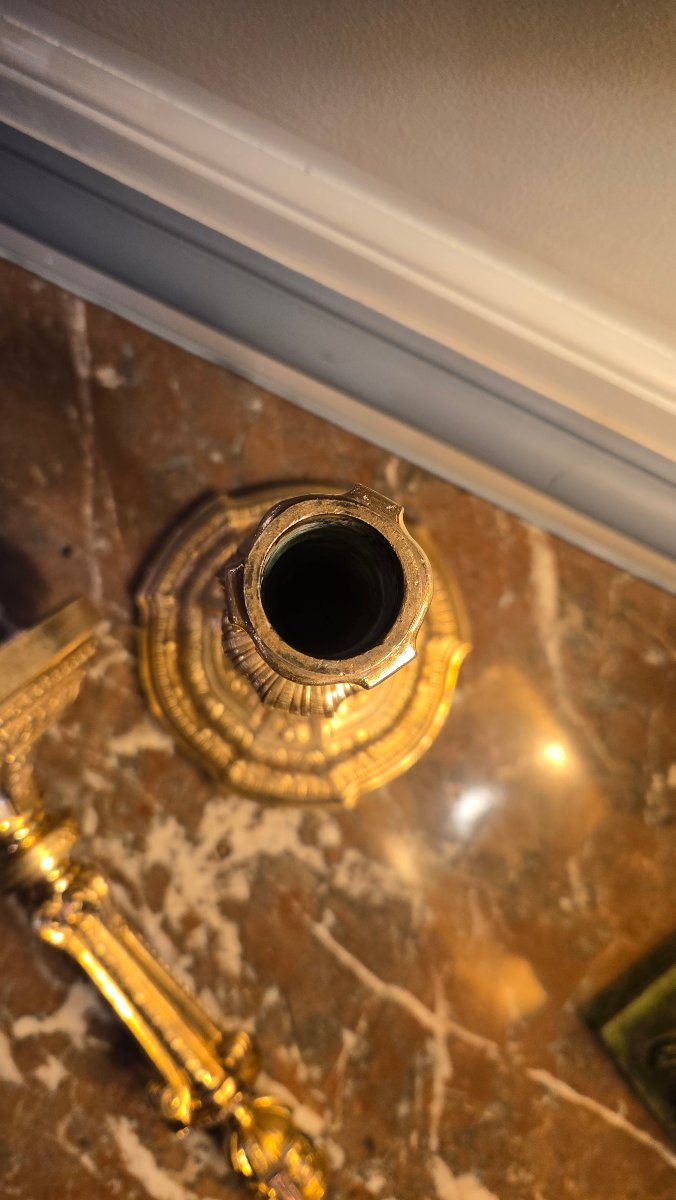
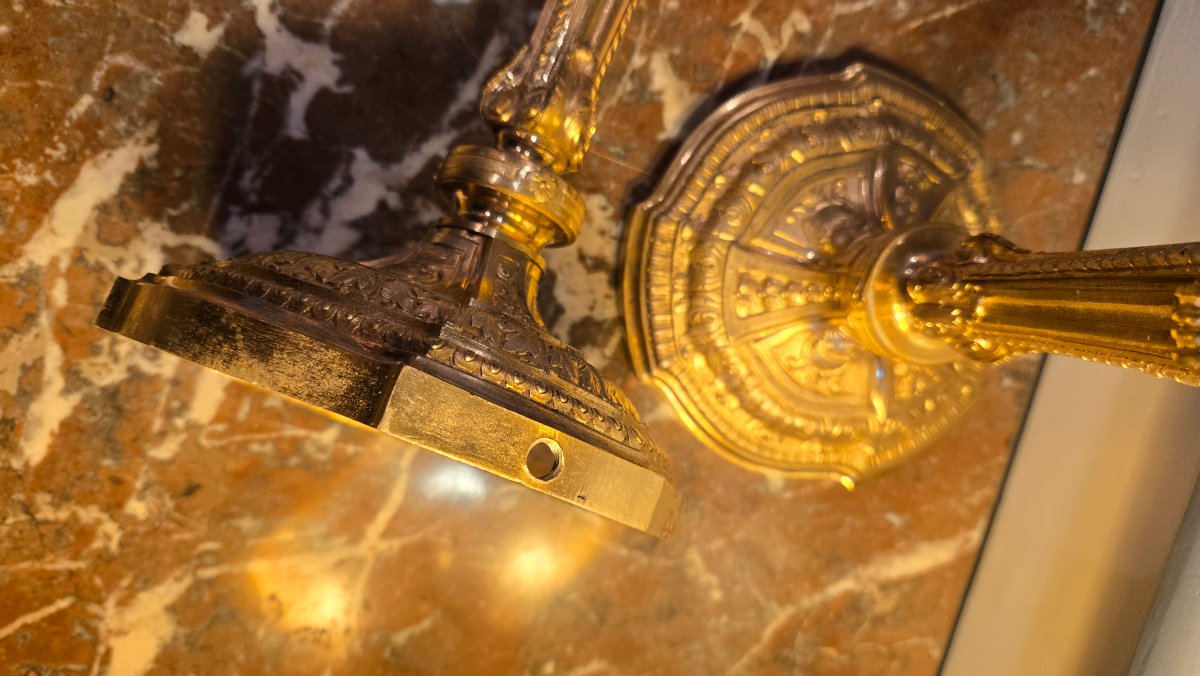
Both candelabra retain their original gilding, showing natural wear consistent with their age. One of them remains in its original assembled state and retains its steel rod threaded at both ends, a traditional assembly system used to hold the various bronze components together. The second was converted into a lamp during the 19th or 20th century. During this conversion, the original rod was replaced with a hollow rod designed to accommodate the electrical wire, and a hole was drilled in the base plinth to allow the cable to exit. This earlier alteration does not affect the overall appearance of the torch, whose structure and decorative elements have remained intact.
Dimensions:
Height: 29 cm
Base diameter: 16.2 cm
With a striking presence, they rest on broad, jagged-edged bases whose proportions contribute to the monumental balance of the whole. Their carefully constructed architecture evokes veritable small monuments, in which each element contributes to a composition of great coherence.
The particularly rich decoration fully embodies the vocabulary of Neoclassical style. The bases are adorned with friezes of flutes, rows of godrons, a string of acanthus leaf capitals, cartouches with striated backgrounds enclosing stylized fire pots, rosettes, four-leaf motifs, and finely chiseled pilasters. The alternation of burnished surfaces, amati backgrounds, and reliefs lends depth and clarity to the whole.
The shaft is undoubtedly the most remarkable element of this pair. With a particularly architectural design, it is punctuated by powerful scrolls that originate at the base and accompany its slender form all the way to the top, where they evoke stylized capitals. This construction gives the candelabra a dynamic and perfectly balanced silhouette, reinforcing their monumental character.
The polygonal finial echoes this same decorative richness through rosettes, four-leaf motifs, fluting, and godrons, ensuring perfect continuity with the composition as a whole.
Through its decorative vocabulary and construction, this pair follows in the tradition of the great neoclassical models popularized in the late 18th century by architects and ornamentalists. While not based on any specific identified model, they reflect the desire—characteristic of the Restoration period—to reconnect with the principles of great French Classicism and with forms inherited from Antiquity.
Both candelabra retain their original gilding, showing natural wear consistent with their age. One of them remains in its original assembled state and retains its steel rod threaded at both ends, a traditional assembly system used to hold the various bronze components together. The second was converted into a lamp during the 19th or 20th century. During this conversion, the original rod was replaced with a hollow rod designed to accommodate the electrical wire, and a hole was drilled in the base plinth to allow the cable to exit. This earlier alteration does not affect the overall appearance of the torch, whose structure and decorative elements have remained intact.
Dimensions:
Height: 29 cm
Base diameter: 16.2 cm
950 €
Period: 19th century
Style: Louis 16th, Directory
Condition: Good condition
Material: Bronze
Reference (ID): 1797743
Availability: In stock
Print