THIS OBJECT WAS SOLD
Clock Monumental, With Garlands Of Flowers
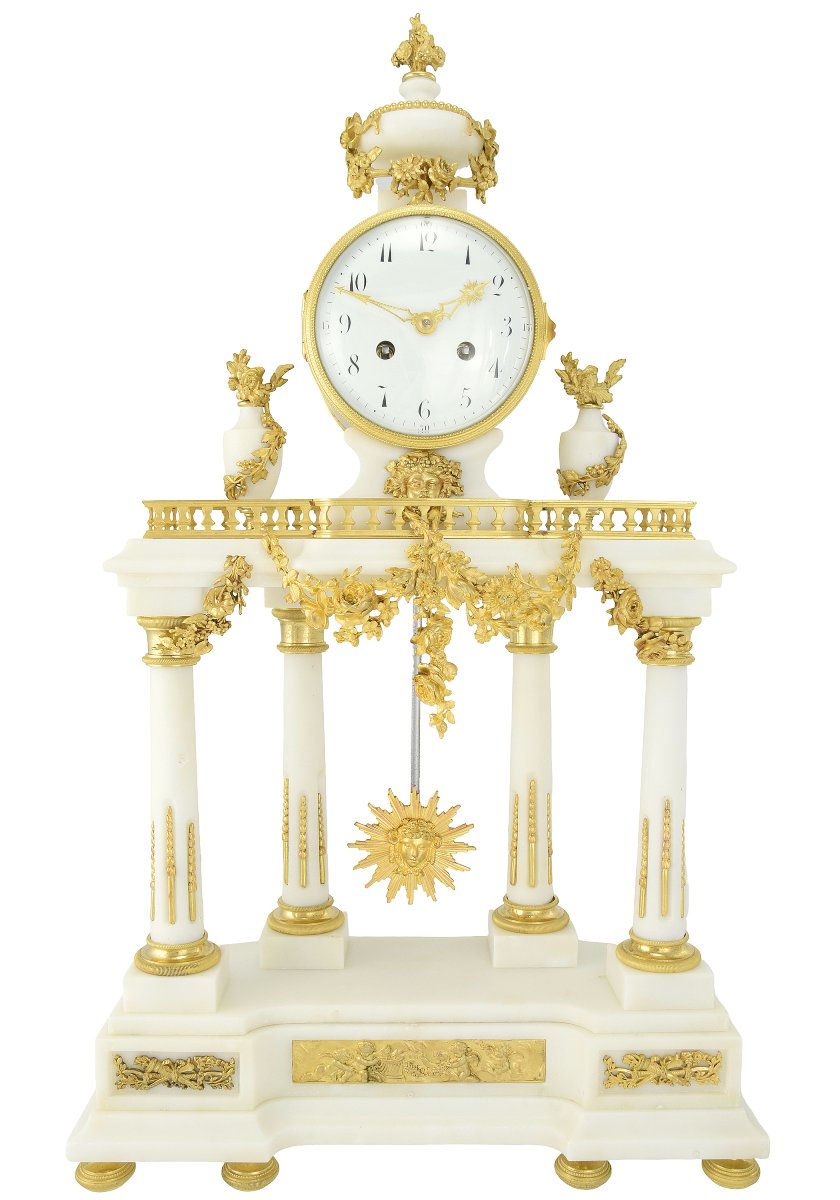
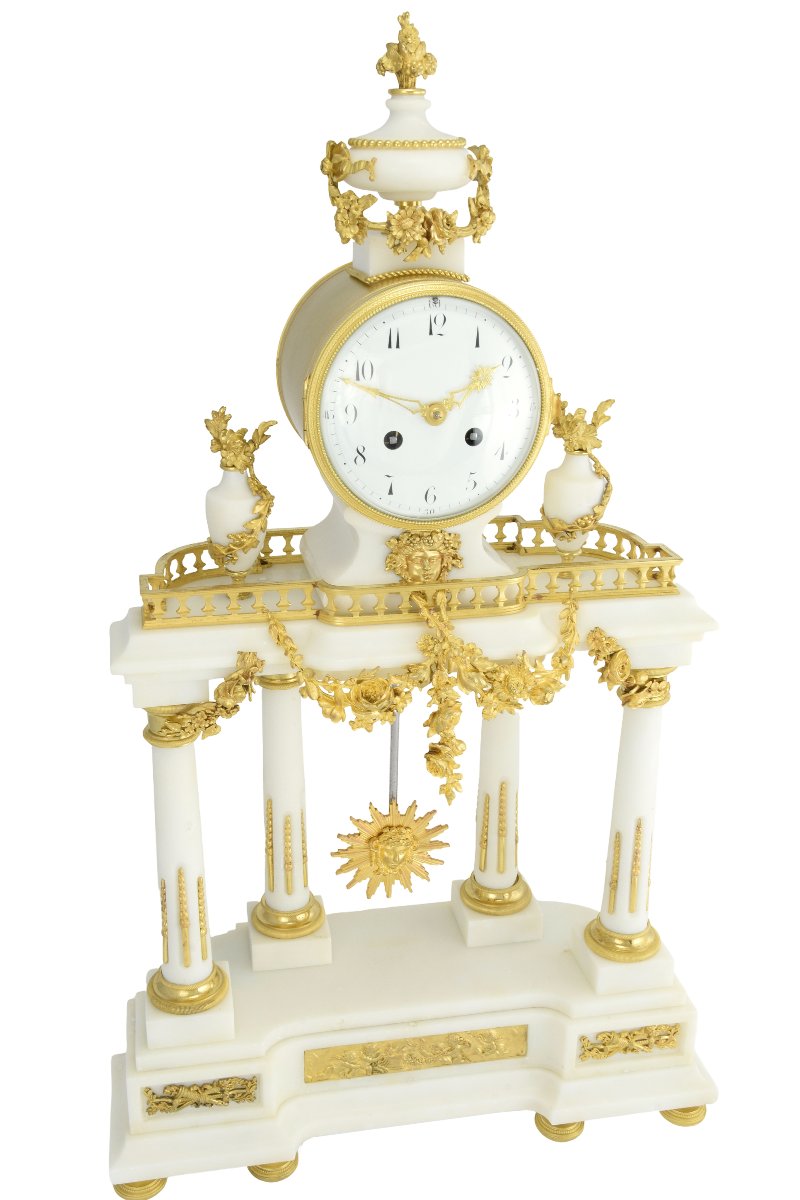
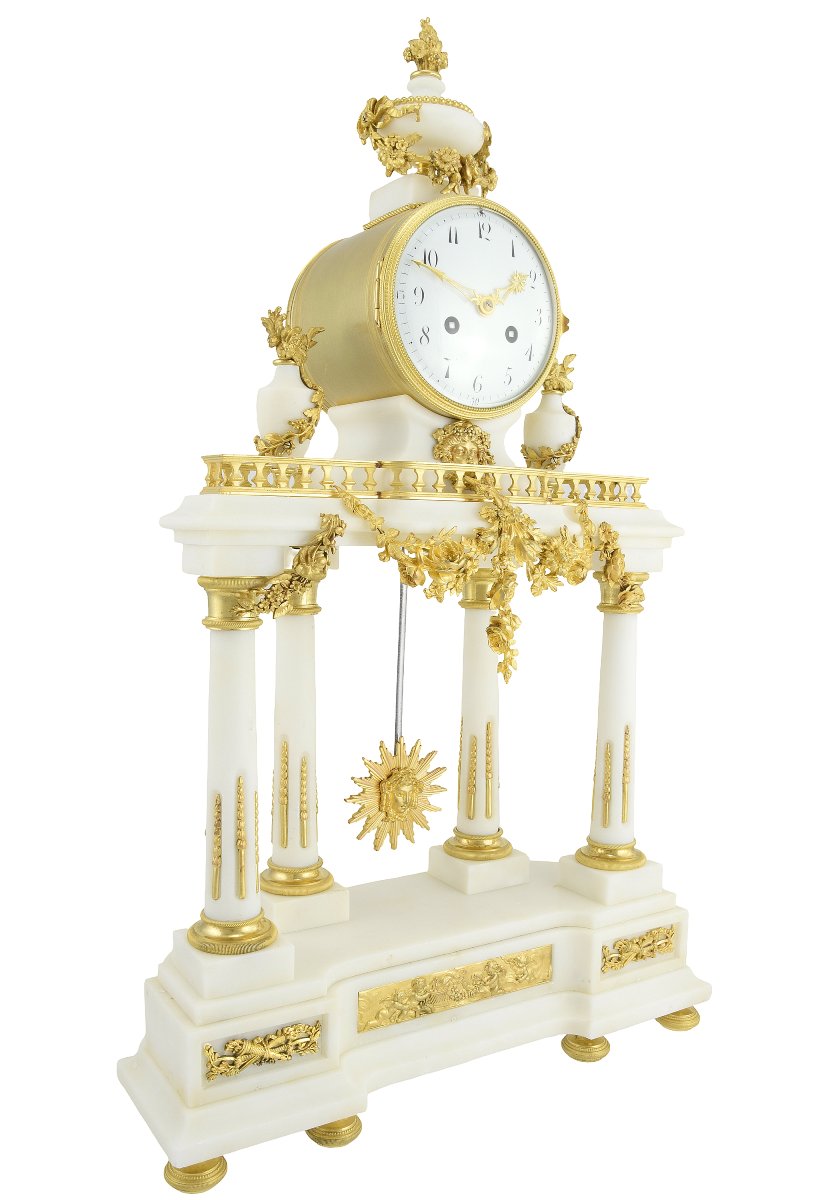



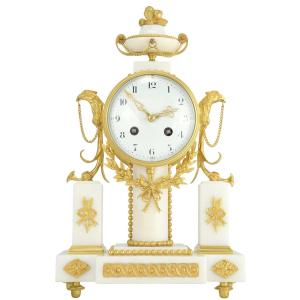
A large, imposing portico clock in the Louis XVI style, crafted duringthe Second Empire (circa 1860). This exceptionally large and rare modelis distinguished by its monumental architecture, the distinctive widespacing of its four columns, and an elegant composition inspired bygrand antique porticos. The piece is executed in white Carrara marblecombined with rich, finely chased, and gilded bronze ornamentation,creating a refined contrast between the purity of the marble and thewarm radiance of the gilding.
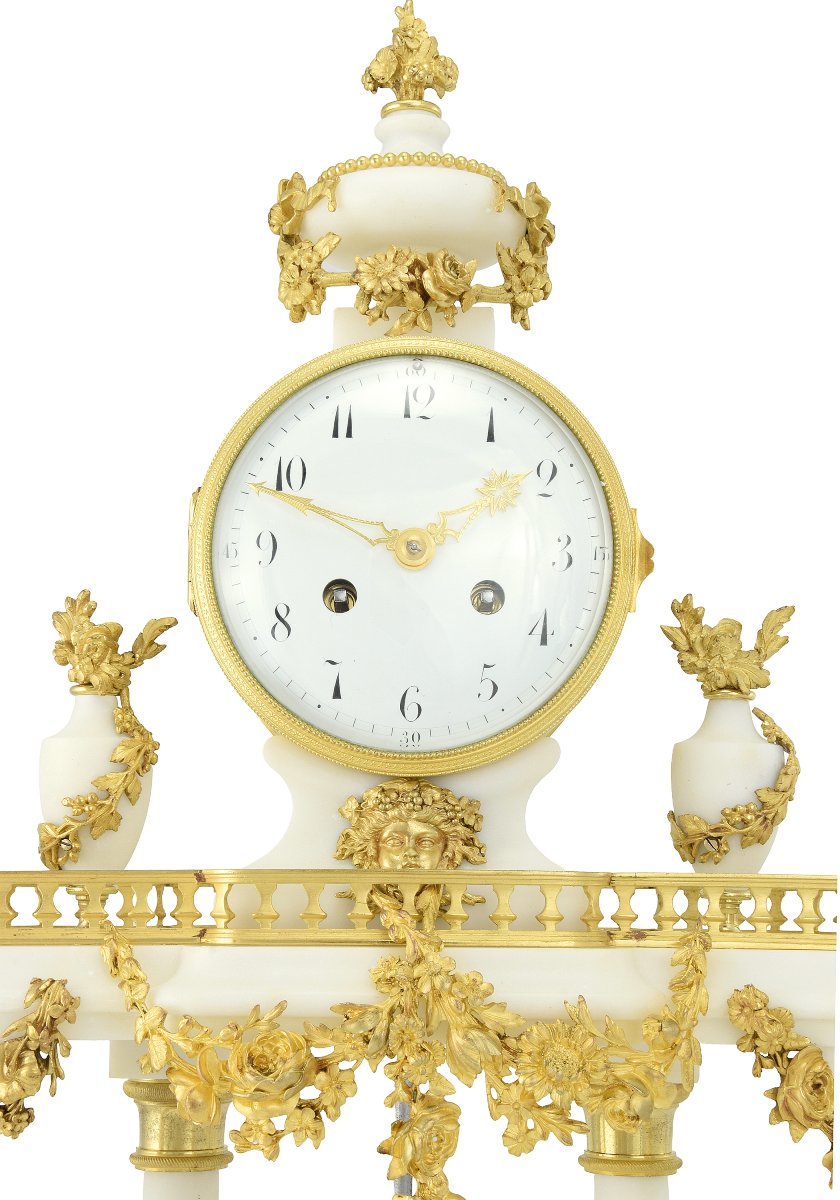
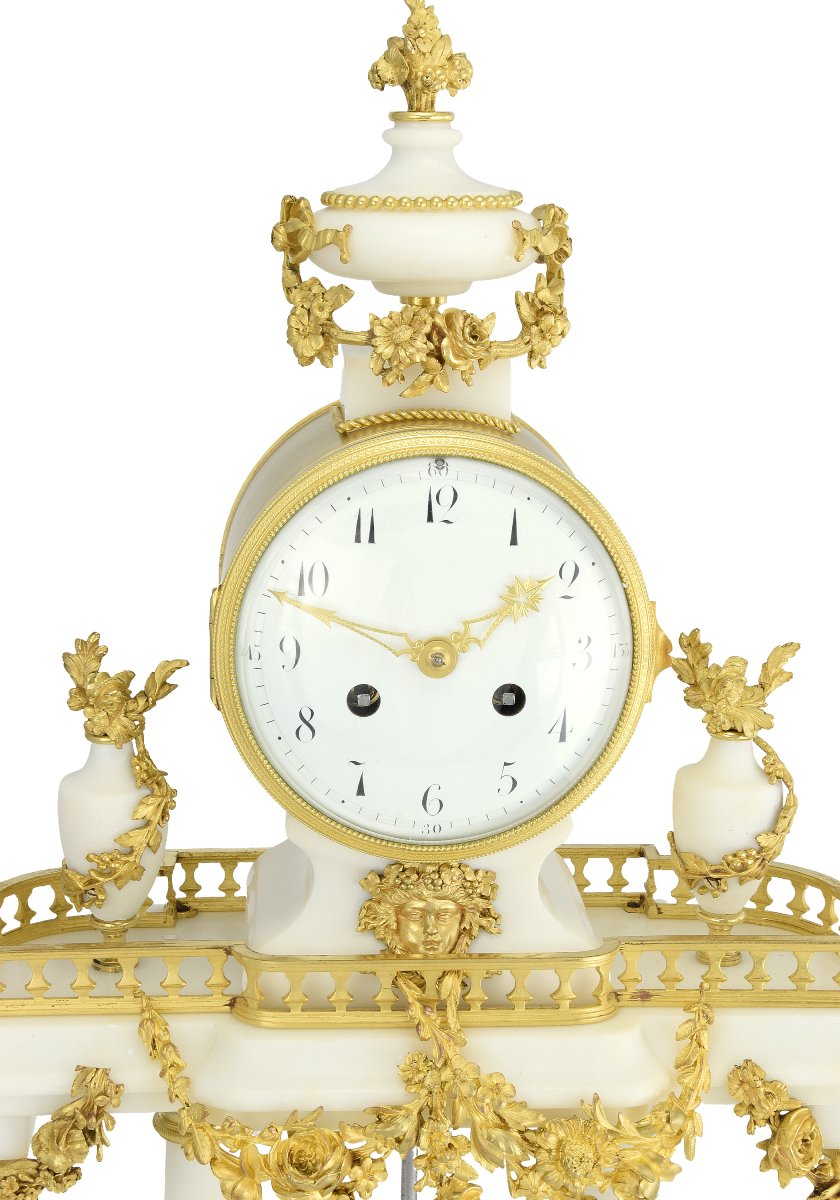
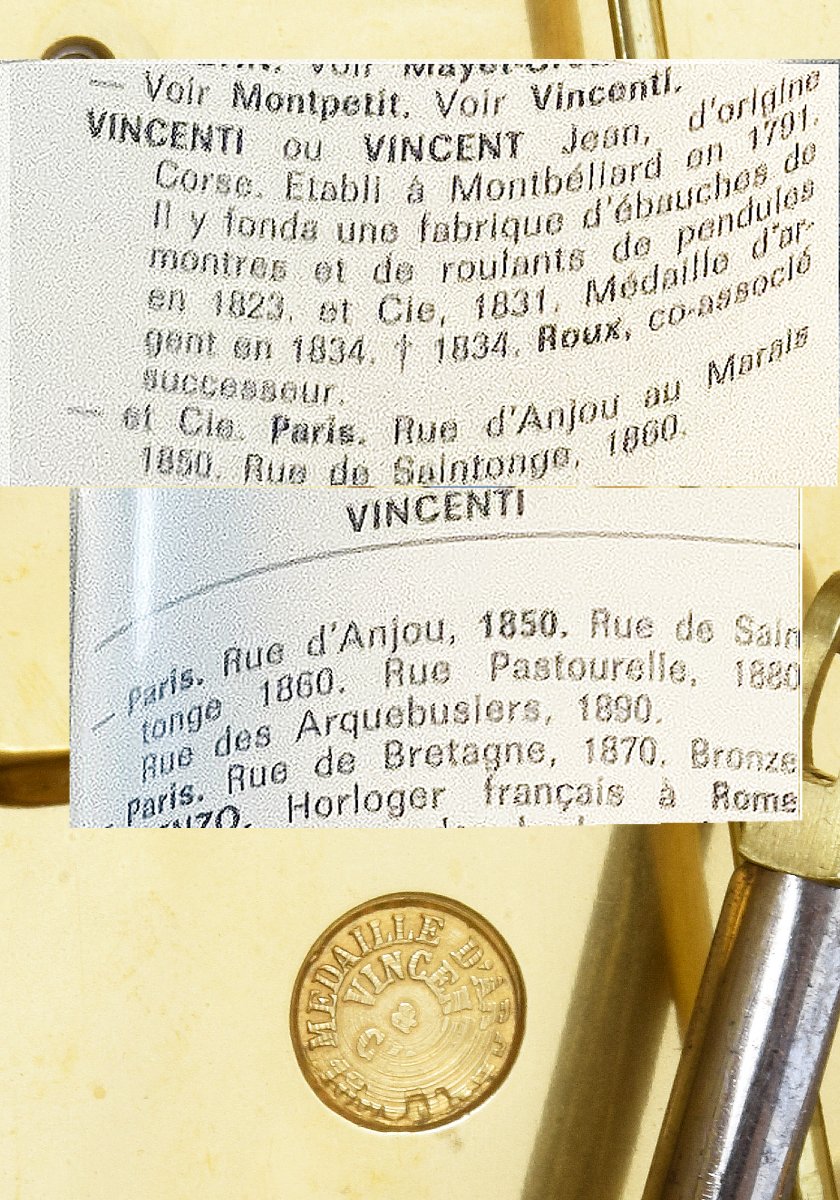
Crowning the piece is a large, baluster-shaped covered vase in Carraramarble, topped with a bouquet of stylized fruit and foliage. Its bodyis accented by a row of beading and held by a gilt-bronze mount formingan openwork gallery decorated with roses, daisies, foliage, andribbons. This floral arrangement—featuring remarkably finechasing—serves as a magnificent decorative finial that emphasizesthe clock's verticality. Beneath the vase sits the circular drumhousing the movement, a feature typical of the most luxurious LouisXVI-style models. The white enamel dial is framed by a beaded bezel anddisplays black painted Arabic numerals. The delicately piercedgilt-bronze hands are exceptionally elegant in design: the hour handterminates in a radiant star, while the minute hand evokes a streak oflight. The movement is housed in an imposing cylindrical drum; the rearreveals a mechanism stamped "Vincenti et Cie"—a prestigiousclockmaker listed in Tardy’s dictionary of horologists.
The central section rests on a plinth surrounded by a gilt-bronzebaluster gallery, an emblematic element of the Louis XVI decorativevocabulary. Flanking the dial are two elegant miniature Medici vasescarved from Carrara marble. They are entwined with gilt-bronze vinegarlands featuring veined leaves and grape clusters—symbols ofabundance and prosperity. Beneath the dial appears a sculptedgilt-bronze female mask wearing a crown of flowers and fruit, evokingan allegory of the seasons or bountiful nature. The upper section ofthe portico is enlivened by a sumptuous floral swag draped between thecolumns. This exceptional garland, entirely chased in gilt-bronze,combines blooming roses, buds, daisies, acanthus leaves, wildflowers,and naturalistic foliage. The richness of the modeling, the relief ofthe petals, and the fine detailing of the veins attest to meticuloussculptural and chasing work.
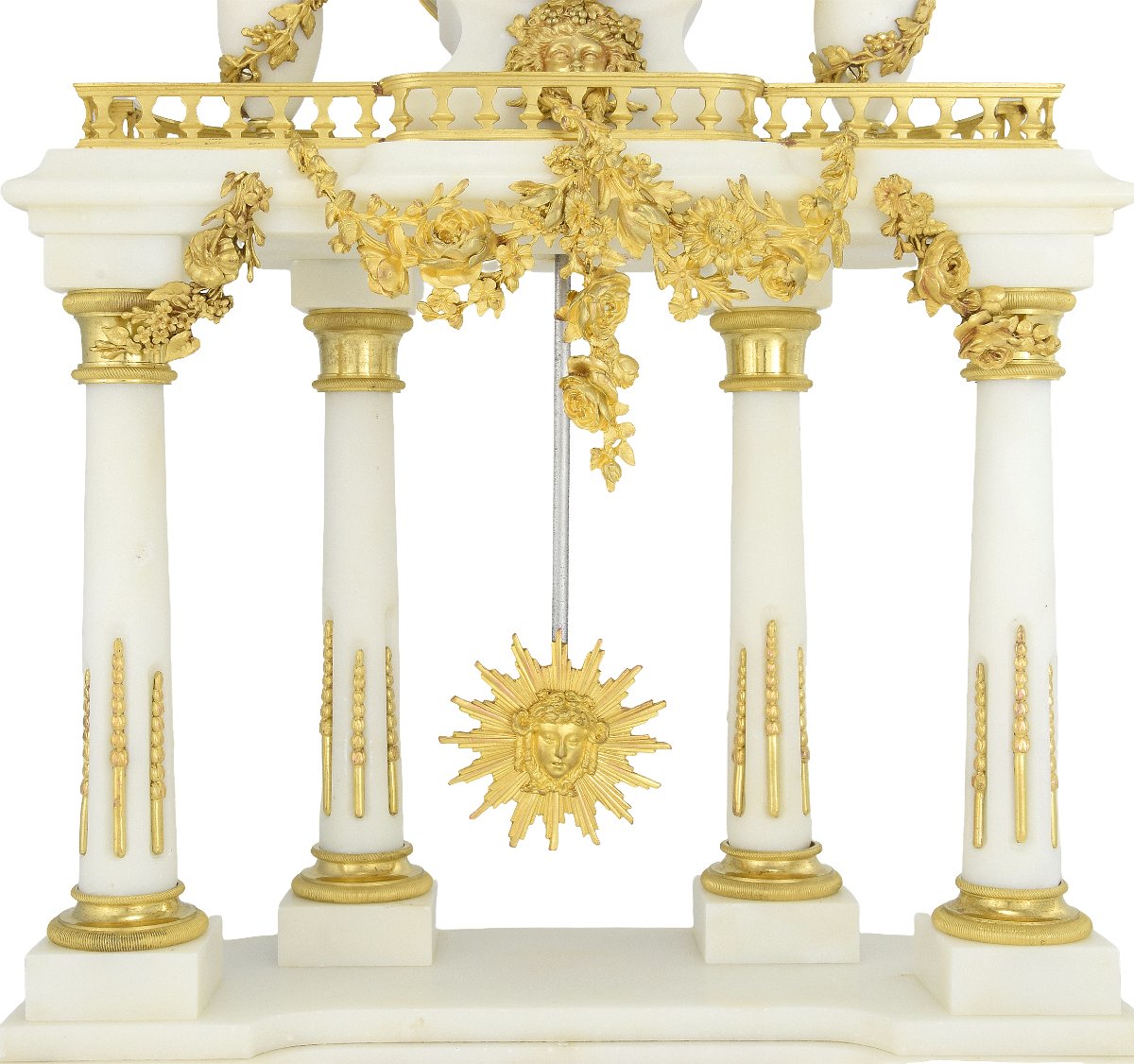
A floral drop cascades from the center, forming a highly elegantbotanical pendant. The architectural structure rests on fourcylindrical Carrara marble columns; their widely spaced arrangement isa key feature of this model. Unlike classical portico clocks withclosely set columns, these are widely spaced, creating an impression oflightness and highlighting the suspended pendulum. The columns areadorned with vertical gilt-bronze mounts featuring bead-and-rod motifs.They are topped by capitals decorated with floral garlands and rest onmolded bases with fine banding. At the center of this architecturalspace swings a remarkable gilt-bronze sunburst pendulum. Its radiantdisc features a female face in high relief, surrounded by a multitudeof diverging rays. This solar motif—a symbol of time andlight—harmoniously animates the composition while reinforcing itsmajestic character.
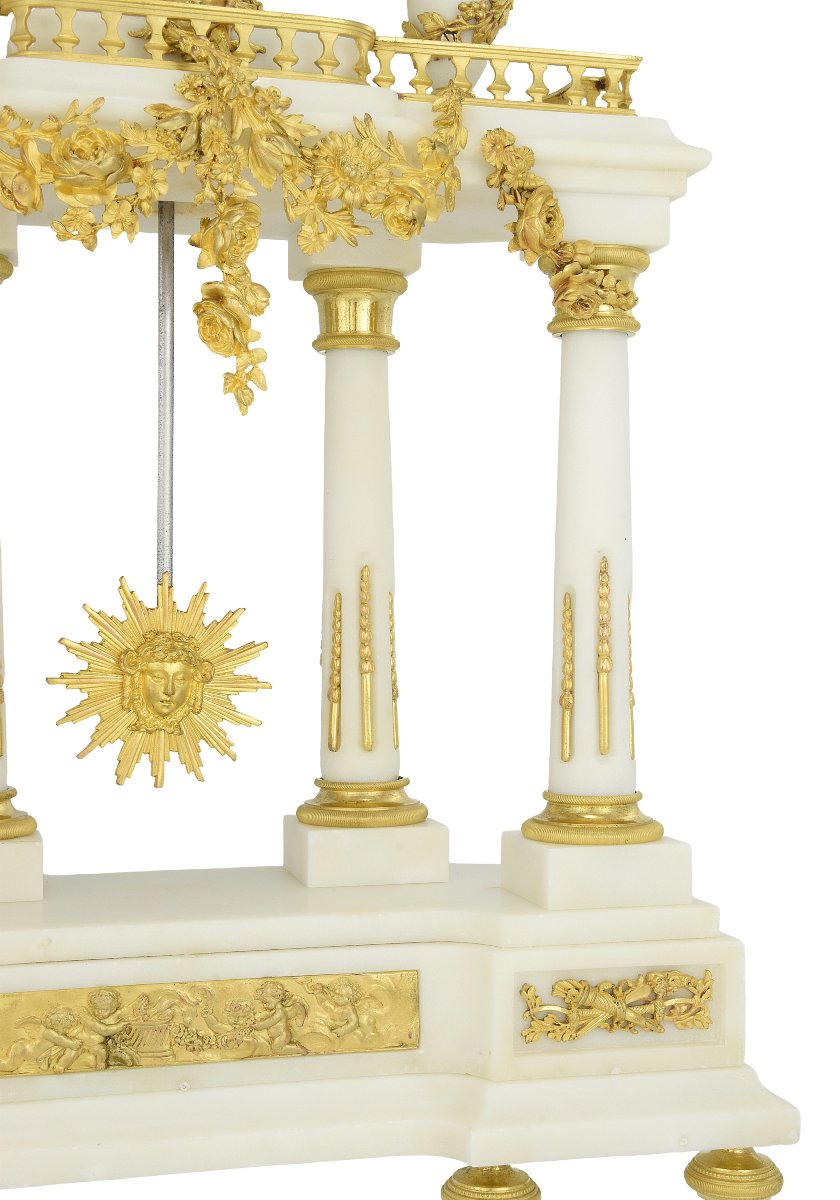
The base features a particularly elegant, dynamic shape, withprojections and recesses that accentuate the clock's monumentalcharacter. The carefully polished Carrara marble highlights severaldecorative ormolu mounts. At the center is a rectangular plaque carvedin low relief, depicting winged putti moving around a flower-adornedaltar—a scene inspired by the 18th-century neoclassicalrepertoire. The ends feature foliate trophies composed of delicatelyintertwined ribbons, foliage, flowers, and pastoral instruments. Thepiece rests on four turned ormolu feet, lending both stability andelegance to this exceptional composition.
With its high-quality materials, abundant floral ornamentation, finelychased details, imposing size, and—above all—its unusualarchitectural design featuring widely spaced, free-standing columns,this portico clock represents a particularly rare and spectacularexample of decorative horology from the Second Empire (Napoleon III)period, drawing inspiration from the most prestigious Louis XVI stylecreations.
Original, unmodified movement. Strikes the hours and half-hours on anantique bell with a clear, authentic tone.
ORDERING AND ADDITIONAL INFORMATION FROM OUR WEBSITE
Crowning the piece is a large, baluster-shaped covered vase in Carraramarble, topped with a bouquet of stylized fruit and foliage. Its bodyis accented by a row of beading and held by a gilt-bronze mount formingan openwork gallery decorated with roses, daisies, foliage, andribbons. This floral arrangement—featuring remarkably finechasing—serves as a magnificent decorative finial that emphasizesthe clock's verticality. Beneath the vase sits the circular drumhousing the movement, a feature typical of the most luxurious LouisXVI-style models. The white enamel dial is framed by a beaded bezel anddisplays black painted Arabic numerals. The delicately piercedgilt-bronze hands are exceptionally elegant in design: the hour handterminates in a radiant star, while the minute hand evokes a streak oflight. The movement is housed in an imposing cylindrical drum; the rearreveals a mechanism stamped "Vincenti et Cie"—a prestigiousclockmaker listed in Tardy’s dictionary of horologists.
The central section rests on a plinth surrounded by a gilt-bronzebaluster gallery, an emblematic element of the Louis XVI decorativevocabulary. Flanking the dial are two elegant miniature Medici vasescarved from Carrara marble. They are entwined with gilt-bronze vinegarlands featuring veined leaves and grape clusters—symbols ofabundance and prosperity. Beneath the dial appears a sculptedgilt-bronze female mask wearing a crown of flowers and fruit, evokingan allegory of the seasons or bountiful nature. The upper section ofthe portico is enlivened by a sumptuous floral swag draped between thecolumns. This exceptional garland, entirely chased in gilt-bronze,combines blooming roses, buds, daisies, acanthus leaves, wildflowers,and naturalistic foliage. The richness of the modeling, the relief ofthe petals, and the fine detailing of the veins attest to meticuloussculptural and chasing work.
A floral drop cascades from the center, forming a highly elegantbotanical pendant. The architectural structure rests on fourcylindrical Carrara marble columns; their widely spaced arrangement isa key feature of this model. Unlike classical portico clocks withclosely set columns, these are widely spaced, creating an impression oflightness and highlighting the suspended pendulum. The columns areadorned with vertical gilt-bronze mounts featuring bead-and-rod motifs.They are topped by capitals decorated with floral garlands and rest onmolded bases with fine banding. At the center of this architecturalspace swings a remarkable gilt-bronze sunburst pendulum. Its radiantdisc features a female face in high relief, surrounded by a multitudeof diverging rays. This solar motif—a symbol of time andlight—harmoniously animates the composition while reinforcing itsmajestic character.
The base features a particularly elegant, dynamic shape, withprojections and recesses that accentuate the clock's monumentalcharacter. The carefully polished Carrara marble highlights severaldecorative ormolu mounts. At the center is a rectangular plaque carvedin low relief, depicting winged putti moving around a flower-adornedaltar—a scene inspired by the 18th-century neoclassicalrepertoire. The ends feature foliate trophies composed of delicatelyintertwined ribbons, foliage, flowers, and pastoral instruments. Thepiece rests on four turned ormolu feet, lending both stability andelegance to this exceptional composition.
With its high-quality materials, abundant floral ornamentation, finelychased details, imposing size, and—above all—its unusualarchitectural design featuring widely spaced, free-standing columns,this portico clock represents a particularly rare and spectacularexample of decorative horology from the Second Empire (Napoleon III)period, drawing inspiration from the most prestigious Louis XVI stylecreations.
Original, unmodified movement. Strikes the hours and half-hours on anantique bell with a clear, authentic tone.
ORDERING AND ADDITIONAL INFORMATION FROM OUR WEBSITE
Explore similar pieces and discover your ideal find:
Mantel Clocks