

Watercolor/gouache, 19th Century. Aristocratic Genre Scene After Jules Girardet, Signed H. Biss
H. BISSON, after Jules GIRARDET (Versailles/Paris, 1856 – Boulogne-Billancourt, 1938)
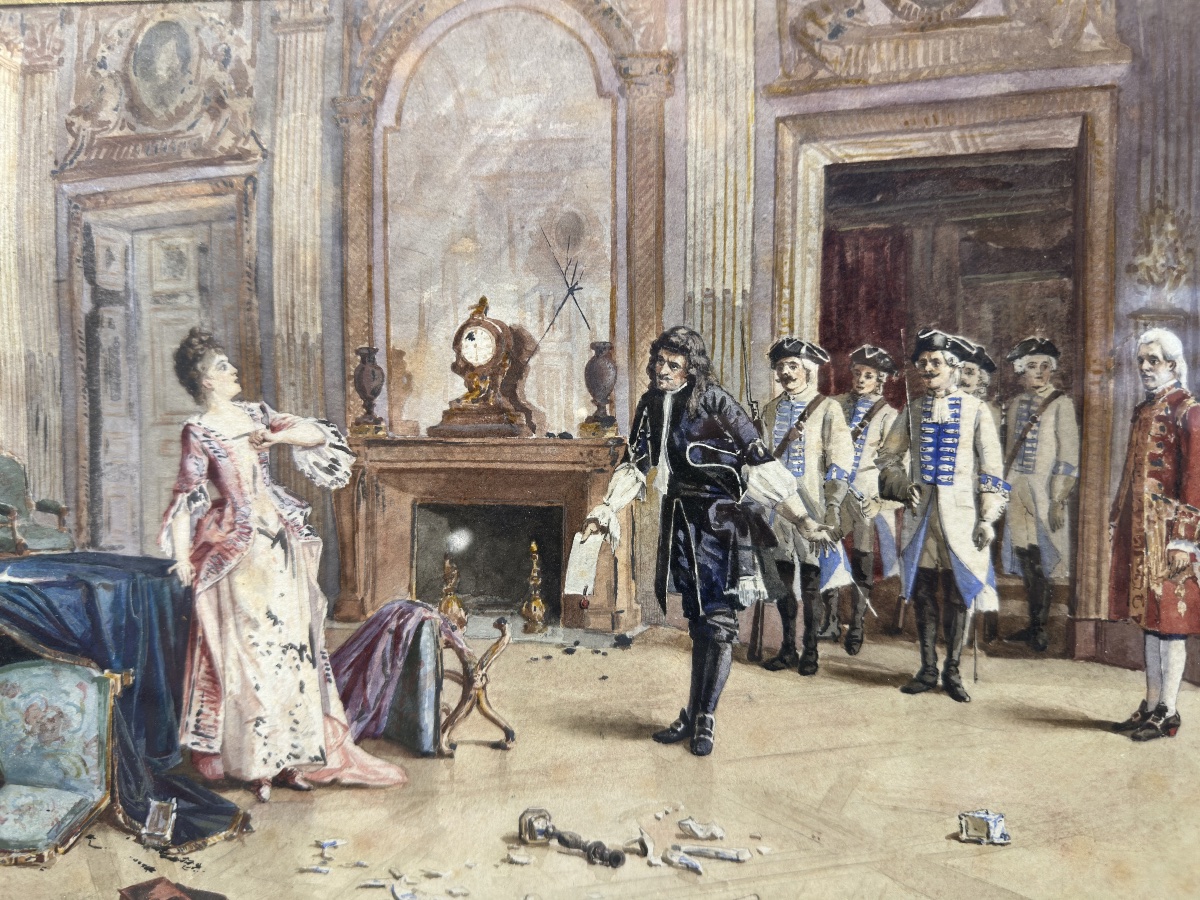
The Duchesse du Maine Ordered to Leave the Tuileries — historical scene (Salon of 1888)
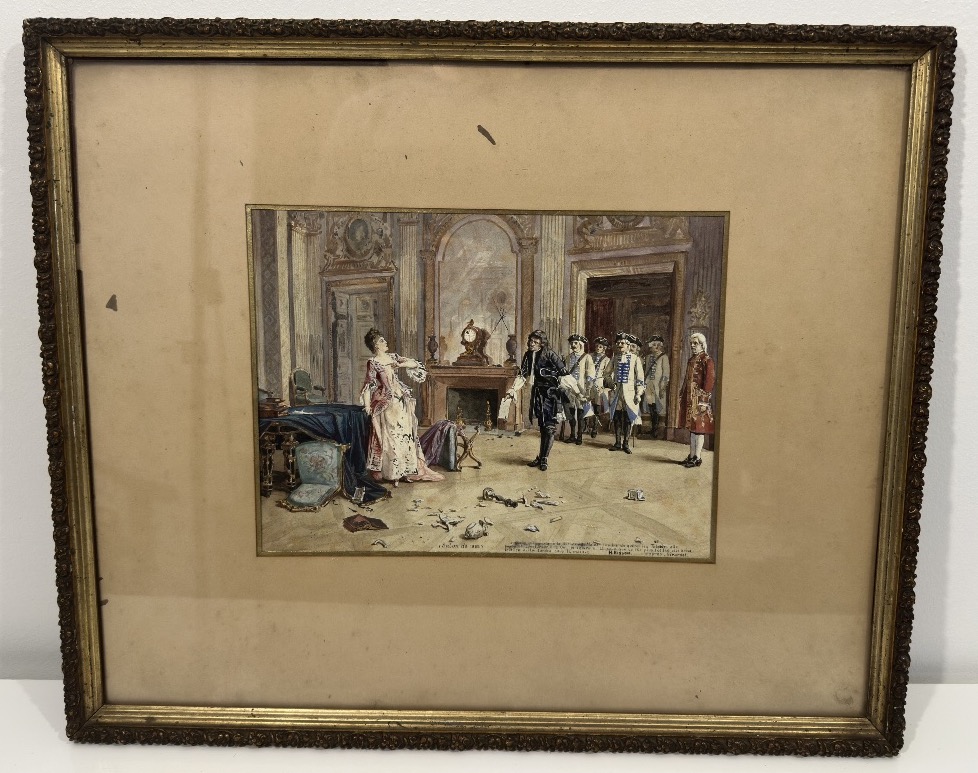
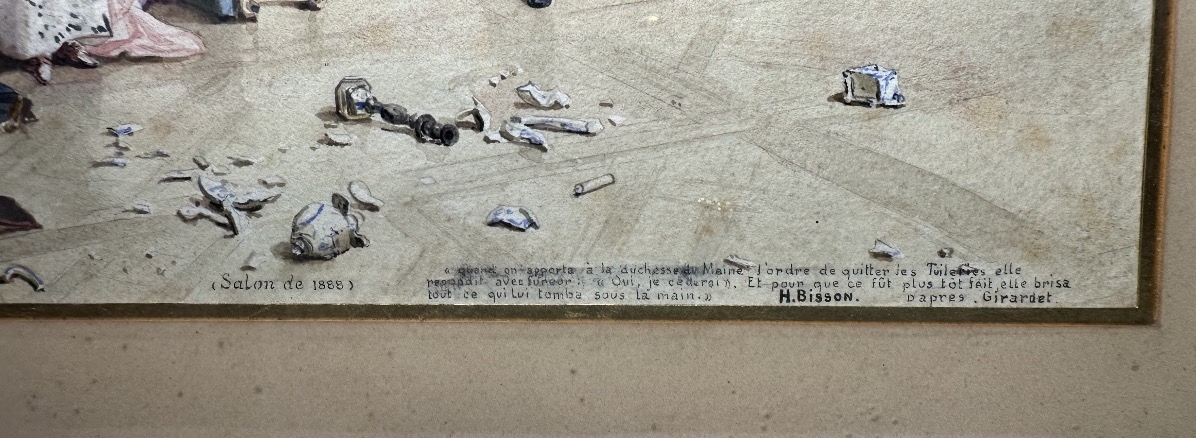
Watercolour and gouache, signed "H. Bisson" and inscribed "d'après Girardet" lower right, bearing the mention "Salon de 1888", 21.5 x 28 cm — Frame: 44 x 53 cm
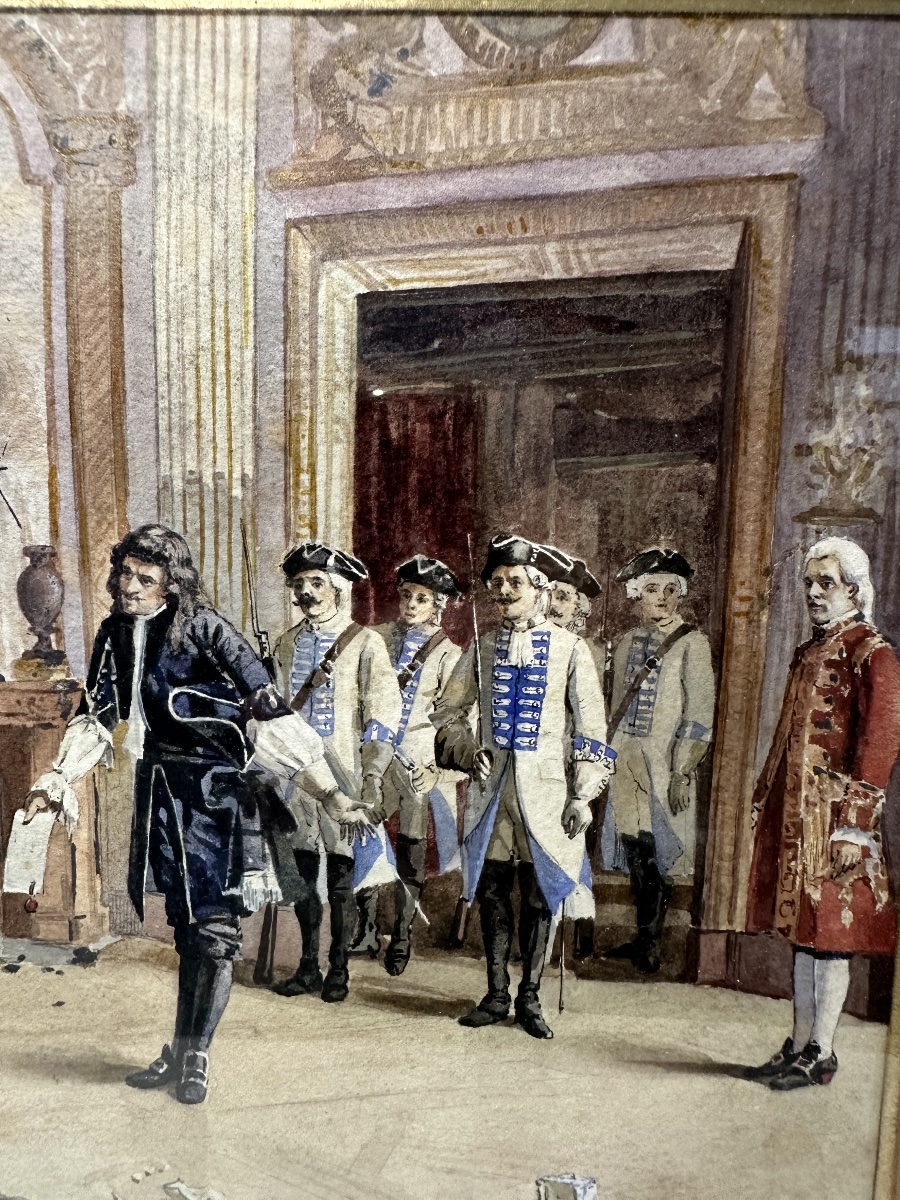
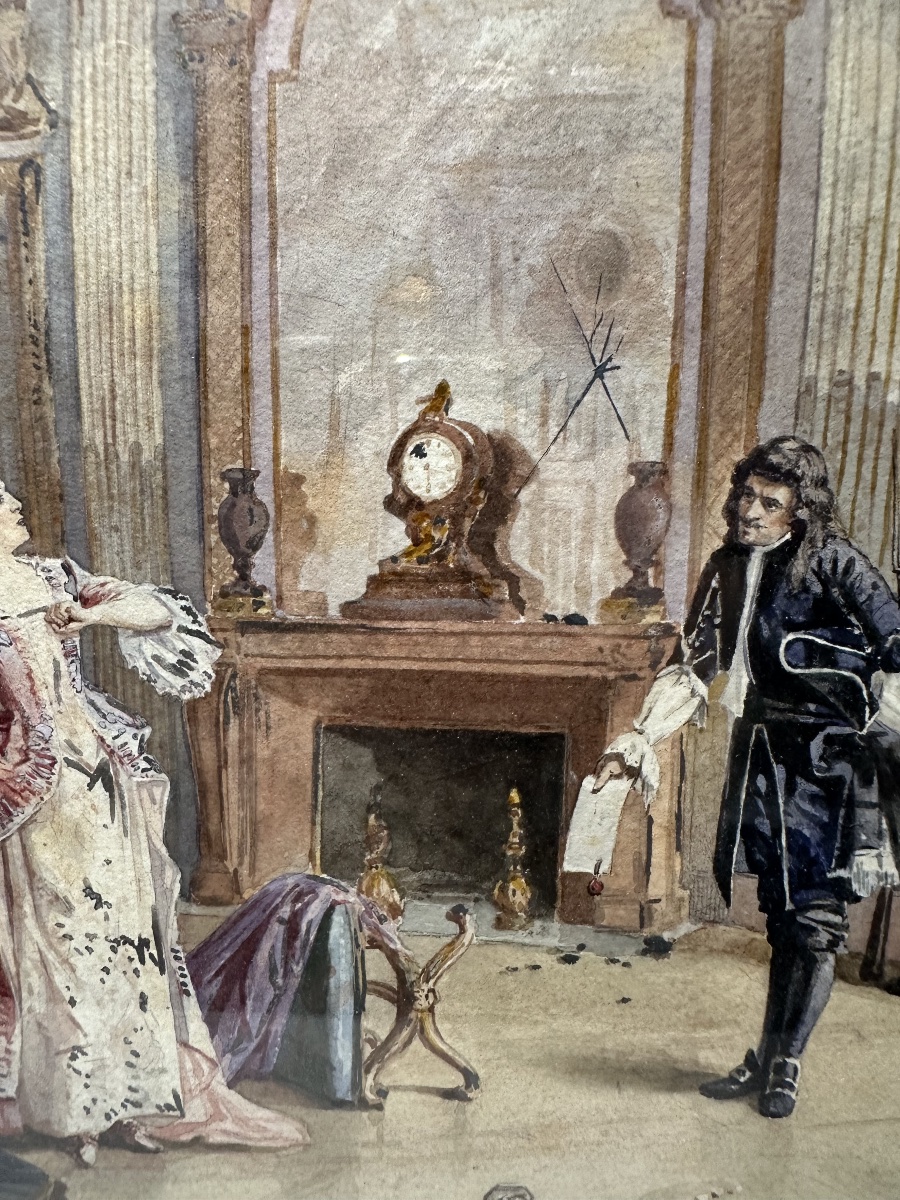
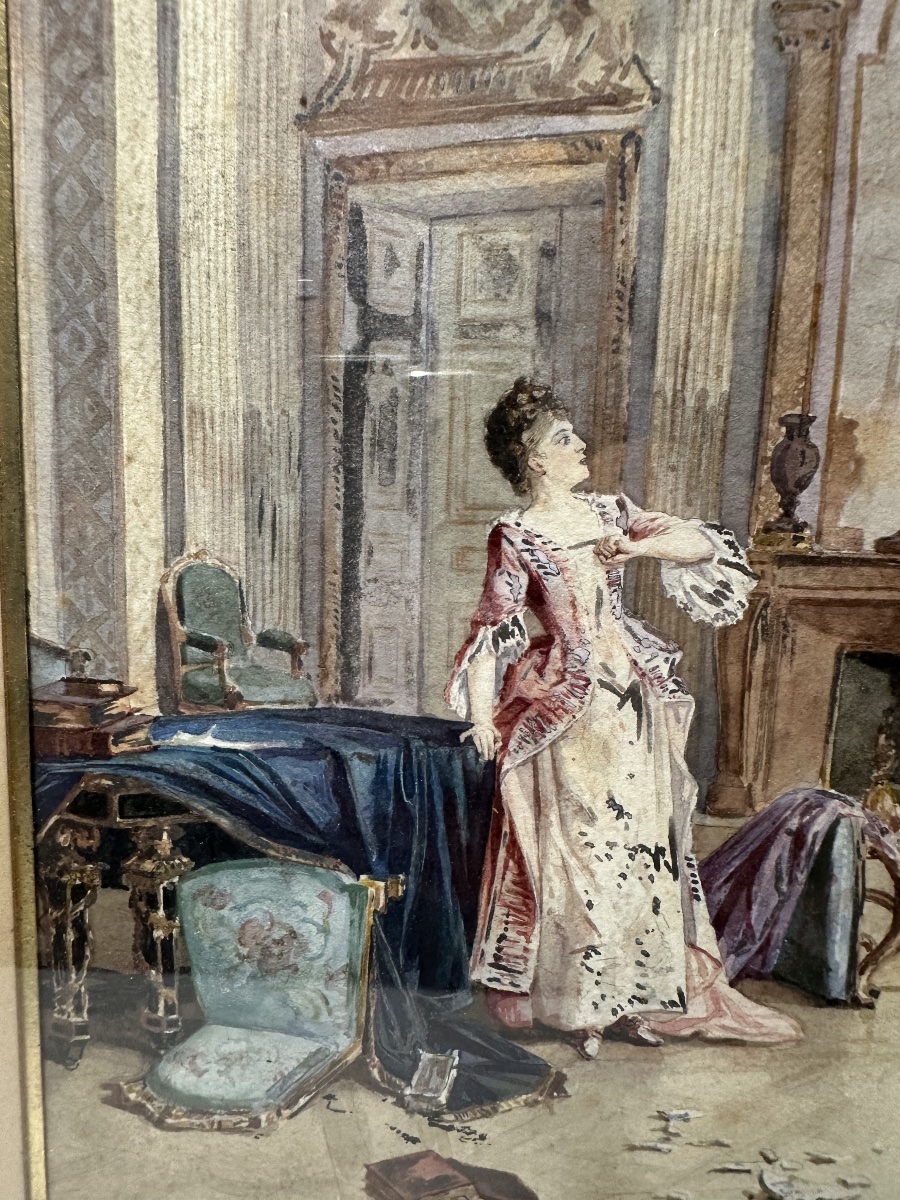
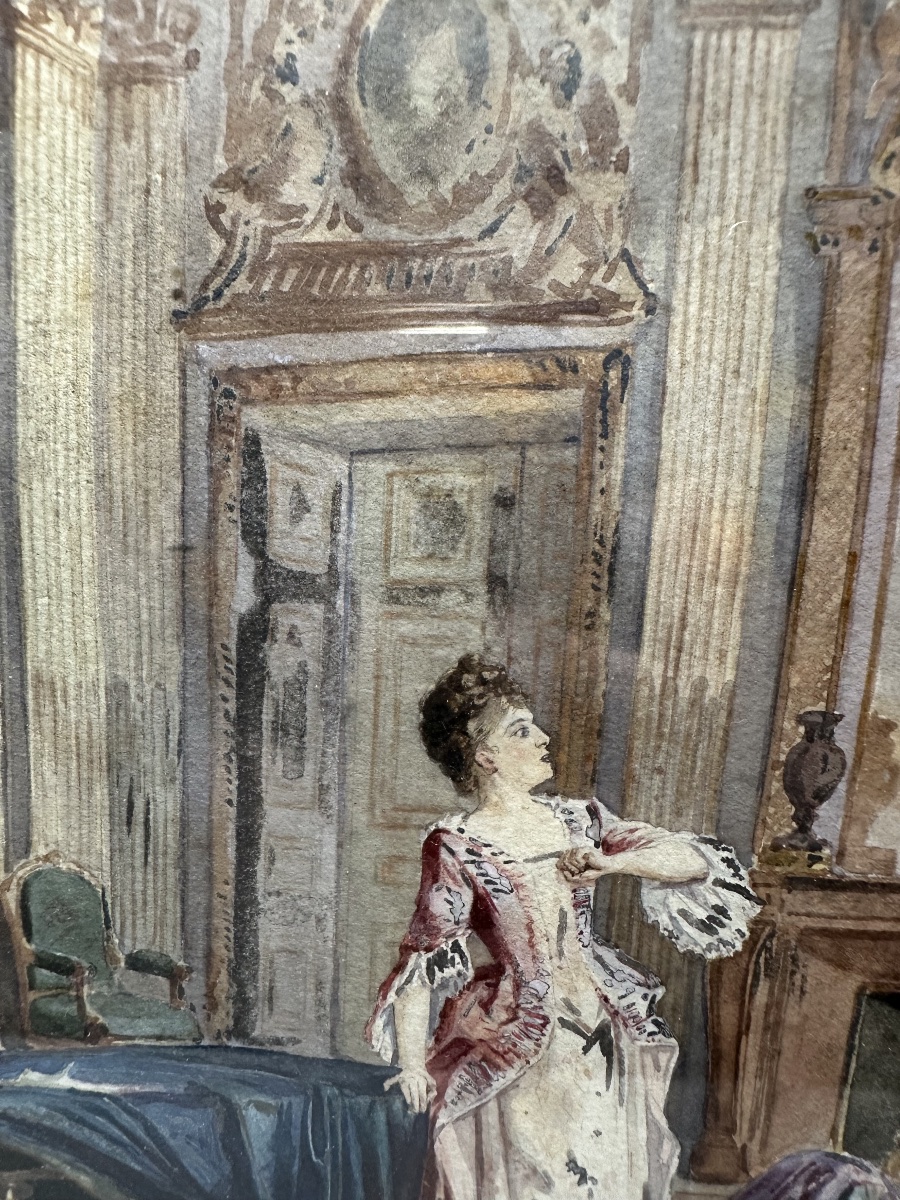
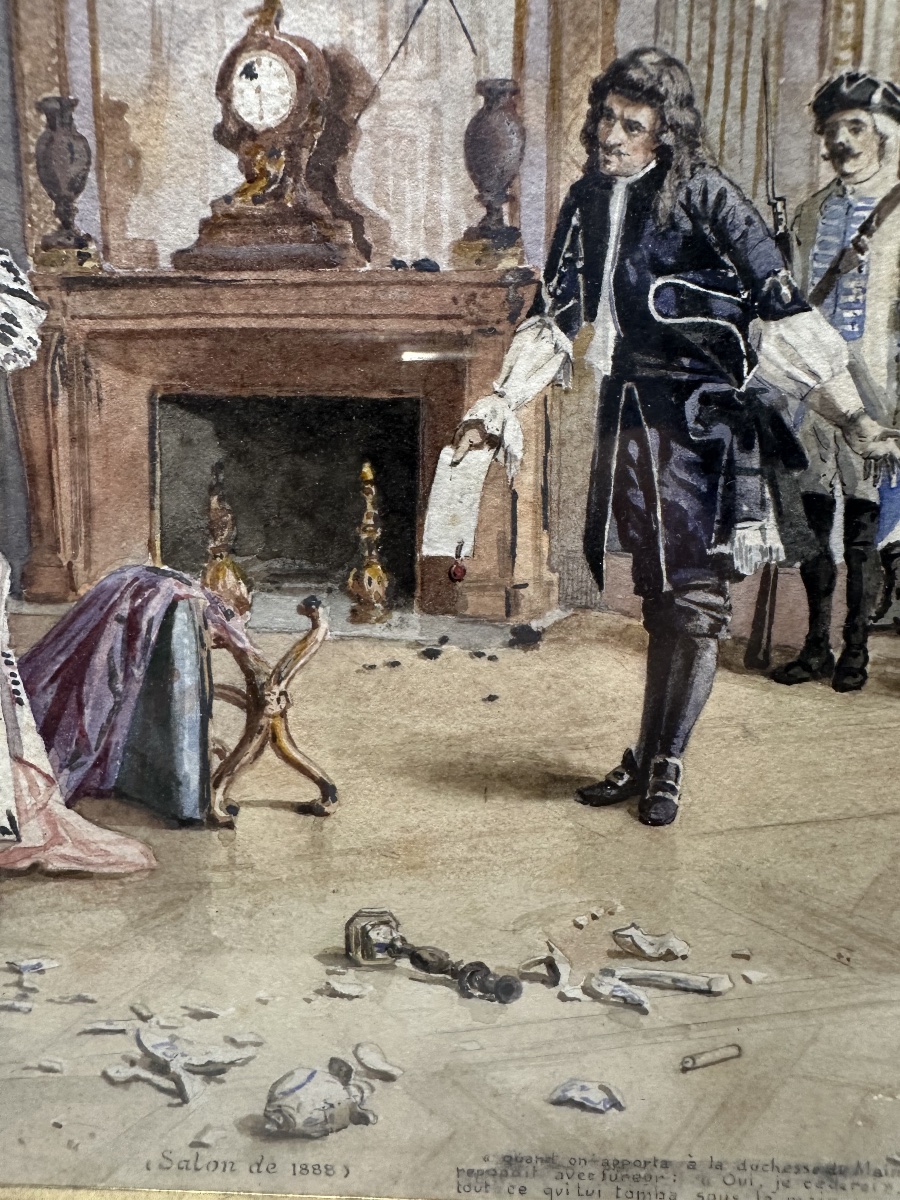
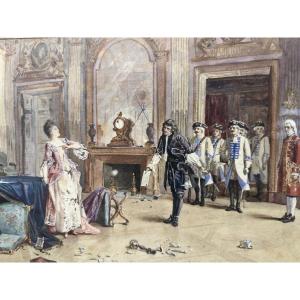
Watercolour and gouache reproducing a historical composition by Jules Girardet, exhibited at the Salon of 1888, illustrating an episode in which the duchesse du Maine is informed of the order to leave the Tuileries: according to the caption inscribed on the work, she is said to have replied that she would accept, but that she would first break everything within her reach. The scene unfolds in a richly architectural palace interior, with columns, a mantel clock, and carved panelling, where the duchess in a pink court gown confronts a man in dark eighteenth-century dress, surrounded by a guard in uniform, while broken porcelain and shattered objects litter the floor in the foreground.
Jules Girardet, whose composition this watercolour reproduces, was a French painter and illustrator of Swiss descent, trained at the École des Beaux-Arts in Paris under Alexandre Cabanel. He specialised in large-scale history painting, drawing on subjects from the revolutionary wars and the Paris Commune, and received several awards at the Paris Salon as well as at the 1889 Universal Exposition. His work is held in several French museums, notably in Quimper and Cholet.
The watercolourist H. Bisson, author of this reproduction, could not be identified with certainty in the sources consulted; he was likely a copyist or practitioner who produced, as was common practice at the time, a watercolour version after a composition shown at the Salon.
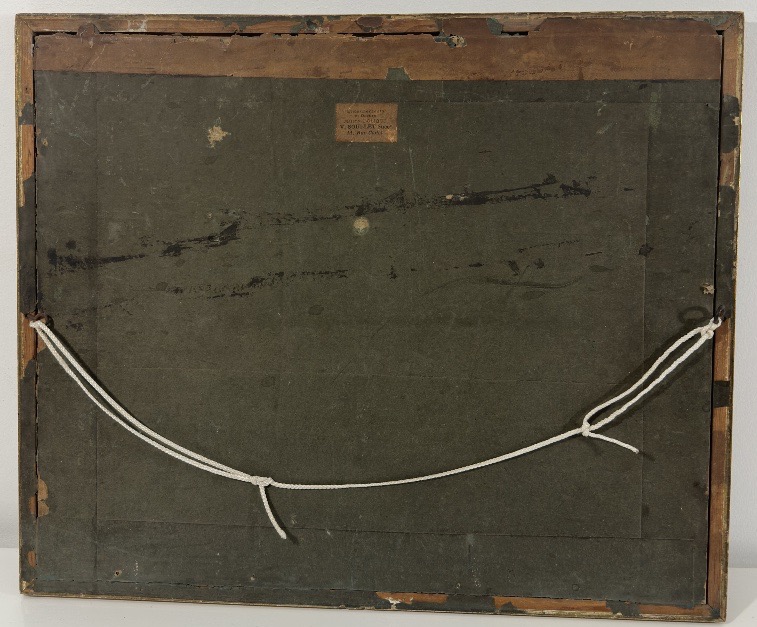
The sheet displays great finesse of execution, with precise drawing and delicate colouring, in the taste of grand academic historical illustration of the late nineteenth century. The gilded frame is of the period.
Deutsch
H. BISSON, nach Jules GIRARDET (Versailles/Paris, 1856 – Boulogne-Billancourt, 1938)
Die Herzogin von Maine erhält den Befehl, die Tuilerien zu verlassen — historische Szene (Salon von 1888)
Aquarell und Gouache, unten rechts signiert "H. Bisson" und bezeichnet "d'après Girardet", mit dem Vermerk "Salon de 1888", 21,5 x 28 cm — Rahmen: 44 x 53 cm
Aquarell und Gouache nach einer historischen Komposition von Jules Girardet, ausgestellt im Salon von 1888, die eine Episode darstellt, in der der Herzogin von Maine der Befehl mitgeteilt wird, die Tuilerien zu verlassen: Laut der auf dem Werk vermerkten Legende soll sie geantwortet haben, sie werde einwilligen, zuvor aber alles zerschlagen, was ihr in die Hände falle. Die Szene spielt sich in einem reich architektonisch gestalteten Palastinnenraum ab, mit Säulen, einem Kaminsims mit Uhr und geschnitzter Täfelung, wo die Herzogin in einem rosafarbenen Hofkleid einem Mann in dunkler Kleidung des 18. Jahrhunderts gegenübersteht, umgeben von einer uniformierten Wache, während zerbrochenes Porzellan und Trümmer den Boden im Vordergrund bedecken.
Jules Girardet, dessen Komposition dieses Aquarell wiedergibt, war ein französischer Maler und Illustrator schweizerischer Herkunft, ausgebildet an der École des Beaux-Arts in Paris im Atelier von Alexandre Cabanel. Er spezialisierte sich auf die große Historienmalerei mit Themen aus den Revolutionskriegen und der Pariser Kommune und erhielt mehrere Auszeichnungen im Pariser Salon sowie auf der Weltausstellung von 1889. Sein Werk befindet sich in mehreren französischen Museen, insbesondere in Quimper und Cholet.
Der Aquarellist H. Bisson, Urheber dieser Reproduktion, konnte in den konsultierten Quellen nicht mit Sicherheit identifiziert werden; es handelt sich wahrscheinlich um einen Kopisten oder Praktiker, der, wie damals üblich, eine aquarellierte Fassung nach einer im Salon gezeigten Komposition anfertigte.
Das Blatt zeichnet sich durch große Ausführungsfeinheit aus, mit präziser Zeichnung und zarter Kolorierung, im Geschmack der großen akademischen Historienillustration des späten 19. Jahrhunderts. Der vergoldete Rahmen ist zeitgenössisch.
Italiano
H. BISSON, da Jules GIRARDET (Versailles/Parigi, 1856 – Boulogne-Billancourt, 1938)
La Duchessa del Maine costretta a lasciare le Tuileries — scena storica (Salon del 1888)
Acquerello e gouache, firmato "H. Bisson" e annotato "d'après Girardet" in basso a destra, con la menzione "Salon de 1888", 21,5 x 28 cm — Cornice: 44 x 53 cm
Acquerello e gouache che riprende una composizione storica di Jules Girardet, presentata al Salon del 1888, illustrando un episodio in cui viene comunicato alla duchessa del Maine l'ordine di lasciare le Tuileries: secondo la didascalia riportata sull'opera, ella avrebbe risposto che avrebbe accettato, ma che prima avrebbe distrutto tutto ciò che le fosse capitato sottomano. La scena si svolge in un interno di palazzo riccamente architettonico, con colonne, un camino sormontato da un orologio e boiseries scolpite, dove la duchessa in abito di corte rosa fronteggia un uomo in abito scuro del XVIII secolo, circondato da una guardia in uniforme, mentre porcellane rotte e oggetti in frantumi coprono il pavimento in primo piano.
Jules Girardet, di cui questo acquerello riprende la composizione, fu un pittore e illustratore francese di origine svizzera, formatosi all'École des Beaux-Arts di Parigi nell'atelier di Alexandre Cabanel. Si specializzò nella grande pittura di storia, con soggetti tratti dalle guerre rivoluzionarie e dalla Comune di Parigi, e ricevette diversi riconoscimenti al Salon di Parigi e all'Esposizione Universale del 1889. La sua opera è conservata in diversi musei francesi, in particolare a Quimper e Cholet.
L'acquerellista H. Bisson, autore di questa ripresa, non ha potuto essere identificato con certezza nelle fonti consultate; si tratta verosimilmente di un copista o praticante che realizzò, come era pratica comune all'epoca, una versione ad acquerello da una composizione esposta al Salon.
Il foglio mostra grande finezza esecutiva, con disegno preciso e colori delicati, nel gusto della grande illustrazione storica accademica di fine Ottocento. La cornice dorata è d'epoca.
Period: 19th century
Style: Other Style
Condition: Excellent condition
Material: Oil painting on paper
Reference (ID): 1779037
Availability: In stock