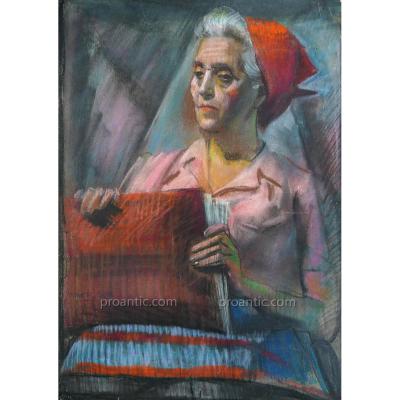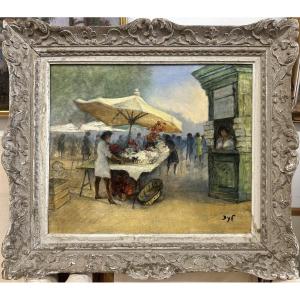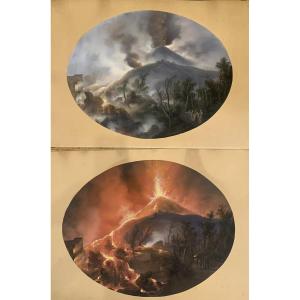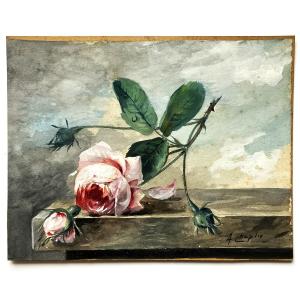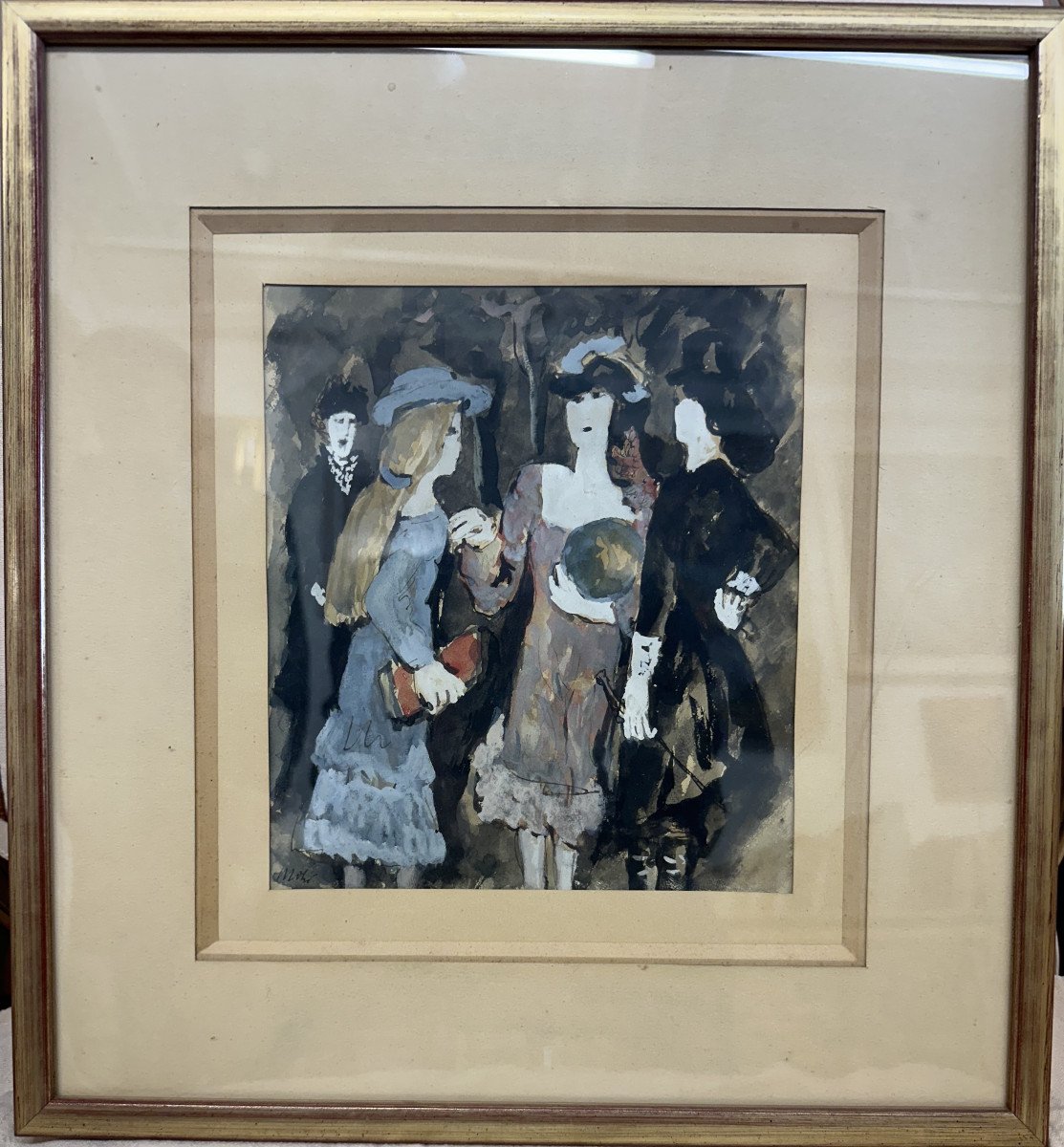
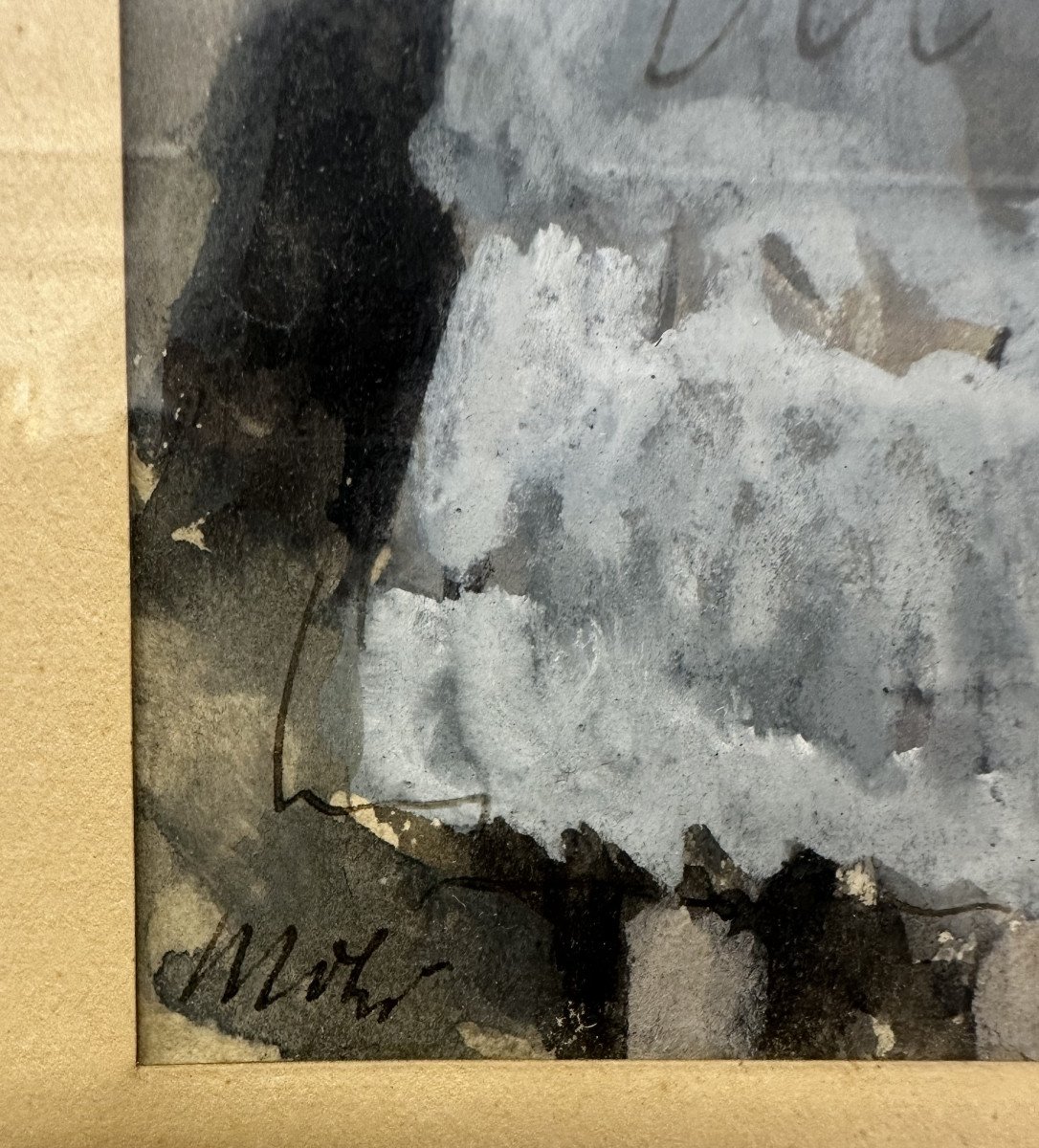
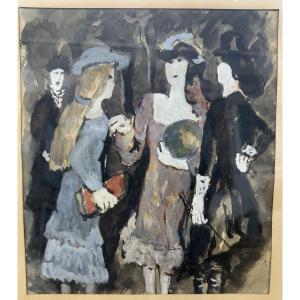


Alexander Mohr (trier 1892 - Athens 1974) "women's Meeting"; Gouache German Expressionist
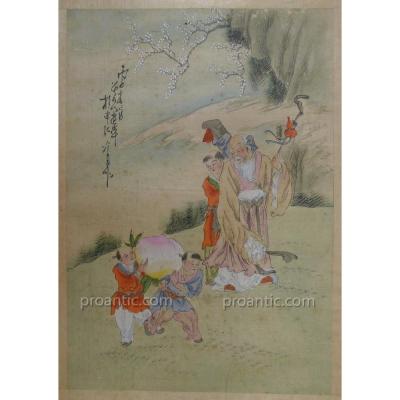
Alexander Mohr (Trier 1892 - Athens 1974) German Expressionist "Women's Meeting"; Gouache signed lower left Dimensions 22 x 20 cm
Alexander Mohr (1892–1974) was a German Expressionist artist.
Life and work
Mohr was born in Frankenberg, Germany, to affluent parents who hailed from an aristocratic background. Mohr commenced his formal artistic instruction in 1905 in Koblenz, Germany under the tutelage of German expressionist William Straube (1871–1954), who was a student of Henri Matisse. His formal training was interrupted by World War I where he served as a Cavalry Officer from 1914 to 1918 in the war's eastern front.
The war behind him, in 1919 Mohr studied under expressionist Adolf Holzel (1853–1934) in Stuttgart and executed his works in the circle of the Rhenish Expressionists in Düsseldorf.
In 1919, he illustrated a book for famed German expressionist writer Carl Maria Weber and later rendered avant-garde illustrations for other publications. Commencing in 1920 Mohr began a lifelong friendship with the French-German writer Joseph Breitbach (1903–1980).
In 1922, Mohr participated in the First International Art Exhibition in Düsseldorf. Later that year Mohr transitioned to Berlin where he became a member of the expressionist November Group and developed an acquaintance with art-handlers Alfred Flechtheim and Wilhelm Uhde.
From 1925 to 1931, Mohr both studied and worked in Paris with three one-man exhibitions in 1927, 1929 and 1930. Through his acquaintance with expressionist Max Jacob, Mohr gained access to Pablo Picasso, with further references from his author friend Joseph Breitbach. While in Paris, Mohr was comfortable and frequently seen with the bon vivant literary elite of Paris, including Jean Schlumberger, André Gide and Julien Green.
Many believe that Mohr's finest expressionist paintings were executed during his Paris years and represented bucolic, mythological scenes influenced by the writings of Virgil, Horace and Ovid as the three canonical poets of Latin literature.
On occasion during 1925 to 1930 Mohr journeyed to Hungary, Spain, Italy and Switzerland to advance his expressionist agenda. In Rhenish Expressionism1932, Mohr visited Greece where he met and married Elsa Kahn, who would remain his lifelong partner. (Elsa's uncle was investment banker Otto Kahn (1867–1934) who built a 127-room mansion on Long Island, the second largest private residence in the United States, after George Vanderbilt's Biltmore Estate in Asheville, North Carolina.)
For the next decade, Mohr worked mostly in Germany, favoring his family homes in Trier and also Merzig, but also with frequent stays in Paris and Greece, inclusive of exhibitions in both Germany and Greece. His last one-man exhibition in Paris was in 1939 as the rumblings of World War II became louder. Mohr recognized the signs of conflict and opted to reside in Greece from 1942 to 1949.
From the mid-1930s, Mohr's artistic style migrated from expressionism to a more abstract form of the German expressionist movement, albeit some characterize this period as a transition to cubism by Mohr. While both expressionism and cubism are forms of modern art, cubism is based much less on the expression of emotion than it is on an intellectual experiment with structure and few would argue that emotion is lacking in Mohr's works. His paintings exude expressive emotion and are executed with quintessential German exactitude. Mohr was a wizard in catching an expression as elusive as thought. A master of expressionist painting, Mohr latched on to the brash and angular. We can only imagine Mohr propped on his studio stool, well-groomed yet smug as he lays evanescent highlights onto the implastic background of the canvas of his early expressionistic work and on another occasion wondering if we will identify the blended nuances, all but hidden, in his later abstract expressionist works.
From 1950 to 1953, Mohr once again migrated to Paris and worked from a studio provided by the Schlumberger family and remained in close contact with his friend Joseph Breitbach.
Beginning in the mid-1950s, Mohr resumed his peripatetic travel rhythm and his lifelong expressionist painting passion became a more casual endeavor. On February 8, 1974, expressionist painter Alexander Mohr died after a short illness in Athens, Greece and was interred there.
Several retrospective exhibitions of the work of Alexander Mohr were held in the following decades. His life is described in Alexander Mohr–Der Maler mit den Flügelschuhen a 410-page illustrated monograph written by Christl Lehnert-Leven and published in 1996 in Germany.
Exhibitions1919 Cologne, Cologne Art Association, Society of the Kunste, November
1922 Düsseldorf, Leonhard Tietz AG, First International Art Exhibition, 28 May to 3 July
1922 Berlin, Gallerie Alfred Flechtheim, One-man exhibition, October
1924 Trier, Artist's home, Christmas exhibition, December
1927 Paris, Galerie Zborowski, One-man exhibition, 7 to 22 January
1927 Trier, Paulusplatz, College exhibition, April
1928 Essen, Folkwang Museum Exhibition, January
1928 Düsseldorf, Kunstpalast, German art exhibition, May to October
1929 Paris, Galerie aux Quatre Chemins, One-man exhibition, 16 to 30 November
1930 Paris, Galerie Klienmann & Cie., One-man exhibition, 31 October to 14 November
1930 Trier, Kornmarkt, Annual exhibition, 30 November to 14 December
1931 Trier, Bezirk, Annual exhibition, 6 to 20 December
1931-1932 Athens, Galerie Parnassos, One-man exhibition, 20 December to 4 January
1932 Luxembourg, Galerie Menn, One-man exhibition, 16 April to 4 May
1932 Trier, Bischof-Korum house, Rhenish exhibition, 18 to 20 June
1932 Trier, Kornmarkt, Annual exhibition, December
1932-1933 Athens, Galerie Studio, One-man exhibition, 18 December to 18 January
1933 Cologne, Cologne Art Association, One-man exhibition, 1 to 26 December
1934 Stuttgart, Wurttembergischer Art Association, One-man exhibition, 6 January to 4 February
1934 Athens, Galerie D’Art Geo, One-man exhibition, 19 November to 15 December
1935 Cologne, Cologne Art Association, One-man exhibition, September
1935 Saarbrücken, National Museum, One-man exhibition, 20 October to 20 November
1936 Trier, Paulusplatz, Exhibition, August to September
1938 Athens, Galerie Stratigopoulos, One-man exhibition, 2 to 19 February
1939 Paris, Galerie Poyet, One-man exhibition, 17 March to 5 April
1939 Trier, Konstantinplatz, Christmas exhibition, 15 November to 16 December
1941 Berlin, Kunstdienst Exhibition, 28 September to 26 October
1941 Trier, Konstantinplatz, Christmas exhibition, December
1942 Posen, Kaiser Friedrich Museum, Exhibition, 21 March to 19 April
1942 Breslau, Station der Vorgen, Exhibition, 21 June to 19 July
1942 Trier, Palastmuseum, Exhibition, July
1942 Luxembourg, Kunsthaus, Exhibition, December
1943 Luxembourg, Kunsthaus Exhibition, 17 October to 19 December
1944 Trier, Palastmuseum Exhibition, July
1944 Luxembourg, Fruhjahrsausstellung, Exhibition, March
1946 Trier, Paulusplatz, Exhibition, 22 September to 12 October
1947 Trier, Paulusplatz, Christmas exhibition, December
1950 Mettlach, Abteigebaude, One-man exhibition, 7 to 21 May
1954 Saarlouis, French Consulate, One-man exhibition, July and August
1958 Athens, Goethe Institute, One-man exhibition, 27 March to 9 April
1958 Saarbrücken, Galerie van Hees, One-man exhibition, 23 October to 7 November
1961 Wurgendorf, Heimhoftheater, One-man exhibition, 11 to 23 November
1961 Koblenz, Kurfurstliches Schloss, One-man exhibition, 10 to 23 December
1962 Marseille, Goethe Institute, One-man exhibition, 5 to 17 February
1962 Bonn, Bucherstube, One-man exhibition, 9 to 29 March
1962 Krefeld, Galerie Carl Uhrig, One-man exhibition, April
1962 Nauheim, Kurhaus, Exhibition, May
1962 Giessen, Universitatsbibliothek, One-man exhibition, 23 June to 11 July
1962 Wetzlar, Exhibition Hall, One-man exhibition, July and August
1962 Bad Ems, Kursaalgebaude, One-man exhibition, 1 to 14 September
1962 Koblenz, Kurfurstliches Schloss, Exhibition, 22 September to 22 October
1962 Frankfurt, Dornbuschaus, One-man exhibition, 3 to 22 November
1964 Düsseldorf, Verein-Malkasten, One-man exhibition, 17 March to 8 April
1966 Ploermel, Galerie les Marmousets, One-man exhibition, 3 to 31 December
1976 Trier, Stadtisches Museum Simeonstift, Exhibition, 12 March to 19 April
1977 Merzig, Hilbringen, Exhibition, 18 to 22 February
1993 Bonn, August Macke House, Rhenish expressionism exhibition, 28 February to 2 May
1996 Trier, Stadtisches Museum Simeonstift, Exhibition, 29 April to 1 September
1996-1997 Trier, Stadtisches Museum Simeonstift, Retrospective, 16 December to 31 March
1997 Koblenz, Mittelrhein-Museum, Retrospective, 30 April to 1 June
1999-2000 Newport Beach, The Pacific Art Foundation, Retrospective, 15 November to 15 May
Alexander Mohr (1892–1974) was a German Expressionist artist.
Life and work
Mohr was born in Frankenberg, Germany, to affluent parents who hailed from an aristocratic background. Mohr commenced his formal artistic instruction in 1905 in Koblenz, Germany under the tutelage of German expressionist William Straube (1871–1954), who was a student of Henri Matisse. His formal training was interrupted by World War I where he served as a Cavalry Officer from 1914 to 1918 in the war's eastern front.
The war behind him, in 1919 Mohr studied under expressionist Adolf Holzel (1853–1934) in Stuttgart and executed his works in the circle of the Rhenish Expressionists in Düsseldorf.
In 1919, he illustrated a book for famed German expressionist writer Carl Maria Weber and later rendered avant-garde illustrations for other publications. Commencing in 1920 Mohr began a lifelong friendship with the French-German writer Joseph Breitbach (1903–1980).
In 1922, Mohr participated in the First International Art Exhibition in Düsseldorf. Later that year Mohr transitioned to Berlin where he became a member of the expressionist November Group and developed an acquaintance with art-handlers Alfred Flechtheim and Wilhelm Uhde.
From 1925 to 1931, Mohr both studied and worked in Paris with three one-man exhibitions in 1927, 1929 and 1930. Through his acquaintance with expressionist Max Jacob, Mohr gained access to Pablo Picasso, with further references from his author friend Joseph Breitbach. While in Paris, Mohr was comfortable and frequently seen with the bon vivant literary elite of Paris, including Jean Schlumberger, André Gide and Julien Green.
Many believe that Mohr's finest expressionist paintings were executed during his Paris years and represented bucolic, mythological scenes influenced by the writings of Virgil, Horace and Ovid as the three canonical poets of Latin literature.
On occasion during 1925 to 1930 Mohr journeyed to Hungary, Spain, Italy and Switzerland to advance his expressionist agenda. In Rhenish Expressionism1932, Mohr visited Greece where he met and married Elsa Kahn, who would remain his lifelong partner. (Elsa's uncle was investment banker Otto Kahn (1867–1934) who built a 127-room mansion on Long Island, the second largest private residence in the United States, after George Vanderbilt's Biltmore Estate in Asheville, North Carolina.)
For the next decade, Mohr worked mostly in Germany, favoring his family homes in Trier and also Merzig, but also with frequent stays in Paris and Greece, inclusive of exhibitions in both Germany and Greece. His last one-man exhibition in Paris was in 1939 as the rumblings of World War II became louder. Mohr recognized the signs of conflict and opted to reside in Greece from 1942 to 1949.
From the mid-1930s, Mohr's artistic style migrated from expressionism to a more abstract form of the German expressionist movement, albeit some characterize this period as a transition to cubism by Mohr. While both expressionism and cubism are forms of modern art, cubism is based much less on the expression of emotion than it is on an intellectual experiment with structure and few would argue that emotion is lacking in Mohr's works. His paintings exude expressive emotion and are executed with quintessential German exactitude. Mohr was a wizard in catching an expression as elusive as thought. A master of expressionist painting, Mohr latched on to the brash and angular. We can only imagine Mohr propped on his studio stool, well-groomed yet smug as he lays evanescent highlights onto the implastic background of the canvas of his early expressionistic work and on another occasion wondering if we will identify the blended nuances, all but hidden, in his later abstract expressionist works.
From 1950 to 1953, Mohr once again migrated to Paris and worked from a studio provided by the Schlumberger family and remained in close contact with his friend Joseph Breitbach.
Beginning in the mid-1950s, Mohr resumed his peripatetic travel rhythm and his lifelong expressionist painting passion became a more casual endeavor. On February 8, 1974, expressionist painter Alexander Mohr died after a short illness in Athens, Greece and was interred there.
Several retrospective exhibitions of the work of Alexander Mohr were held in the following decades. His life is described in Alexander Mohr–Der Maler mit den Flügelschuhen a 410-page illustrated monograph written by Christl Lehnert-Leven and published in 1996 in Germany.
Exhibitions
450 €
Period: 20th century
Style: Other Style
Condition: Condition of use
Material: Gouache
Width: 20
Height: 22
Reference (ID): 1319475
Availability: In stock
Print