


Superb Denarius With The Dioscuri — Certificate Of Authenticity
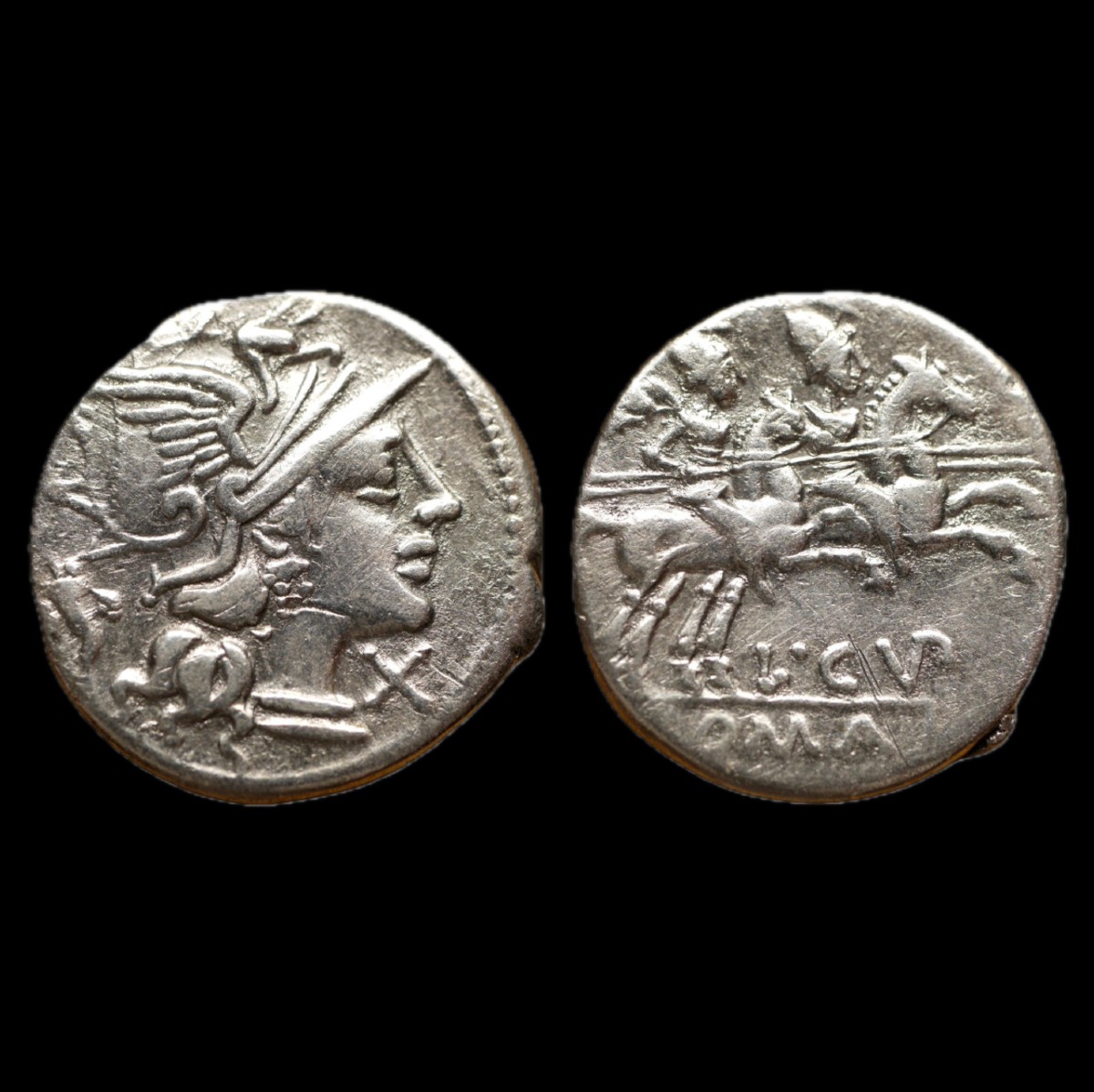
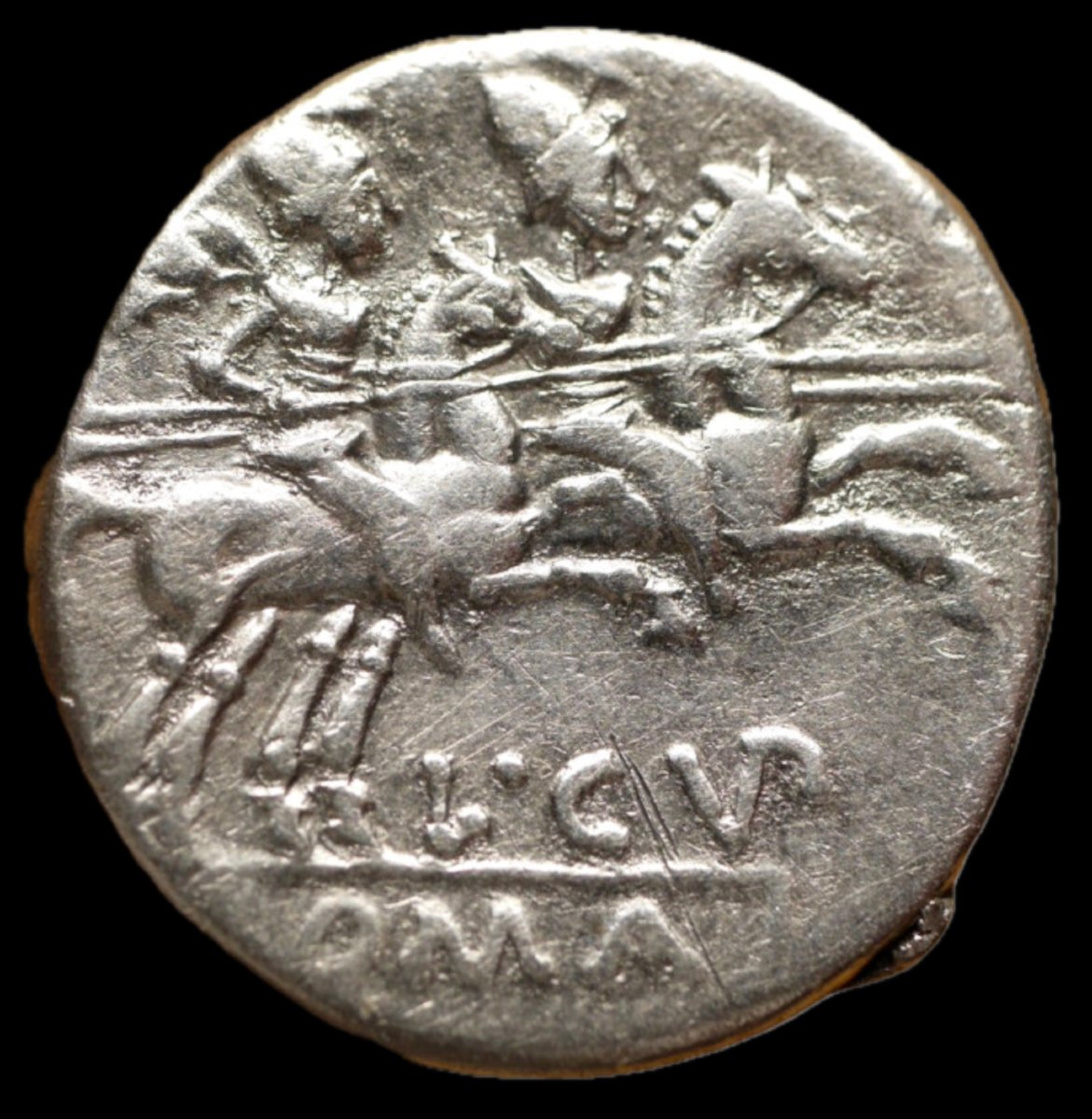
This Republican denarius of L. Cupiennius, struck at Rome in 147 BC, belongs to one of those types that speaks immediately to the collector through the purity of its iconographic language, the nobility of its silver, and the continuity of a monetary tradition that had by then become classical in the Middle Republic: the obverse combines the helmeted head of Roma, the value mark X, and the cornucopia, while the reverse shows the Dioscuri galloping right, with L·CVP beneath the horses and ROMA in the exergue; the attribution to Crawford 218/1 and RSC Cupiennia 1 fully accords here with the typology published by Numista, WildWinds, and specialist sale catalogues.
Each specimen is examined, described, and accompanied by a certificate of authenticity in accordance with the standards of the art and heritage market; the present piece is appealing for its particularly balanced appearance, in which Roma’s portrait remains ample and expressive, the cornucopia stands out clearly behind the head, and the reverse with the divine horsemen retains a very convincing visual impetus, within a diameter of 19 mm and a weight of 3.82 g—figures that fit coherently within the benchmarks observed for this type, Numista giving 3.58 g and 18.4 mm as reference characteristics, while comparable specimens published in specialist sales notably range between 3.35 g and 4.10 g, for diameters of about 16.66 to 19.0 mm.
Analysis & Expertise
Close observation under ×10 magnification and raking light. Direct examination of the obverse reveals a head of Roma right of particularly satisfying presence, whose winged helmet retains a highly legible architecture, with visor, wing, fastenings, and contour lines clearly articulated; the face, well centered, shows firm modeling of forehead, nose, mouth, and chin, while the neck, necklace, and the baseline of the bust remain clearly constructed, giving the whole a visual steadiness especially appreciable for a Republican denarius of this group.
The value mark X, placed under the chin, reads immediately, and the cornucopia behind the head—an essential distinguishing element of the type—stands out with remarkable clarity; the obverse field, while retaining the slight natural irregularities of an ancient hammered flan, remains sufficiently open to allow the portrait to “breathe,” and the beaded border can still be followed around a large part of the circumference, reinforcing the impression of a well-struck specimen.
The reverse retains a very special appeal, because the Dioscuri scene remains not only identifiable, but visually animated, with the two riders surging to the right, each holding his spear, in a composition that is still proud and taut; the horses preserve fine energy of movement, the line of the spears remains intelligible, the mark L·CVP beneath the horses can be recognized with firmness, and ROMA, within its linear frame in the exergue, remains legible with the frankness that gives the reverse its true numismatic footing.
The silver surface presents a homogeneous ancient appearance, in a luminous light gray, with relief that still catches the light favorably on the high points of the portrait, the helmet, and the horsemen; small edge irregularities, metal tension, the natural structuring of the letters, and the absence of any continuous peripheral break foreign to striking fully accord with the expected physiognomy of a Republican denarius struck by hammer, while the whole retains that highly sought-after balance between typological legibility, beauty of style, and the presence of metal.
What lifts this coin above a simple reference specimen is the combination of a well-set Roma portrait, a very legible cornucopia, a particularly lively Dioscuri reverse, and an overall state of reading that is highly favorable; the collector thus encounters not merely a correctly attributed coin, but an object that still restores, with real elegance, the visual breath of the Roman Republic in the mid-second century BC.
Characteristics
Monetary authority
The issue is attributed to L. Cupiennius, identified by the monetary legend L·CVP, and classified within the gens Cupiennia, according to the nomenclature of the principal numismatic corpora.
Mint
The mint is Rome, an attribution explicitly retained by Numista and repeated by specialist catalogues corresponding to this reference.
Dating
The strike is placed in 147 BC, a date given concordantly by Numista, WildWinds, and the consulted specialist sale catalogues.
Denomination
This is a denarius, i.e., the principal silver denomination of the Roman Republic, here still in the phase where the X mark recalls the value of ten asses.
Metal
The type is catalogued in silver, Numista specifying a reference composition of .950 for this issue.
Weight
The observed weight for this specimen is 3.82 g, a very harmonious figure for this type and fully compatible with the available documentation, which records comparanda at 3.35 g, 3.47 g, 3.79 g, 3.93 g, and 4.10 g.
Diameter
The observed diameter is 19 mm, fitting very favorably within the attested range for the type, Numista giving 18.4 mm as a reference and specialist sales publishing examples around 18.8 to 19.0 mm.
Technique
The coin is the product of a hammer strike, a technique indicated by Numista for this type and fully consistent with the observed flan morphology.
Obverse
The obverse shows the helmeted head of Roma right, with a cornucopia behind and X under the chin, according to the canonical description of the type.
Reverse
The reverse shows the Dioscuri on horseback galloping right, each holding a spear, with L·CVP below and ROMA in the exergue within a linear frame.
Typological references
Identification rests on Crawford 218/1, with concordances CRR 404, RCV I 94, BMC RR 852, RBW 937, and RSC Cupiennia 1, according to the repertories cited by Numista and specialist sale catalogues.
Rarity and collecting position
The type may be aptly presented as sought-after, Numista assigning it a rarity index of 90, placing it in a zone of sustained interest for collectors of Republican denarii, while remaining well documented in specialist sales.
Historical context
This issue belongs to a moment when the denarius was already firmly established as Rome’s principal silver coin, and when Republican iconographic language still maintained strong fidelity to its founding schemes; the presence of Roma on the obverse and the Dioscuri on the reverse belongs to a long-standing tradition, which Britannica notes for the earliest Roman denarii, whose Dioscuri reverse remained in use for several decades before moneyers introduced more broadly familial and more individualized themes.
In this context, the denarius of L. Cupiennius appears as a particularly elegant transitional piece, for it remains faithful to the great Republican canon while introducing—through the cornucopia placed behind Roma’s head—a distinctive sign proper to the issue; Numista further notes that several earlier scholars saw in this cornucopia a possible allusion to the name Cupiennius or Copiennius, giving the coin an already personal touch within a vocabulary that remains profoundly traditional.
The X mark under the chin, for its part, refers to the original value of the denarius, understood as equivalent to ten asses—a monetary relationship from which the very name denarius derives; this detail, often only modestly noticed by the non-specialist eye, carries for the collector a genuine doctrinal weight, for it inscribes the coin within the long history of civic accounting and the Roman weight system.
Cultural value
The cultural value of this piece is considerable—not through decorative excess, but precisely through that sovereign economy of signs that characterizes the finest creations of the Roman Republic: Roma, the cornucopia, the Dioscuri, ROMA in the exergue, and the abbreviated name of the moneyer suffice to hold together civic identity, abundance, divine protection, and public authority.
For the collector, the appeal of this denarius lies in its union of two evocative powers rarely separated in Republican numismatics: on the one hand the classical beauty of Roma’s portrait, and on the other the heroic movement of the Dioscuri, divine horsemen whose presence on the Republican denarius counts among the great emblems of Roman monetary imagination.
From the standpoint of art history, this coin belongs to that Roman civilization of the mid-second century BC in which coin engraving, without renouncing civic legibility, reaches a quality of profile, line, and composition that already approaches true miniature sculpture; it thus offers the learned cabinet a presence of style as well as historical interest.
Traceability & Guarantees
From a European provenance, from an established numismatic dealer, this specimen was acquired through a specialized international transaction conducted within a recognized numismatic network and validated by reference experts, in accordance with the highest standards of the art and heritage market; examination of the present object rests on direct observation of its stylistic, technical, and material characteristics, set in relation to the recognized references for Roman Republican coinage.
Each specimen is examined, described, and accompanied by a certificate of authenticity in accordance with the standards of the art and heritage market; in the present case, the concordance between the Roma / cornucopia / Dioscuri typology, the monetary legend L·CVP, the ROMA exergue, the metrological data, and the references Crawford 218/1 and RSC Cupiennia 1 establishes a particularly solid numismatic attribution.
Period: Before 16th century
Style: Rome and Antic Greece
Condition: Good condition
Reference (ID): 1730195
Availability: In stock