


Japanese Bronze By Terahata Sukenojô - German Shepherd
Artist: Terahata Sukenojo (寺畑助之丞) (1892-1970)
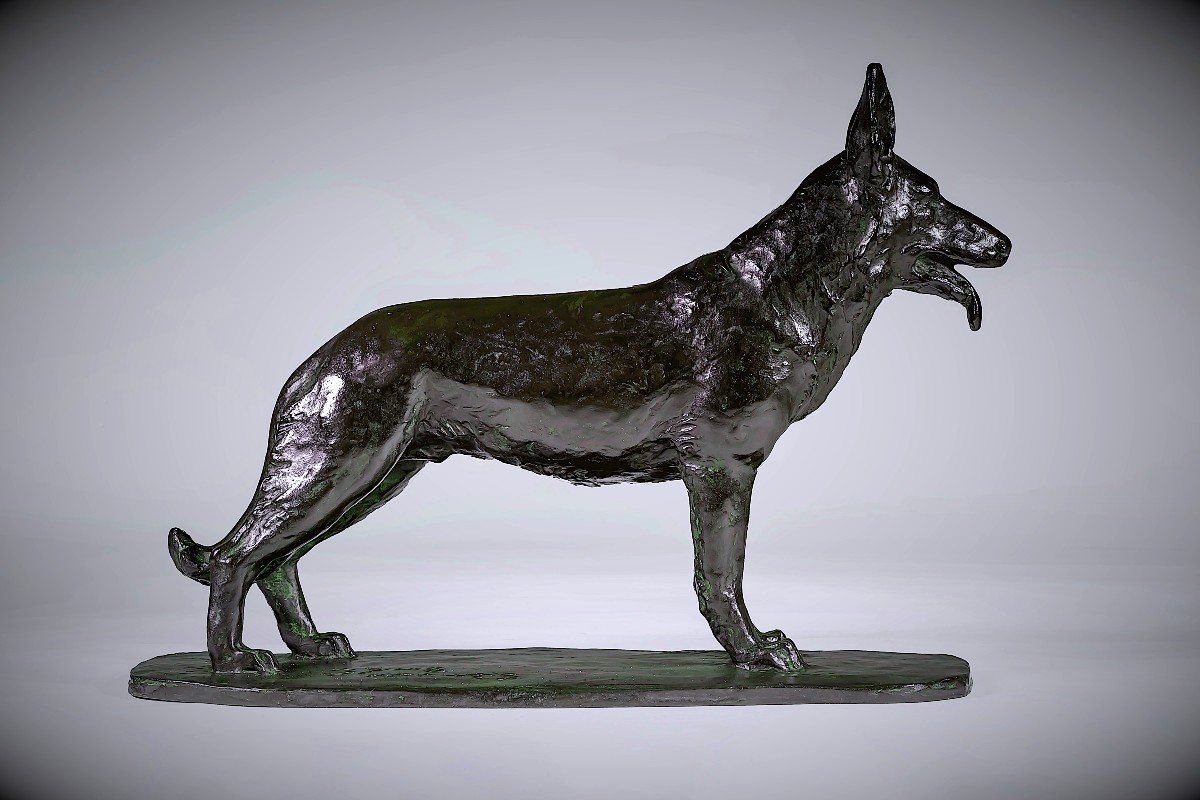
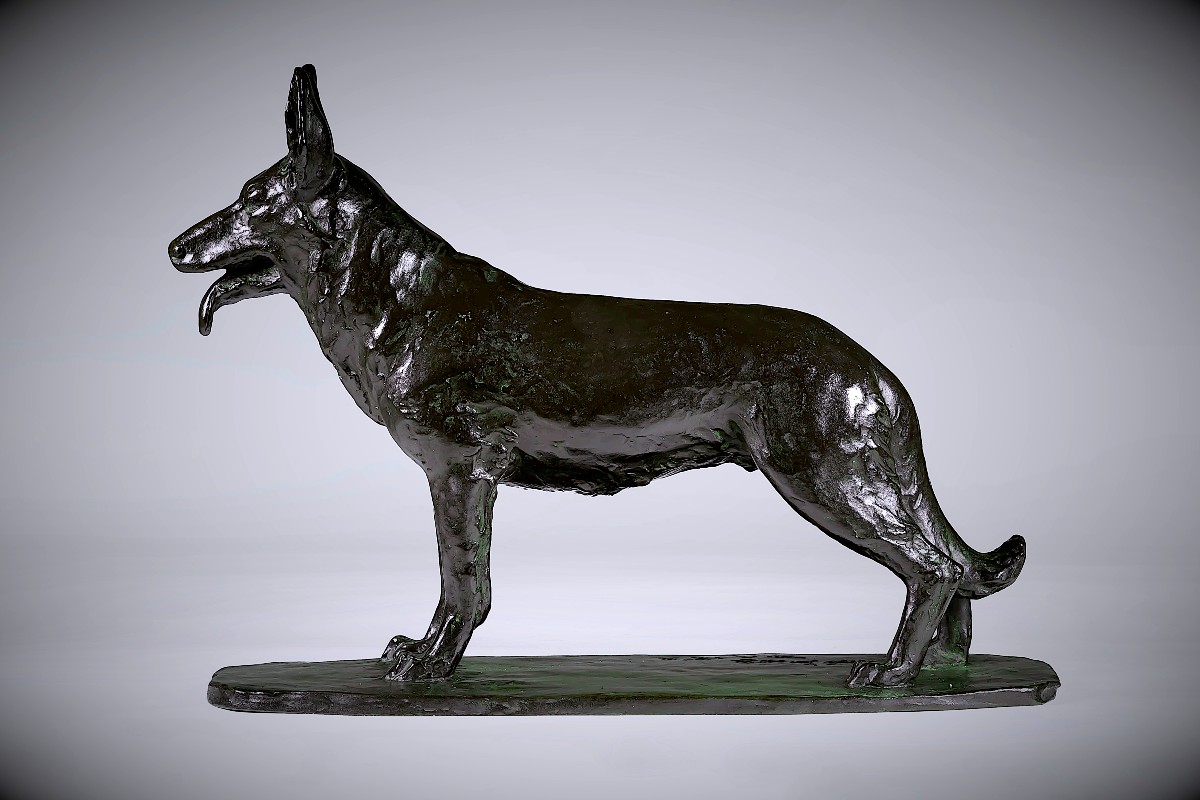
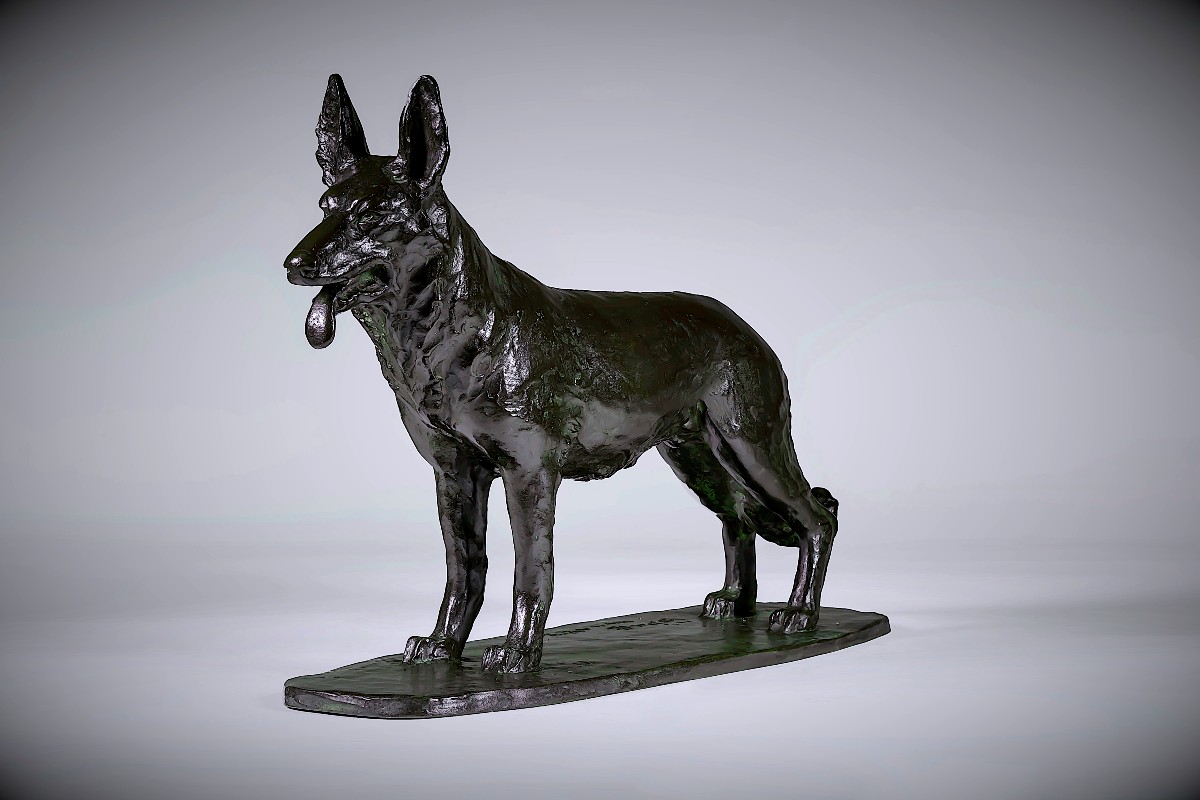
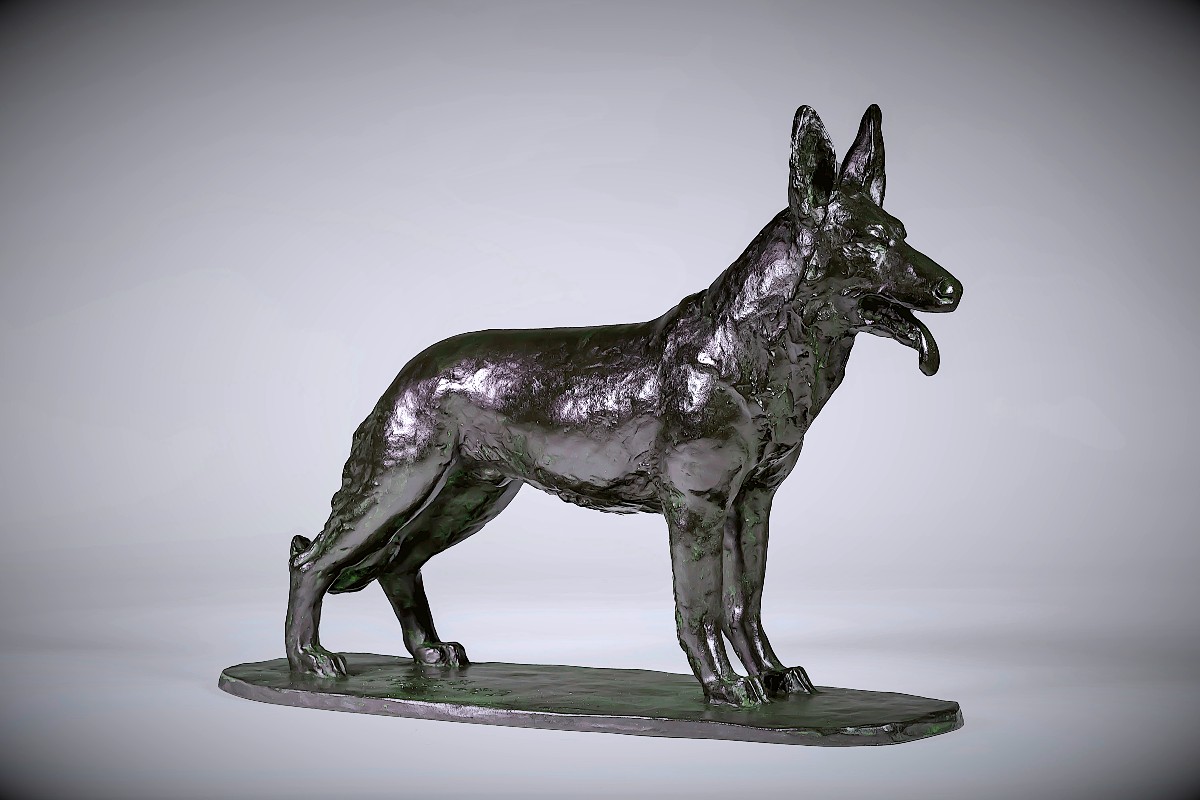
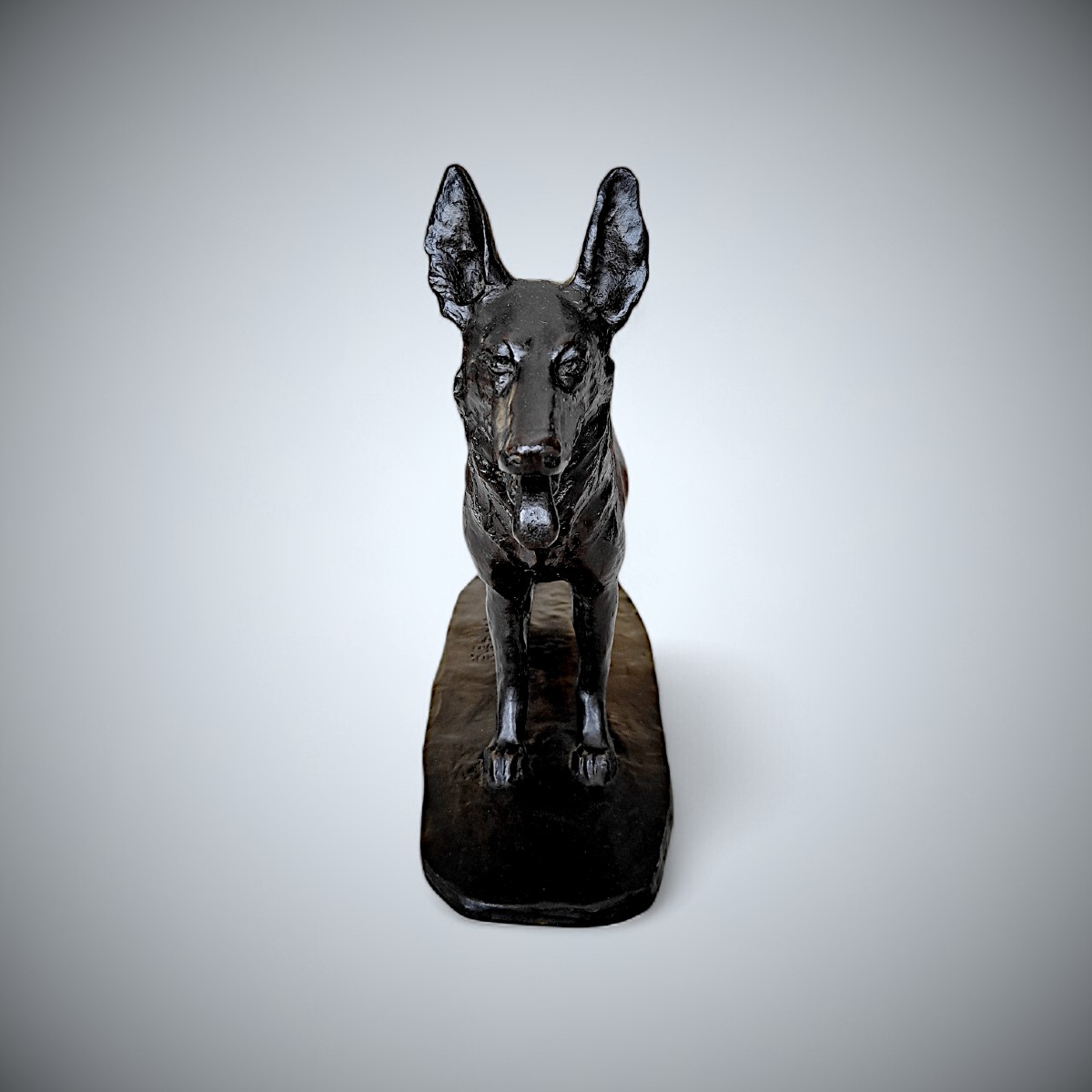
This powerful bronze sculpture of a German Shepherd (Alsatian) is signed Terahata Sukenojo (寺畑助之丞) (1892-1970) and dates from the 17th year of the Shōwa era (1942), a period when Japan was undergoing a period of intense mobilization and sculpture was often called upon to embody vigilance, strength, and unwavering determination. The choice of subject—a noble, motionless, and alert working dog—resonates deeply with the ideals of the time, but the sculpture transcends propaganda through its understated naturalism and structural mastery.
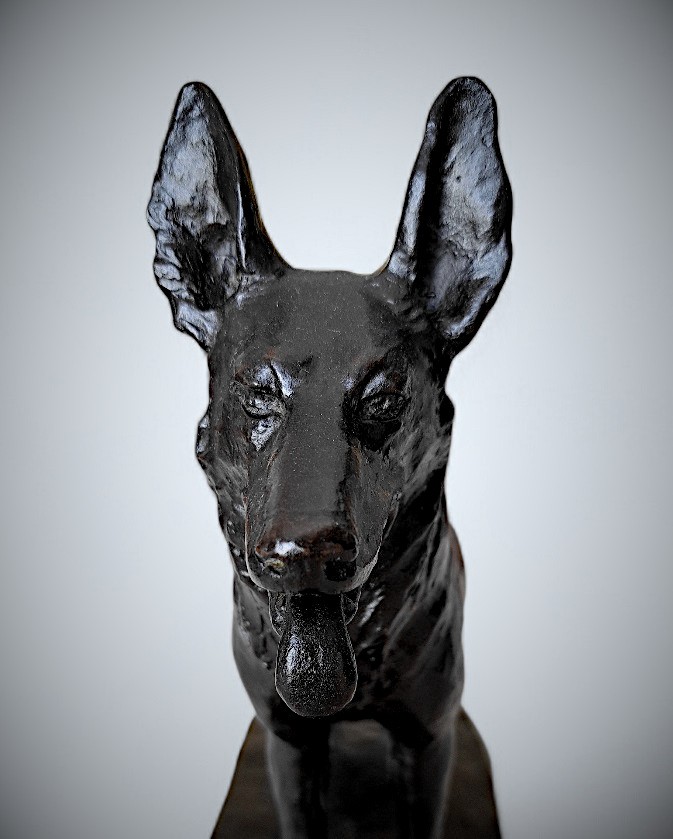
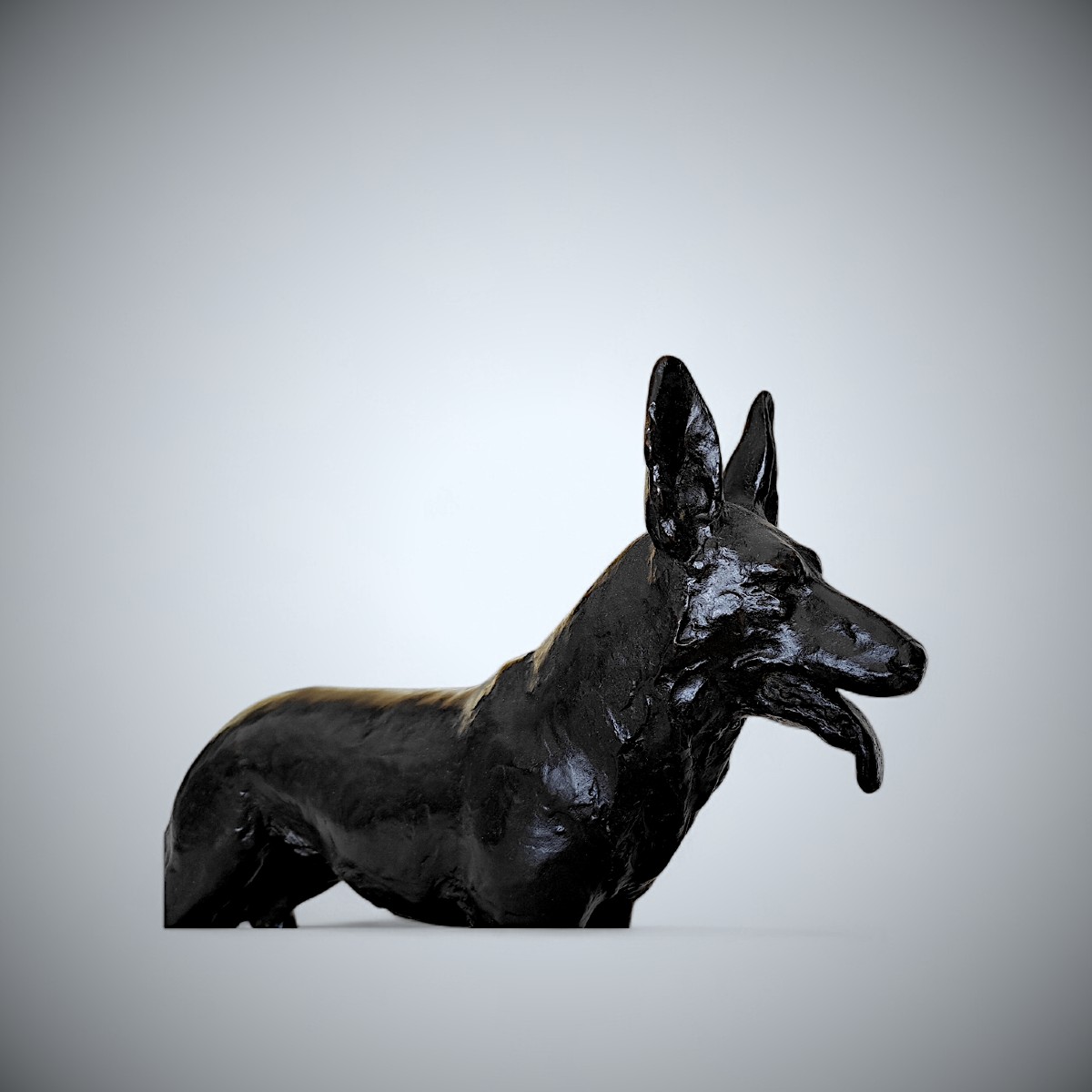
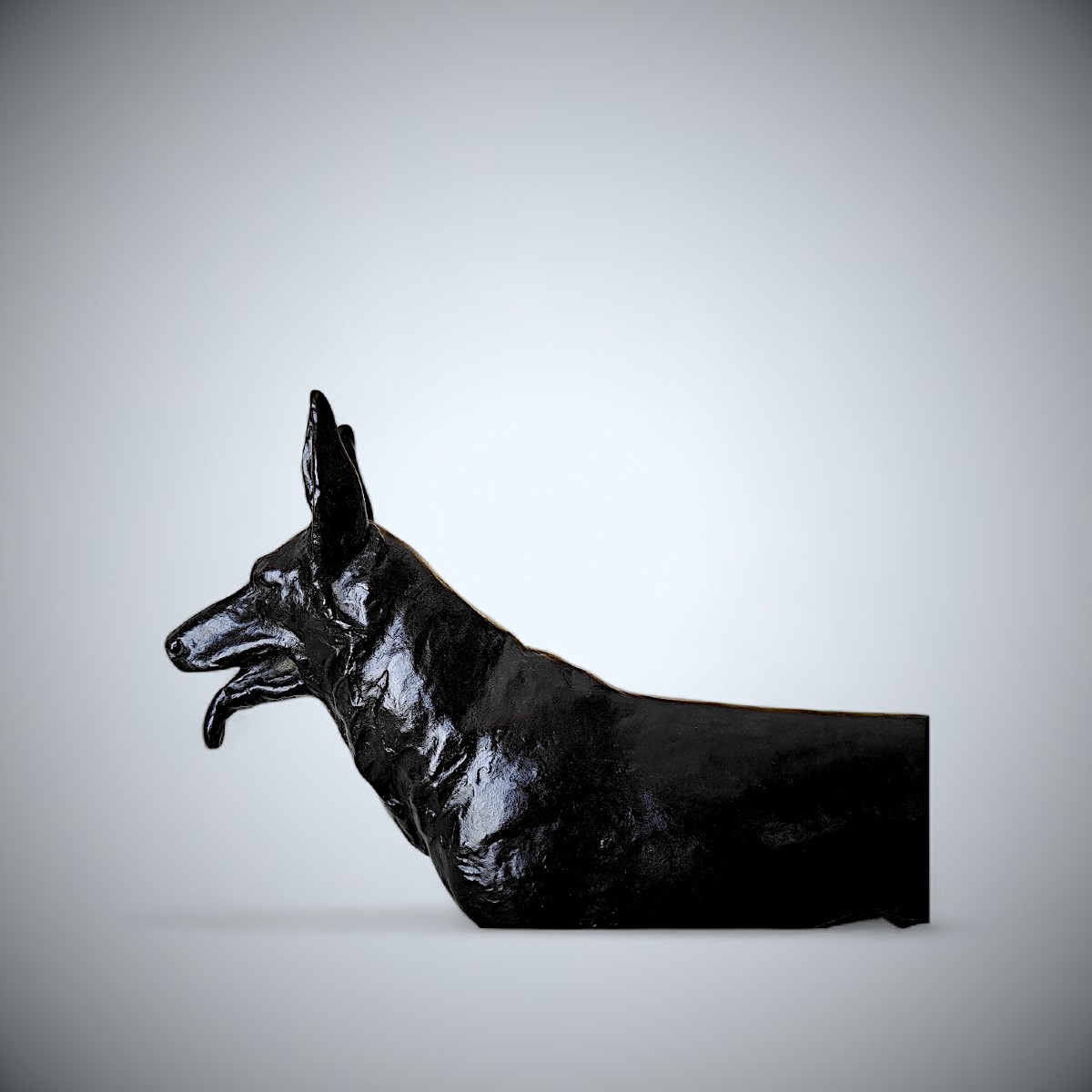
The animal stands in a contrapposto pose that is both tense and controlled: one front paw slightly raised, its head turned in intense concentration, its ears pricked, and its muzzle slightly open as if perceiving an unseen command. The long, athletic body is modeled with broad, assured planes rather than excessive detail. The musculature is suggested by a subtle modulation of the surface, the bronze vibrating with a tactile vitality. The patina—dark, almost black like iron, with subtle green undertones—reinforces the impression of density and contained power.
His training at the Tokyo School of Fine Arts (from which he graduated in 1918) provided him with a solid academic foundation in the principles of Western sculpture, particularly in anatomical study and structural clarity. His early appointment in 1920 as an engineer with the Governor-General of Korea, where he supervised the architectural sculpture of the new Governor-General's building in Seoul, further refined his sense of monumentality and rigorous composition. These experiences are evident here: the dog's posture is architectural, its silhouette sharp and assertive, and its mass carefully balanced on the horizontal axis of the pedestal.
Throughout the 1920s and 1930s, Terahata played a central role in both formal and semi-formal art circles. A professor at the Tokyo Higher School of Arts and Crafts, and later an influential figure in the Shin Kōzō-sha (New Structure Society), he bridged the gap between academic tradition and modern structural sensibilities. His wartime involvement—particularly his leading roles in sculptural cultural organizations and naval commissions—places this 1942 work within a context of national service. Yet, rather than through ostentatious symbolism, the sculpture expresses its authority through restraint.
The German Shepherd itself, a breed internationally associated with intelligence, loyalty, and rigorous discipline, becomes a universal emblem of vigilance. Terahata avoids anecdotal narrative; there is no master, no setting, no theatrical gesture. The figure, on the contrary, is autonomous, its energy contained. The slightly rough surface, bearing the traces of the sculptor's hand, animates the bronze with a striking immediacy and prevents the form from becoming static.
Born in 1892 in Takaoka, in the Toyama prefecture—a region renowned for its bronze-casting traditions—Terahata's sensitivity to metal was likely shaped by his regional heritage as much as by his academic training. This heritage subtly shines through in his mastery of the mass and patina. This sculpture is not merely an animal study; it expresses a singular presence: serene, intelligent, resolute.
Dating from the height of the turbulent Shōwa era, this German Shepherd is both of its time and timeless: an embodiment of controlled strength, rendered with sculptural intelligence and unwavering dignity.
The animal stands in a contrapposto pose that is both tense and controlled: one front paw slightly raised, its head turned in intense concentration, its ears pricked, and its muzzle slightly open as if perceiving an unseen command. The long, athletic body is modeled with broad, assured planes rather than excessive detail. The musculature is suggested by a subtle modulation of the surface, the bronze vibrating with a tactile vitality. The patina—dark, almost black like iron, with subtle green undertones—reinforces the impression of density and contained power.
His training at the Tokyo School of Fine Arts (from which he graduated in 1918) provided him with a solid academic foundation in the principles of Western sculpture, particularly in anatomical study and structural clarity. His early appointment in 1920 as an engineer with the Governor-General of Korea, where he supervised the architectural sculpture of the new Governor-General's building in Seoul, further refined his sense of monumentality and rigorous composition. These experiences are evident here: the dog's posture is architectural, its silhouette sharp and assertive, and its mass carefully balanced on the horizontal axis of the pedestal.
Throughout the 1920s and 1930s, Terahata played a central role in both formal and semi-formal art circles. A professor at the Tokyo Higher School of Arts and Crafts, and later an influential figure in the Shin Kōzō-sha (New Structure Society), he bridged the gap between academic tradition and modern structural sensibilities. His wartime involvement—particularly his leading roles in sculptural cultural organizations and naval commissions—places this 1942 work within a context of national service. Yet, rather than through ostentatious symbolism, the sculpture expresses its authority through restraint.
The German Shepherd itself, a breed internationally associated with intelligence, loyalty, and rigorous discipline, becomes a universal emblem of vigilance. Terahata avoids anecdotal narrative; there is no master, no setting, no theatrical gesture. The figure, on the contrary, is autonomous, its energy contained. The slightly rough surface, bearing the traces of the sculptor's hand, animates the bronze with a striking immediacy and prevents the form from becoming static.
Born in 1892 in Takaoka, in the Toyama prefecture—a region renowned for its bronze-casting traditions—Terahata's sensitivity to metal was likely shaped by his regional heritage as much as by his academic training. This heritage subtly shines through in his mastery of the mass and patina. This sculpture is not merely an animal study; it expresses a singular presence: serene, intelligent, resolute.
Dating from the height of the turbulent Shōwa era, this German Shepherd is both of its time and timeless: an embodiment of controlled strength, rendered with sculptural intelligence and unwavering dignity.
850 €
Period: 20th century
Style: Asian art
Condition: Perfect condition
Material: Bronze
Length: 35 cm
Height: 26 cm
Reference (ID): 1715976
Availability: In stock
Print