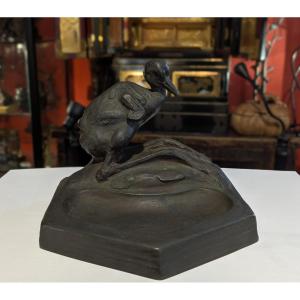


Japanese Bronze By Katô Tatsuo 加藤 龍雄 - Minogame And Crane
Artist: Katô Tatsuo 加藤 龍雄
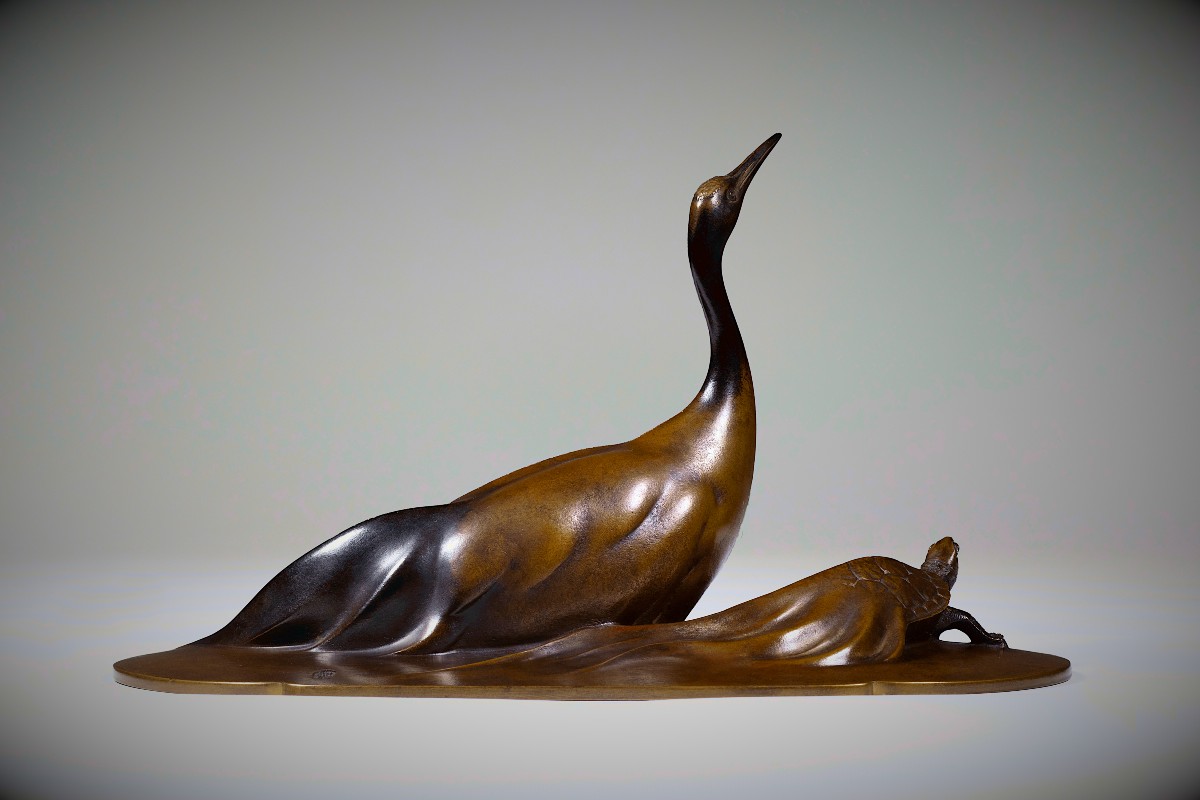
A Japanese bronze sculpture depicting a Minogame (蓑亀), by the sculptor Katō Tatsuo 加藤龍雄 (real name Katō Yasaburō 弥三郎), active
in the late Meiji and early Taishō periods.
Katō Tatsuo was a pupil of Ōshima Jōun 大島如雲 (1858–1940), one of the leading figures in the modernization of Japanese sculpture, who taught at the Tokyo School of Fine Arts and exhibited in Europe at the turn of the 20th century. Through this lineage, Katō belongs to the elite generation of Japanese bronze sculptors whose works were created at a time of growing international appreciation for Japanese art.
The artist is especially celebrated for his representations of the Minogame, the mythical long-tailed turtle. According to Japanese tradition, the Minogame is so ancient that strands of algae trail from its shell, forming its characteristic tail. It is a powerful symbol of longevity, happiness, and prosperity, and plays a central role in the well-known legend of Urashima Tarō, in which the turtle serves as a guide between the mortal world and the realm of immortality. T
his refined composition is distinguished by the exceptional quality of the casting, the subtle, richly nuanced brown patina, and the remarkable naturalism of the modeling, particularly in the treatment of the shell, limbs, and flowing algae. The inclusion of the smaller turtle enhances the symbolic dimension of continuity and eternity.
Both decorative and deeply symbolic, this bronze exemplifies the refined aesthetic of early 20th-century Japanese sculpture, in which technical mastery and ancient iconography are brought into perfect harmony. A work of outstanding quality, ideally suited to an important collection of Japanese art or a sophisticated interior seeking an emblematic object of serenity and permanence.
Circa 1920.
Katō Tatsuo was a pupil of Ōshima Jōun 大島如雲 (1858–1940), one of the leading figures in the modernization of Japanese sculpture, who taught at the Tokyo School of Fine Arts and exhibited in Europe at the turn of the 20th century. Through this lineage, Katō belongs to the elite generation of Japanese bronze sculptors whose works were created at a time of growing international appreciation for Japanese art.
The artist is especially celebrated for his representations of the Minogame, the mythical long-tailed turtle. According to Japanese tradition, the Minogame is so ancient that strands of algae trail from its shell, forming its characteristic tail. It is a powerful symbol of longevity, happiness, and prosperity, and plays a central role in the well-known legend of Urashima Tarō, in which the turtle serves as a guide between the mortal world and the realm of immortality. T
his refined composition is distinguished by the exceptional quality of the casting, the subtle, richly nuanced brown patina, and the remarkable naturalism of the modeling, particularly in the treatment of the shell, limbs, and flowing algae. The inclusion of the smaller turtle enhances the symbolic dimension of continuity and eternity.
Both decorative and deeply symbolic, this bronze exemplifies the refined aesthetic of early 20th-century Japanese sculpture, in which technical mastery and ancient iconography are brought into perfect harmony. A work of outstanding quality, ideally suited to an important collection of Japanese art or a sophisticated interior seeking an emblematic object of serenity and permanence.
Circa 1920.
2 200 €
Period: 20th century
Style: Art Deco
Condition: Perfect condition
Material: Bronze
Length: 27 cm
Height: 15 cm
Reference (ID): 1624725
Availability: In stock
Print