


Japanese Bronze By Kondo Shoshin (masazane) - Tiger Licking Its Paws
Artist: Kondō Shōshin (masazane, 正眞)
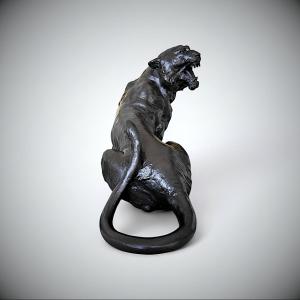
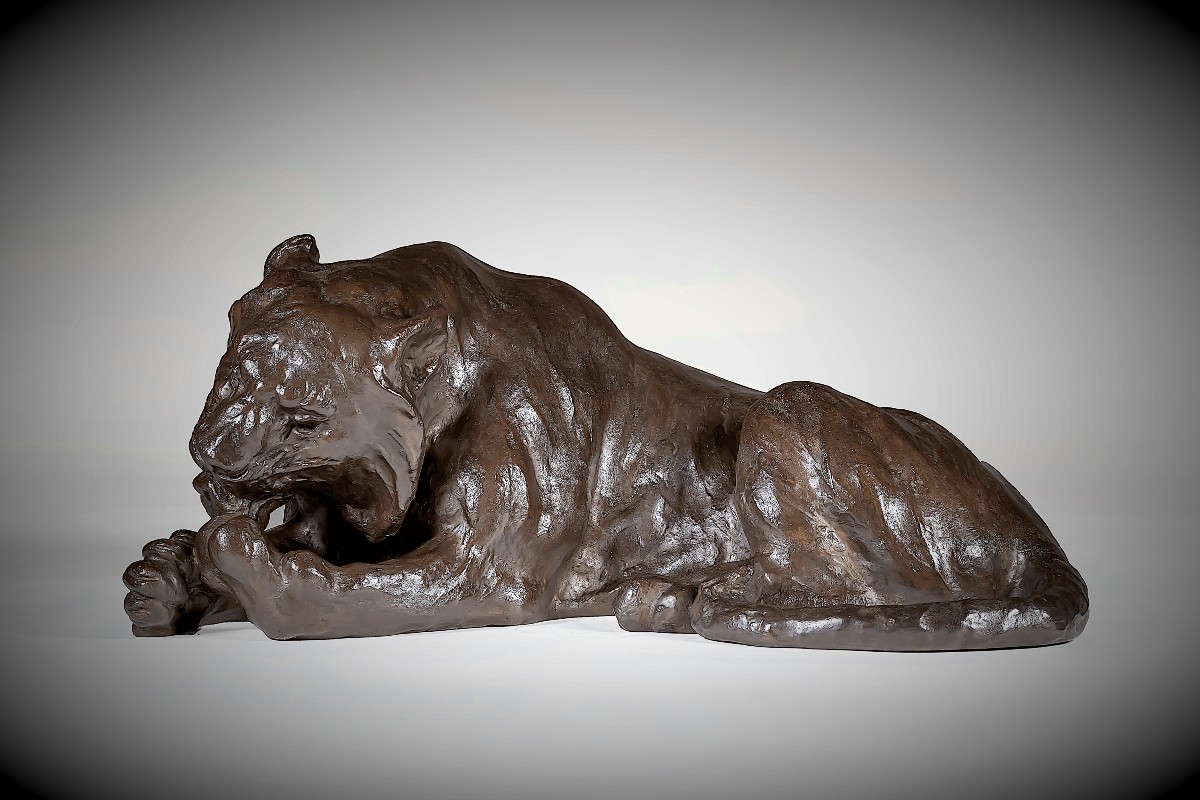
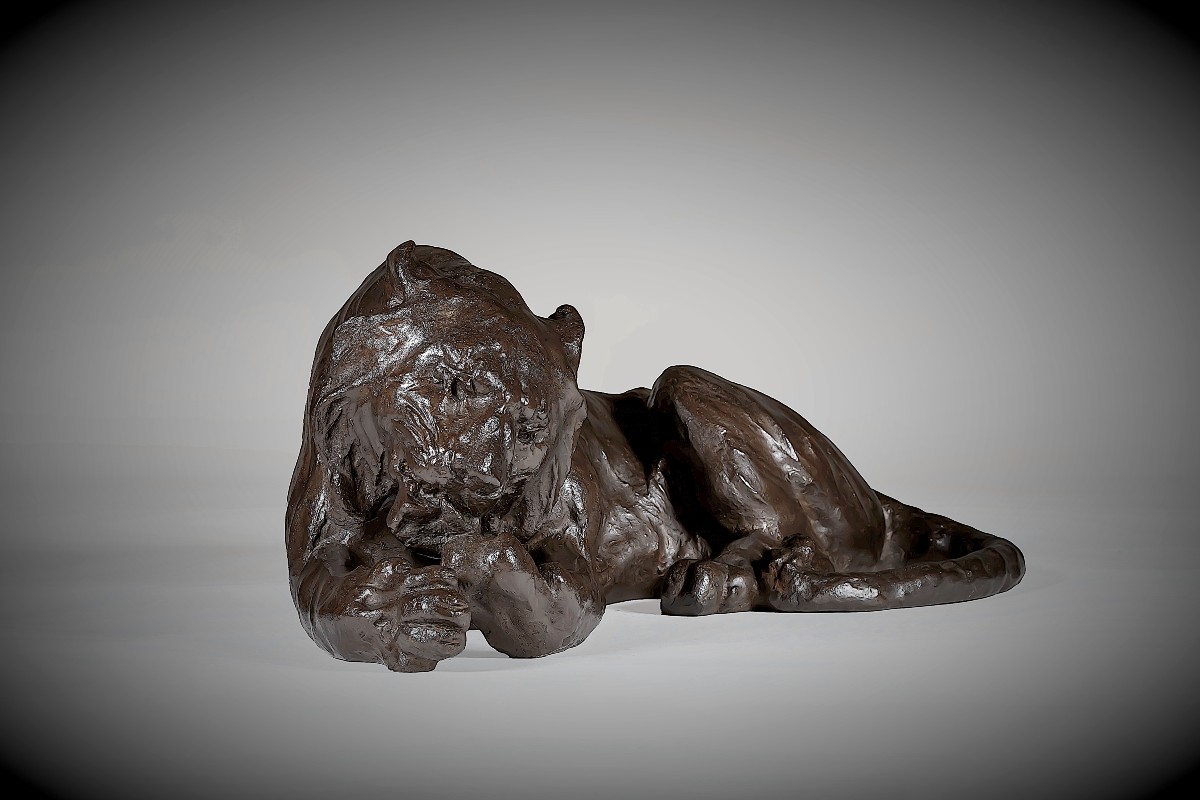
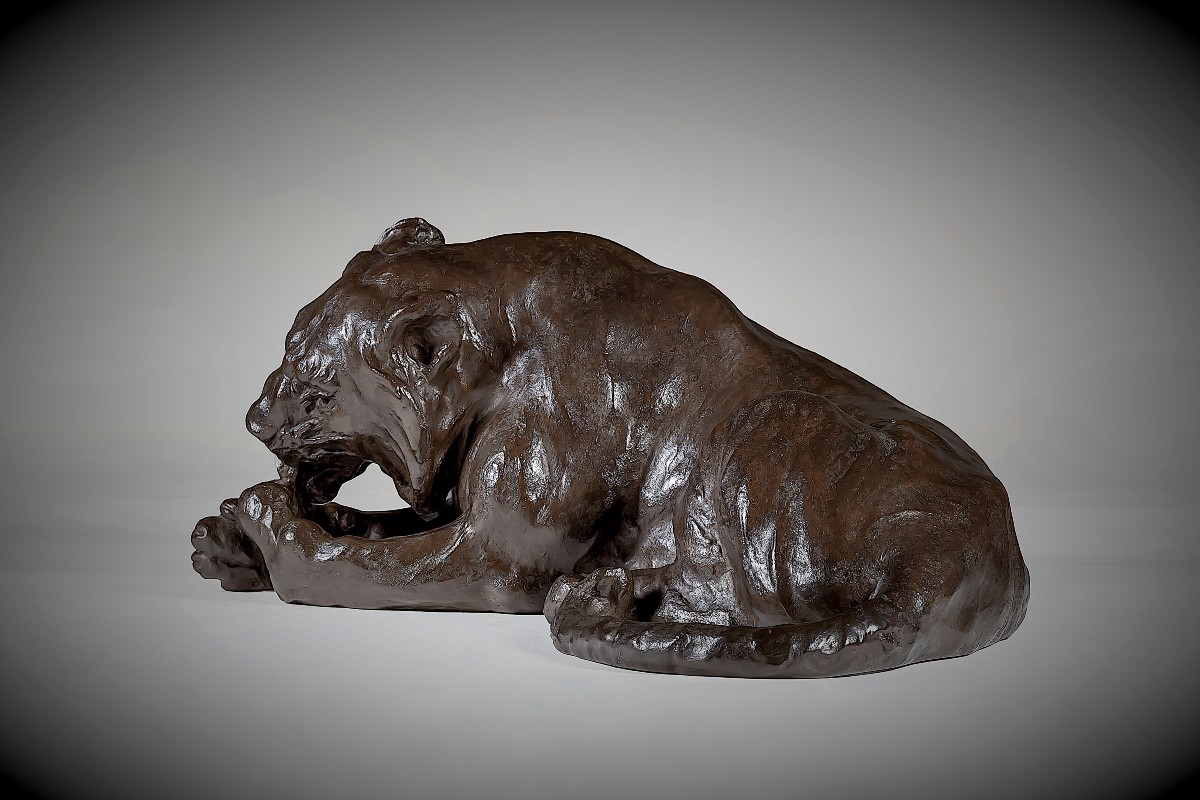
This bronze, depicting a tiger absorbed in the intimate act of licking its paw, exemplifies the refined naturalism and restrained power characteristic of Kondō Shōshin (Masazane, 正眞). The animal is shown at rest, its massive body folded in a compact horizontal composition, yet charged with latent strength. Rather than portraying the tiger in a moment of aggression, the sculptor chose a calm, almost intimate instant, allowing observation, anatomy, and surface to take precedence over drama.
The modeling is exceptionally delicate. The head tilts slightly forward, the jaws gently open, while the tongue reaches for the paw; this small movement animates the entire sculpture. The musculature is rendered through subtle transitions rather than sharp definitions, suggesting strength beneath the skin without exaggeration. The surface bears a soft, nuanced patina, catching the light along the shoulders, flanks, and hips, while the deeper hollows remain in shadow, accentuating the sense of volume and mass. The finely articulated legs anchor the composition and guide the viewer's gaze toward the animal's contemplative expression.
Kondo Shōshin was a student of Ōshima Jōun (1858–1940), one of the most influential figures in modern Japanese bronze sculpture and a staunch advocate of sculptural realism during the Meiji and Taishō eras. Under Jōun's tutelage, Shōshin absorbed a rigorous approach to form, an in-depth study of live models, and a profound respect for traditional casting techniques, while simultaneously developing his own calmer, more introspective sensibility. This work clearly reflects this heritage: the anatomical precision and technical mastery are reminiscent of the master, while the serene and introspective atmosphere is characteristic of Shōshin. As an object, the bronze represents a subtle synthesis of observation and poetry.
The tiger—an emblem of power and authority in East Asian art—is depicted here not as a symbol of ferocity, but as a living being indulging in a moment of contemplation. This choice elevates the sculpture beyond mere animal virtuosity, inviting prolonged contemplation and revealing the artist's profound empathy for his subject. It is a work that will appeal as much to collectors of modern Japanese bronzes as to connoisseurs who appreciate the sculpture's restraint, technical excellence, and psychological subtlety.
The modeling is exceptionally delicate. The head tilts slightly forward, the jaws gently open, while the tongue reaches for the paw; this small movement animates the entire sculpture. The musculature is rendered through subtle transitions rather than sharp definitions, suggesting strength beneath the skin without exaggeration. The surface bears a soft, nuanced patina, catching the light along the shoulders, flanks, and hips, while the deeper hollows remain in shadow, accentuating the sense of volume and mass. The finely articulated legs anchor the composition and guide the viewer's gaze toward the animal's contemplative expression.
Kondo Shōshin was a student of Ōshima Jōun (1858–1940), one of the most influential figures in modern Japanese bronze sculpture and a staunch advocate of sculptural realism during the Meiji and Taishō eras. Under Jōun's tutelage, Shōshin absorbed a rigorous approach to form, an in-depth study of live models, and a profound respect for traditional casting techniques, while simultaneously developing his own calmer, more introspective sensibility. This work clearly reflects this heritage: the anatomical precision and technical mastery are reminiscent of the master, while the serene and introspective atmosphere is characteristic of Shōshin. As an object, the bronze represents a subtle synthesis of observation and poetry.
The tiger—an emblem of power and authority in East Asian art—is depicted here not as a symbol of ferocity, but as a living being indulging in a moment of contemplation. This choice elevates the sculpture beyond mere animal virtuosity, inviting prolonged contemplation and revealing the artist's profound empathy for his subject. It is a work that will appeal as much to collectors of modern Japanese bronzes as to connoisseurs who appreciate the sculpture's restraint, technical excellence, and psychological subtlety.
1 400 €
Period: 20th century
Style: Asian art
Condition: Perfect condition
Material: Bronze
Length: 34 cm
Height: 15 cm
Reference (ID): 1708895
Availability: In stock
Print