


Japanese Bronze By Takahashi Kaishu – Duck
Artist: Takahashi Kaishū (高橋介州, 1905–2004)
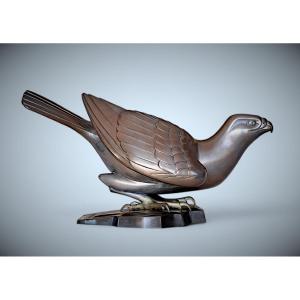
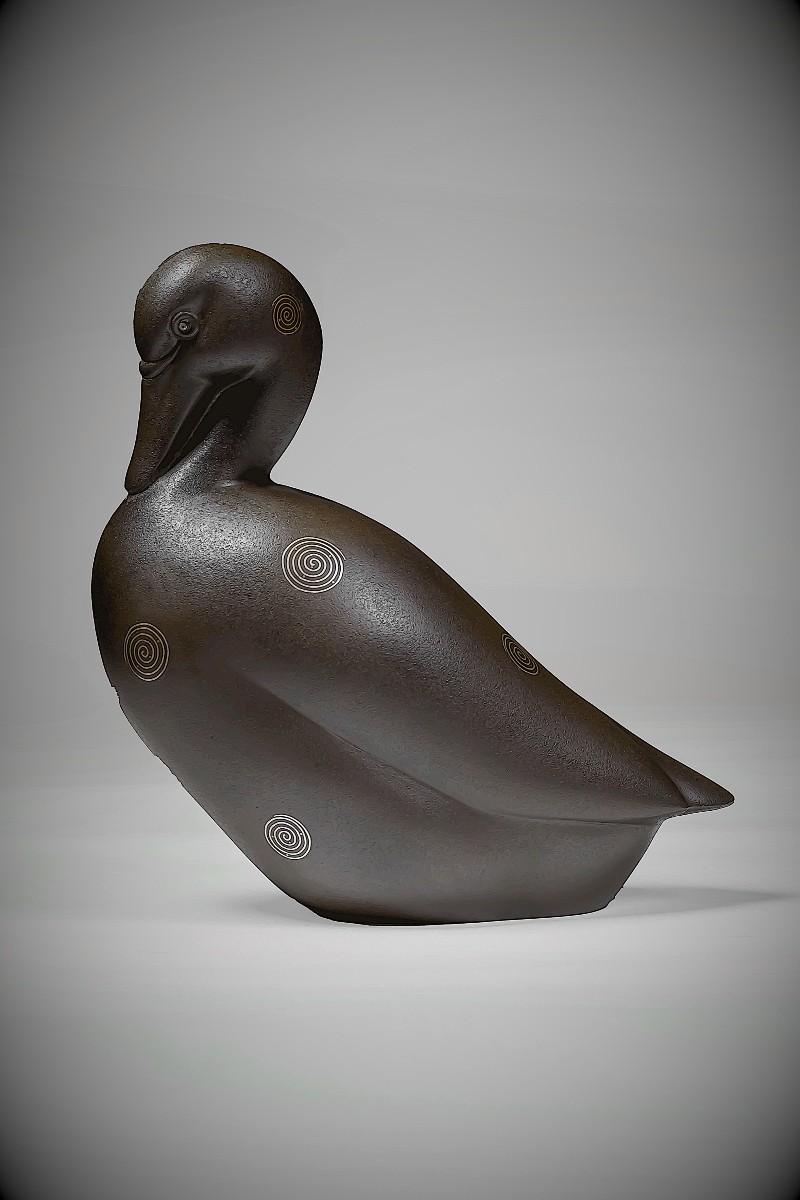
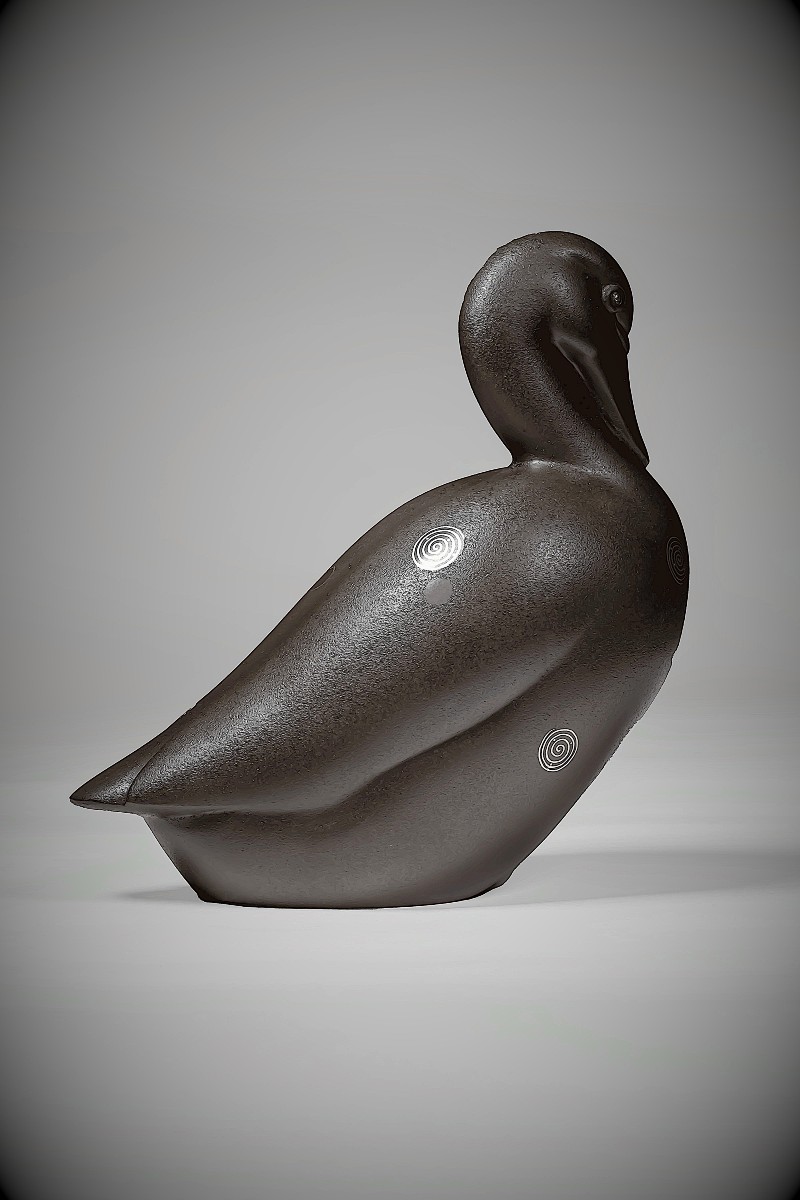
This elegant bronze sculpture of a duck is a refined work by Takahashi Kaishū (高橋介州, 1905–2004), the artist name of Takahashi Isamu, one of the greatest masters of 20th-century Japanese metalwork. Created during the Shōwa era, around 1950, it exemplifies Kaishū's characteristic synthesis of traditional Kaga techniques and a modern sculptural sensibility.
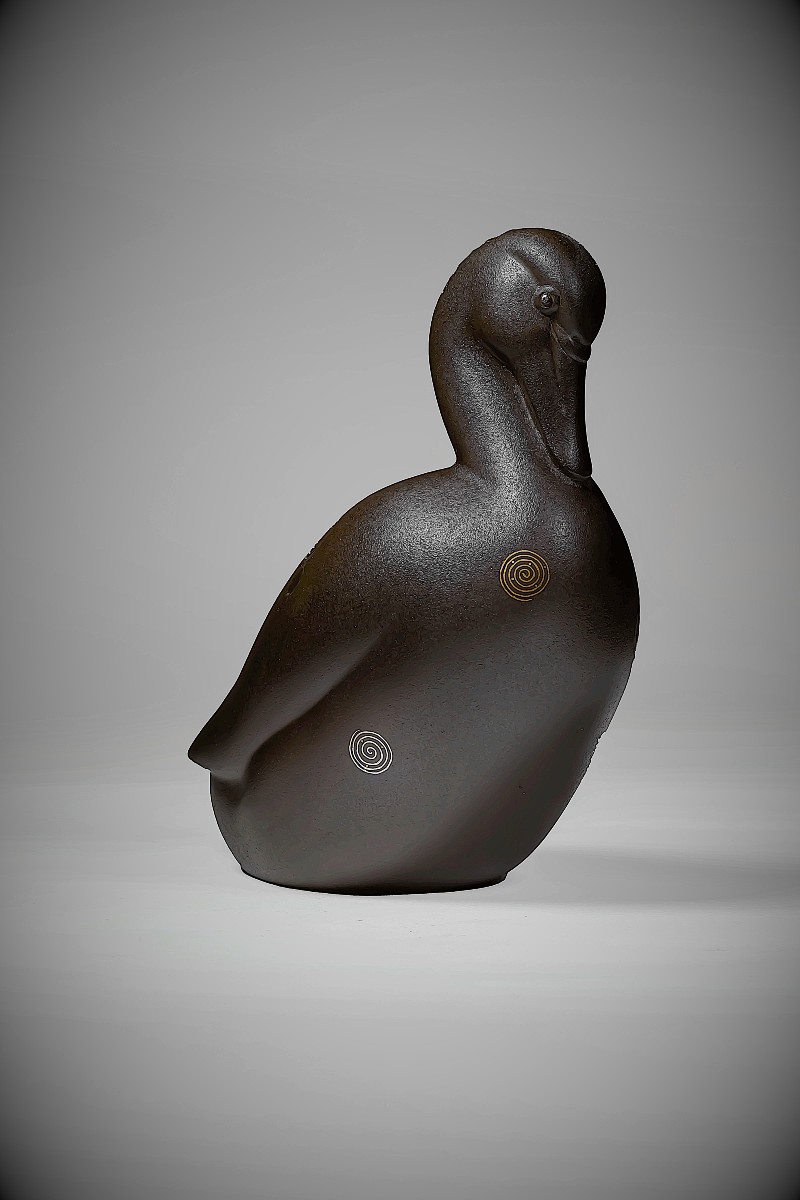
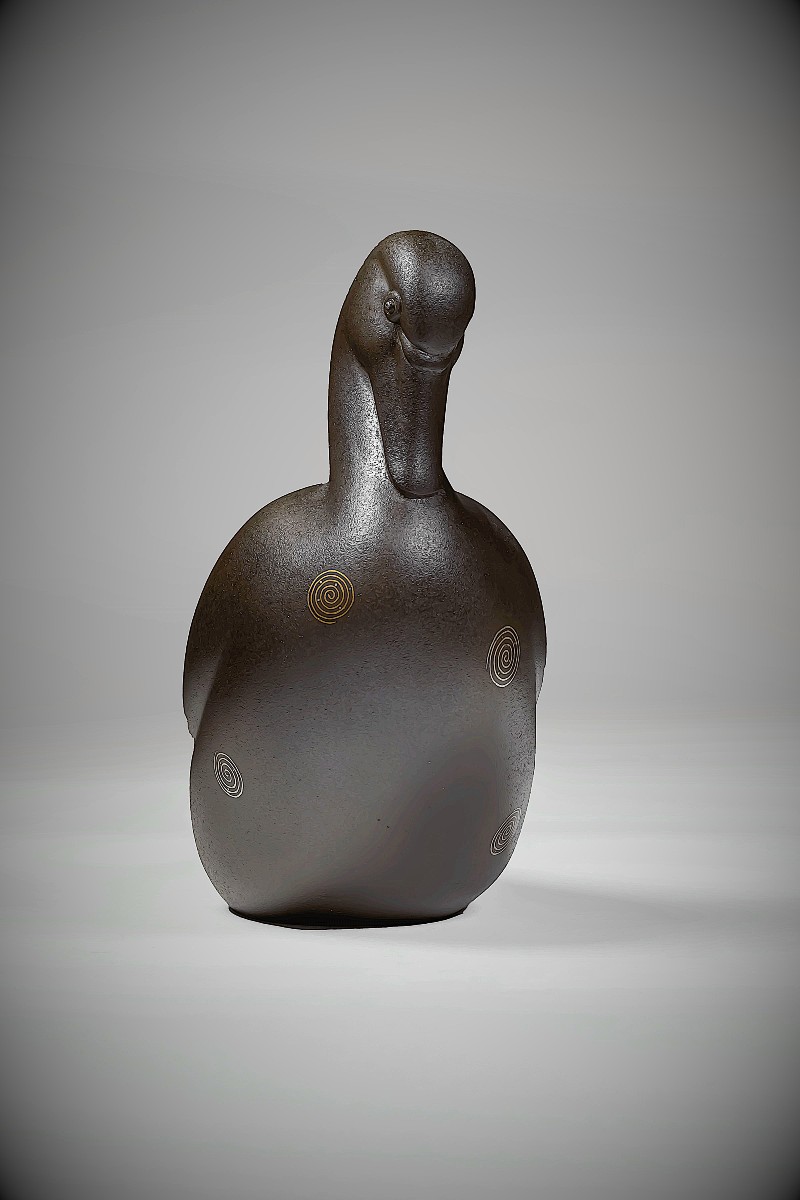
The bird is depicted in a compact and fluid silhouette, its head slightly inclined and its harmoniously curved body expressing serene introspection and restrained vitality. The surface is enlivened by delicate spiral inlays of silver and gold, executed using Kaga Zōgan techniques. These subtle yet rhythmic motifs evoke movement, water, and continuity, and are seamlessly integrated into the sculptural form, far from being mere ornamentation. The bronze's deep, subtly textured patina enhances the soft luminosity of the metal inlays.
The sculpture is signed on the reverse and bears the artist's signature, 勇 (Isamu), in silver inlay.
The work is accompanied by its original tomobako (wooden storage box). The exterior of the lid is inscribed: 加賀象嵌 水鳥置物 (Kaga Zōgan – Ornamental Object: Water Bird), clearly identifying Kaga's prestigious inlay technique and the subject of the sculpture. The reverse of the lid is signed 介州作 (Kaishū saku, "made by Kaishū") and bears the artist's seal.
Born in Kanazawa in 1905, Takahashi Kaishū graduated from the Tokyo School of Fine Arts in 1929. That same year, he was selected for the Teiten (帝展), the official exhibition of the Imperial Academy of Arts, marking his early recognition among Japan's artistic elite. Kaishū's reputation quickly spread beyond Japan's borders: he exhibited in Belgium at the 1930 World's Fair, where he received an award, and was later honored with a gold medal at the 1933 World's Fair in Chicago.
After World War II, Kaishū continued to exhibit and refine his artistic style. In 1982, he was designated an Important Intangible Cultural Property, more commonly known as a Living National Treasure (Ningen Kokuhō), in recognition of his mastery and transmission of traditional metalworking techniques. Kaishū is widely recognized as one of the most prominent artists who perpetuated and revitalized the Kaga metalworking tradition, which encompasses bronze casting and marquetry in soft metals such as gold and silver.
The origins of the Kaga Zōgan date back to the early Edo period, when Maeda Toshinaga (1562–1614), the second lord of the Kaga domain, invited metalworking specialists from Kyoto to develop advanced ornamental techniques. Two main methods define this tradition: Hira Zōgan (flat marquetry) and Ito Zōgan (thread marquetry), both employed with great subtlety in this work.
Comparable works by Takahashi Kaishū are preserved in important institutional collections, including the Ishikawa Prefectural Museum, where another example is reproduced in *The Art of Ishikawa*, plate 288.
This sculpture is a serene and masterful expression of Japanese modernism during the Shōwa period, uniting sculptural purity, symbolic ornamentation, and exceptional craftsmanship. Preserved with its original tomobako and clear inscriptions, it represents a rare and highly sought-after work of art, a Living National Treasure firmly rooted in the Kaga tradition.
The bird is depicted in a compact and fluid silhouette, its head slightly inclined and its harmoniously curved body expressing serene introspection and restrained vitality. The surface is enlivened by delicate spiral inlays of silver and gold, executed using Kaga Zōgan techniques. These subtle yet rhythmic motifs evoke movement, water, and continuity, and are seamlessly integrated into the sculptural form, far from being mere ornamentation. The bronze's deep, subtly textured patina enhances the soft luminosity of the metal inlays.
The sculpture is signed on the reverse and bears the artist's signature, 勇 (Isamu), in silver inlay.
The work is accompanied by its original tomobako (wooden storage box). The exterior of the lid is inscribed: 加賀象嵌 水鳥置物 (Kaga Zōgan – Ornamental Object: Water Bird), clearly identifying Kaga's prestigious inlay technique and the subject of the sculpture. The reverse of the lid is signed 介州作 (Kaishū saku, "made by Kaishū") and bears the artist's seal.
Born in Kanazawa in 1905, Takahashi Kaishū graduated from the Tokyo School of Fine Arts in 1929. That same year, he was selected for the Teiten (帝展), the official exhibition of the Imperial Academy of Arts, marking his early recognition among Japan's artistic elite. Kaishū's reputation quickly spread beyond Japan's borders: he exhibited in Belgium at the 1930 World's Fair, where he received an award, and was later honored with a gold medal at the 1933 World's Fair in Chicago.
After World War II, Kaishū continued to exhibit and refine his artistic style. In 1982, he was designated an Important Intangible Cultural Property, more commonly known as a Living National Treasure (Ningen Kokuhō), in recognition of his mastery and transmission of traditional metalworking techniques. Kaishū is widely recognized as one of the most prominent artists who perpetuated and revitalized the Kaga metalworking tradition, which encompasses bronze casting and marquetry in soft metals such as gold and silver.
The origins of the Kaga Zōgan date back to the early Edo period, when Maeda Toshinaga (1562–1614), the second lord of the Kaga domain, invited metalworking specialists from Kyoto to develop advanced ornamental techniques. Two main methods define this tradition: Hira Zōgan (flat marquetry) and Ito Zōgan (thread marquetry), both employed with great subtlety in this work.
Comparable works by Takahashi Kaishū are preserved in important institutional collections, including the Ishikawa Prefectural Museum, where another example is reproduced in *The Art of Ishikawa*, plate 288.
This sculpture is a serene and masterful expression of Japanese modernism during the Shōwa period, uniting sculptural purity, symbolic ornamentation, and exceptional craftsmanship. Preserved with its original tomobako and clear inscriptions, it represents a rare and highly sought-after work of art, a Living National Treasure firmly rooted in the Kaga tradition.
2 100 €
Period: 20th century
Style: Design 50's and 60's
Condition: Perfect condition
Material: Bronze
Height: 18 cm
Depth: 21 cm
Reference (ID): 1690624
Availability: In stock
Print