



Francesco Botticini (florence, 1446–florence, 1498) - And Workshop - Martirdom Of Saint Genesio
The proposed work is a predella panel, painted in tempera grassa on wood and depicting the martyrdom of Saint Genesius, patron saint of actors, whose attribute (a violin) is placed before him, lying on the ground.
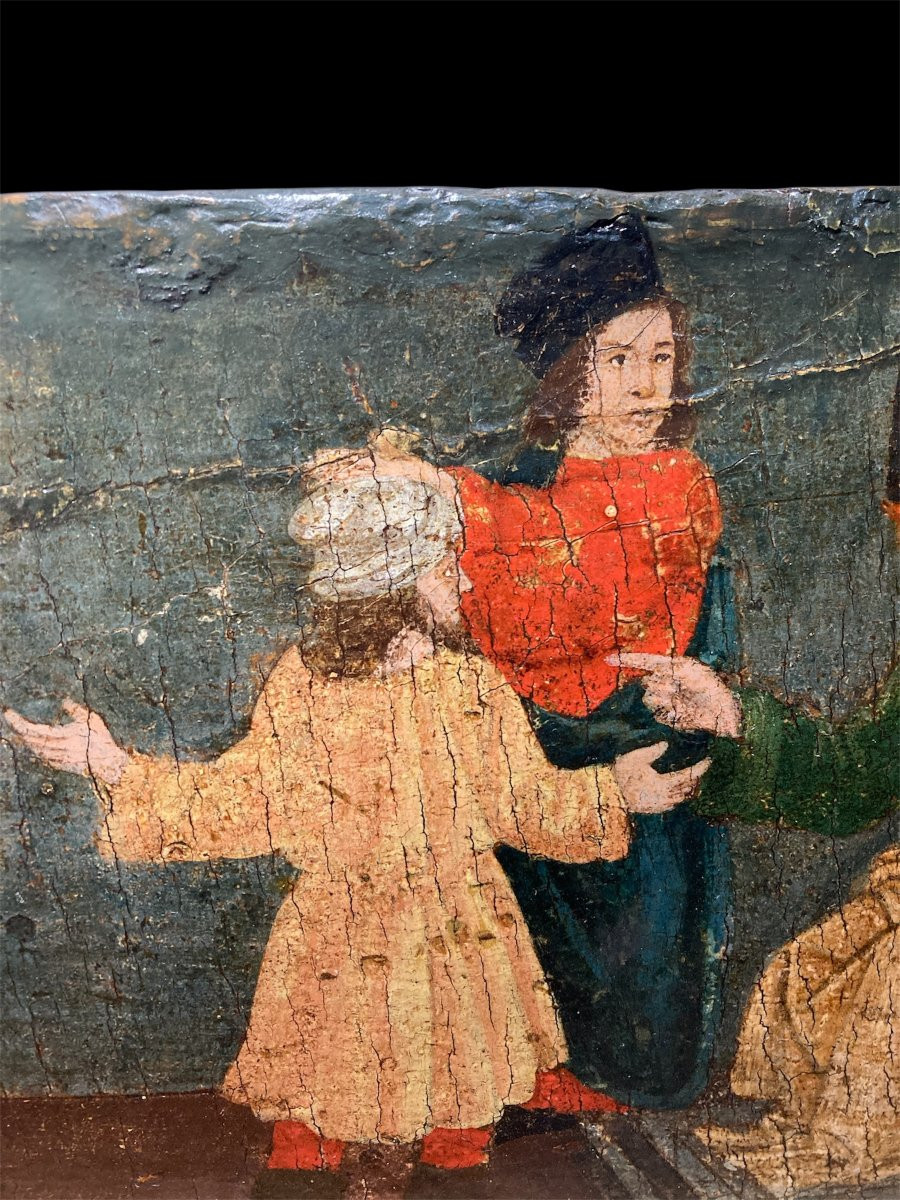
The panel is divided into two sections: on the right, two civilians report to Emperor Diocletian that Genesius, during a theatrical performance, had uttered phrases in praise of Christianity. The emperor, listening and complying with what they reported, therefore sentences the actor to death.
On the left, at the same time, the martyr can be seen kneeling in prayer, with his attribute in front of him, while the executioner, in a visibly exasperated posture (and expression), prepares to behead the saint with a long saber.
Compositionally, the scene is simple and rational: the figures are virtually on the same level, divided by the vertical wall of the imperial building's entrance, almost an atrium, in an open space surrounded by walls on two sides, within which stands the emperor's throne, raised on two steps. The few architectural lines (steps, walls) highlight the perspective and rationally separate the spaces and scenes.
The landscape is also rendered with few elements: sparse bushes dot the clearing of gently rolling hills, crossed by a winding stream, with an intention that must be found in the Nordic experience that had already taken root in Florence in the second half of the 15th century.
In the background, the mountains and the sky blend into a single color.
An interesting and at the same time characterising element are the garments, typical of the period, which we can also find in the work that most closely brings the attribution of this work to the production of Francesco Botticini, namely the predella of the Tabernacle of San Sebastiano, created in 1480 for the church of San Sebastiano in Empoli, and which may represent a termini post quem.
Furthermore, during this period, Botticini was in a mature phase of his career, influenced by Sandro Botticelli and Filippo Lippi.
Observing the garments and draperies, we can appreciate their similarity: the sheer fall of the central figure's robes, with parallel splayed folds, the voluminous and sinewy drapery of the non-standing figures (Genesius and Diocletian), identical both in the direction of the folds and in the way the fabric is arranged on the floor, almost like a star.
The naive yet extremely expressive manner of the faces is also identical, as is a significant technical detail: the application of gold in the crown and scepter (hard to read in our work), apparently executed by the same artisan, so similar is the result.
Judging the quality of the work (or rather, the works), one might conclude that the main altarpiece in both cases is certainly of Botticini origin, but the creation of our predella (like that of the Tabernacle of Saint Sebastian!) is likely to have been physically created by a workshop apprentice.
Looking carefully at the two works, even the colors seem to have the same mix and the same tones, even though in ours you can still see a splendid, very vivid shade of red.
Historically, in 1489, 12 km from the church where the Tabernacle of San Sebastiano was located and 45 km from Botticini's workshop, the Collegiate Church dedicated to Saints Genesius and Maria Assunta was reopened for worship, by permission of the Florentine magistrate, who granted the request made by the provost of San Miniato, Giovanni Cavalcanti, through his vicar Pier Vettori.
Unfortunately, until 1622, San Miniato was linked to the dioceses of Lucca and Florence, where a fire broke out in the 16th century that destroyed the archives... it is therefore impossible to obtain documents documenting the commissioning of an altarpiece for the Collegiate Church. However, given the stylistic similarities mentioned above and the temporal coincidences, especially in relation to a saint who is truly rare in Italy, we must evaluate this theory with extreme trust.
The predella is in overall good condition: in the figurative areas, apart from a pronounced crack, there are no missing or overpainted areas, which, however, are limited to a blue portion of the upper right part and the left edge.
The figuration of the other scenes probably ran to the left of our predella and was removed there, damaging the edge, which was then repainted.
Minor losses, subsequently repainted, are found in the first 5 mm or so of the lower edge (and to a lesser extent on the upper edge), thus not compromising the visual enjoyment of the figuration.
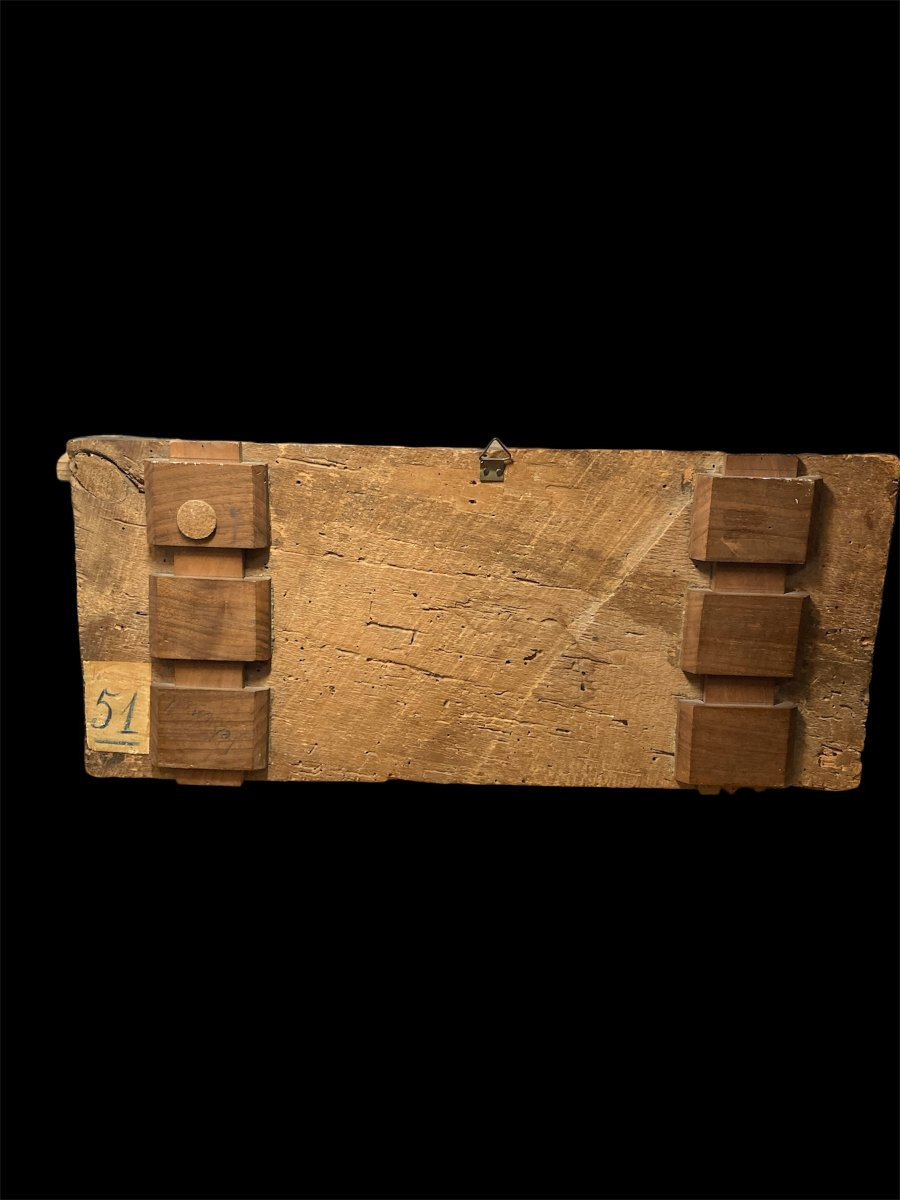
Parquetry on the back to balance the natural curvature of the panel.
Considering its age, the work is in good condition.
Dimensions: 49 x 21 cm
Period: Before 16th century
Style: Other Style
Condition: Fully restored
Material: Painted wood
Width: 49
Height: 21
Reference (ID): 1687213
Availability: In stock