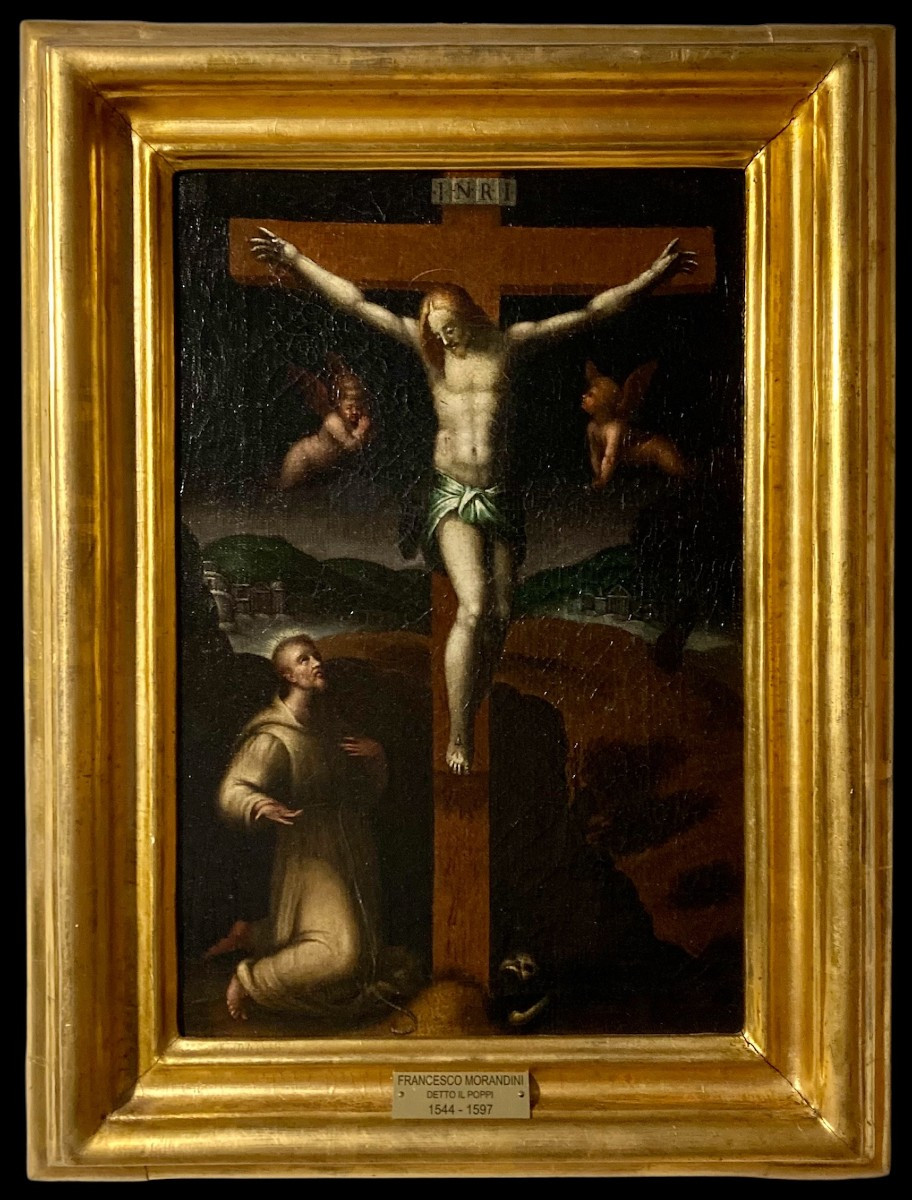
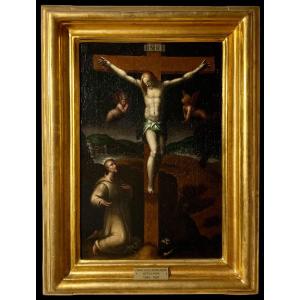


Francesco Morandini, Known As Il Poppi (poppi 1544 – 1597 Florence) – Scene Of The Crucifixion
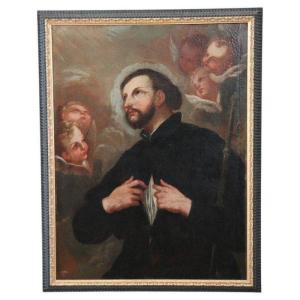
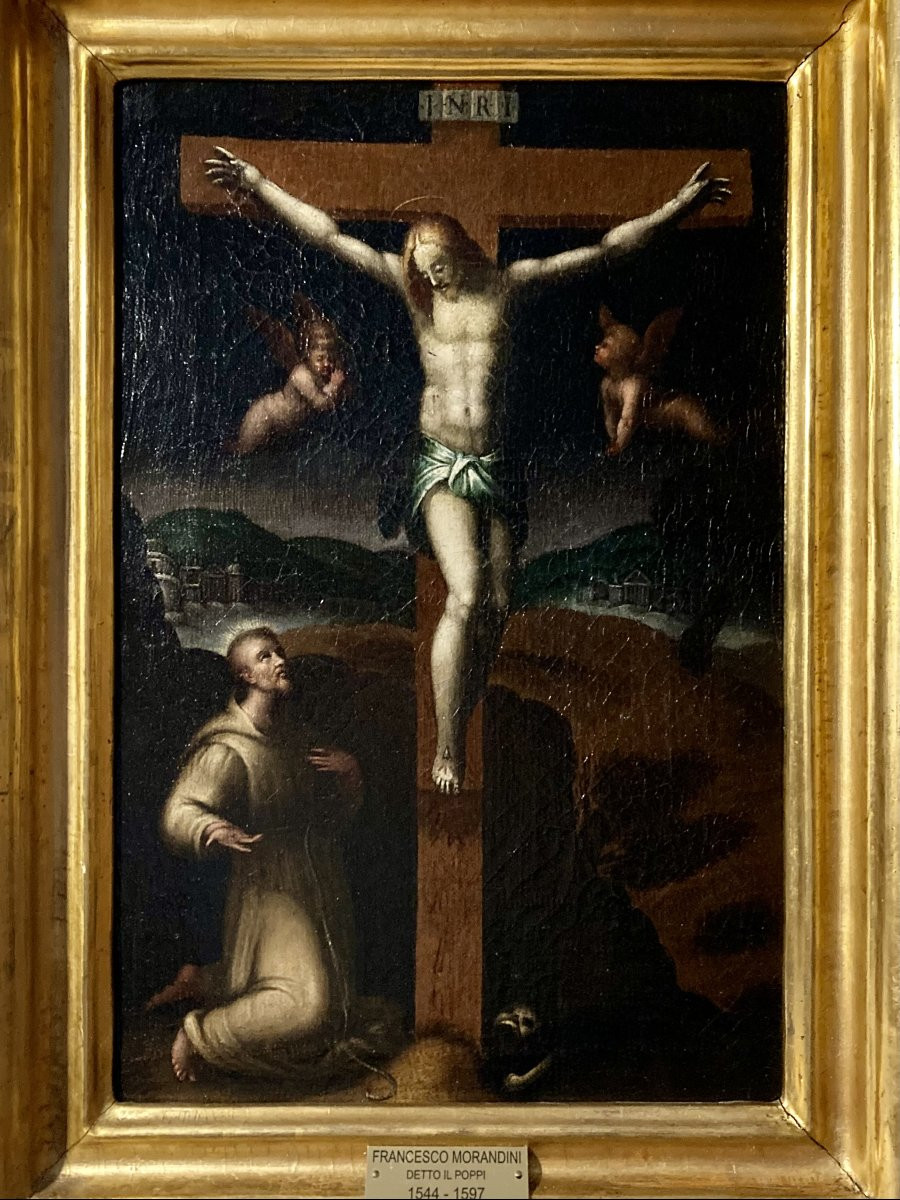
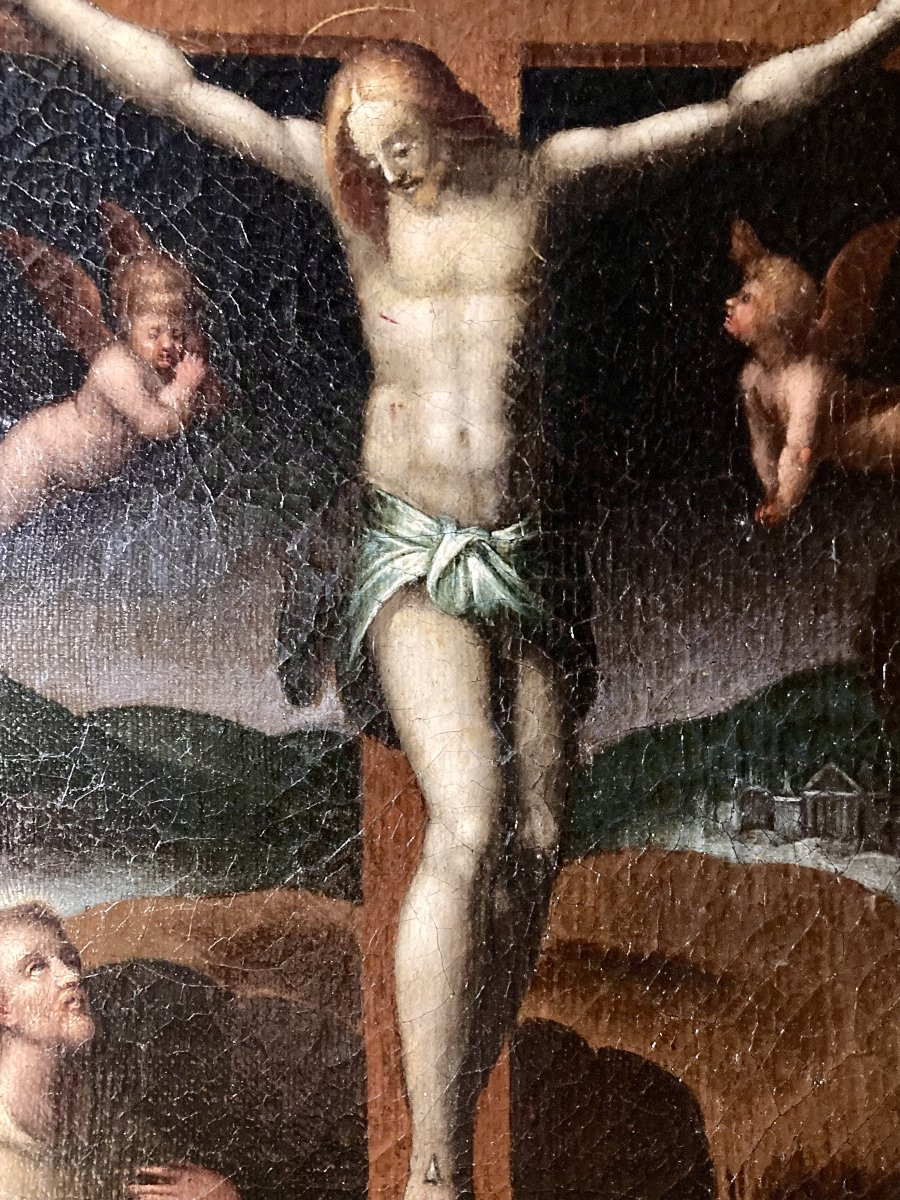
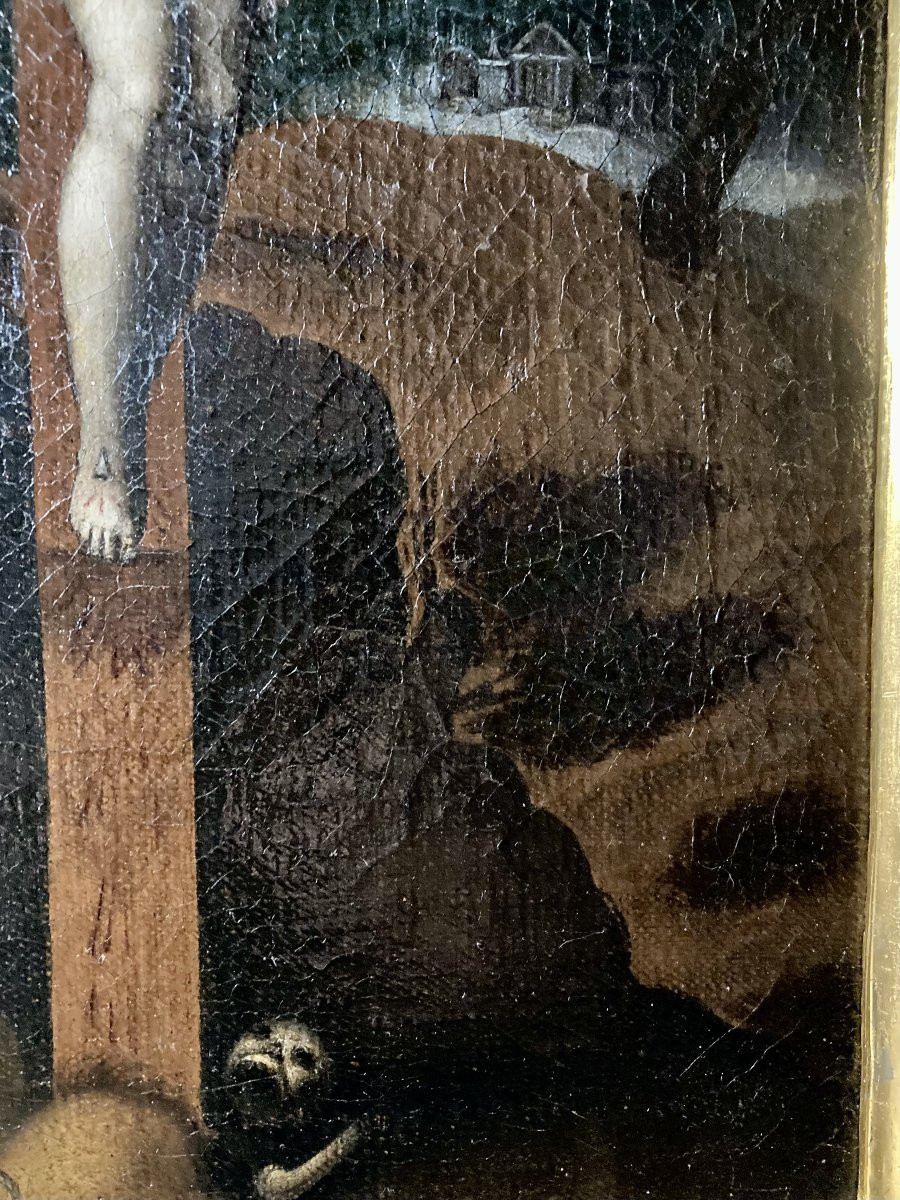
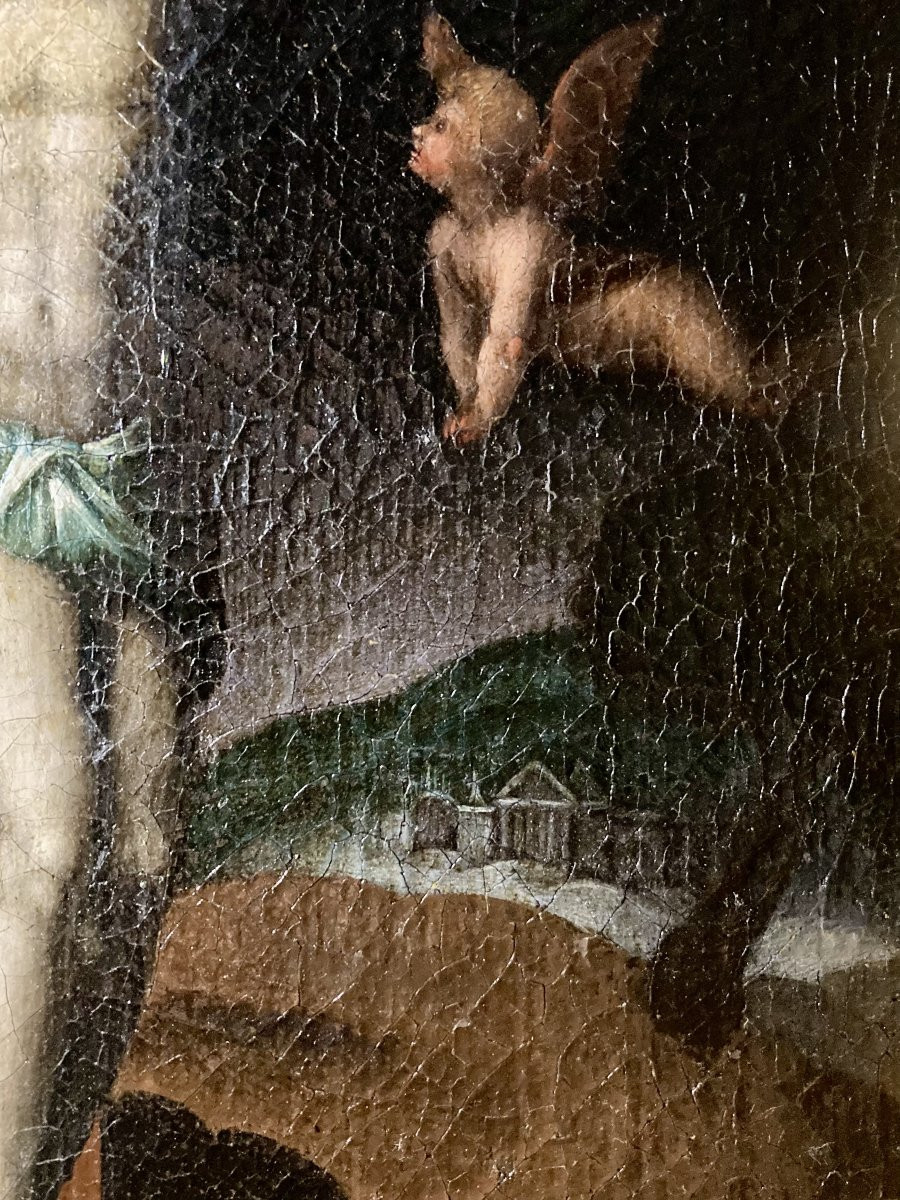
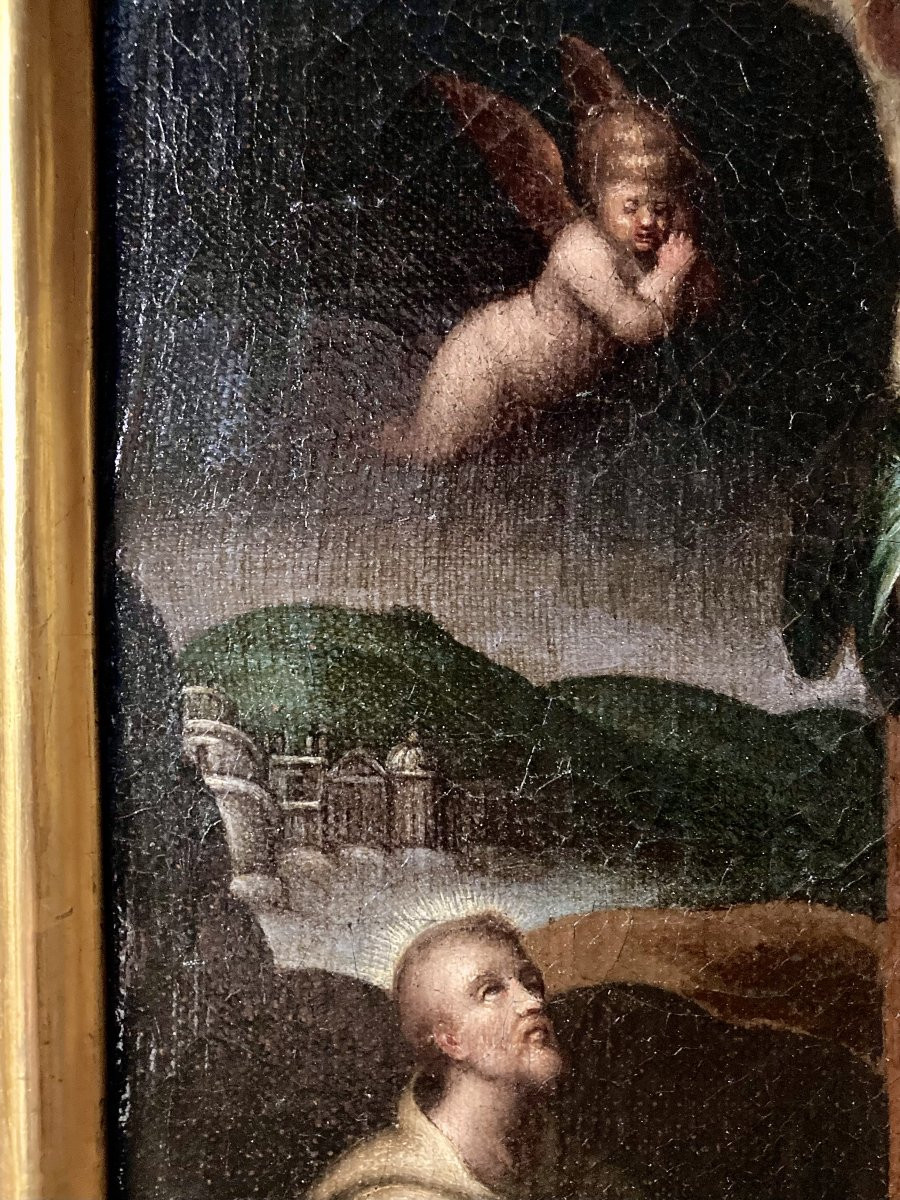
This previously unpublished painting, depicting a scene of the Crucifixion with Saint Francis and Angels, is part of Poppi’s extensive body of devotional work commissioned by private patrons.
In fact, following the success of his work in the Studiolo of Francesco I, Vasari’s pupil devoted himself to producing numerous works sharing the same subject matter.
Borghini himself (1584) mentions numerous paintings titled “Christ Crucified,” by Poppi, in the residences of Florentine gentlemen.
These subjects appear both on panel (large altarpieces, such as those at San Michele a San Salvi or San Francesco a Castiglion Fiorentino) and on canvas (notable examples include one housed at the National Gallery of Parma, inv. GN392, another extremely similar one in a private Florentine collection, and a small canvas sold at auction by Pandolfini, lot 81, auction 220 of 2017).
Many of these canvases have been lost or are unavailable on the market; however, a common thread can be recognized among them in a drawing by Poppi preserved at the Wicar Museum in Lille, inv. 329, where the two angels and Christ can be seen in the characteristic composition, with various figures of mourners and saints.
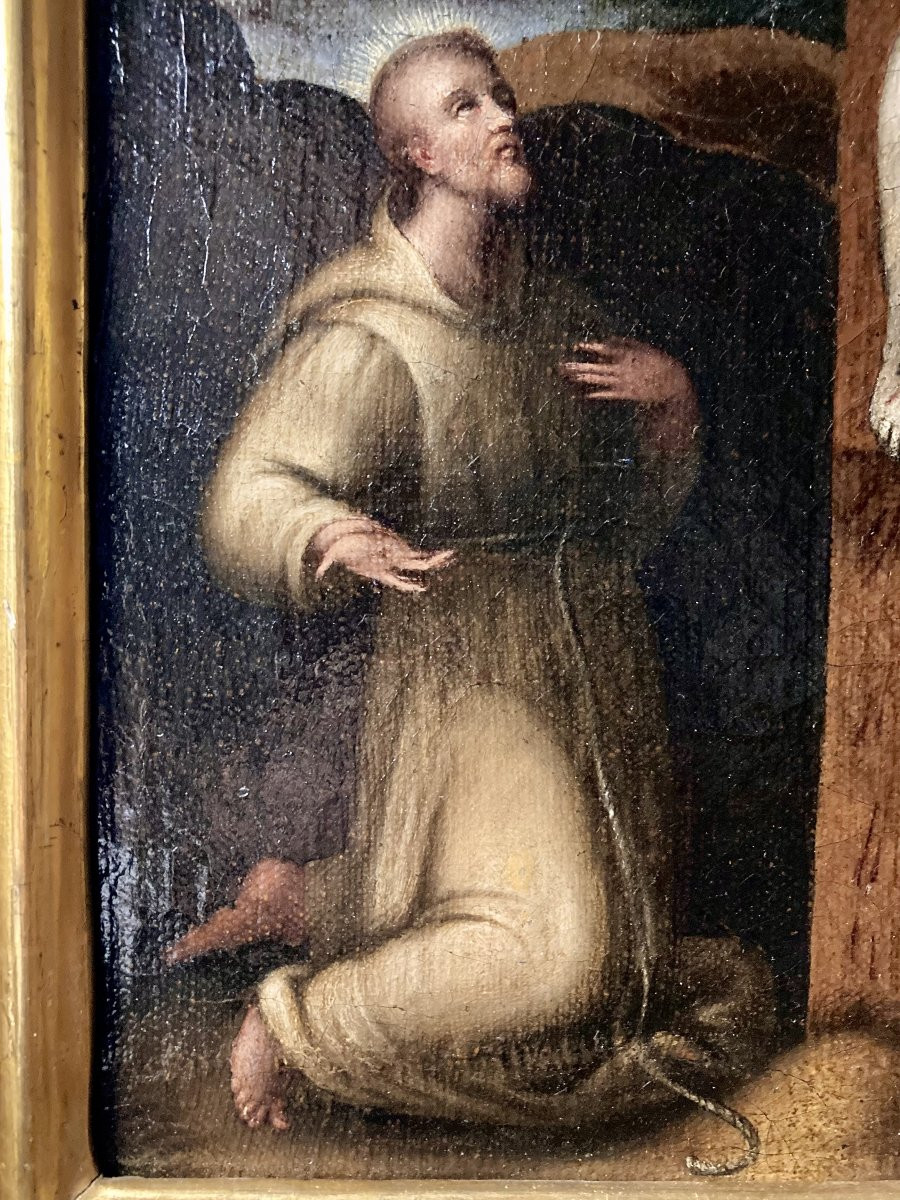
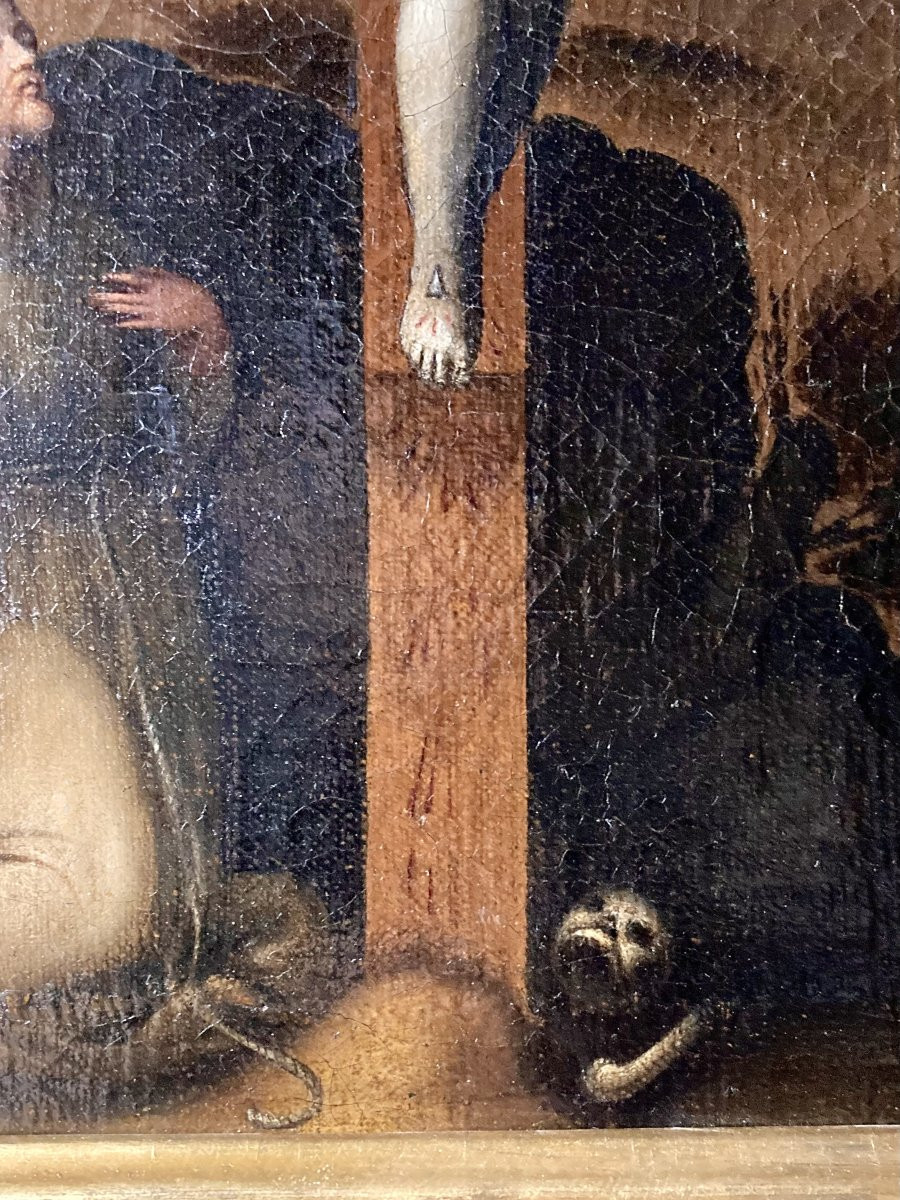
While two of the three paintings depict Mary Magdalene at the foot of the Cross and the third (the Pandolfini example) shows Christ alone, our example features St. Francis at the foot of the Cross.
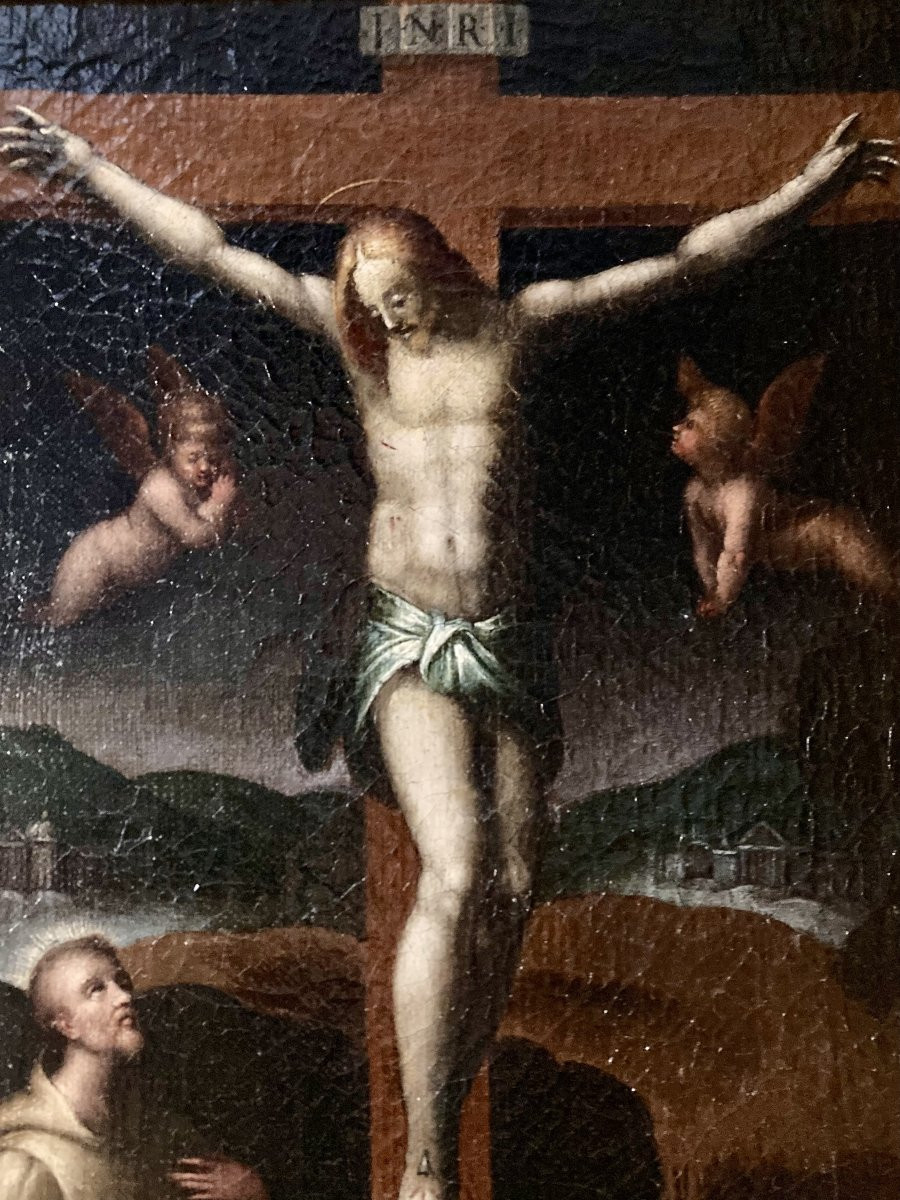
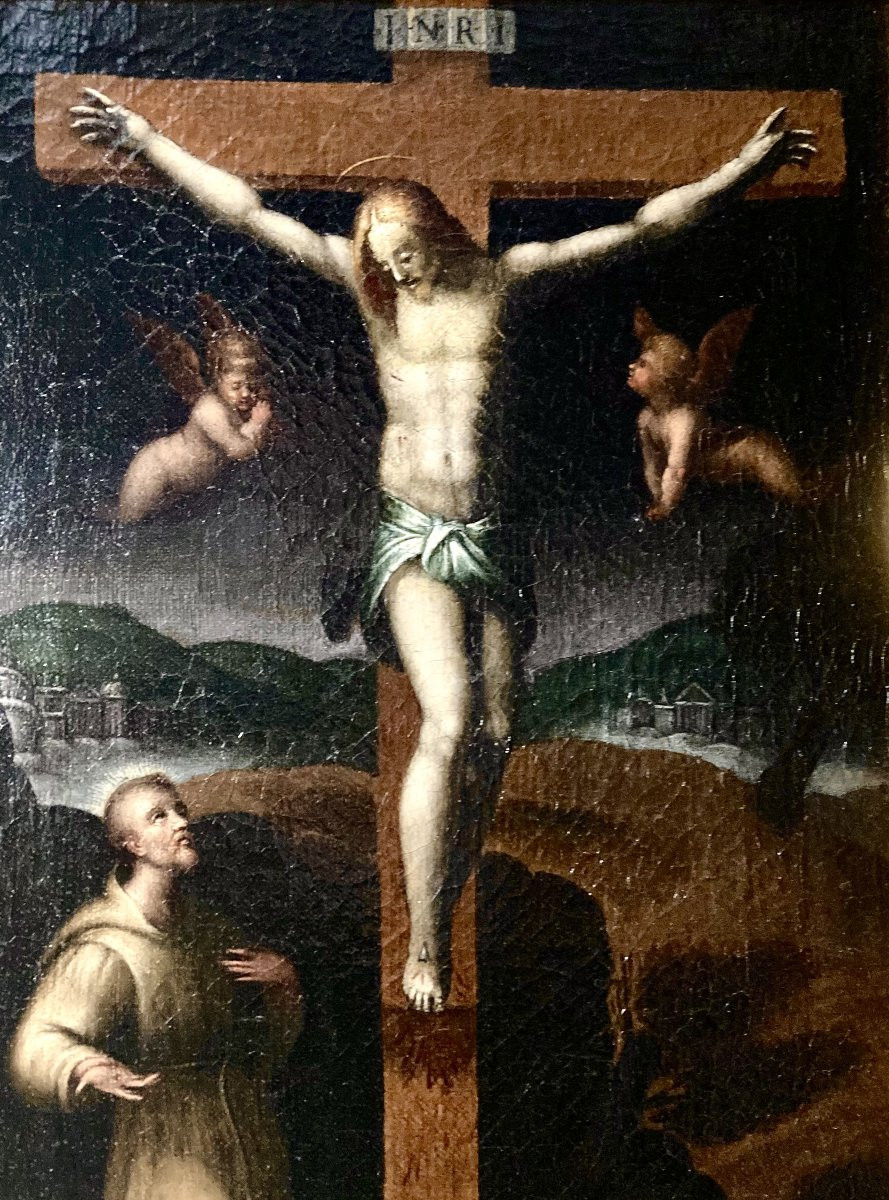
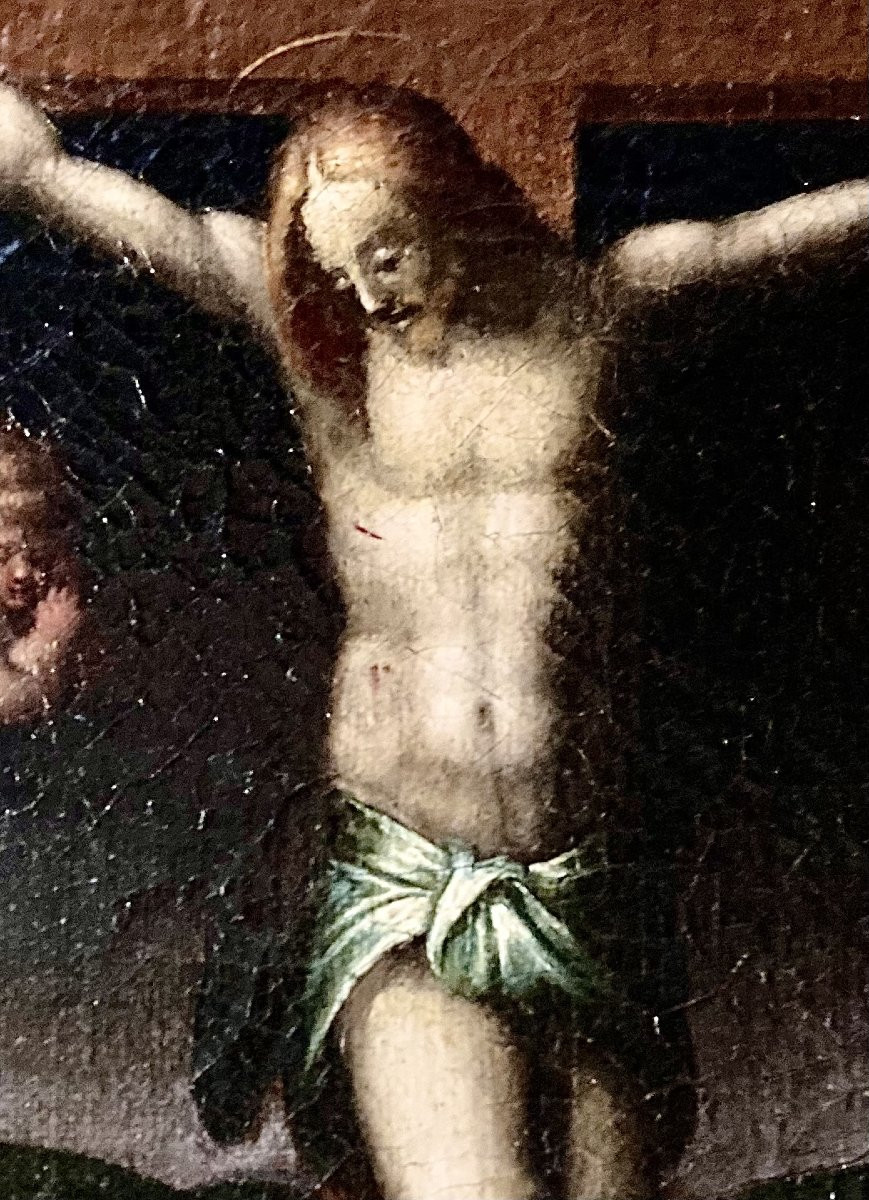
From an iconographic perspective, Christ stands on the Cross with his head tilted to the right, his arms gently forming a U-shape, denoting a plastic coherence softened by the skillful use of light that sets Christ’s body apart from the Cross and the dark background.
The X-shaped loincloth that appears to radiate from the central knot is typical of Poppi’s hand, a feature found in all the aforementioned comparisons.
The body, like the angels and Saint Francis, is characterized by iridescent colors and a striking chiaroscuro, as bold as it is lifelike.
In the background, on both the right and left, one can make out centrally planned buildings of classical origin reminiscent of Vasari (one need only look at the Crucifixion in the Seripando Chapel in Naples), repeatedly cited (clearly in a Morandini-inspired style) by Poppi in his paintings (in a form particularly analogous to ours in the small panel in a private Florentine collection).
The tones and the “landscape of death” (Pacini, 1979) also unite Poppi’s more devotional depictions (I am referring, therefore, especially to the small canvases rather than the large altarpieces, for obvious reasons of adapting the style to the available space), stemming moreover from a culture linked to the great painters (including Vasari) with whom Poppi had trained.
The shadows, the trees so dimly lit as to be almost invisible, the distant buildings swallowed up by space, rendered in an almost metaphysical gray, isolate the central scene without sacrificing the setting, a favorite of the artist.
The dark background, however, places the elements the viewer is presumed to observe in their proper place on the scale of priority.
Chronologically, it can be stated with certainty that the work dates from the late 1570s to the early 1590s, as it is certainly later than the completion of the Studiolo and the version preserved in Parma; it is therefore part of a corpus of varied works (to which this variant featuring St. Francis is now added) intended for the private devotion of gentlemen.
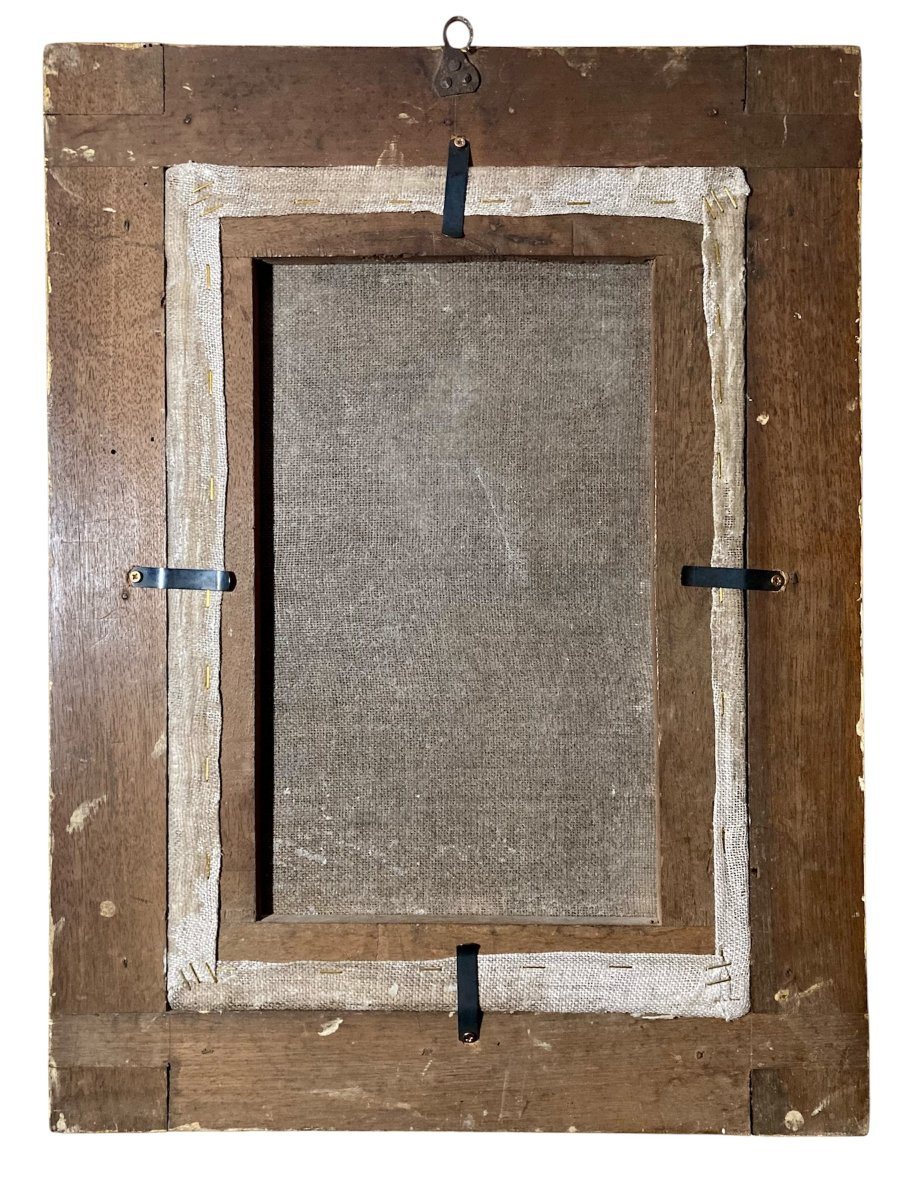
The canvas has been cut out and mounted on a modern rigid canvas, but retains every inch of the original pictorial space: in fact, one can see how the canvas is bordered by a monochrome brown frame delimiting the pictorial space.
With a 19th-century gilded frame.
Dimensions: 41 x 28 cm (without frame) / 53 x 40 cm (with frame)
Period: 16th century
Style: Other Style
Condition: Re-canvas
Material: Oil painting
Width: 28
Height: 41
Reference (ID): 1762693
Availability: In stock