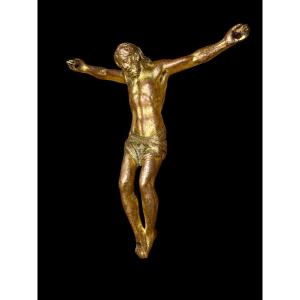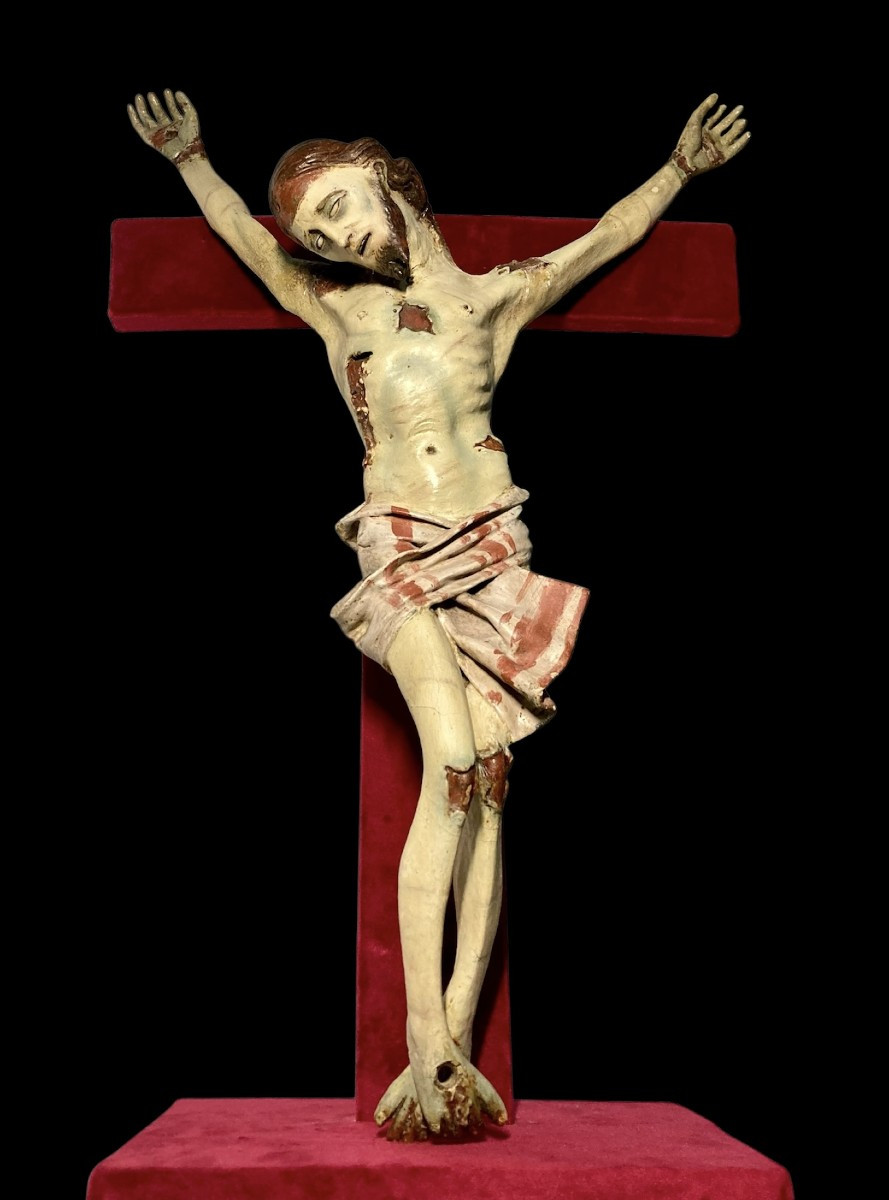
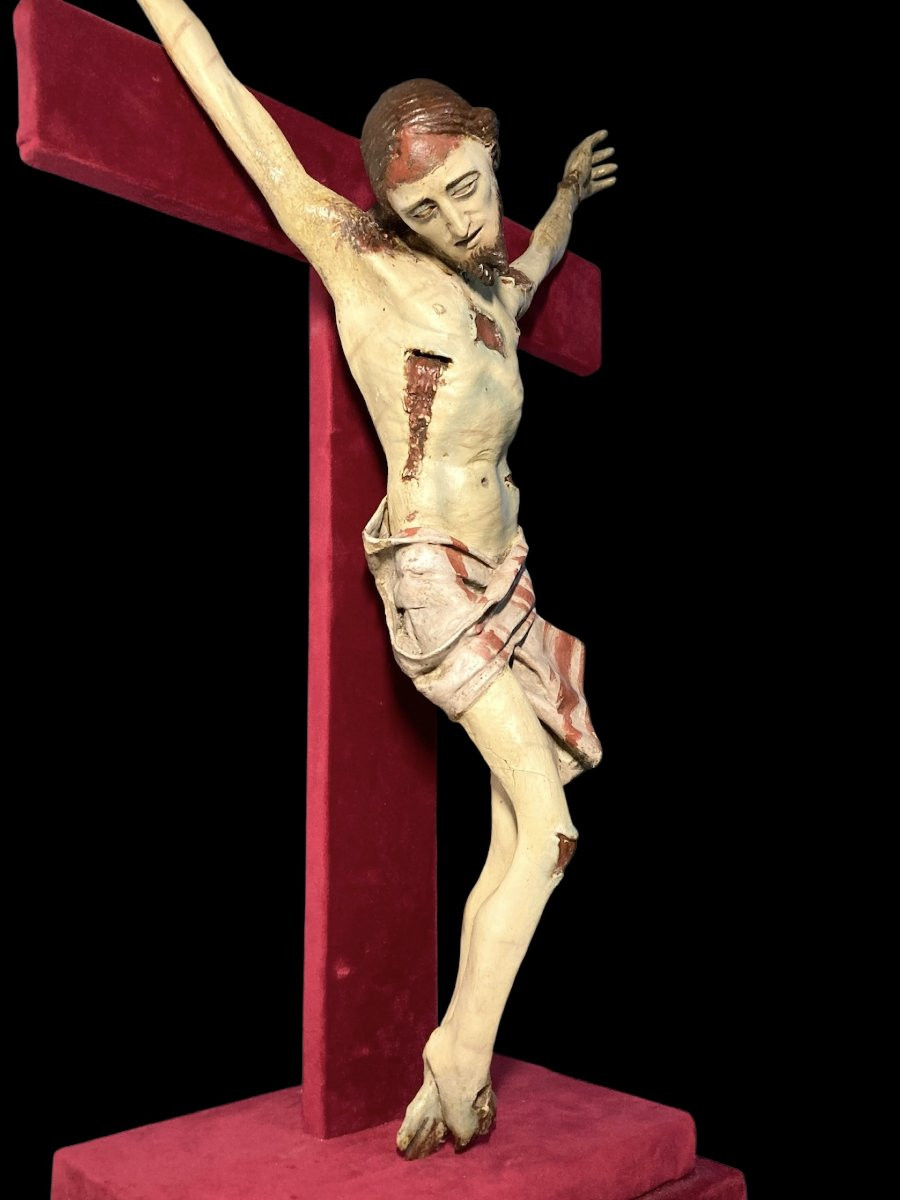
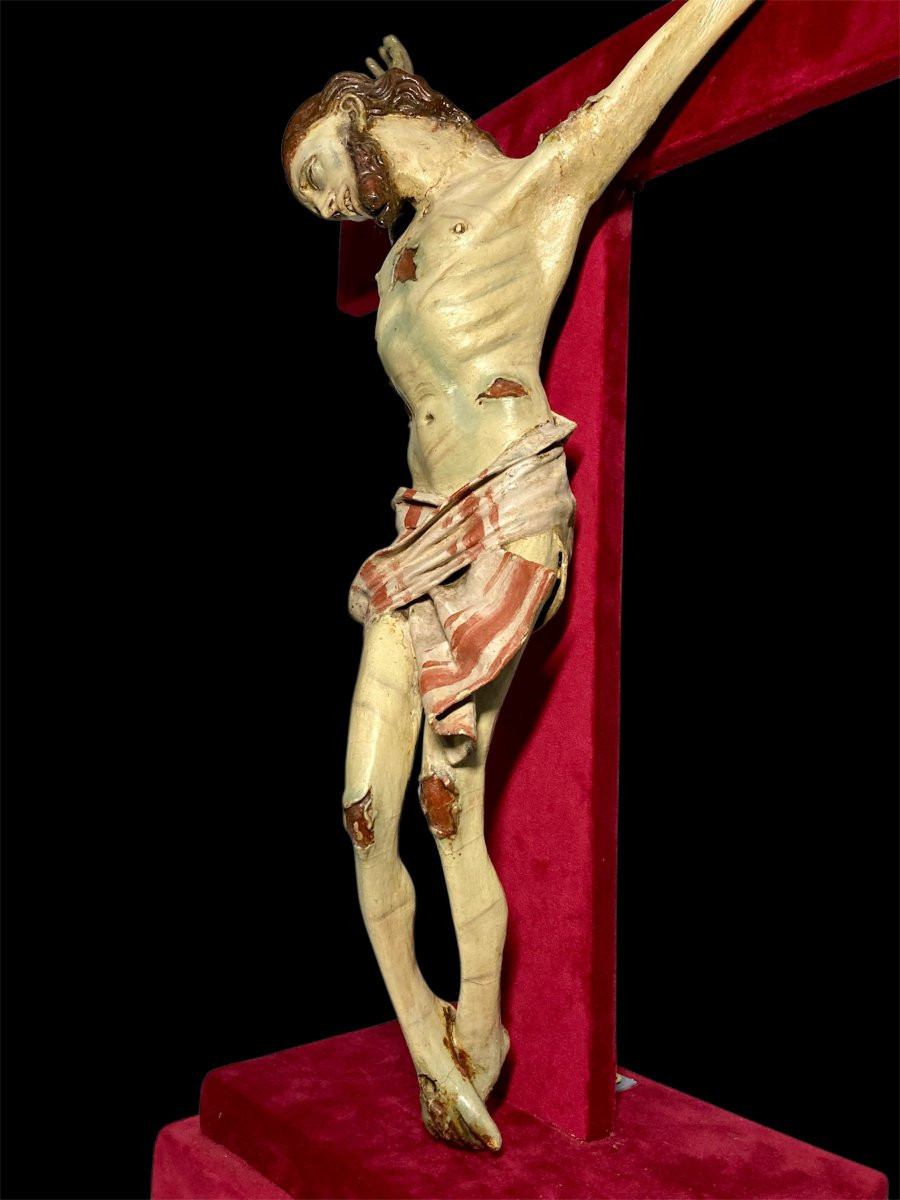
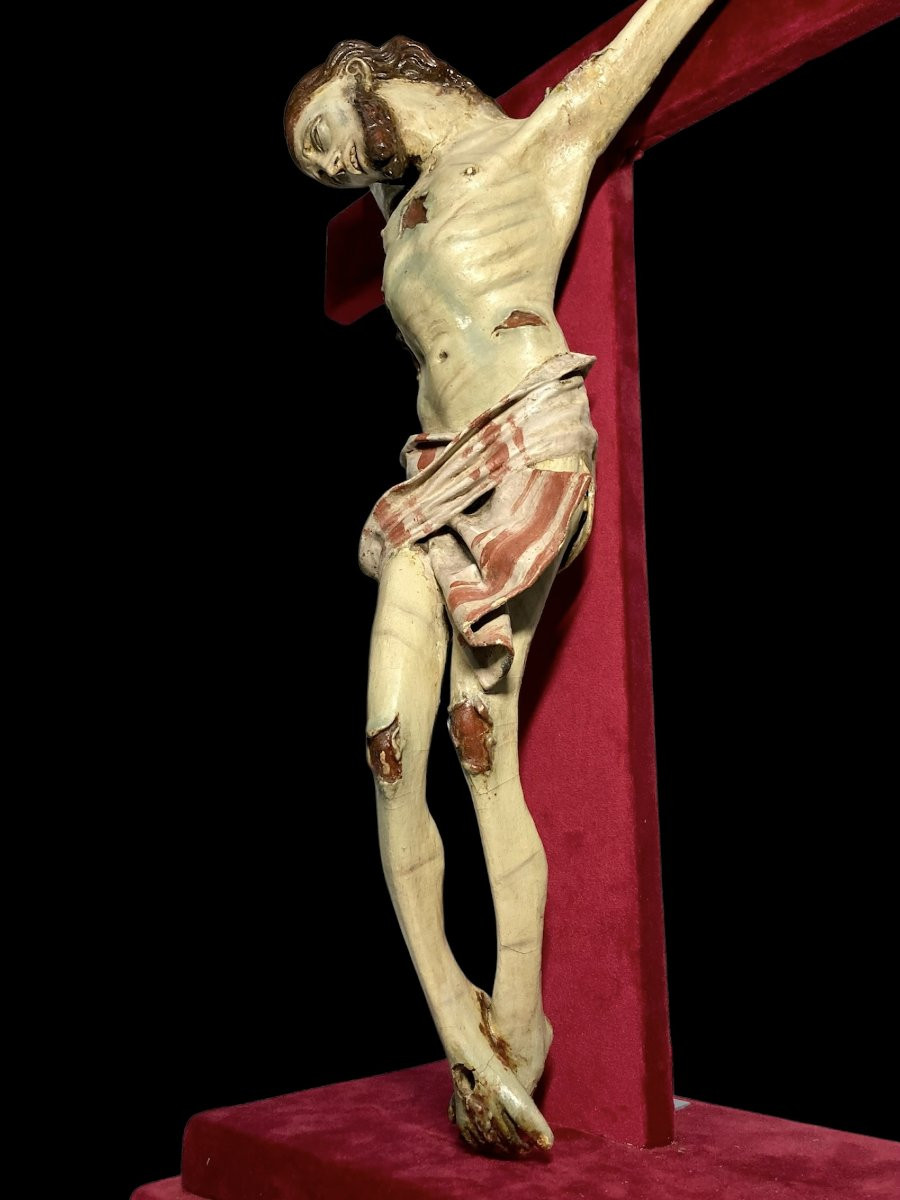


Naples - Second Quarter Of The 17th Century - Crucified Christ With Wounds - Papier-mâché, Wood, And Glass
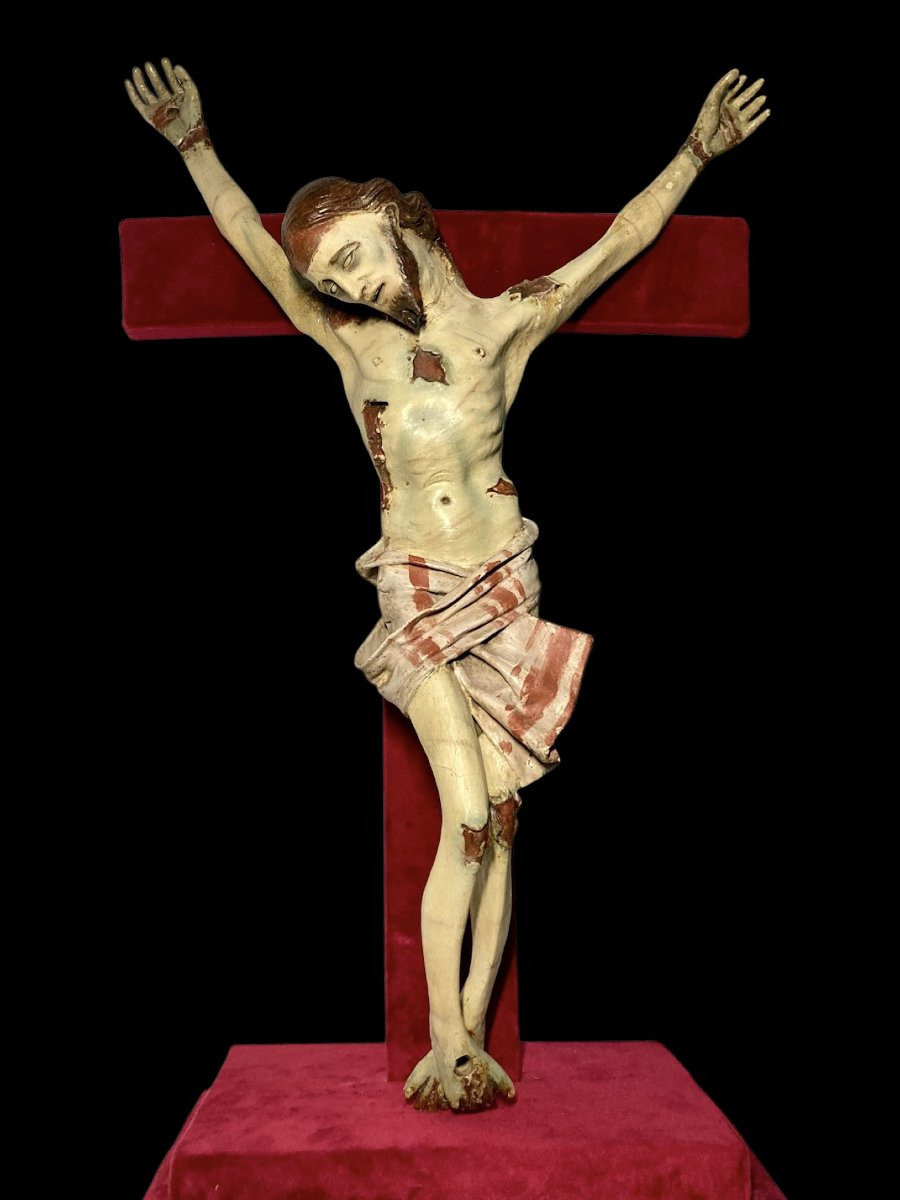
The Christ in question is considered a unique work by a Neapolitan papier-mâché master.
Building on the legacy of Caravaggio, a significant realist sensibility developed in Naples and southern Italy, often manifesting in devotional works where the subject embodies and expresses the pain and passion that the patron would then absorb and share in his ascent toward God.
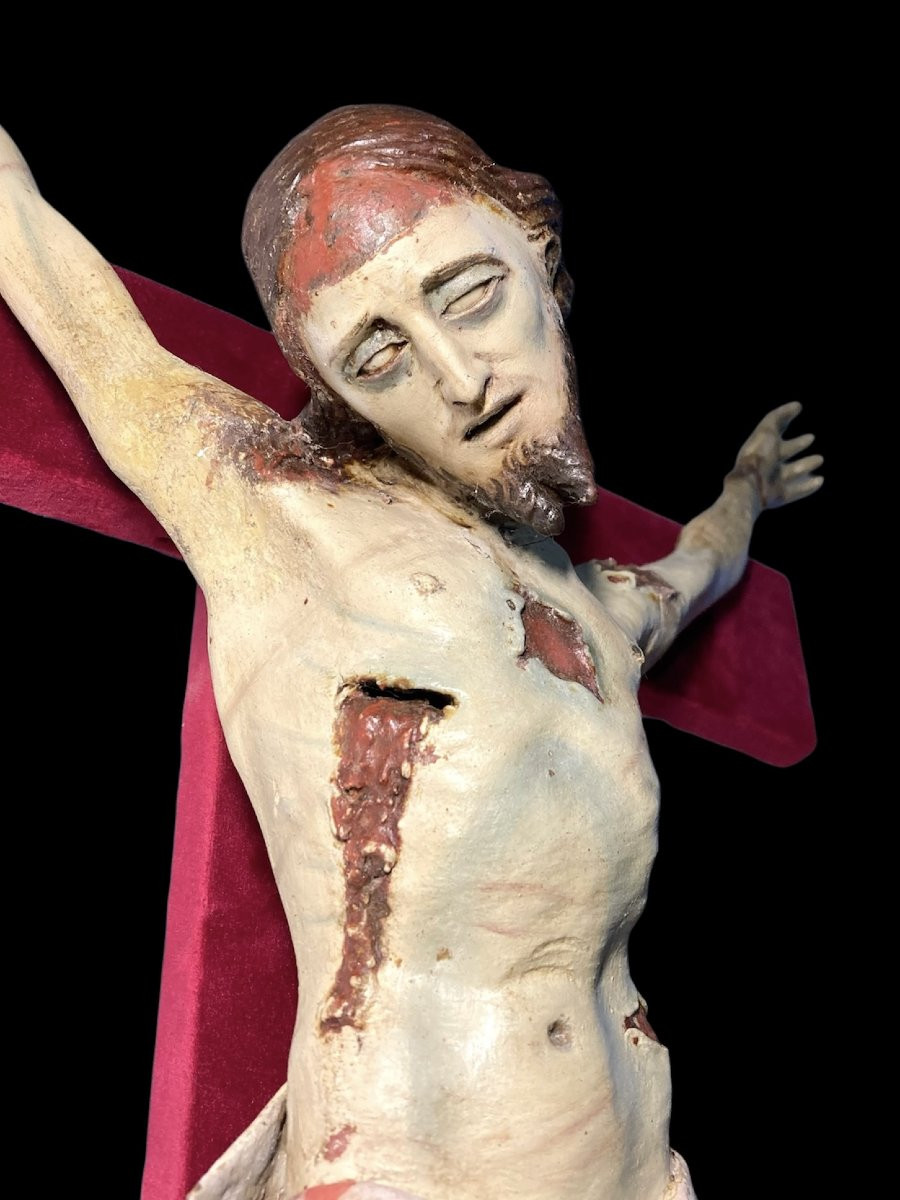
It is precisely here that, from the early 1600s, a series of crucifixes began to take shape, characterized by deep wounds and lacerations, of which the one at the center of the chest is distinctive of the Neapolitan (and later Apulian) region.
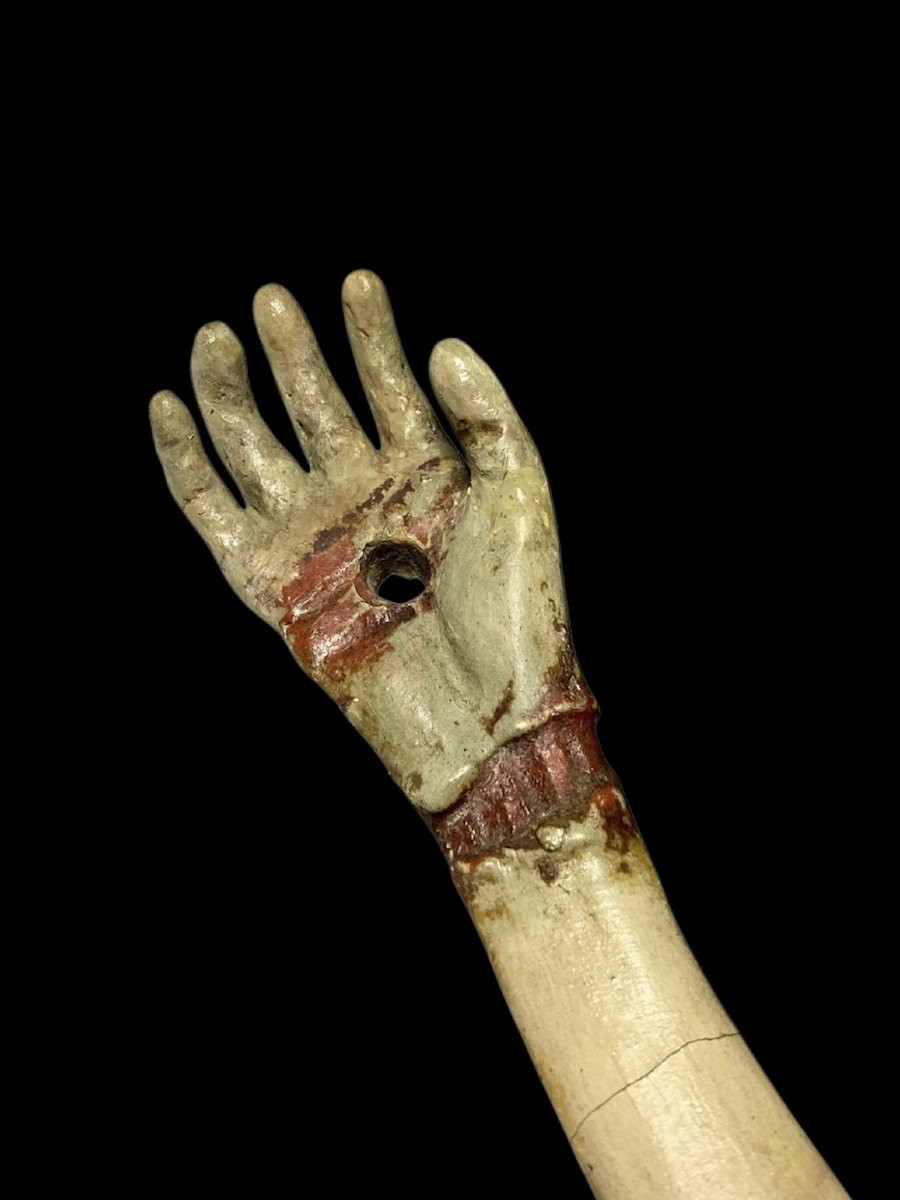
Our Christ features a hollow papier-mâché structure; when viewed from inside the nail holes, it appears to be made of a thick, dense layer of textile fibers and, in part, paper, with a layer of plaster.
In fact, to create continuity between the papier-mâché and wooden surfaces, the latter were also covered with the same material.
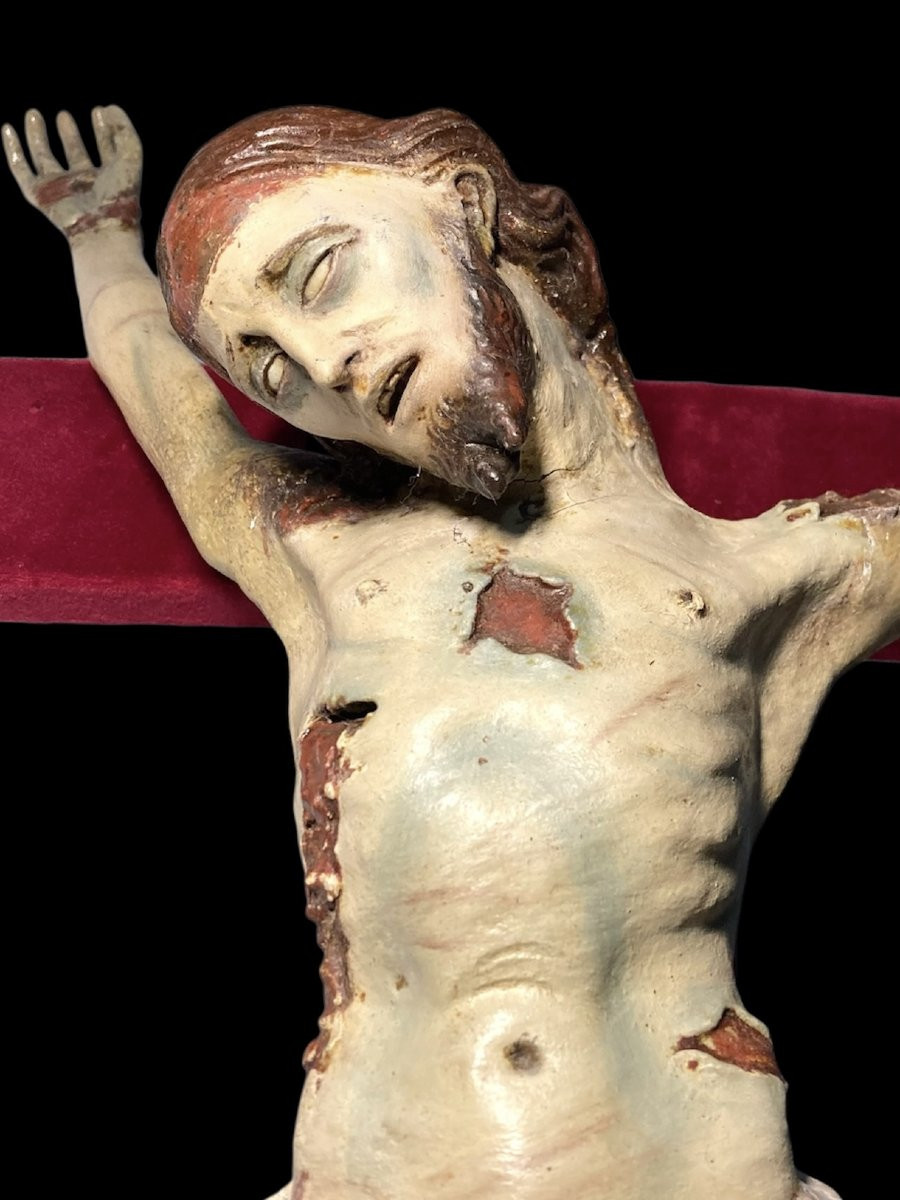
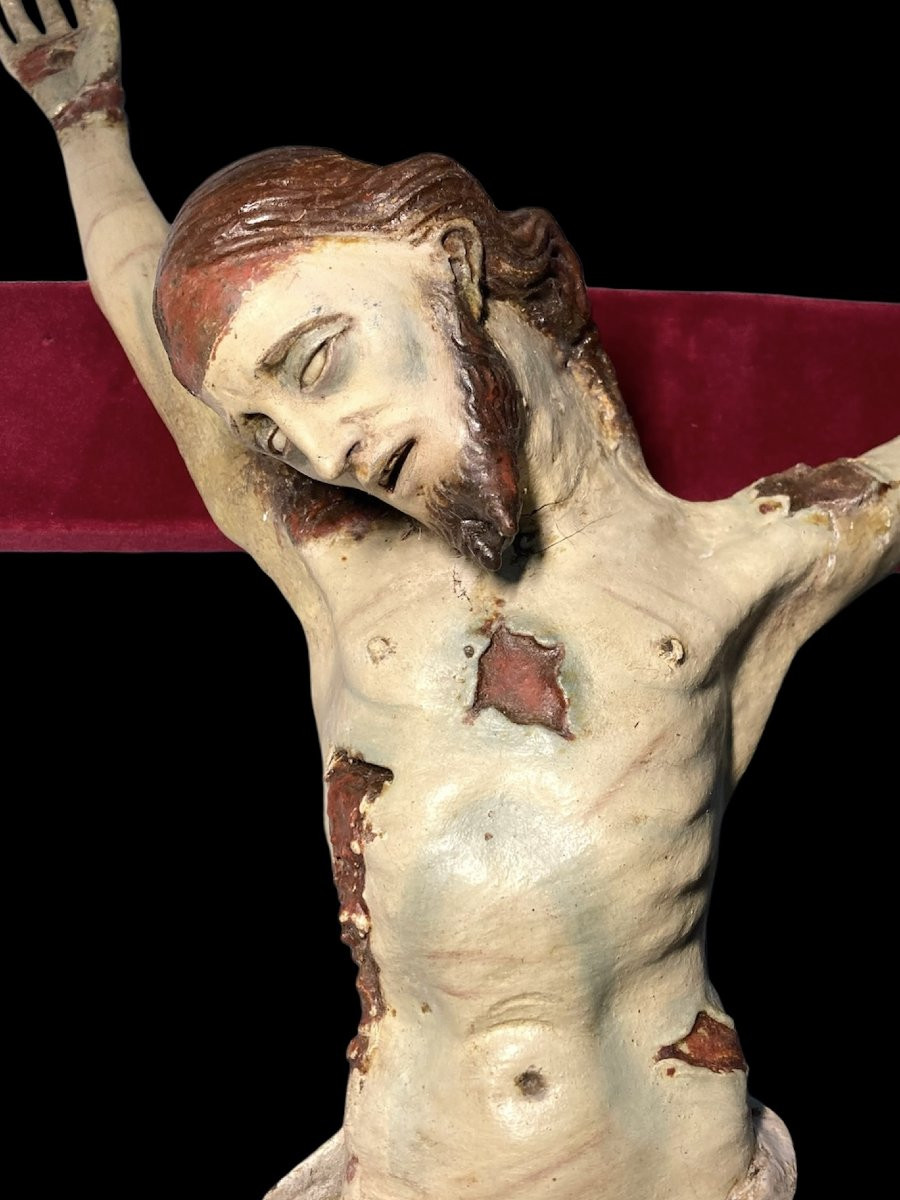
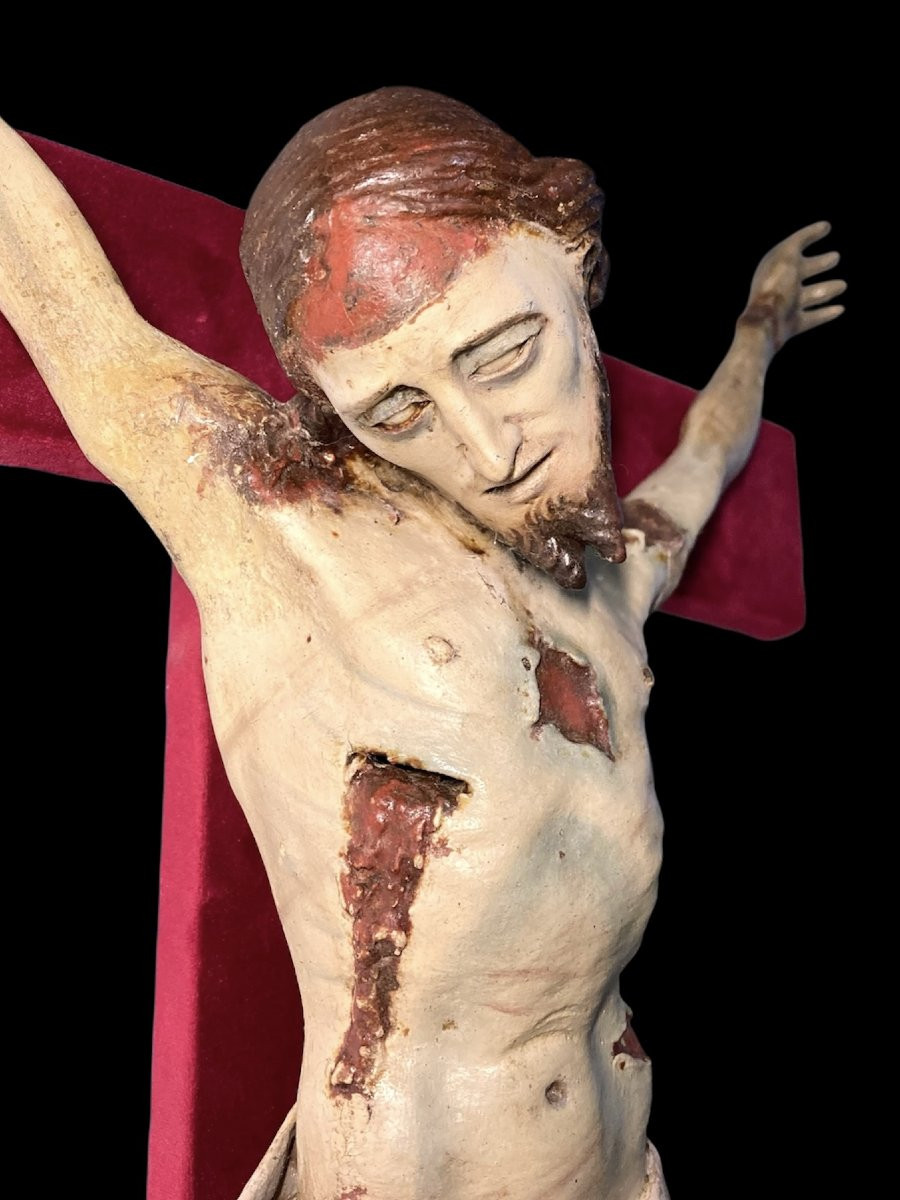
The polychromy is executed in tempera, and the glass eyes—white to highlight the sclera—feature tiny specks resulting from the ancient glass-making process.
The mouth is half-open, with teeth and tongue visible and masterfully rendered.
The use of cyanotic blue stems from the intention to depict the moment of passing, the last breath, in which the soul departs from the body and the blood, ceasing to circulate, coagulates and takes on the characteristic blue color.
The chest is also captured at the moment it deflates after the final breath, a detail rendered through two small but significant wrinkles carved into the lower-middle abdomen.
This attention stems from the widespread interest in anatomy during that period, which led many masters to attend anatomy lectures to stay current on the subject.
Thus, the focus on realism and drama constitutes the true artistic intent of both the artist and the patron, who, in this case—given the presence of marks from flagellation and ligature injuries on the wrists—was most likely a minor figure.
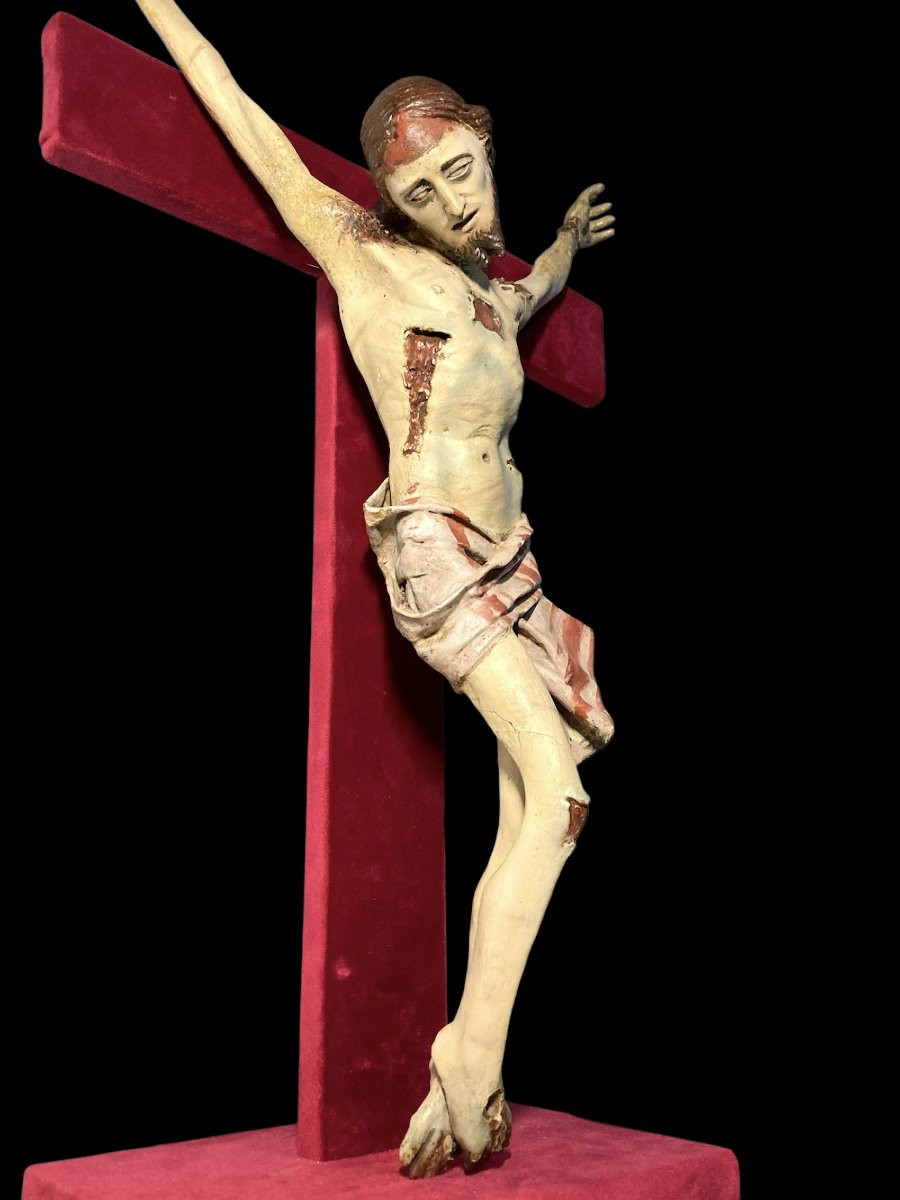
However, observing the iconographic details, we can note elements that are distinctly archaic: the arms spread in a V-shape, stretched to the extreme, which heighten the sense of agony and the twisting movement of the body; the reclined head, the gaunt face, and the pointed beard; the pink loincloth with red stripes.
All these elements, though not part of Neapolitan Baroque culture, are in fact the most suitable for representing the idea of that true Christ—wounded, dead, and suffering—in the most dramatic way possible.
These aforementioned characteristics indicate that the artist, perhaps guided by the patron, had conducted historical research to identify what in art history best embodied the figurative vision.
We can compare this Christ to German works akin to the Vesperbild, where the Passion reaches its peak of drama, Christ assumes poses of agonizing contortion, and his body appears emaciated, angular, and gaunt.
Even the loincloth, which with its movement to the right balances the composition by countering the twist of the head, has nothing Baroque about it except for its bold movement. It is made of the typical fabrics that were in use until the 15th and 16th centuries.
The use of pink and red is a macabre allusion to blood.
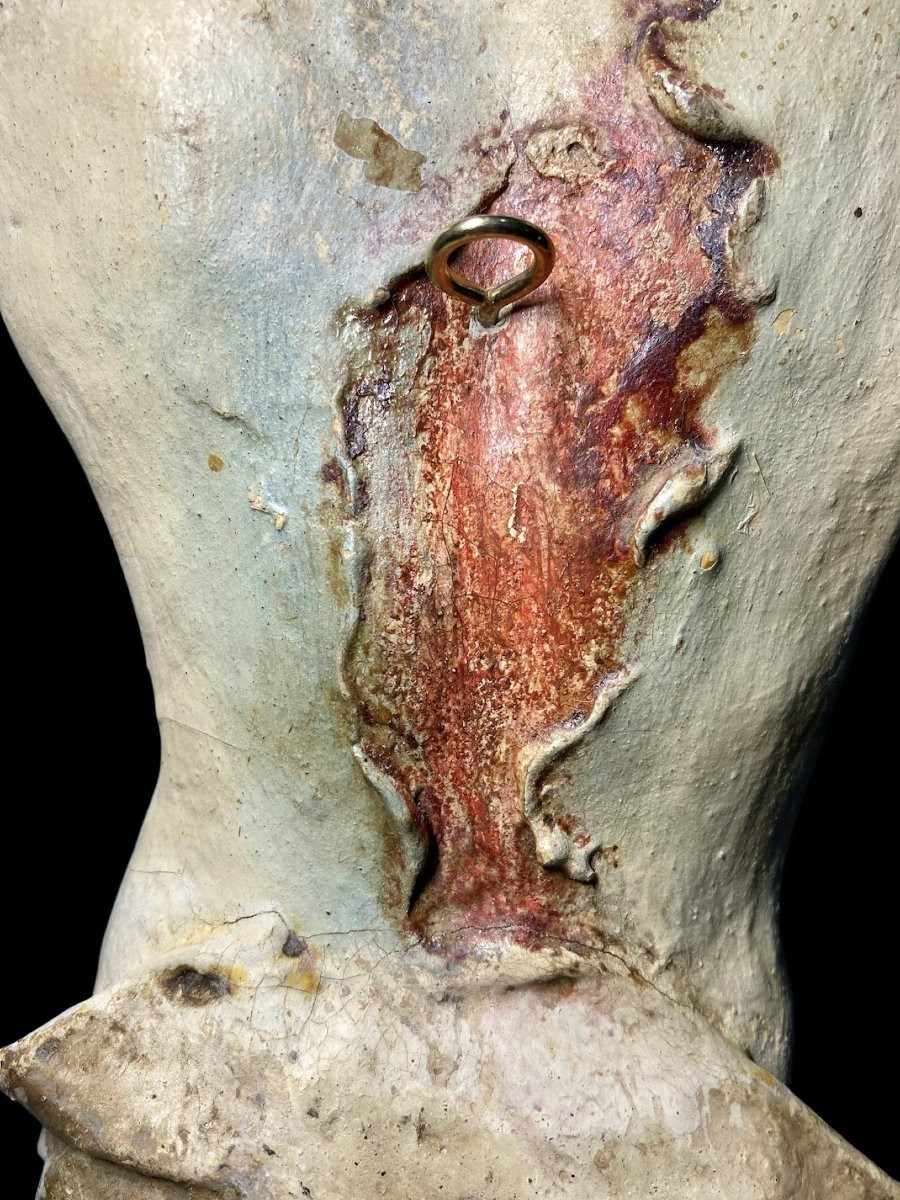
Macabre but far from merely allusive is the peeling of the wounds, which, outlined in cyanotic blue, flake outward to reveal the stagnant blood within the enormous, deep wounds.
The most characteristic of these is the wound in the side, from which a trickle of blood mixed with viscera emerges, dripping in clots down the torso; these are rendered in relief using plaster and glue to realistically simulate the movement.
This wound is wide and deep and cuts through all the material layers of that section of the torso, allowing the viewer to observe the construction of the wound’s inner walls.
Thus, the work represents a unique piece within the Neapolitan Baroque landscape, as the master papier-mâché artist (though certainly the patron) drew upon stylistic elements from an earlier historical period to best embody the taste and sentiment of the era, in order to create the perfect object.
The high figurative quality, the skillful use of glass, papier-mâché, and wood, the visual and anatomical precision of the wounds and colors, as well as the skillful use of papier-mâché and color—which have ensured that our Christ has come down to us in excellent condition with slight but widespread cracking and micro-cracking—attest to the avant-garde nature and significant artistic personality of the artist, who nevertheless remains anonymous for now, attributable to the large circle of Neapolitan masters of the genre.
Dim. cm 39 x 12 x 60 h
Building on the legacy of Caravaggio, a significant realist sensibility developed in Naples and southern Italy, often manifesting in devotional works where the subject embodies and expresses the pain and passion that the patron would then absorb and share in his ascent toward God.
It is precisely here that, from the early 1600s, a series of crucifixes began to take shape, characterized by deep wounds and lacerations, of which the one at the center of the chest is distinctive of the Neapolitan (and later Apulian) region.
Our Christ features a hollow papier-mâché structure; when viewed from inside the nail holes, it appears to be made of a thick, dense layer of textile fibers and, in part, paper, with a layer of plaster.
In fact, to create continuity between the papier-mâché and wooden surfaces, the latter were also covered with the same material.
The polychromy is executed in tempera, and the glass eyes—white to highlight the sclera—feature tiny specks resulting from the ancient glass-making process.
The mouth is half-open, with teeth and tongue visible and masterfully rendered.
The use of cyanotic blue stems from the intention to depict the moment of passing, the last breath, in which the soul departs from the body and the blood, ceasing to circulate, coagulates and takes on the characteristic blue color.
The chest is also captured at the moment it deflates after the final breath, a detail rendered through two small but significant wrinkles carved into the lower-middle abdomen.
This attention stems from the widespread interest in anatomy during that period, which led many masters to attend anatomy lectures to stay current on the subject.
Thus, the focus on realism and drama constitutes the true artistic intent of both the artist and the patron, who, in this case—given the presence of marks from flagellation and ligature injuries on the wrists—was most likely a minor figure.
However, observing the iconographic details, we can note elements that are distinctly archaic: the arms spread in a V-shape, stretched to the extreme, which heighten the sense of agony and the twisting movement of the body; the reclined head, the gaunt face, and the pointed beard; the pink loincloth with red stripes.
All these elements, though not part of Neapolitan Baroque culture, are in fact the most suitable for representing the idea of that true Christ—wounded, dead, and suffering—in the most dramatic way possible.
These aforementioned characteristics indicate that the artist, perhaps guided by the patron, had conducted historical research to identify what in art history best embodied the figurative vision.
We can compare this Christ to German works akin to the Vesperbild, where the Passion reaches its peak of drama, Christ assumes poses of agonizing contortion, and his body appears emaciated, angular, and gaunt.
Even the loincloth, which with its movement to the right balances the composition by countering the twist of the head, has nothing Baroque about it except for its bold movement. It is made of the typical fabrics that were in use until the 15th and 16th centuries.
The use of pink and red is a macabre allusion to blood.
Macabre but far from merely allusive is the peeling of the wounds, which, outlined in cyanotic blue, flake outward to reveal the stagnant blood within the enormous, deep wounds.
The most characteristic of these is the wound in the side, from which a trickle of blood mixed with viscera emerges, dripping in clots down the torso; these are rendered in relief using plaster and glue to realistically simulate the movement.
This wound is wide and deep and cuts through all the material layers of that section of the torso, allowing the viewer to observe the construction of the wound’s inner walls.
Thus, the work represents a unique piece within the Neapolitan Baroque landscape, as the master papier-mâché artist (though certainly the patron) drew upon stylistic elements from an earlier historical period to best embody the taste and sentiment of the era, in order to create the perfect object.
The high figurative quality, the skillful use of glass, papier-mâché, and wood, the visual and anatomical precision of the wounds and colors, as well as the skillful use of papier-mâché and color—which have ensured that our Christ has come down to us in excellent condition with slight but widespread cracking and micro-cracking—attest to the avant-garde nature and significant artistic personality of the artist, who nevertheless remains anonymous for now, attributable to the large circle of Neapolitan masters of the genre.
Dim. cm 39 x 12 x 60 h
4 500 €
Period: 17th century
Style: Other Style
Condition: Excellent condition
Material: Other
Width: 39
Height: 60
Depth: 12
Reference (ID): 1751036
Availability: In stock
Print