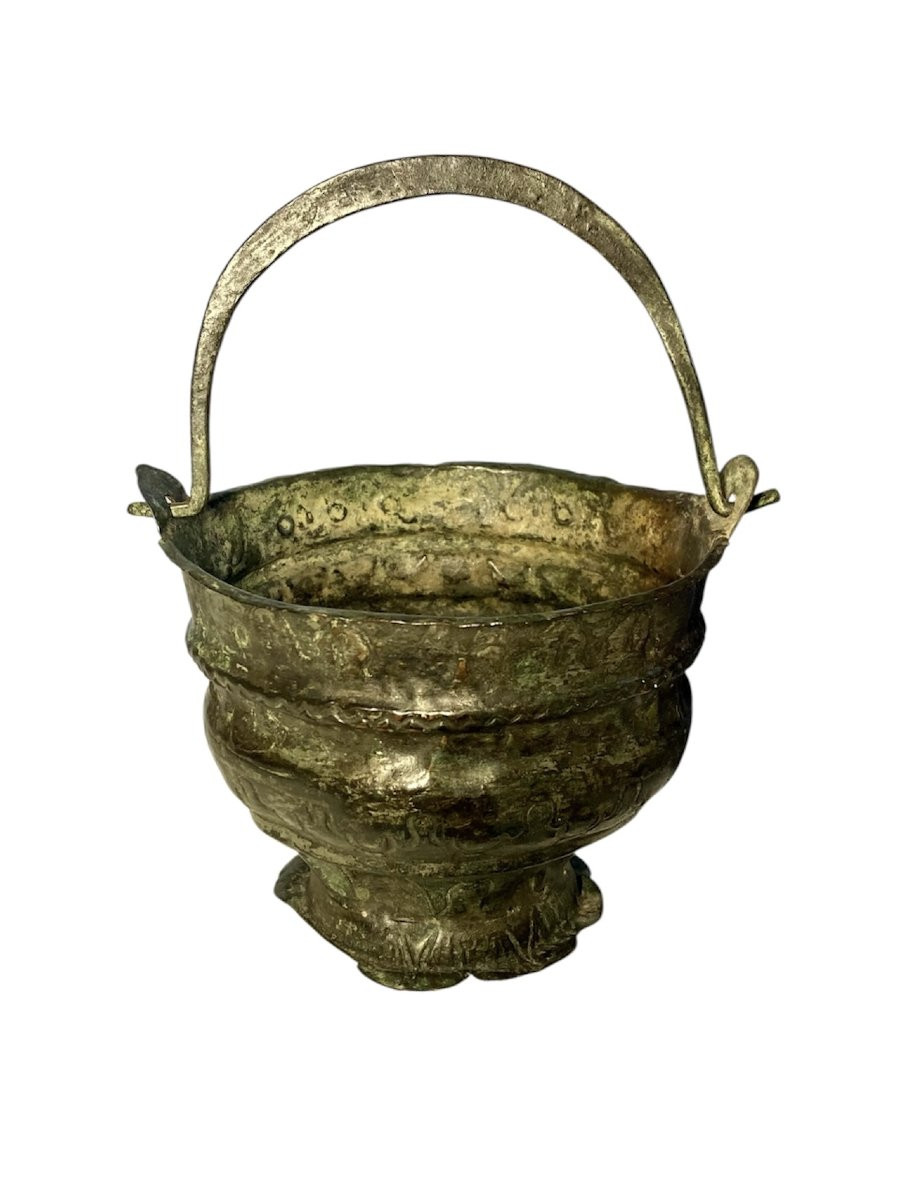


Norman Sicily - Mid-12th Century - Architectural Bronze-sheet Situla (allegory Of The Church)
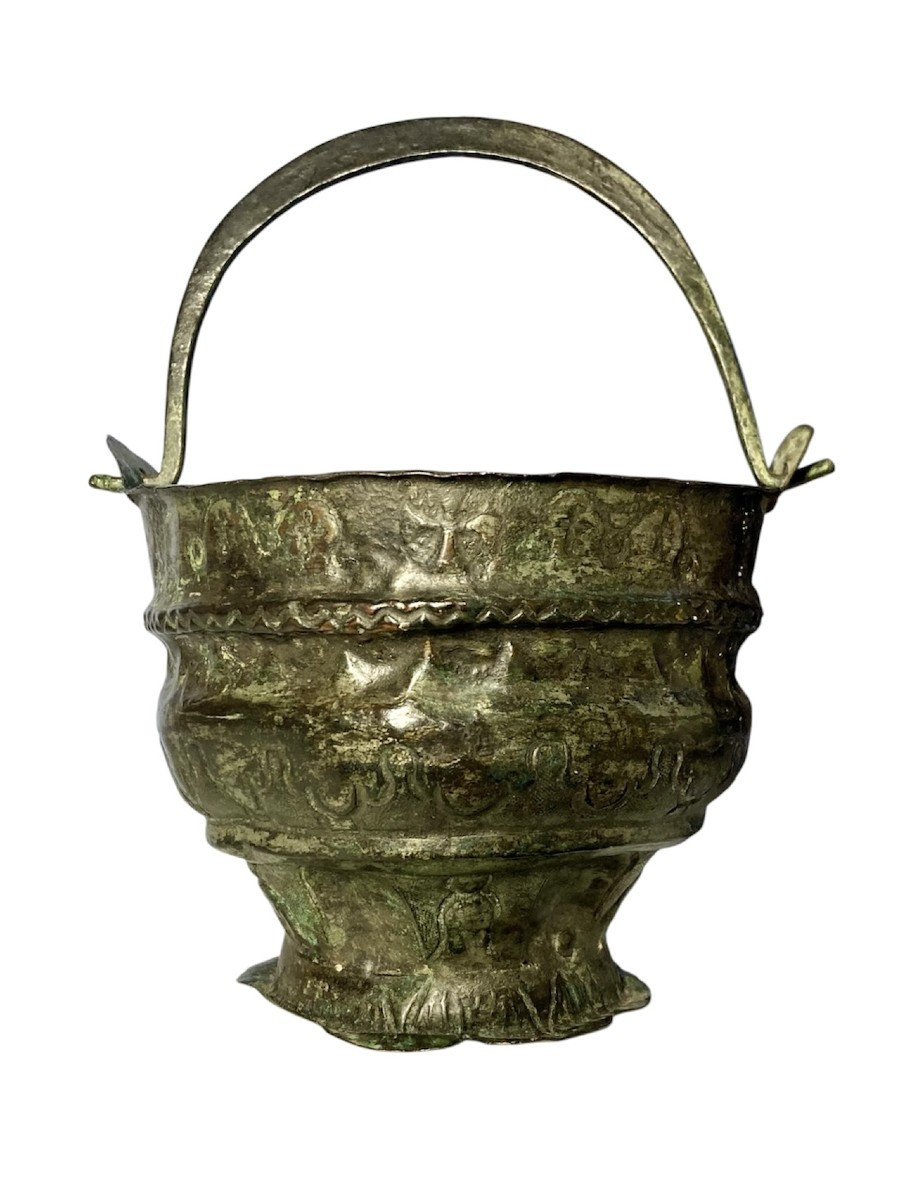
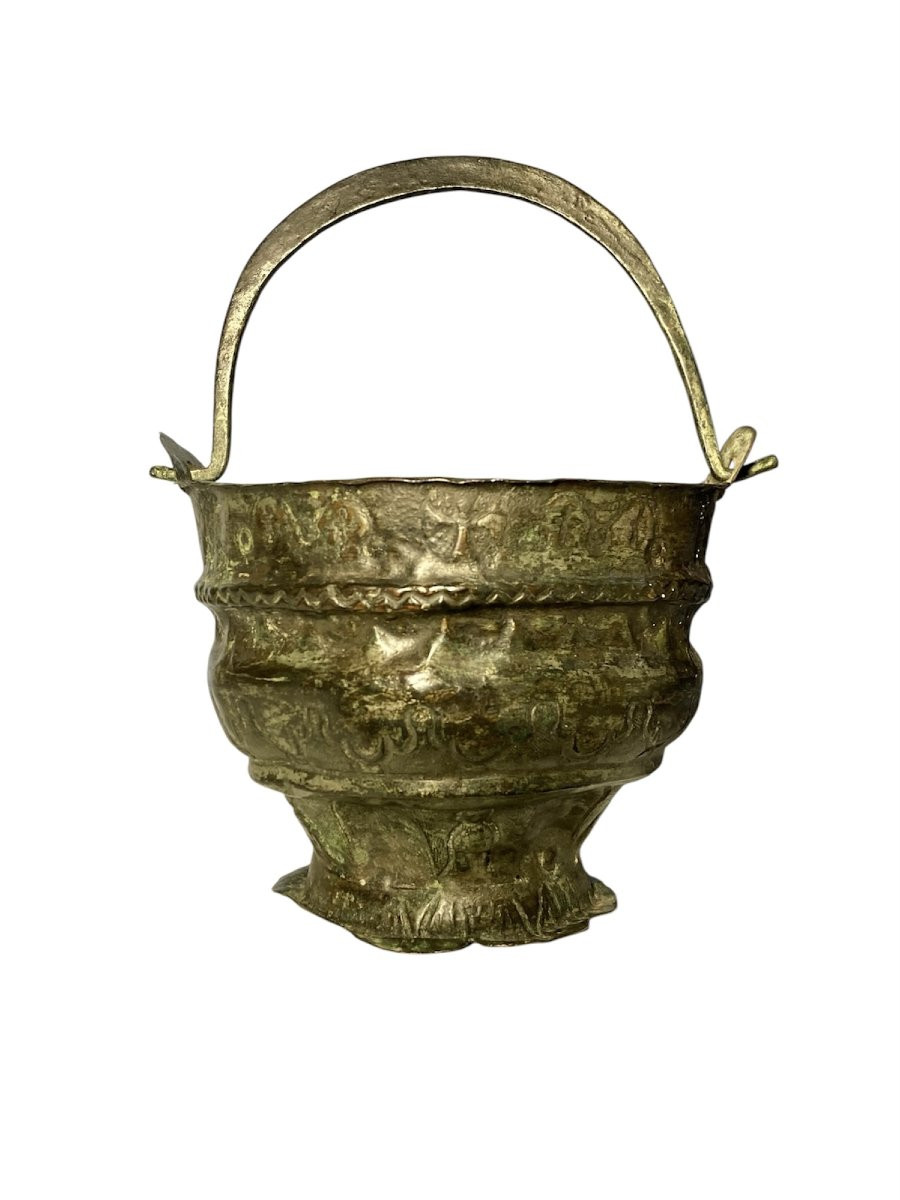
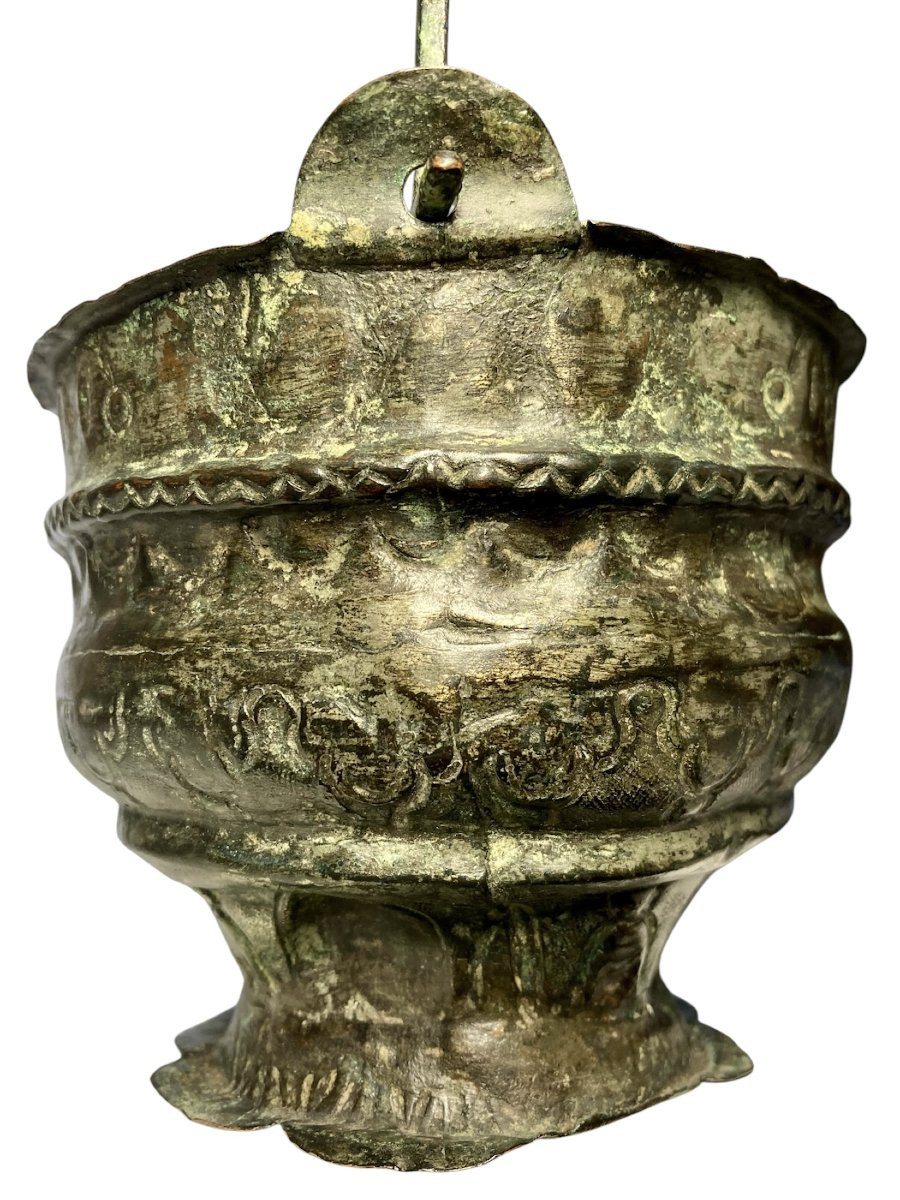
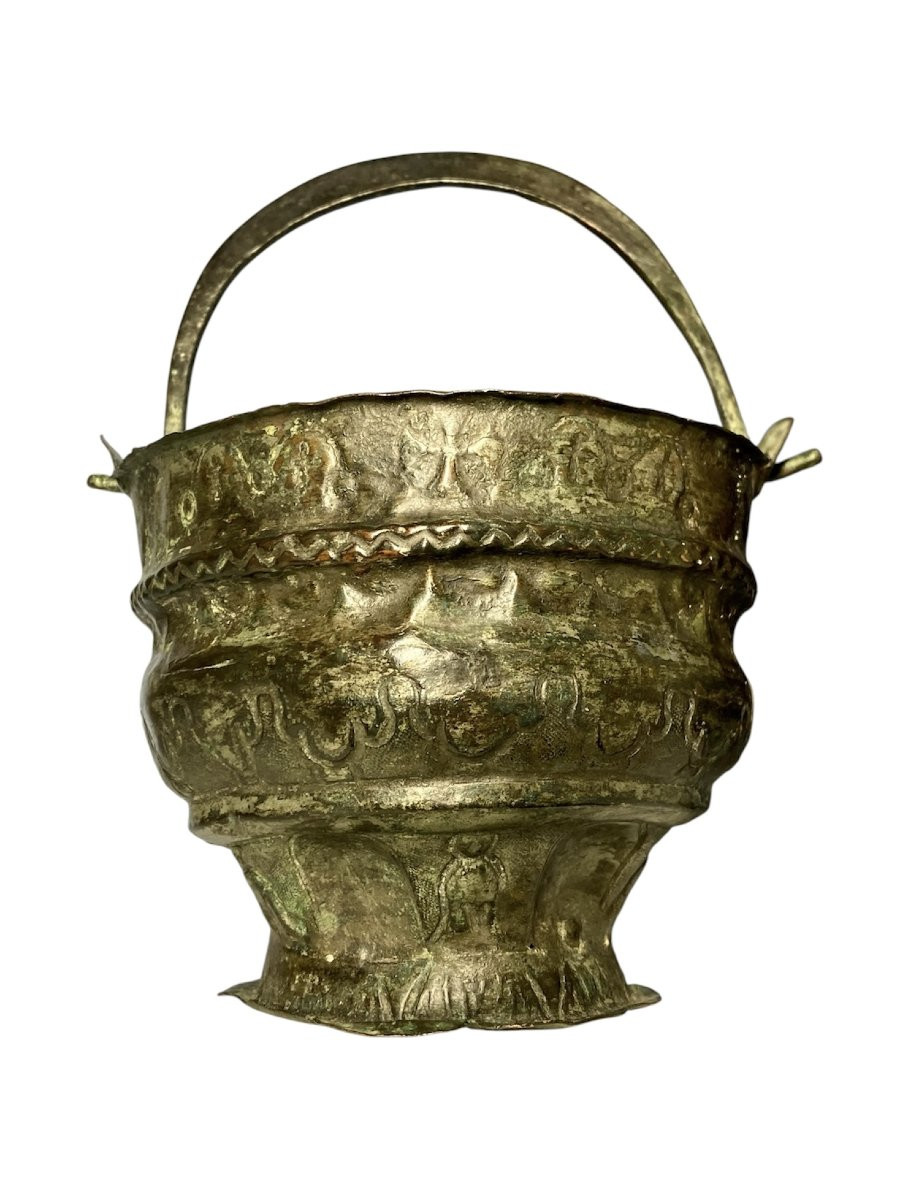
This situla, a unique example of Sicilian-Norman sacred goldsmithing (and beyond), is composed of a single sheet of copper cut to a design, embossed, and formed to define the shape of the bucket. Only the circular bottom is soldered to the base, internally and concealed, to seal the piece against water without creating a visually striking assembly.
The unique and complex workmanship of the single sheet harks back to the technical expertise of Byzantine master goldsmiths, who belonged to a culture that played a key role in the construction of Norman Sicily, importing materials and objects, as well as new techniques and ancient traditions (especially in sculpture and architecture).
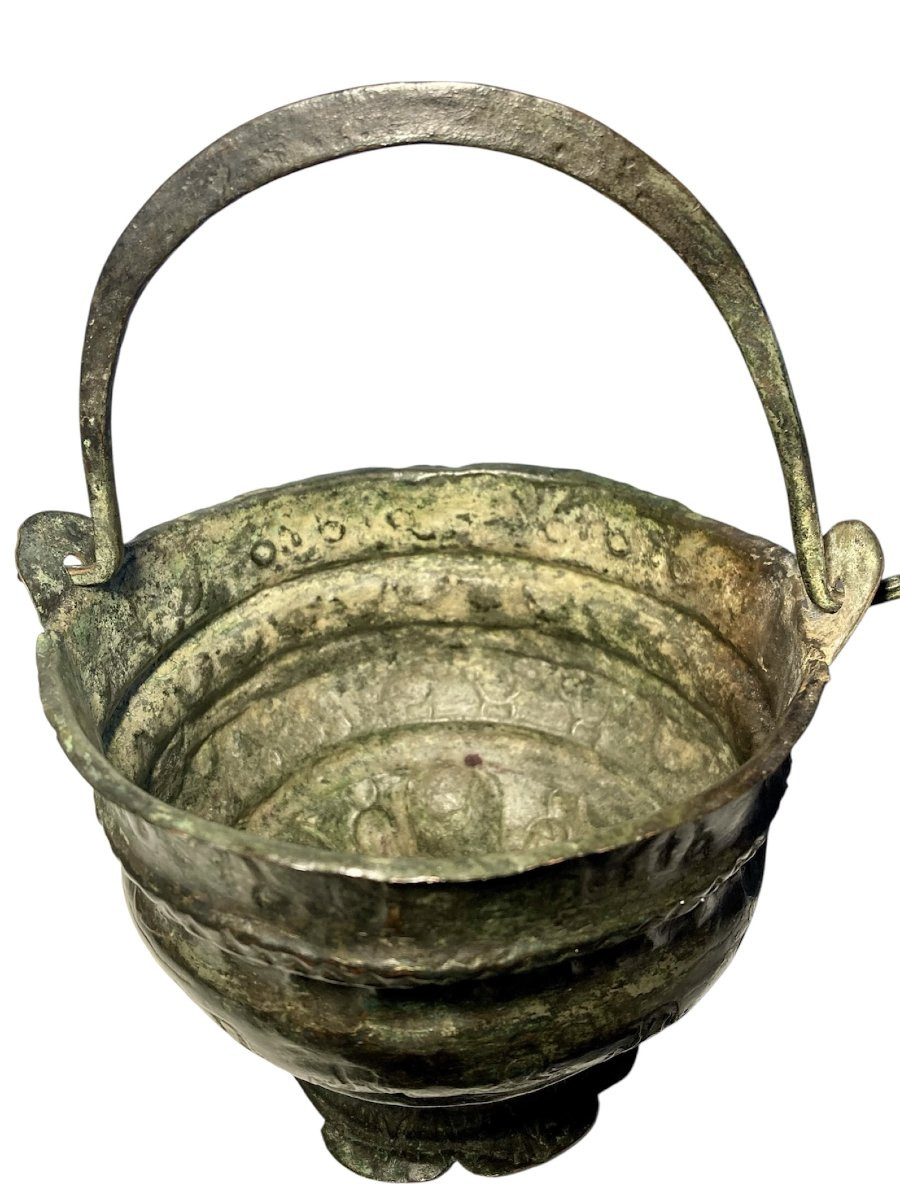
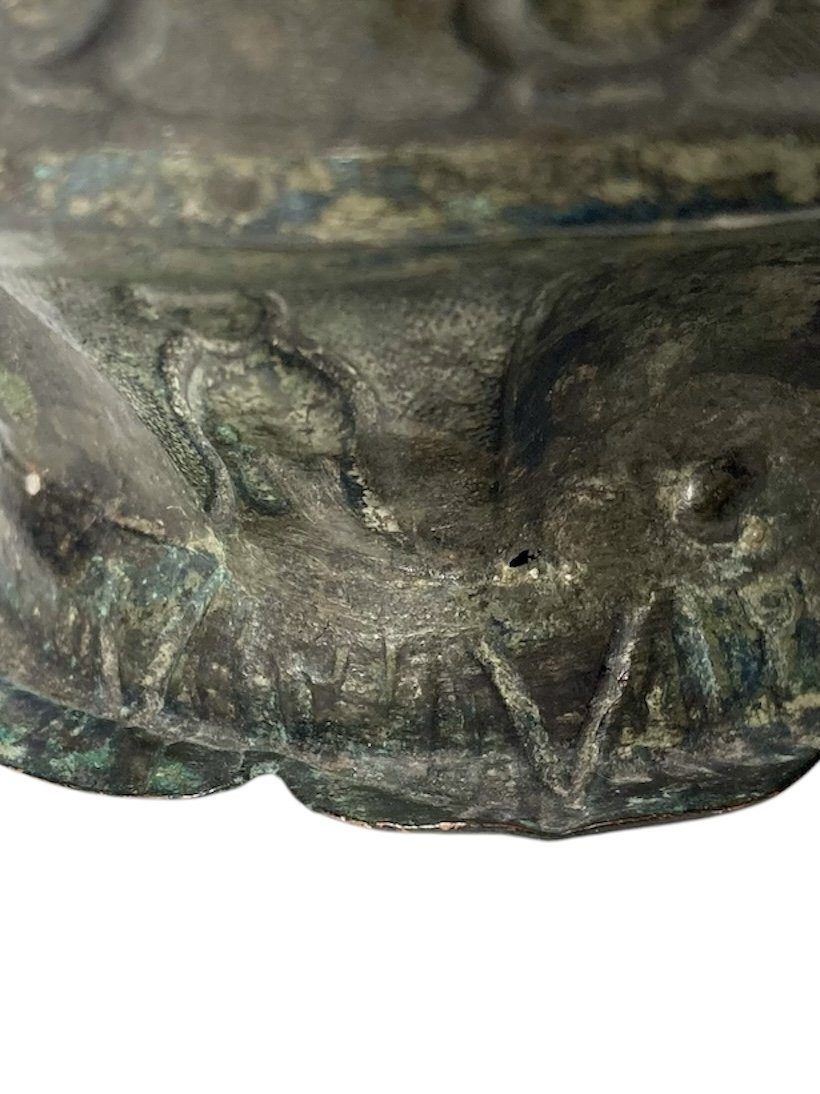
On a morphological and technical level, the single piece, yet intricately crafted and crafted in multiple registers, is a striking demonstration of the incredible skill of the master goldsmith entrusted with the object's creation. The handle support ears and the polylobed base are carved from the main sheet, significantly complicating the process of hand-shaping the bucket.
The embossing is entirely done freehand, hammered, both from the outside and inside of the sheet depending on the decoration, further highlighting the absolute and rare mastery of the craftsman.
Decoratively, we can identify five registers. Starting from the top:
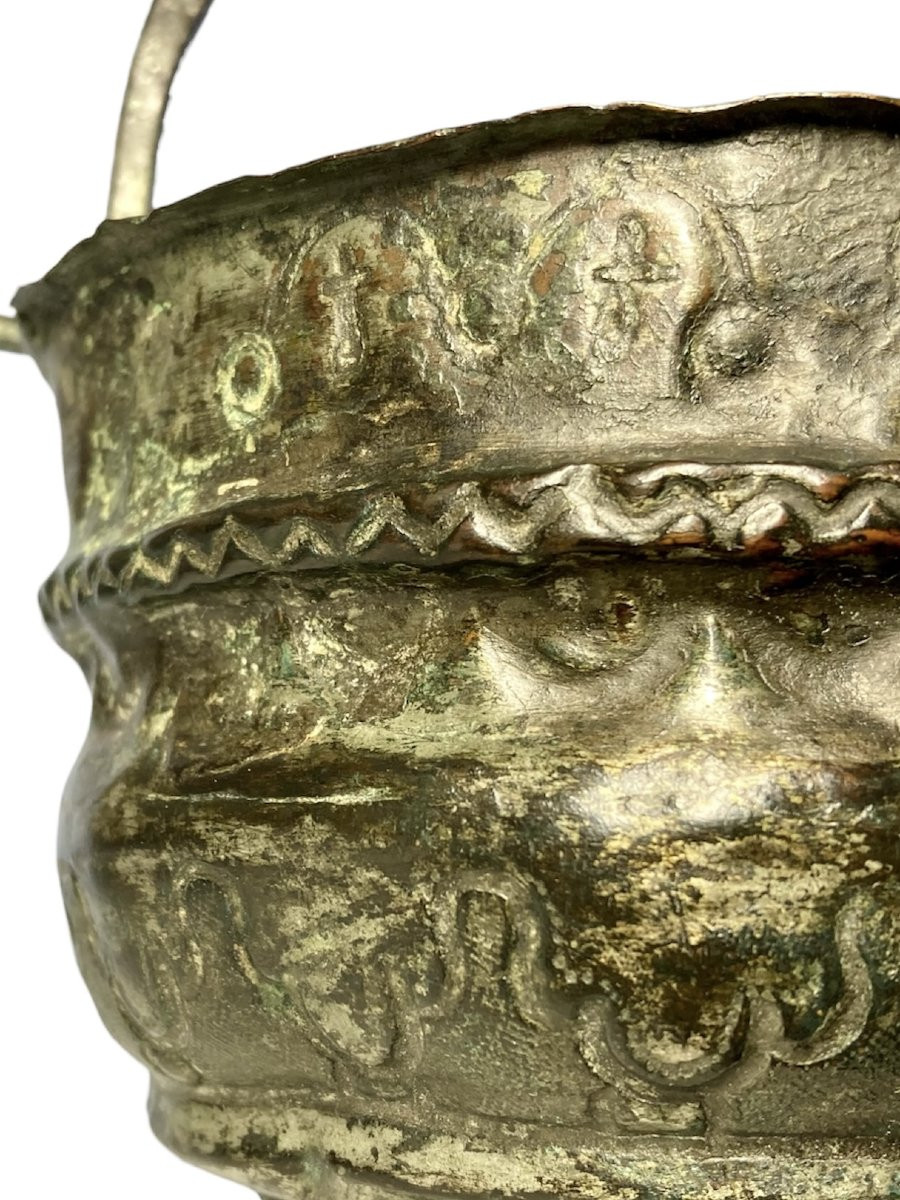
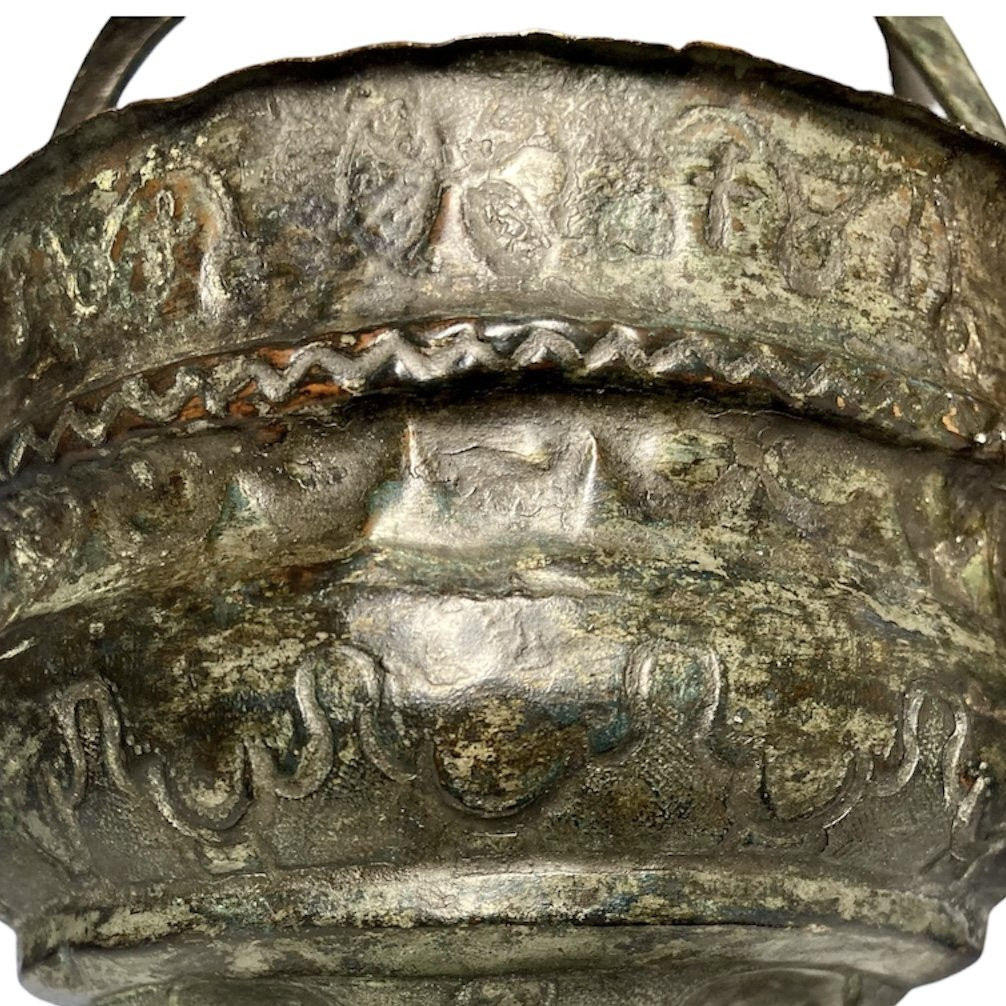
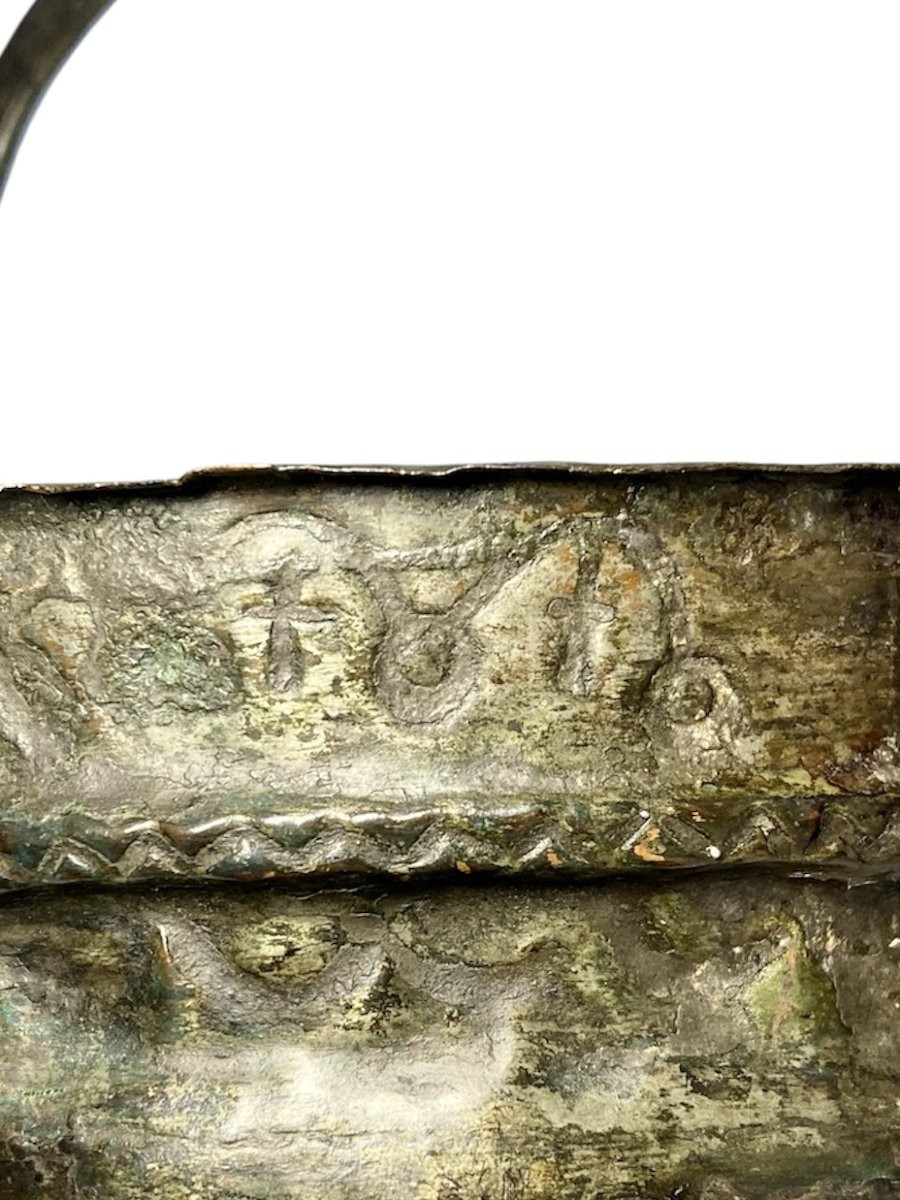
- The first register features three different symbols arranged (twice) around the circumference of the situla: a Greek cross pattée within a circle; a pair of blind round arches supported by round corbels, each containing an extremely simplified Latin cross; and three stylized leaves (the two outer ones facing upward, the central one facing downward).
The inscribed cross, although recurrent in various geographical locations, upon careful analysis finds exact correspondence in Sicilian-Norman iconography applied to sculpture, where we can see many examples with the same proportions, the same typology, and above all the same arched termination of the arms, whose outer perimeters merge with the circumference of the inscribing circle.
Moreover, it is a type of cross widely used in the Byzantine context, therefore easily adopted in Sicilian-Norman lands.
The blind round arches, although the Arab-derived pointed arch was introduced with the first Rogerian construction sites, always remain, especially in the decoration of the upper part of the walls (as architectural friezes).
The three leaves are a symbolism that can be traced back to Byzantine culture, where the stylization and sacralization of natural elements must always be interpreted in a theological key. These symbols have a strong apotropoeic value.
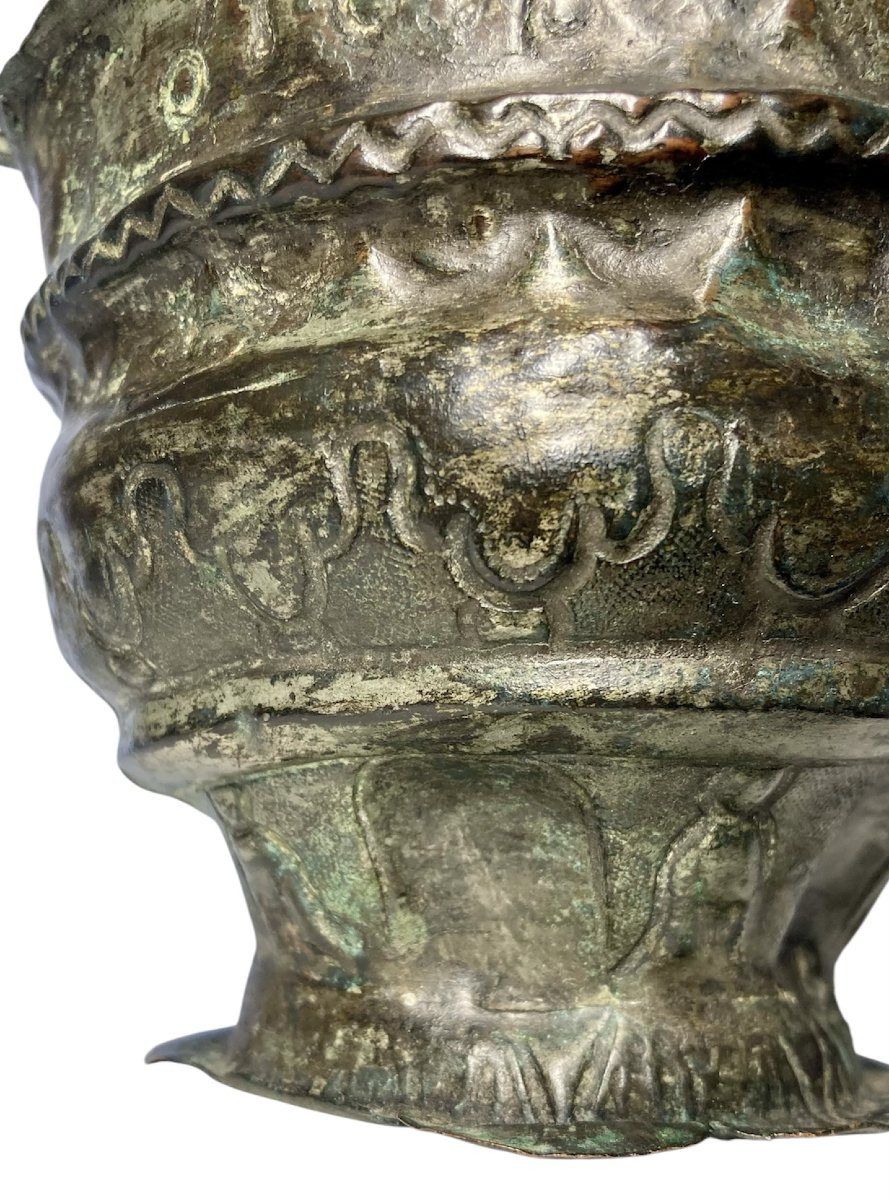
- Separated by a deeply embossed partition band and decorated with an embossed knurled motif, the second register features a wave motif, a prefiguration of the sacred content (holy water), stylized in the decoration of its container.
- The third register appears less clearly separated from the upper one, if only by the embossment that, at the edge, slightly protrudes outward. Thus, a repetitive palm motif, also typical of the figurative culture of the Sicilian-Norman area and of the construction sites of the period, follows uniformly along the circumference of the object. Here too, we can observe how a motif typical of sculpture, and more specifically, of architectural decoration, is inserted into the form and substance of this piece, albeit with extreme stylization.
Also note the enrichment of the decoration through dense and fine engraving.
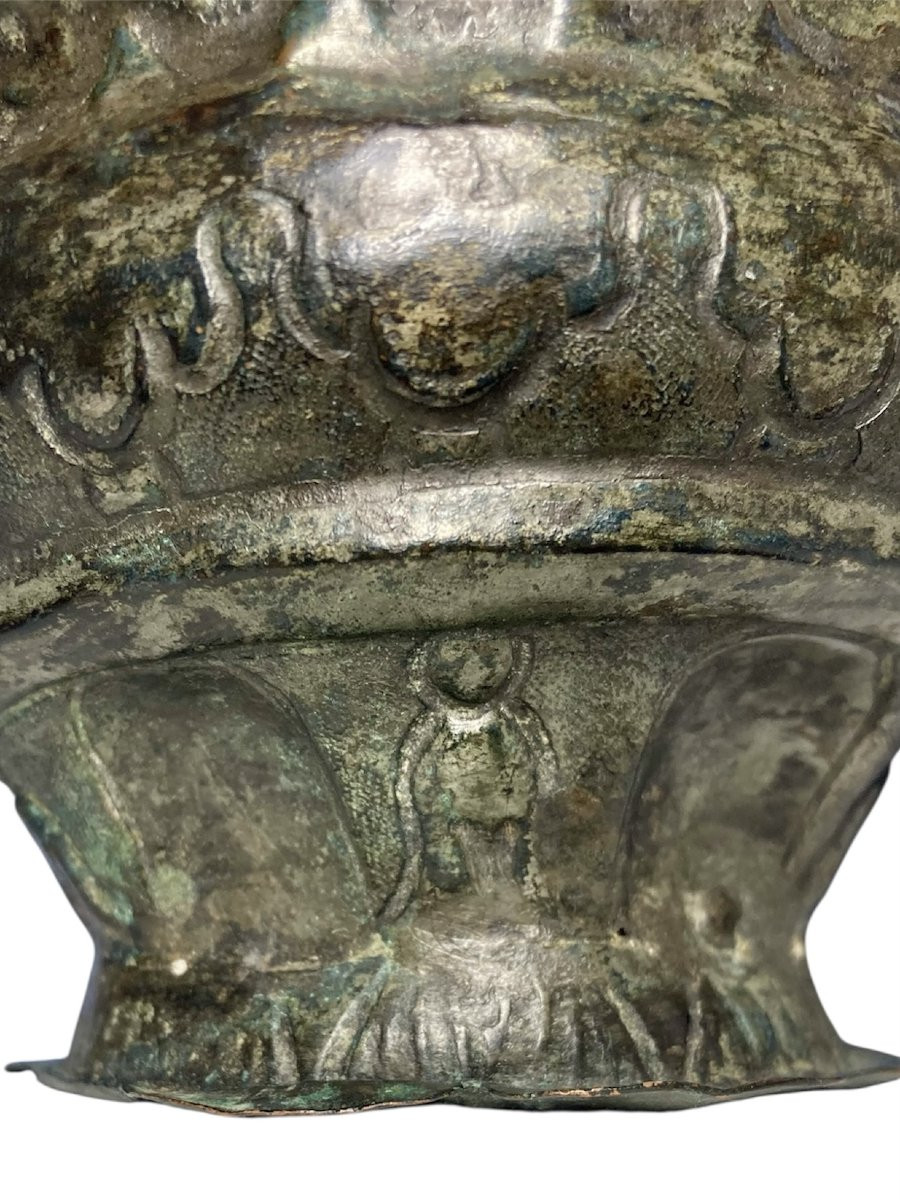
- The fourth register is introduced by an inward projection of the overhang, forming an angle that recesses the shape of the bucket. Here, round-arched niches, significantly projecting from the outside (and therefore concave), alternate with pointed-arch mullioned windows, surmounted by an oculus that partially covers the top of the arch (fig. 3).
This is the most distinctive element of the object, which unequivocally places it, both geographically and chronologically, in Sicily in the years immediately following 1130. Indeed, the Ruggerian construction sites imported the Byzantine tradition, combined with the Arab one, absorbing them into the Norman one, creating a unique example in every field of art history. Romanesque (blind round arches), Byzantine (strong symbolism, Christological allusions, and extreme technical expertise in goldsmithing), and Arab (pointed mullioned windows surmounted by an oculus) cultures coexist in this object, shaping it as a church, a mobile sanctuary intended to contain holy water.
In fact, the upper register symbolically and decoratively protects the contents, depicted in the immediately lower register, while the palm decoration simulates decoration, never merely aesthetic, but rather intended as a gift and a perennial honor, a source of visual gratification and spiritual uplift, present in churches and places of worship. Finally, the penultimate register represents the structure, the architecture (even typologically "new," we might say) on which the mobile church in question rests and in which the contents are housed: holy water, also an allegory of the Church and its titular Almighty.
- The final register, which then introduces the polylobed eight-petal base created by hammering the slab to form a flat horizontal surface, is composed of a succession of lanceolate leaves separated by a central rib. Consistently, the leaves of the final register lead to the petals of the base.
Everything is harmony, everything is symbol, allusion, allegory, devotion, and transcendence.
Dim. cm 13,5 x 11 x 15,5 h
The unique and complex workmanship of the single sheet harks back to the technical expertise of Byzantine master goldsmiths, who belonged to a culture that played a key role in the construction of Norman Sicily, importing materials and objects, as well as new techniques and ancient traditions (especially in sculpture and architecture).
On a morphological and technical level, the single piece, yet intricately crafted and crafted in multiple registers, is a striking demonstration of the incredible skill of the master goldsmith entrusted with the object's creation. The handle support ears and the polylobed base are carved from the main sheet, significantly complicating the process of hand-shaping the bucket.
The embossing is entirely done freehand, hammered, both from the outside and inside of the sheet depending on the decoration, further highlighting the absolute and rare mastery of the craftsman.
Decoratively, we can identify five registers. Starting from the top:
- The first register features three different symbols arranged (twice) around the circumference of the situla: a Greek cross pattée within a circle; a pair of blind round arches supported by round corbels, each containing an extremely simplified Latin cross; and three stylized leaves (the two outer ones facing upward, the central one facing downward).
The inscribed cross, although recurrent in various geographical locations, upon careful analysis finds exact correspondence in Sicilian-Norman iconography applied to sculpture, where we can see many examples with the same proportions, the same typology, and above all the same arched termination of the arms, whose outer perimeters merge with the circumference of the inscribing circle.
Moreover, it is a type of cross widely used in the Byzantine context, therefore easily adopted in Sicilian-Norman lands.
The blind round arches, although the Arab-derived pointed arch was introduced with the first Rogerian construction sites, always remain, especially in the decoration of the upper part of the walls (as architectural friezes).
The three leaves are a symbolism that can be traced back to Byzantine culture, where the stylization and sacralization of natural elements must always be interpreted in a theological key. These symbols have a strong apotropoeic value.
- Separated by a deeply embossed partition band and decorated with an embossed knurled motif, the second register features a wave motif, a prefiguration of the sacred content (holy water), stylized in the decoration of its container.
- The third register appears less clearly separated from the upper one, if only by the embossment that, at the edge, slightly protrudes outward. Thus, a repetitive palm motif, also typical of the figurative culture of the Sicilian-Norman area and of the construction sites of the period, follows uniformly along the circumference of the object. Here too, we can observe how a motif typical of sculpture, and more specifically, of architectural decoration, is inserted into the form and substance of this piece, albeit with extreme stylization.
Also note the enrichment of the decoration through dense and fine engraving.
- The fourth register is introduced by an inward projection of the overhang, forming an angle that recesses the shape of the bucket. Here, round-arched niches, significantly projecting from the outside (and therefore concave), alternate with pointed-arch mullioned windows, surmounted by an oculus that partially covers the top of the arch (fig. 3).
This is the most distinctive element of the object, which unequivocally places it, both geographically and chronologically, in Sicily in the years immediately following 1130. Indeed, the Ruggerian construction sites imported the Byzantine tradition, combined with the Arab one, absorbing them into the Norman one, creating a unique example in every field of art history. Romanesque (blind round arches), Byzantine (strong symbolism, Christological allusions, and extreme technical expertise in goldsmithing), and Arab (pointed mullioned windows surmounted by an oculus) cultures coexist in this object, shaping it as a church, a mobile sanctuary intended to contain holy water.
In fact, the upper register symbolically and decoratively protects the contents, depicted in the immediately lower register, while the palm decoration simulates decoration, never merely aesthetic, but rather intended as a gift and a perennial honor, a source of visual gratification and spiritual uplift, present in churches and places of worship. Finally, the penultimate register represents the structure, the architecture (even typologically "new," we might say) on which the mobile church in question rests and in which the contents are housed: holy water, also an allegory of the Church and its titular Almighty.
- The final register, which then introduces the polylobed eight-petal base created by hammering the slab to form a flat horizontal surface, is composed of a succession of lanceolate leaves separated by a central rib. Consistently, the leaves of the final register lead to the petals of the base.
Everything is harmony, everything is symbol, allusion, allegory, devotion, and transcendence.
Dim. cm 13,5 x 11 x 15,5 h
2 000 €
Period: Before 16th century
Style: Other Style
Condition: Good condition
Material: Copper
Width: 13.5
Height: 15.5
Depth: 11
Reference (ID): 1750986
Availability: In stock
Print