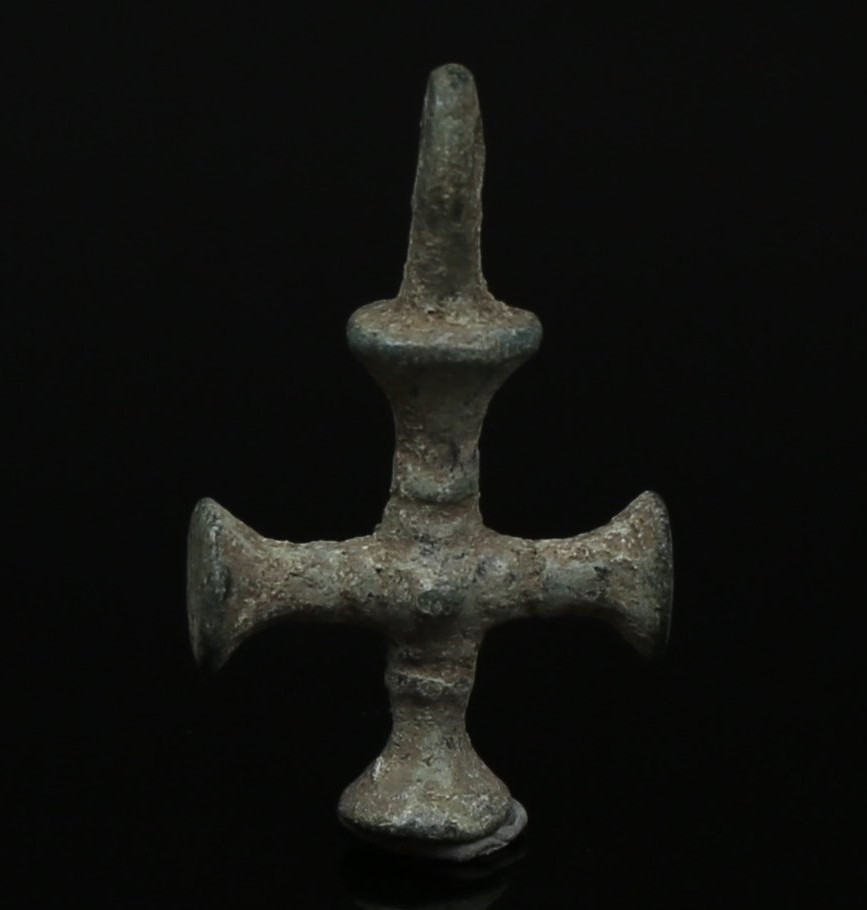
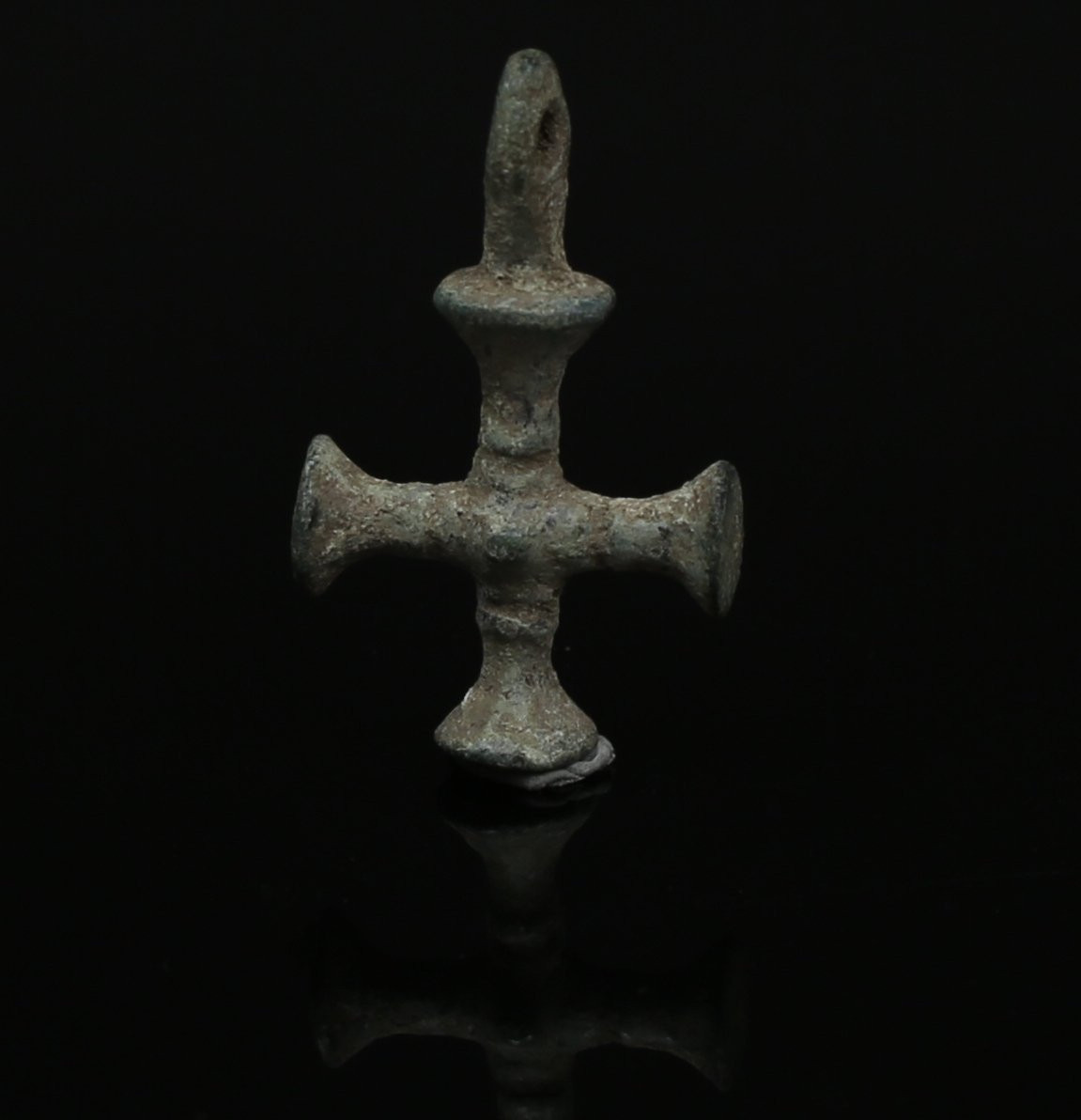
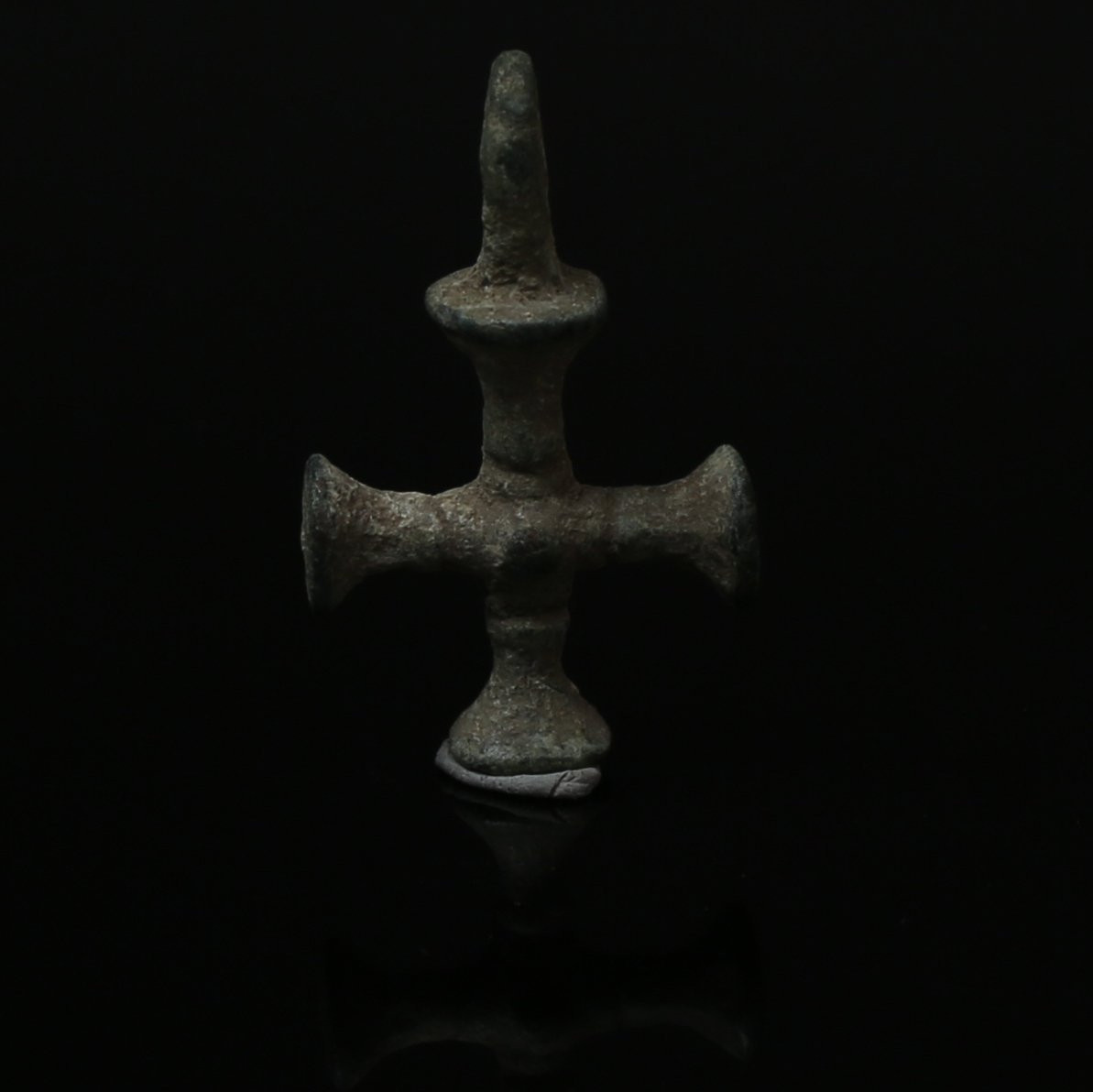


A refined Byzantine bronze pendant in the shape of a Latin cross, dated between the 7th and 10th century AD. Both ornamental and devotional, it reflects the deep interweaving of art and faith in the Byzantine world. With its balanced proportions and restrained elegance, it stands as a direct witness to the daily piety and spiritual identity of Eastern Christians. Worn around the neck, it served simultaneously as a protective symbol, a profession of faith, and a sacred talisman.
FeaturesObject: Cross pendant
Culture: Byzantine
Period: 7th–10th century AD
Material: Patinated bronze
Dimensions: 34 × 20 mm
Condition: Good condition; stable archaeological patina indicating ancient burial
Provenance: Former Dutch private collection, acquired before the 1990s
Authenticity: Certificate of authenticity provided
Sale: European specialized auction, conducted within a recognized numismatic network and under expert supervision
In the Byzantine Empire, the cross occupied a central place in religious, political, and artistic life. Cruciform pendants, produced widely in the workshops of Constantinople, Antioch, and Anatolia, were worn by clergy and laypeople alike.
These votive crosses embodied the presence of God in everyday life and symbolized the protection of the believer against evil. They might be blessed, contain relics, or simply represent adherence to the Orthodox faith.
Even in their most austere forms—such as this example—they carry profound spirituality: the cross becomes the meeting point of the earthly and the celestial, a visible sign of communion between humanity and the divine.
Shape: Cross with evenly balanced arms, softly rounded by ancient wear.
Surface: Natural brown-green patina, with small mineral incrustations.
Structure: Original suspension loop at the top, confirming its use as a pendant.
Technique: Cast in a mold, then finished by hand to refine the arms and edges.
Authenticity: Coherent ancient wear; untouched patina; no restoration or reworking.
The pendant aligns perfectly with early medieval Byzantine cross pendants preserved in major reference collections (British Museum, Dumbarton Oaks, Byzantine and Christian Museum of Athens).
Cultural and Spiritual ValueThis pendant is a direct relic of Byzantine devotion: a personal object charged with symbolism, situated between jewelry, emblem of faith, and archaeological artifact.
Its ancient patina, harmonious form, and documented provenance make it a desirable piece for collectors of early Christian, medieval, or Byzantine art.
It embodies the mystical sobriety of Byzantine culture, where material beauty served the sacred and affirmed the permanence of faith.













 Le Magazine de PROANTIC
 TRÉSORS Magazine
 Rivista Artiquariato