THIS OBJECT WAS SOLD
Mycenaean Terracotta Head — With Certificate Of Authenticity

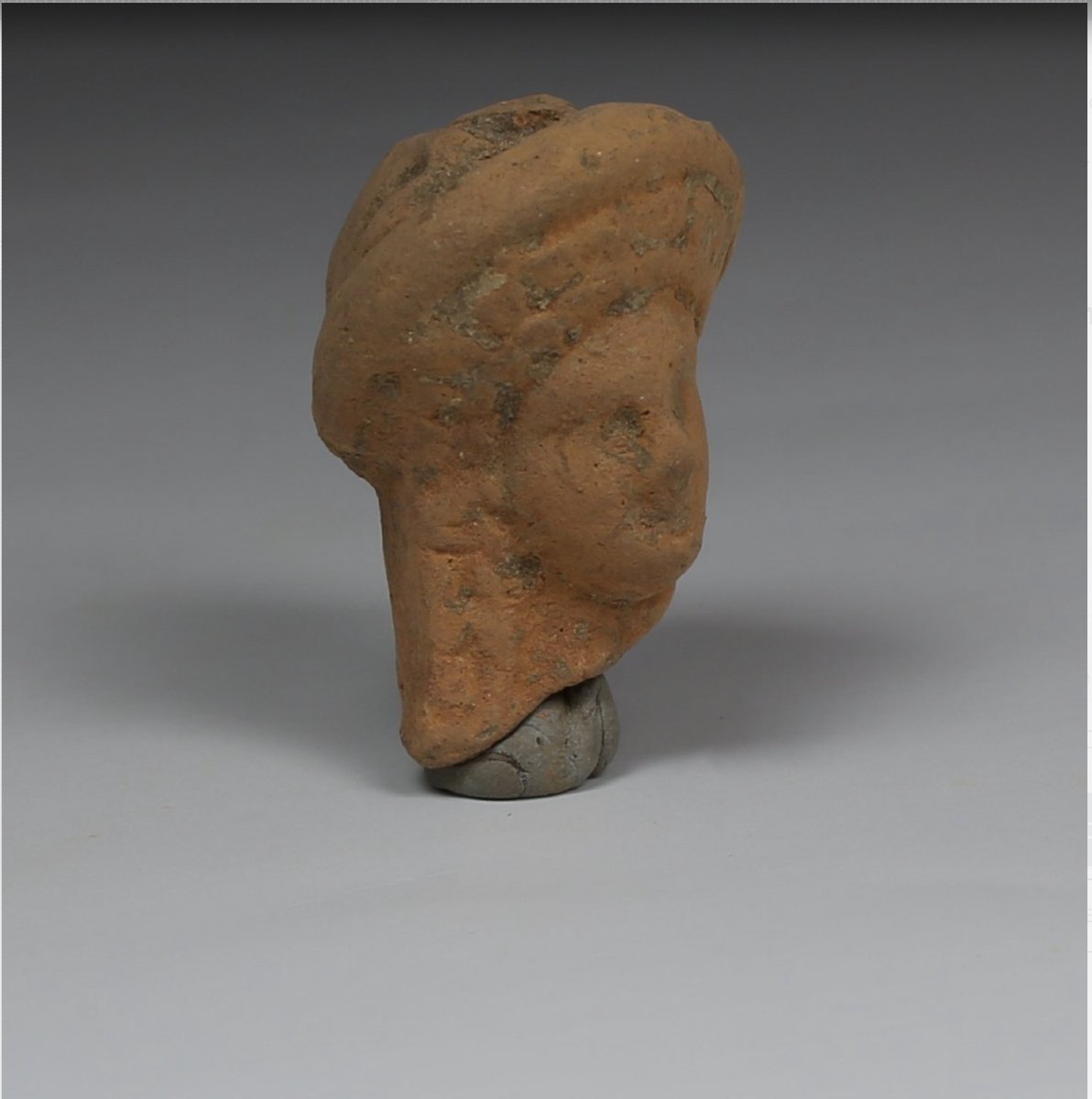




Originating from an old English private collection (1980–1995) and accompanied by its certificate of authenticity, this female terracotta head exemplifies the serene balance and refined modeling of Greek coroplastic art.
The face, oval and harmonious, displays a straight nasal ridge, rounded cheeks, and a cap-like coiffure structured by a front band. The surface bears a brown-ochre patina, enhanced by gray mineral veils, producing a soft, unified chromatic vibration that testifies to both age and artistic restraint.
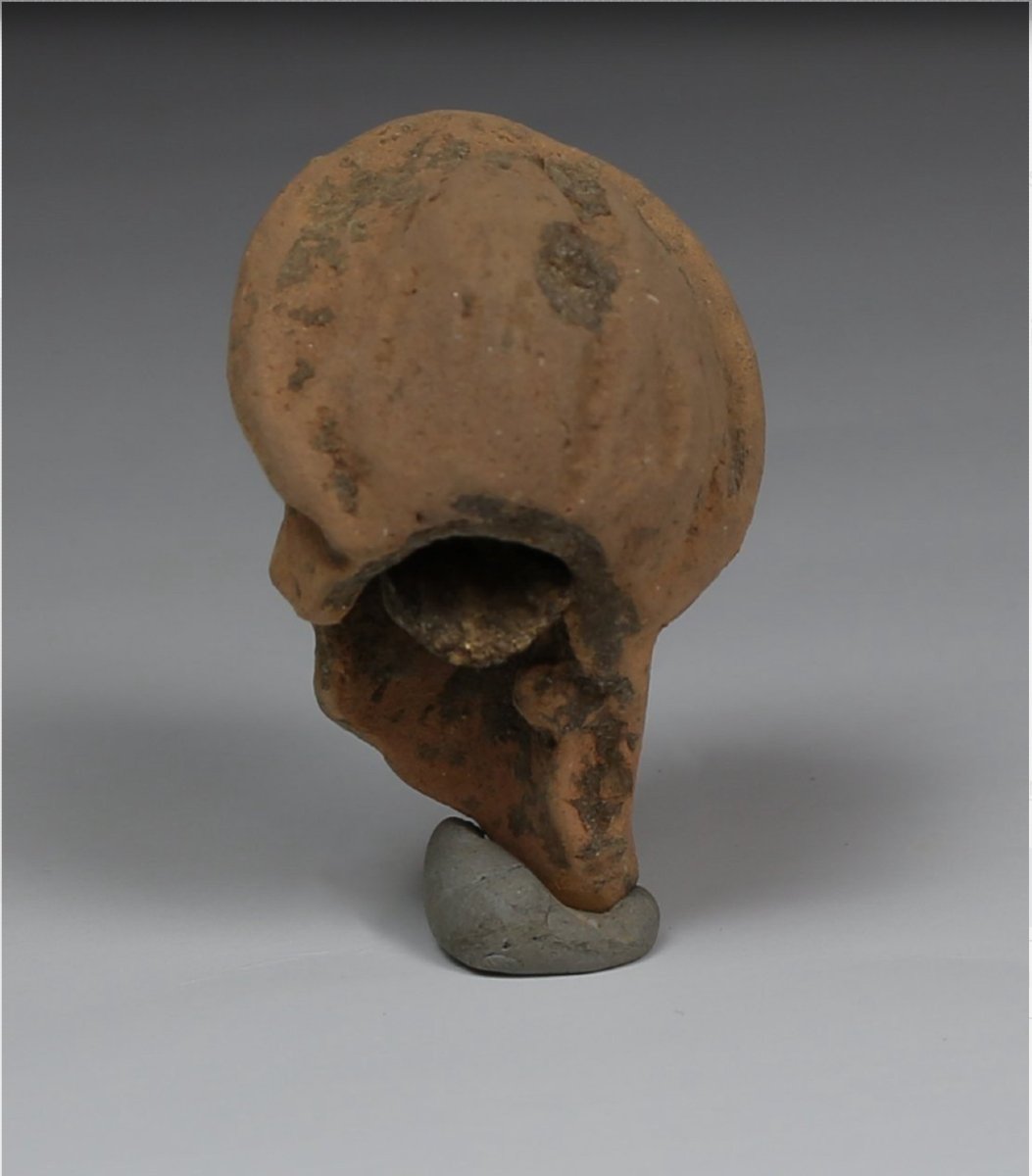
Seen in profile, the rolled hairstyle is carefully modeled, falling naturally toward the nape, while the gaze retains its hieratic dignity. The rear vent aperture, typical of careful workshop practice, attests to proper hollowing and firing control; faint tooling and smoothing marks preserve the gestures of the ancient artisan. The underside points of support confirm a stable pre-firing setup, characteristic of authentic coroplastic production.
Technical FeaturesObject: Female votive head (fragment of a figurine)
Culture: Greek, Hellenistic coroplastic art (Tanagra type)
Period: Late 4th – 3rd century B.C.
Material: Molded terracotta, brown-ochre patina with gray nuances
Dimensions: 40 × 28 mm
Condition: Excellent preservation; stabilized surface, readable volumes, authentic patina
Provenance: Former English private collection (1980–1995)
Authenticity: Certificate and expert documentation provided
Sale: European specialized adjudication, supervised by certified experts
This piece belongs to the repertoire of the “Tanagra” figurines, the epitome of Hellenistic refinement.
The veiled or capped female heads, molded in two-part matrices with rear vents for moisture release before firing, are distinctive of Boeotian and Attic workshops.
Its soft modeling, balanced oval face, architectural coiffure, and gentle volumetric transitions closely match canonical examples preserved in the British Museum, Metropolitan Museum of Art, Louvre, and Museum of Fine Arts, Boston.
Emerging in the last quarter of the 4th century B.C., Tanagra figures embody an aesthetic of idealized naturalism—graceful, intimate, and spiritual—diffused throughout the Greek world and celebrated in modern scholarship.
Formal and Material AnalysisVolumetry: Regularly modeled face, firm chin, visible brow arch, smooth transitions toward the neck.
Hairstyle: Cap-shaped headdress with frontal band and lateral rolls; typical of veiled or sakkos-bound figures.
Patina and deposits: Brown-ochre with subtle gray mineral veils; natural micro-concretions consistent with burial.
Workshop technique: Hollowed rear cavity with vent hole; smoothing traces visible; fine grain clay with ferruginous inclusions.
Firing: Controlled oxidizing atmosphere; dense, compact texture; chromatic stability and mineral cohesion.
British Museum: Head of a female terracotta figure wearing a sakkos, Tanagra type, mold-made, vent at back.
Metropolitan Museum of Art: Terracotta head of a veiled woman (Tanagra Figurines essay).
Museum of Fine Arts, Boston: Head of Tanagra-style female figure (veil drawn over the head, delicate modeling).
Louvre Museum: Tanagra figurines collection (noting mold-made technique and dorsal vent).
In the Aegean world, female terracotta effigies held a central role in votive, domestic, and funerary rituals.
Rather than individualized portraits, they embodied protective presences—mediators between humanity and the divine.
The Hellenistic period elevated this concept into an aesthetic of transfigured daily life, fusing realism with spiritual grace.
This fragment, by its purity and restraint, exemplifies the religious humanism of the Greek spirit, where the sculpted visage became a vessel of serenity and devotion.
Through the clarity of its modeling, the authentic patina, and the fidelity of its technique (molding, venting, manual refinement), this head perfectly embodies the Tanagra ideal: equilibrium, modesty, and silent beauty.
It is a documented, museum-quality piece, emblematic of Greek coroplastic art — suitable for both academic study and discerning private collections.
Note: The stands, frames, and display elements visible in the photographs are intended solely for presentation purposes and are not included in the sale.
Explore similar pieces and discover your ideal find:
archeology