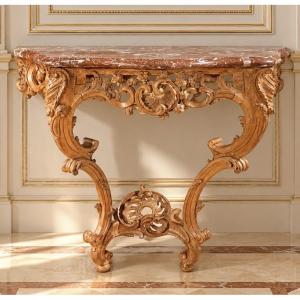
Louis XV Carved Oak Wall Console With An Elaborate Rococo Shell – 18th Century
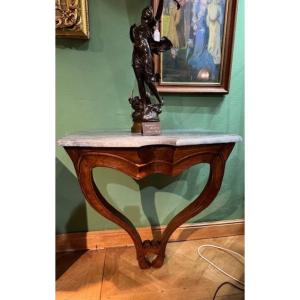
An interesting Louis XV period wall-mounted console, entirely crafted from solid carved oak and retaining a substantial section of its original architectural paneling. Originally part of an 18th-century interior woodwork scheme, this piece is distinguished by its vigorous carving and exceptionally expressive Rococo ornamentation.
The console features a molded, semicircular wooden shelf supported by an imposing, deeply carved fantastical shell. Remarkably asymmetrical in composition, this exuberant Rococo ornament displays powerful scrolling forms, sinuous ridges, and deeply undercut surfaces, suggesting a scallop shell freely transformed by the sculptor's imagination.
This decoration perfectly illustrates the fascination with aquatic and marine forms that characterized French Rococo art during the 18th century. Seashells, rocks, and natural marine formations became sources of inspiration for ornamental designers, who distorted and combined them into imaginative, sometimes almost fantastical compositions. This artistic freedom, particularly developed from the 1730s onward, can be seen in the ornamental designs of Juste-Aurèle Meissonnier, Jacques de Lajoüe, and François Boucher.
In this example, the shell is no longer merely a decorative motif: it becomes the structural body of the console itself, directly supporting the molded shelf.
The lower section retains its original solid oak paneling, composed of vertically molded panels enriched with carved leafy scrolls and decorative motifs incised directly into the wood. The composition combines the dramatic depth of the upper shell with the more restrained architectural ornamentation below, characteristic of the work of 18th-century French architectural woodcarvers and joiners.
A close examination of the construction suggests that this panel originally belonged to a much larger architectural installation. The abrupt termination of the side moldings at the top, together with evidence of old cuts visible on the reverse, indicates that the paneling most likely continued both above and below the surviving section.
This arrangement raises an intriguing possibility regarding its original function: the console may once have supported the basin of a wall-mounted fountain incorporated into the paneling of an 18th-century interior.
The shelf would have held a basin designed to collect water from a reservoir mounted higher on the original woodwork, now lost. Such installations were found in affluent French residences, particularly in dining rooms, where fountains served both a practical domestic purpose and an architectural decorative function.
Although this interpretation remains hypothetical, it is consistent with the construction and arrangement of the surviving panel, as well as its prominent marine-inspired ornamentation.
The powerful carving, freely interpreted shell motif, and architectural character of the paneling also suggest a possible regional origin in France's Rhône Valley, perhaps Lyon or the Dauphiné region around Grenoble. Eighteenth-century decorative woodwork from these areas frequently displayed vigorous carving and elaborate Rococo compositions, although a precise geographical attribution cannot presently be established.
Entirely made of solid oak, this architectural element has been carefully cleaned, waxed, and hand-polished in our workshop. Its beautifully polished surface enhances the depth of the carving, the natural variations of the oak, and its well-preserved antique patina.
Retaining an important portion of its original architectural woodwork, this piece now serves as a decorative wall console while offering a fascinating glimpse into the craftsmanship and ornamental imagination of mid-18th-century French interiors.
Louis XV period, circa 1740–1760.
French regional craftsmanship, possibly Lyon or the Dauphiné region.
Dimensions:
Overall height: 83 cm (32.7 in)
Overall width: 58.5 cm (23 in)
Shelf width: 48 cm (18.9 in)
Overall depth: 19.5 cm (7.7 in)
950 €
Period: 18th century
Style: Louis 15th - Transition
Condition: Good condition
Material: Oak
Reference (ID): 1851808
Availability: In stock
Print