Neapolitan School, Circle Of Leonardo Coccorante (naples, C. 1680 – 1750)
Neapolitan school, circle of Leonardo Coccorante (Naples, c. 1680 – 1750)
“Architectural Capriccio with a Harbor and Figures”
Technique: Oil on canvas with relining
Canvas: 151x95 cm
Frame: 167x111 cm, contemporary
Condition: Very good, consistent with the period
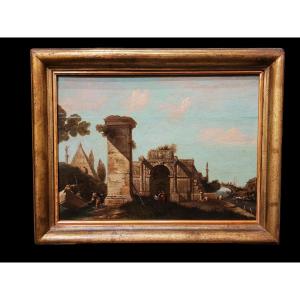
This elegant painting depicts an evocative idealized harbor, bustling with merchants, sailors, and commoners, set within a spectacular architectural backdrop that blends classical, medieval, and fantastical elements in the style of 18th-century capriccio.
The composition unfolds through a carefully balanced perspective: on either side, monumental architectural structures frame the opening toward the sea, while in the foreground, archaeological fragments, urns, columns, and building materials draw the viewer into an imaginary space rich in classical allusions. At the center of the scene, a small boat docks near a mighty fortified city, dominated by towers, bell towers, and bastions that evoke the eastern Mediterranean, while in the background a mountainous silhouette ideally recalls the Gulf of Naples.
The scene is enlivened by a refined staffage composed of merchants and commoners, among whom a figure in Levantine attire stands out, directing the unloading of goods. Of particular interest is the presence, on the crate carried by the porter, of a merchant’s mark consisting of two “V” letters separated by a small cross. This type of mark, attested in Mediterranean commercial tradition between the 17th and 18th centuries, was used as an identifying symbol for merchants or shipping companies and constitutes an iconographic detail of considerable interest, testifying to the artist’s attention to aspects of port life and maritime trade.
The artist’s decision to reproduce this mark with precision, rather than resorting to a generic conventional symbol, demonstrates a particular attention to the realities of port and commercial life. It cannot be ruled out that this element constitutes a reference to the work’s patron or to his mercantile activities, in accordance with a well-documented practice in 18th-century painting commissioned for private use, in which symbols, insignia, and proprietary marks were sometimes discreetly incorporated into the composition.
In terms of compositional approach, architectural repertoire, atmospheric quality, and the typology of the figures, the painting appears to belong to the Neapolitan circle of Leonardo Coccorante, one of the foremost masters of 18th-century fantastic landscape painting. In particular, the rendering of light and the lively characterization of the figurative elements show affinities with that figurative tradition which, building on Coccorante’s legacy, found further development among artists working in Naples during the second quarter of the 18th century.
4 900 €
Period: 18th century
Style: Louis 15th - Transition
Condition: Good condition
Material: Oil painting
Reference (ID): 1848940
Availability: In stock
Print