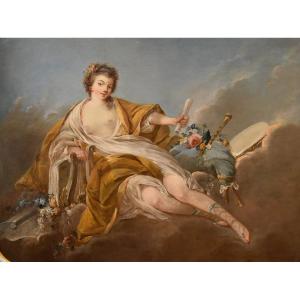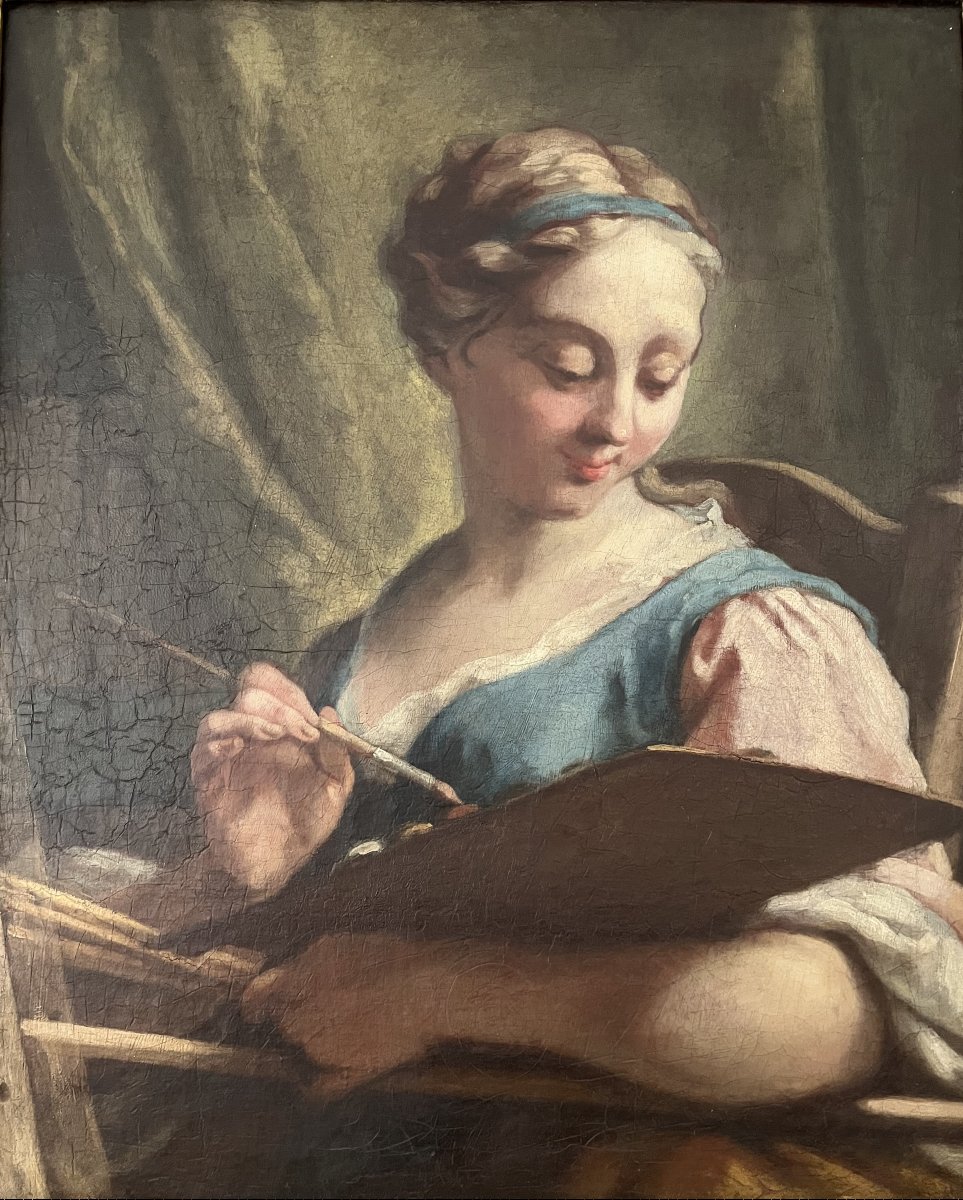


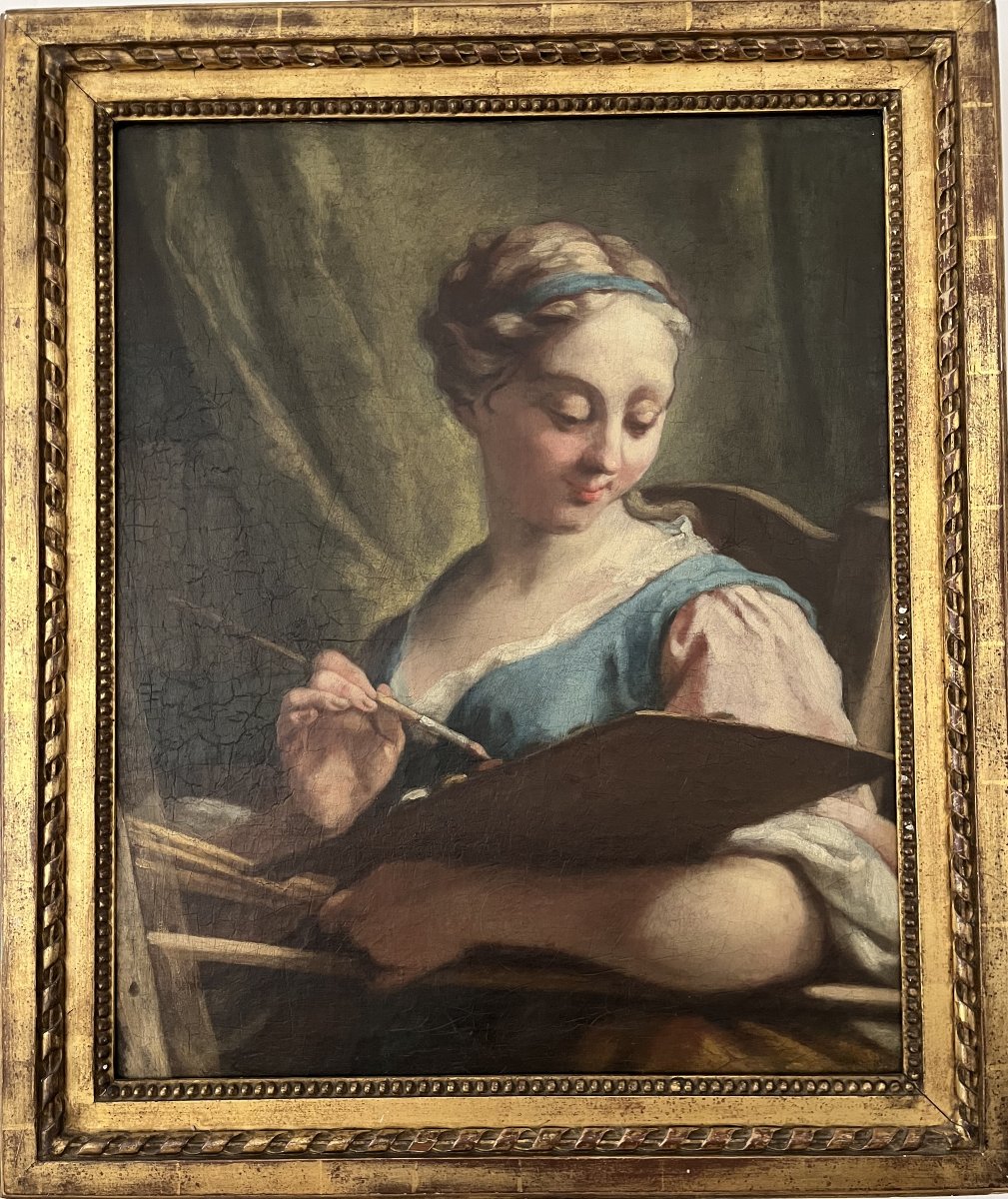


Studio Of Jean II Restout (rouen 1692–1768 Paris), Allegory Of Painting
Artist: Jean Ii Restout (rouen 1692-1768 Paris)
c. 1747
Oil on canvas
H. 59; W. 48 cm
Gilded wood and stucco frame
This delicate allegory depicts Painting in the form of a young woman. Bathed in a soft golden light, the model wears a blue headband that echoes the color of her bodice. Seated in front of an easel and leaning over her palette, she holds a paintbrush in one hand, which she is dipping into her paint. The figure stands out against a dark background, dominated by a heavy green curtain and a bookcase.
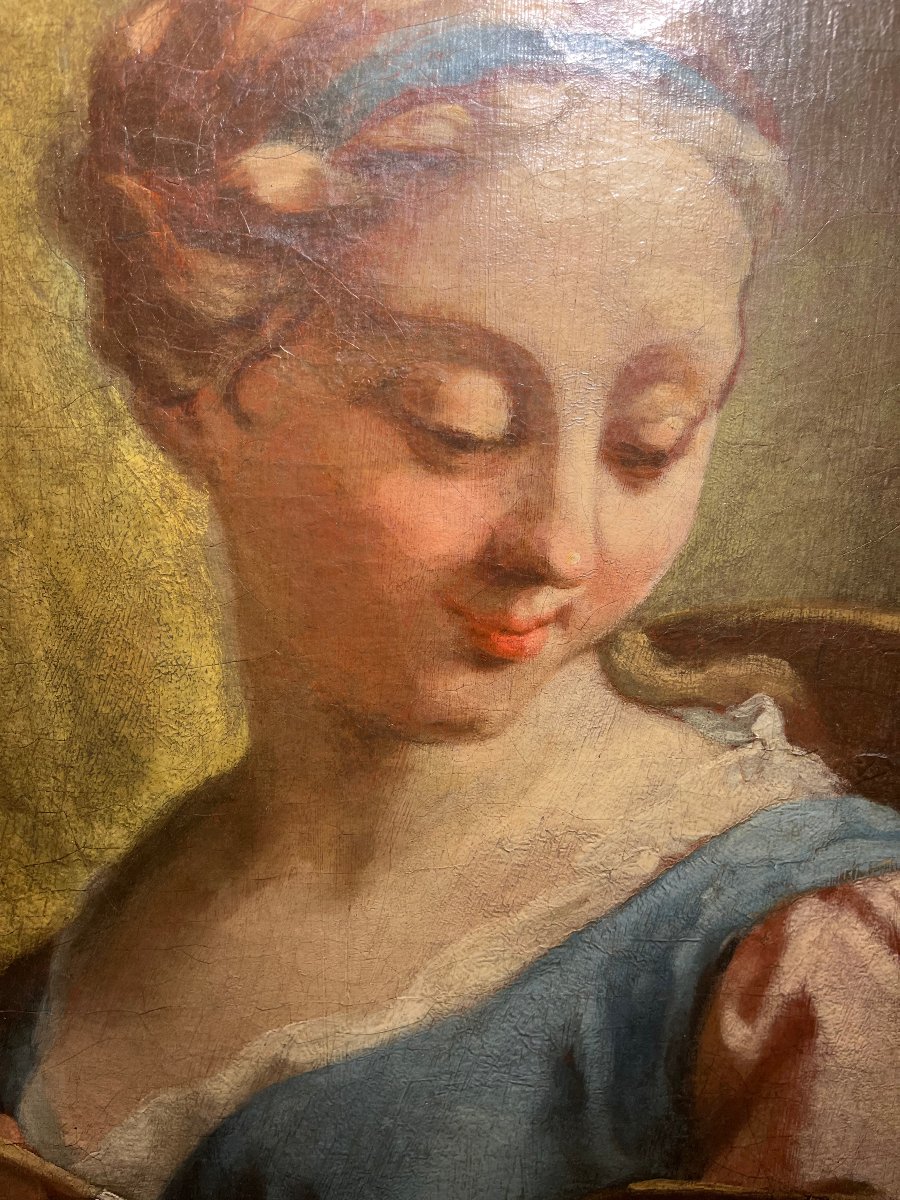
Her enigmatic smile, her half-closed eyes, and the grace of her posture evoke the art of Correggio and Leonardo da Vinci, two of Jean Restout’s (1692–1768) favorite models. This type of face appears in many of his compositions, notably in *The Birth of the Virgin* at the Church of Saint-Honoré-d’Eylau in Paris, painted in 1744. This allegory charmingly illustrates the 18th-century taste for personifications of the arts.
This painting can be compared to a composition on the same subject, housed at the Antoine Lécuyer Museum in Saint-Quentin, from which it borrows the essential elements: the young woman’s pose, her gestures, and the color palette. It differs from that work in several ways, notably in the background, but most notably in the placement of the easel: while it is located behind the model in the Saint-Quentin painting, here it is in front of her, on the left. A repainting, visible where the canvas was moved back, shows that this change resulted from a decision made during the painting process, rather than from a simple mechanical copy.
This hesitation may reflect a process of experimentation leading up to the final composition. It may also suggest that the work was created in a studio, either under the master’s supervision or on the initiative of a student who took some artistic liberties. Jean II Restout’s Parisian studio, nicknamed the “école des pointus,” indeed welcomed many talented young artists, including Charles-Nicolas Cochin, Noël Hallé, and his own son, Jean-Bernard Restout.
The painting at the Musée Lécuyer, exhibited at the 1747 Salon, must have been a great success: Restout produced several copies of it, with or without variations. Our version, in which his distinctive style is evident—from the shape of the face to his characteristic touches of white—is among the most brilliant.
Biography of Jean II Restout
A descendant of a prestigious dynasty of artists, Jean II Restout was the son of Jean I Restout (1666–1702) and the nephew of Eustache (1655–1743) and Jacques Restout (c. 1650–c. 1701), all renowned painters. His mother, Marie Jouvenet, was herself a painter and the sister of Jean Jouvenet (1644–1717), with whom he served his apprenticeship. He married Marie-Anne Hallé, daughter of Claude-Guy Hallé and sister of Noël Hallé, who would later become his student.
His career at the Royal Academy was brilliant: it began in 1717 with his admission, thanks to his series on Venus and Aeneas, and culminated in his appointment as director in 1760.
Best known for his large-scale religious subjects, Restout also excelled at decorative art, mythological compositions, and more intimate subjects, such as portraits. His art drew inspiration from both Classicism and Rococo.
5 000 €
Period: 18th century
Style: Louis 15th - Transition
Condition: Excellent condition
Material: Oil painting
Width: 49 cm
Height: 59,5 cm
Reference (ID): 1846396
Availability: In stock
Print