
Neoclassical School, Pluto And Cerberus
Artist: école Néoclassique
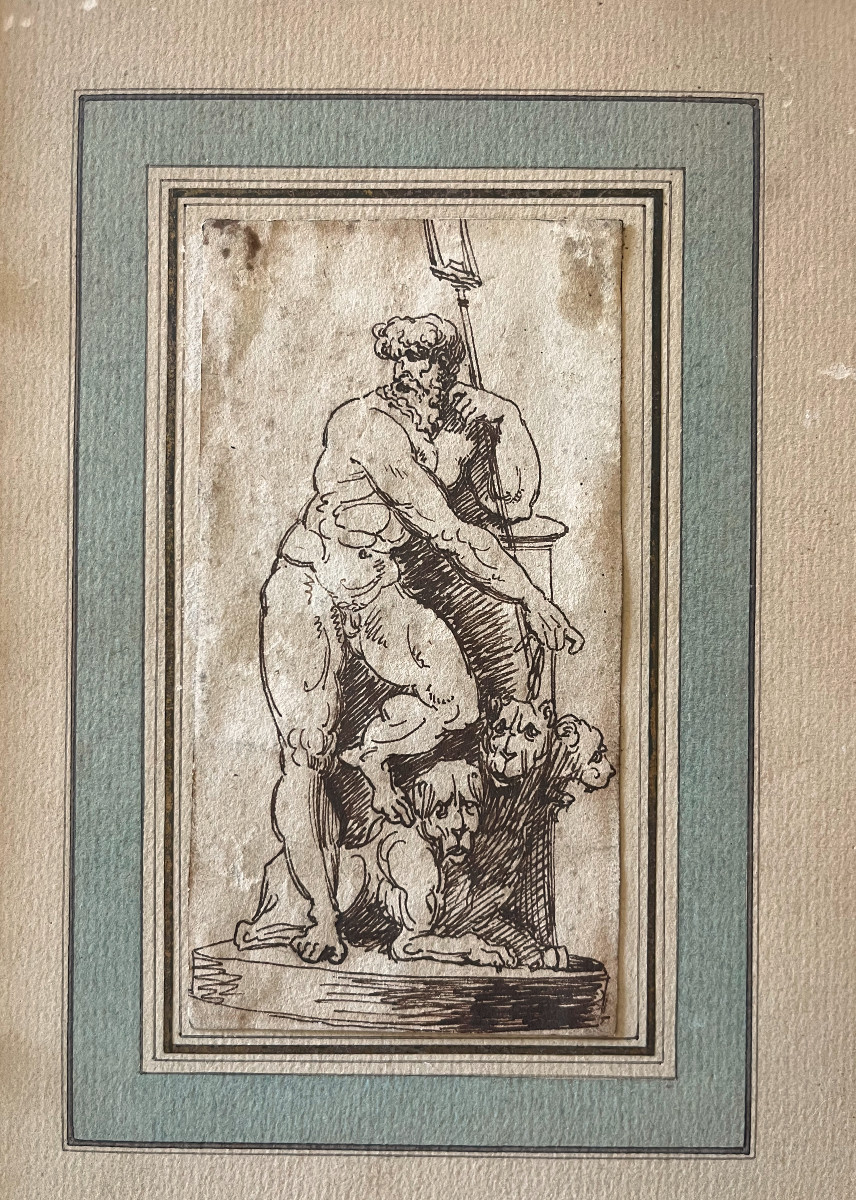
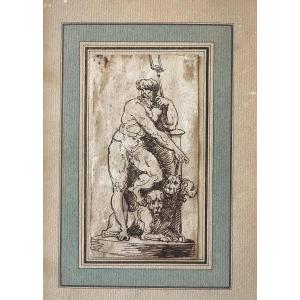
This Neoclassical drawing depicts the god Pluto holding Cerberus in chains.
The pen stroke is precise, emphasizing the characters' features and the god's musculature, as well as the shadow cast on the column supporting him.
Pluto is depicted here holding one of his attributes, the bident, in one hand, while the other holds Cerberus firmly in chains.
The elongated format of the drawing, as well as the pedestal on which the group stands, indicate that this is most likely a study or survey of a sculpture. The subject was, in fact, quite popular with artists of the 17th and 18th centuries, as evidenced by sculptures by Michel Anguier and Augustin Pajou, depicting Pluto and Cerberus.
PLUTON AND CERBERE IN GREEK AND ROMAN MYTHOLOGY
Pluto, or Hades to the Greeks, is part of the first generation of Olympian gods. Rescued by his brother, Jupiter or Zeus, from the bowels of his father Saturn, who had swallowed all his progeny so as not to be dethroned, he is entrusted with reigning over the Underworld. With his companion, Proserpine, he presides over the Kingdom of the Dead, whose entrance is guarded by Cerberus, a monstrous three-headed dog.
The animal, born of the union of Typhon and Echidna, has as siblings other terrifying creatures, such as the Hydra of Lerna, the Lion of Nemea, or the Chimera. Stationed at the end of the River Styx, from where the dead arrive under Charon's guidance, Cerberus prevents no one from entering the underworld, but forbids anyone from leaving it. Twice, however, he fails in his mission: by allowing Orpheus to coax his beloved Eurydice out with his songs, and when he is defeated and briefly captured by Hercules, during one of the hero's twelve labors.
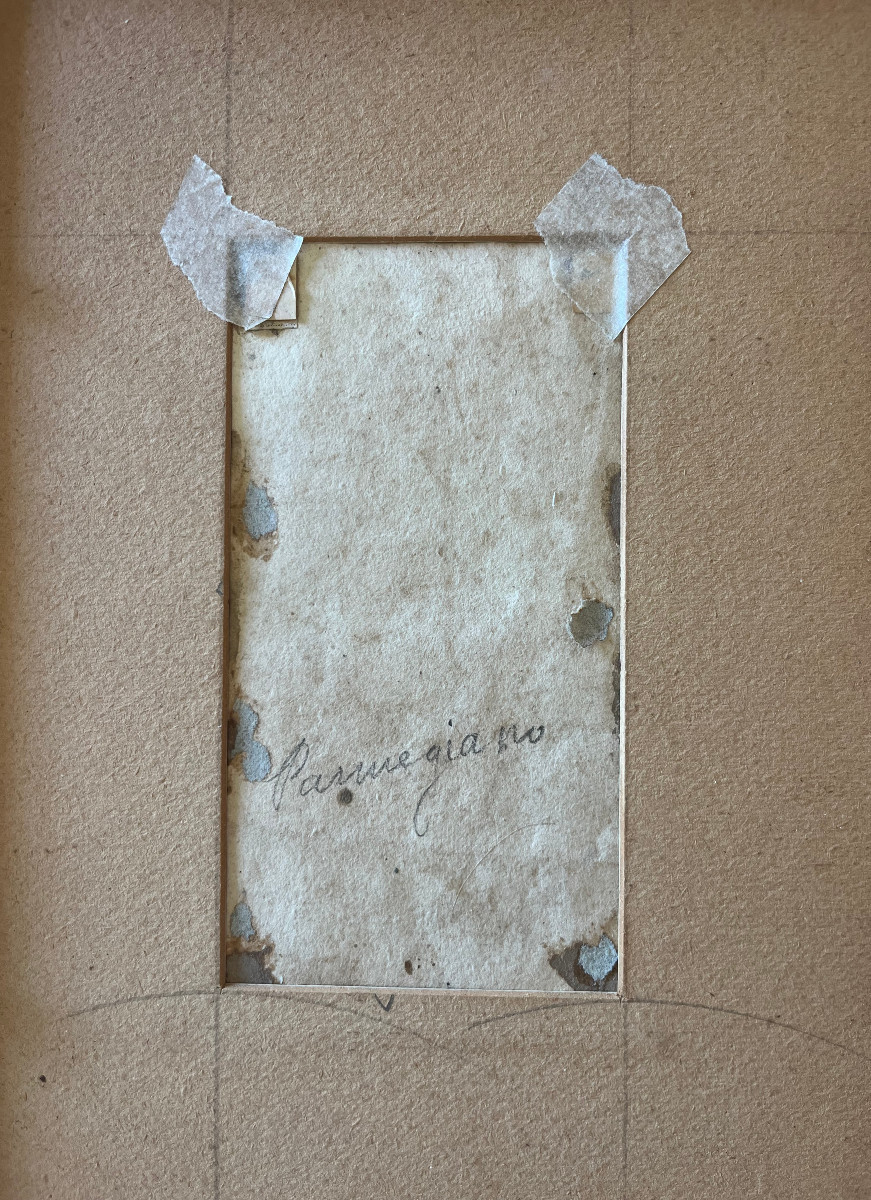
Drawing in good condition. Stains in the upper part. Mounted under passe-partout. Inscribed in pencil "Parmegiano" on the back. Sold with a black wooden frame.
The pen stroke is precise, emphasizing the characters' features and the god's musculature, as well as the shadow cast on the column supporting him.
Pluto is depicted here holding one of his attributes, the bident, in one hand, while the other holds Cerberus firmly in chains.
The elongated format of the drawing, as well as the pedestal on which the group stands, indicate that this is most likely a study or survey of a sculpture. The subject was, in fact, quite popular with artists of the 17th and 18th centuries, as evidenced by sculptures by Michel Anguier and Augustin Pajou, depicting Pluto and Cerberus.
PLUTON AND CERBERE IN GREEK AND ROMAN MYTHOLOGY
Pluto, or Hades to the Greeks, is part of the first generation of Olympian gods. Rescued by his brother, Jupiter or Zeus, from the bowels of his father Saturn, who had swallowed all his progeny so as not to be dethroned, he is entrusted with reigning over the Underworld. With his companion, Proserpine, he presides over the Kingdom of the Dead, whose entrance is guarded by Cerberus, a monstrous three-headed dog.
The animal, born of the union of Typhon and Echidna, has as siblings other terrifying creatures, such as the Hydra of Lerna, the Lion of Nemea, or the Chimera. Stationed at the end of the River Styx, from where the dead arrive under Charon's guidance, Cerberus prevents no one from entering the underworld, but forbids anyone from leaving it. Twice, however, he fails in his mission: by allowing Orpheus to coax his beloved Eurydice out with his songs, and when he is defeated and briefly captured by Hercules, during one of the hero's twelve labors.
Drawing in good condition. Stains in the upper part. Mounted under passe-partout. Inscribed in pencil "Parmegiano" on the back. Sold with a black wooden frame.
580 €
Period: 18th century
Style: Louis 16th, Directory
Condition: Good condition
Material: Paper
Width: 8 cm
Height: 13,8 cm
Reference (ID): 1767125
Availability: In stock
Print