

Antonio Bellucci (pieve Di Soligo, Treviso 1654-1726) Attributed To, Sleeping Venus
Artist: Antonio Bellucci (pieve Di Soligo, Trévise 1654-1726) Attribué à
Oil on canvas
H. 36 cm, W. 44 cm.
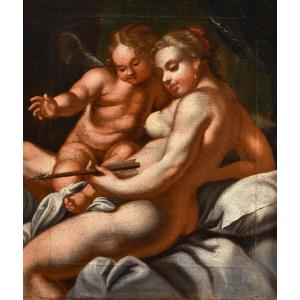
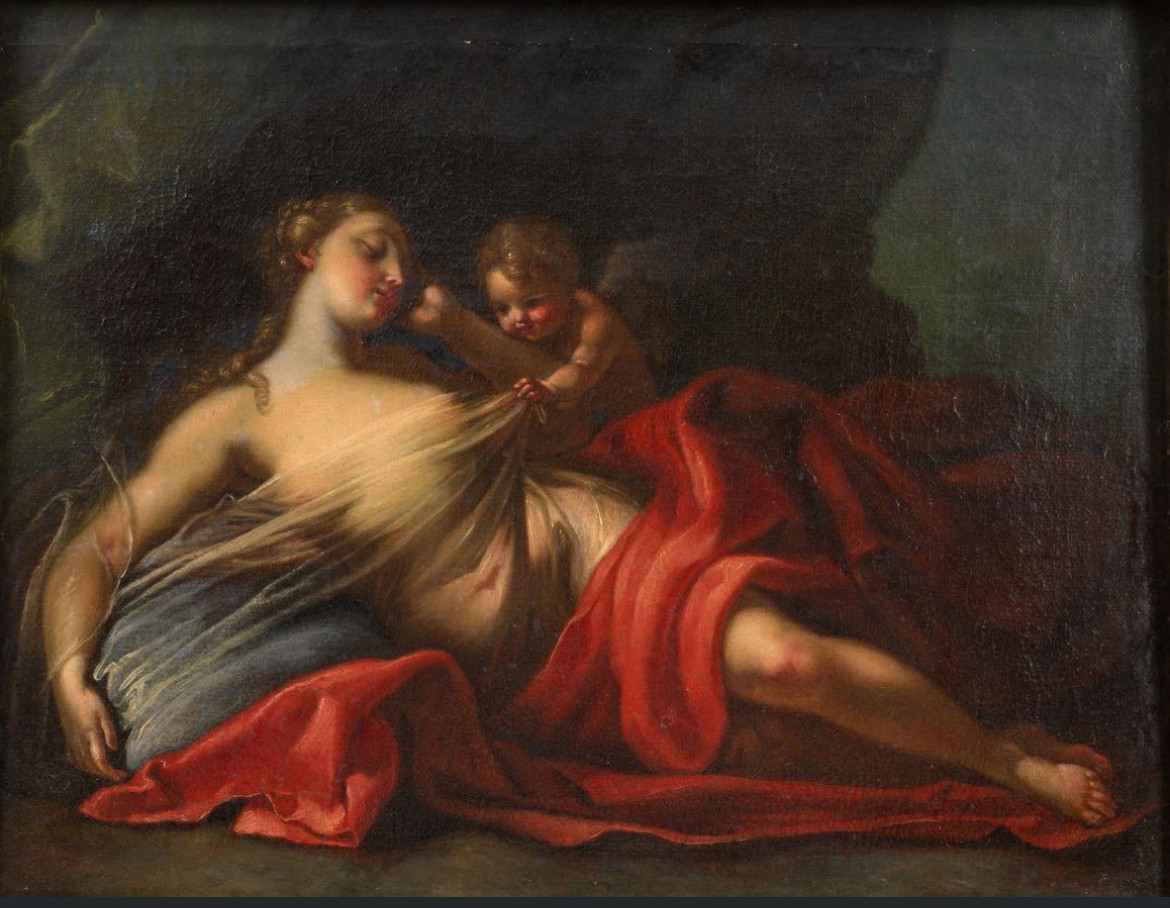
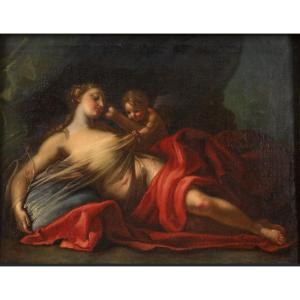
This delicate and intimate painting depicts Venus, or Aphrodite, asleep. Beside her, Cupid mischievously approaches to discover her.
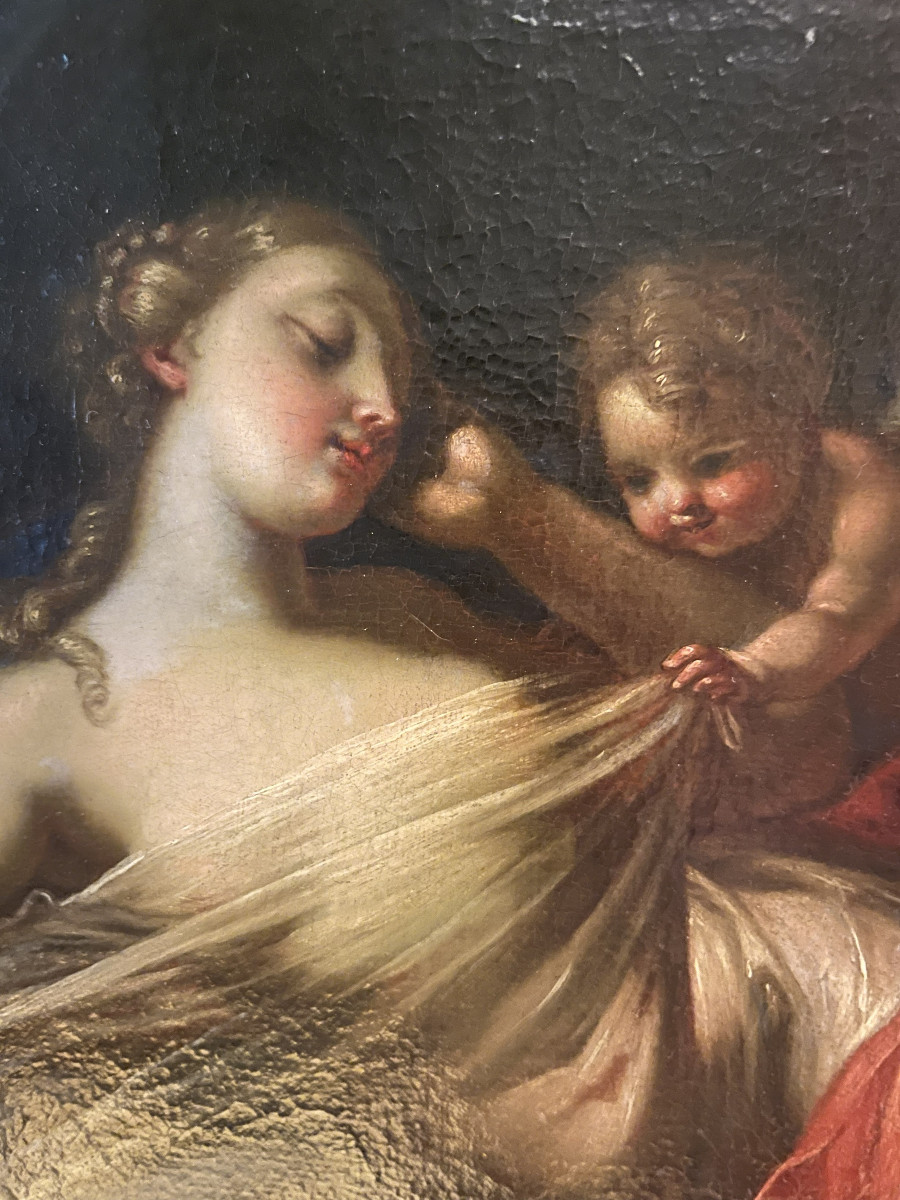
The goddess of love rests in an alcove, on a comfortable makeshift bed. She is draped in a red fabric that billows around her. A thin veil wraps around her body, concealing her intimacy. Her eyes closed, she rests on one hand, her face serene and relaxed, lost in deep sleep. Cupid prepares to push back the veil to reveal Venus's form to the viewer.
The blue drapery surrounding them opens onto a nocturnal landscape, while the scene is illuminated by a light coming from the left. The contrast between Venus's soft, luminous complexion and the darker background is striking. The artist demonstrates here his masterful use of chiaroscuro.
The abundance of drapery, like the one against which the scene is set, is a recurring feature in Bellucci's work. It is reminiscent of Joseph and Potiphar's Wife in the Castelvecchio Museum in Verona. Venus's languid pose, meanwhile, evokes the Danaë in the Budapest Museum of Fine Arts, or The Love jealous of Fidelity in the Bordeaux Museum of Fine Arts.
The work, which exudes both calm and sensuality, was probably intended for a private collector.
About Antonio Bellucci:
A major figure in Venetian painting of the turn of the century, Antonio Bellucci is considered one of the greatest painters of the Italian Baroque. During his career, he acquired considerable renown and worked for the greatest patrons in Europe, from Italy to Germany and England. Bellucci's art was shaped by the combined influences of his masters, Pietro Libri and Antonio Zanchi.
He managed to unite the delicate decorative forms of the Baroque with the tenebrism of previous centuries, from which he gradually distanced himself. Moreover, his style is considered a perfect synthesis of all the currents of 17th-century Venetian painting.
Bellucci created sumptuous decorations for the most prestigious clients, from the Habsburg court in Vienna to that of the Prince of Liechtenstein, as well as for the residences of European nobility.
He himself had a great influence on his contemporaries, his students, and subsequent generations of painters, such as Antonio Ballestra and Sebastiano Ricci. Through his travels and successes abroad, he established himself as a precursor for Venetian decorative painters, such as the Ricci and Tiepolo families, who would follow in his footsteps in the great European courts.
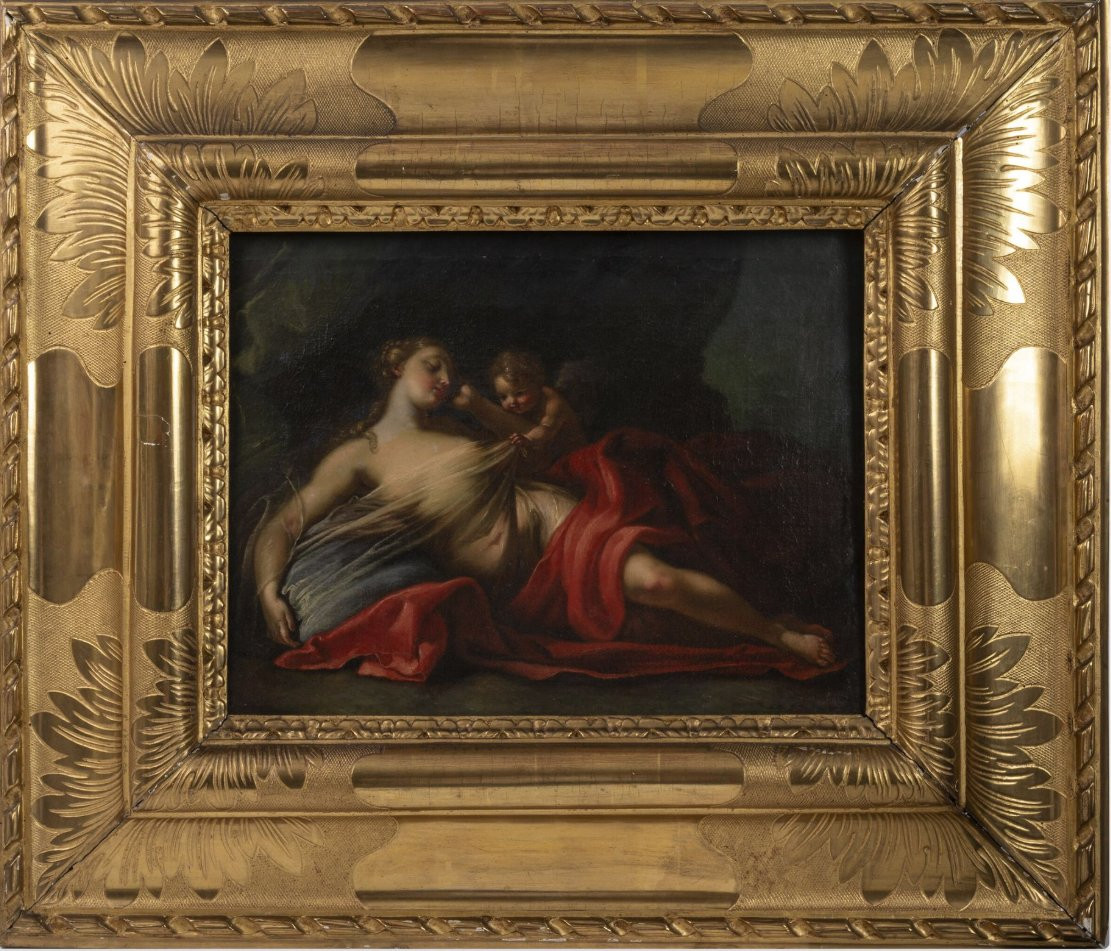
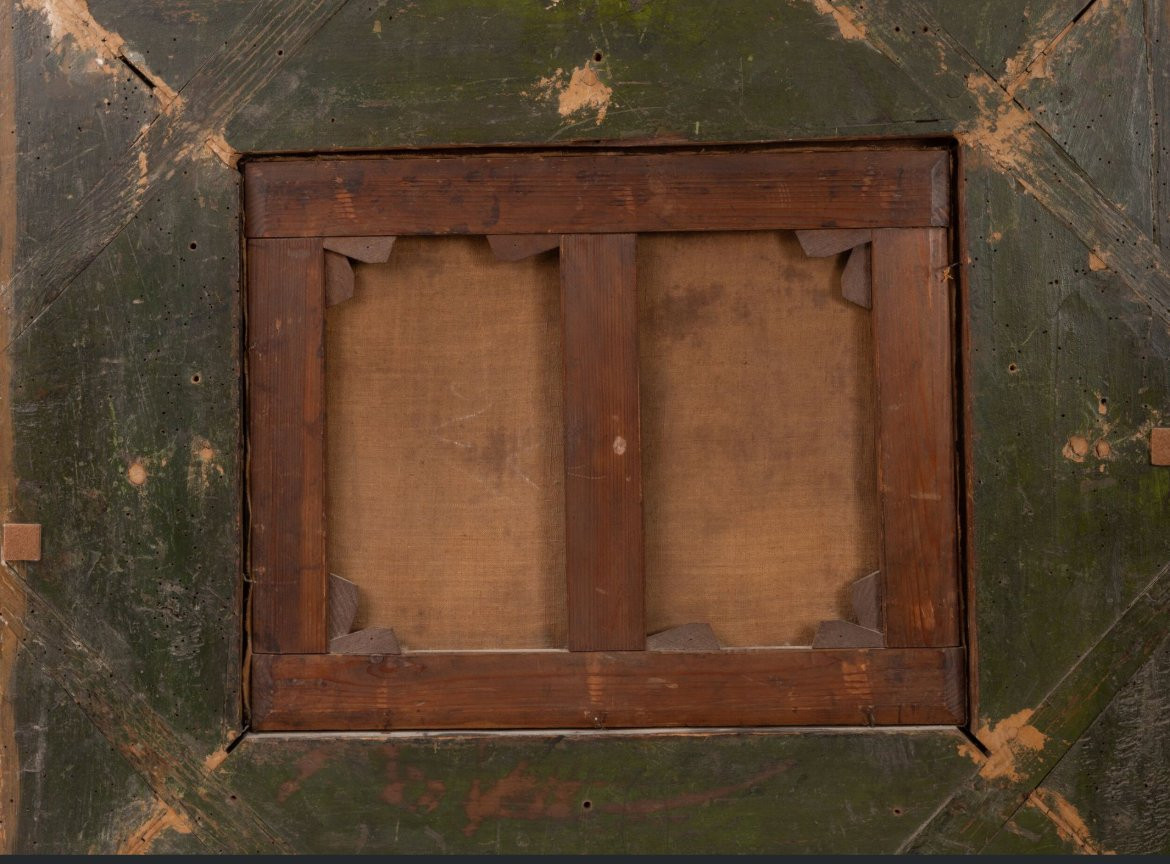
Condition report: Good overall condition, slight mark from the stretcher on the upper part. Relined and restored. Sold in its giltwood frame.
H. 36 cm, W. 44 cm.
This delicate and intimate painting depicts Venus, or Aphrodite, asleep. Beside her, Cupid mischievously approaches to discover her.
The goddess of love rests in an alcove, on a comfortable makeshift bed. She is draped in a red fabric that billows around her. A thin veil wraps around her body, concealing her intimacy. Her eyes closed, she rests on one hand, her face serene and relaxed, lost in deep sleep. Cupid prepares to push back the veil to reveal Venus's form to the viewer.
The blue drapery surrounding them opens onto a nocturnal landscape, while the scene is illuminated by a light coming from the left. The contrast between Venus's soft, luminous complexion and the darker background is striking. The artist demonstrates here his masterful use of chiaroscuro.
The abundance of drapery, like the one against which the scene is set, is a recurring feature in Bellucci's work. It is reminiscent of Joseph and Potiphar's Wife in the Castelvecchio Museum in Verona. Venus's languid pose, meanwhile, evokes the Danaë in the Budapest Museum of Fine Arts, or The Love jealous of Fidelity in the Bordeaux Museum of Fine Arts.
The work, which exudes both calm and sensuality, was probably intended for a private collector.
About Antonio Bellucci:
A major figure in Venetian painting of the turn of the century, Antonio Bellucci is considered one of the greatest painters of the Italian Baroque. During his career, he acquired considerable renown and worked for the greatest patrons in Europe, from Italy to Germany and England. Bellucci's art was shaped by the combined influences of his masters, Pietro Libri and Antonio Zanchi.
He managed to unite the delicate decorative forms of the Baroque with the tenebrism of previous centuries, from which he gradually distanced himself. Moreover, his style is considered a perfect synthesis of all the currents of 17th-century Venetian painting.
Bellucci created sumptuous decorations for the most prestigious clients, from the Habsburg court in Vienna to that of the Prince of Liechtenstein, as well as for the residences of European nobility.
He himself had a great influence on his contemporaries, his students, and subsequent generations of painters, such as Antonio Ballestra and Sebastiano Ricci. Through his travels and successes abroad, he established himself as a precursor for Venetian decorative painters, such as the Ricci and Tiepolo families, who would follow in his footsteps in the great European courts.
Condition report: Good overall condition, slight mark from the stretcher on the upper part. Relined and restored. Sold in its giltwood frame.
4 900 €
Period: 17th century
Style: Louis 14th, Regency
Condition: Good condition
Material: Oil painting
Width: 44 cm
Height: 36 cm
Reference (ID): 1704498
Availability: In stock
Print