


“the Bon Vivant” Bernardo Keilhau, Known As Monsù Bernardo (attributed) (elsinore 1624 – Rome 1687)
“The Bon Vivant”
Bernardo Keilhau, known as Monsù Bernardo (attributed) (Elsinore 1624 – Rome 1687)
Critical Analysis: Prof. Emilio Negro
Technique: Oil on canvas with a lintel frame
Canvas: 93x70 cm
Frame: 109 x 87 cm
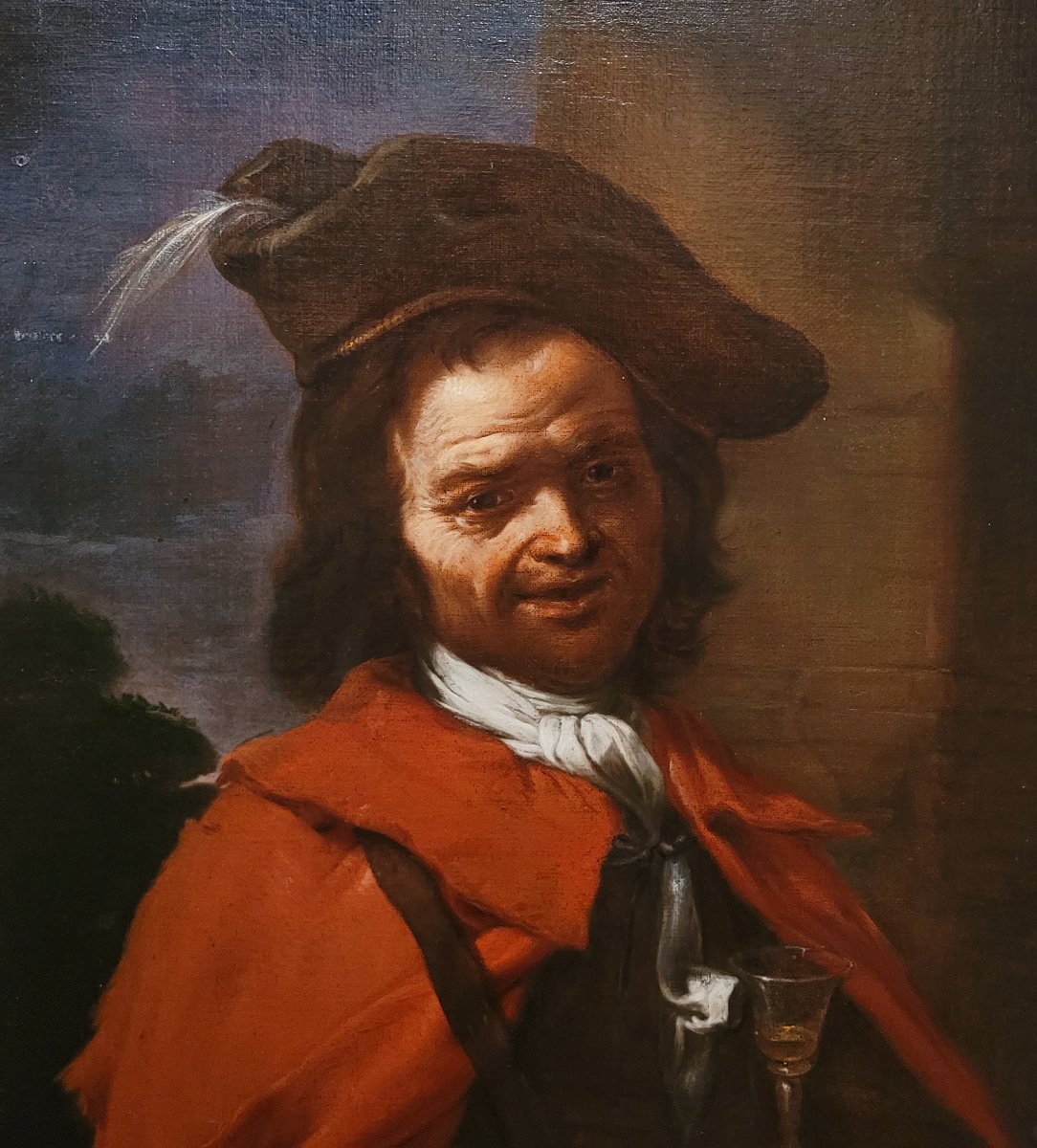
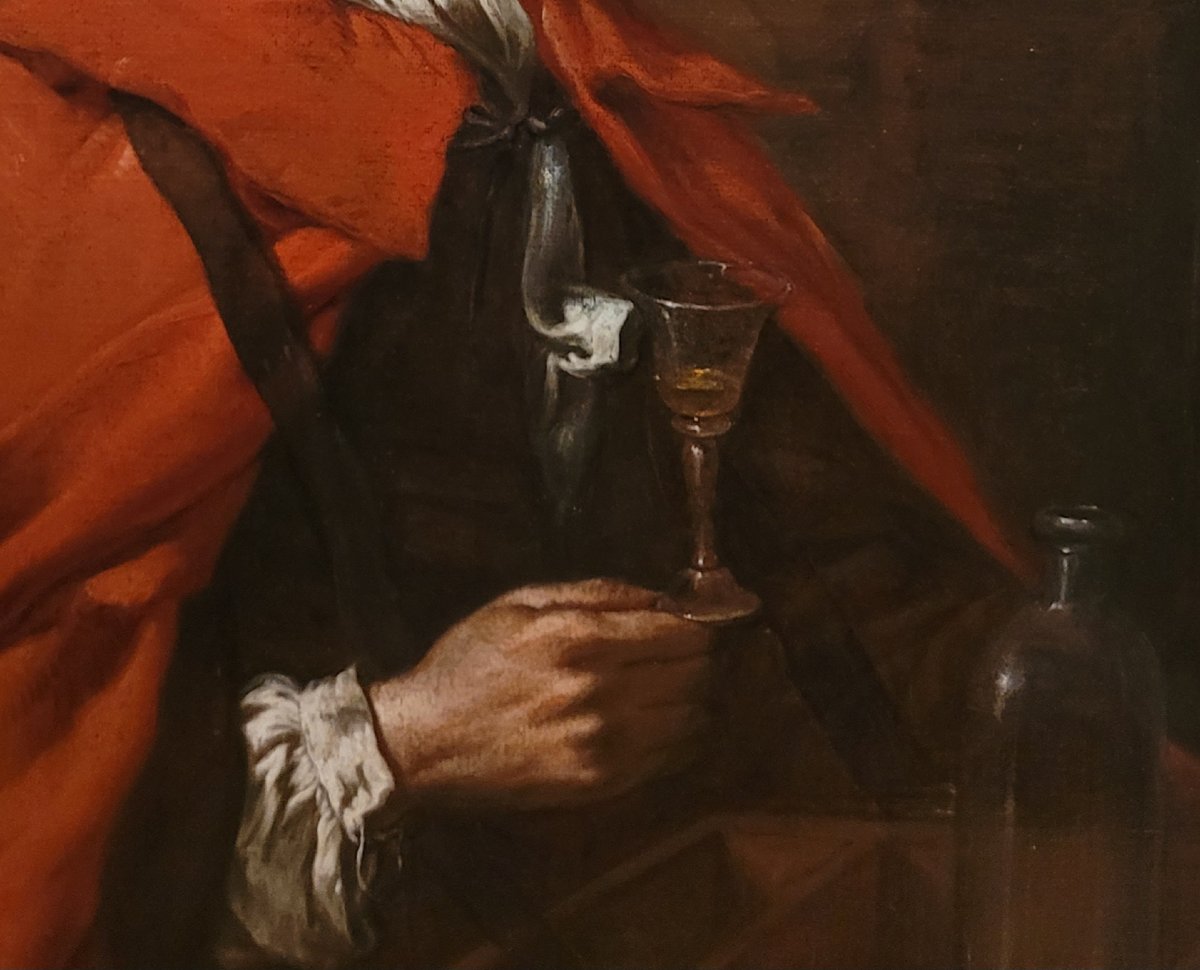
The work depicts a half-length portrait of a man captured in a moment of spontaneous naturalness, as he directs a direct, slightly smiling gaze toward the viewer, pausing mid-gesture as he raises an elegant glass of liqueur. The figure wears a wide red cloak draped over his shoulders, beneath which a dark robe fastened with a soft black bow is faintly visible. The whiteness of the linen collar and cuffs creates a refined chromatic contrast to the warm tones of his clothing.
The figure is characterized by a wide-brimmed hat adorned with a white feather, an accessory that helps lend him an air that is both theatrical and casual, typical of 17th-century genre painting. The background, built up through a succession of deep browns and warm glazes, offers a glimpse of a barely suggested architectural backdrop and a landscape opening on the left, following a compositional approach that accentuates the three-dimensional presence of the figure emerging from the half-light.
The painting is part of the tradition of genre painting that developed in seventeenth-century Rome, where Northern and Italian artists developed a visual language capable of blending Caravaggesque naturalism with a more intimate observation of daily life.
The work focuses on the psychological character of the figure rather than on a simple narrative description. The face, rendered through a delicate balance of light and shadow, conveys an intensely individualized appearance, in which the wrinkles, the faint smile, and the gaze directed toward the viewer suggest a lively and spontaneous presence, far removed from any idealization.
Particularly effective is the relationship between the intense red of the cloak and the deep browns of the background, a chromatic solution that lends the composition a remarkable tonal balance.
The brushwork alternates between a more fluid application on the garments and greater precision in rendering the flesh tones, achieving a convincing balance between painterly synthesis and descriptive accuracy.
From a stylistic perspective, the painting features numerous elements attributable to the circle of Bernardo Keilhau, known as Monsù Bernardo, a Danish artist active primarily in Rome and one of the most significant practitioners of genre painting in the second half of the 17th century.
Indeed, similarities can be observed in the physiognomic construction of the faces, in the choice to depict isolated half-length figures, in the color palette dominated by browns, reds, and luminous whites, and in the particular ability to convey a subtle psychological irony without resorting to caricature.
8 500 €
Period: 17th century
Style: Louis 14th, Regency
Condition: Excellent condition
Material: Oil painting
Reference (ID): 1846104
Availability: In stock
Print