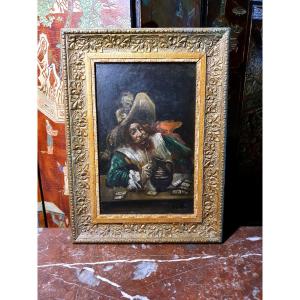
“portrait Of A Gentleman” Signed And Dated In The Lower Right Corner “gouchon, Pinxit 1860”
“Portrait of a Gentleman”
Signed and dated lower right “Gouchon, pinxit 1860”
Oil on canvas mounted on a wooden panel
Canvas: 76 x 61 cm
Frame: recently made wooden frame, 87 x 72 cm
The painting depicts an elegantly dressed adult man, shown in half-length and turned slightly in a three-quarter profile toward the viewer.
The figure wears a black suit, featuring a loose-fitting jacket and a white shirt with a high collar, complemented by a wide black bow tie. The extremely formal attire places the subject within the affluent and respectable society of the mid-19th century.
The face is the visual and psychological center of the composition. The artist paid particular attention to the characterization of the subject’s features: the prominent nose, broad forehead, shape of the mouth, sideburns, and hairstyle all contribute to making the subject recognizable as an individual rather than a mere conventional type.
The composed and reserved expression, with the gaze directed toward the viewer, establishes a direct connection yet one devoid of theatrical emphasis.
Behind the figure, one can glimpse an armchair or upholstered chair in reddish-brown tones, while the background consists of a uniform surface in shades of ochre, brown, and gold.
The composition is framed within an oval format, which was particularly common in nineteenth-century private portraiture.
The date indicated, 1860, places the painting at a particularly significant moment in the history of European portraiture.
In the second half of the nineteenth century, portraiture became widely popular among the bourgeoisie and the more affluent social classes. Between 1848 and 1914, the growth of the bourgeoisie and its economic power fueled strong demand for portraits intended for private homes and reception areas.
The male portrait of the mid-century still retained many elements of the academic tradition: a composed pose, formal attire, a neutral background, and a strong emphasis on physiognomic recognizability.
At the same time, the genre was undergoing a phase of transformation. The spread of photography, which had begun in previous decades and was becoming increasingly accessible, profoundly altered the social function of the portrait. By the 1860s, painting and photography coexisted as both competing and complementary tools of social representation.
The painting thus belongs to a period marked by both continuity within the portraiture tradition and a transformation of its social significance.
1 700 €
Period: 19th century
Style: Napoleon 3rd
Condition: Excellent condition
Material: Oil painting
Reference (ID): 1854242
Availability: In stock
Print