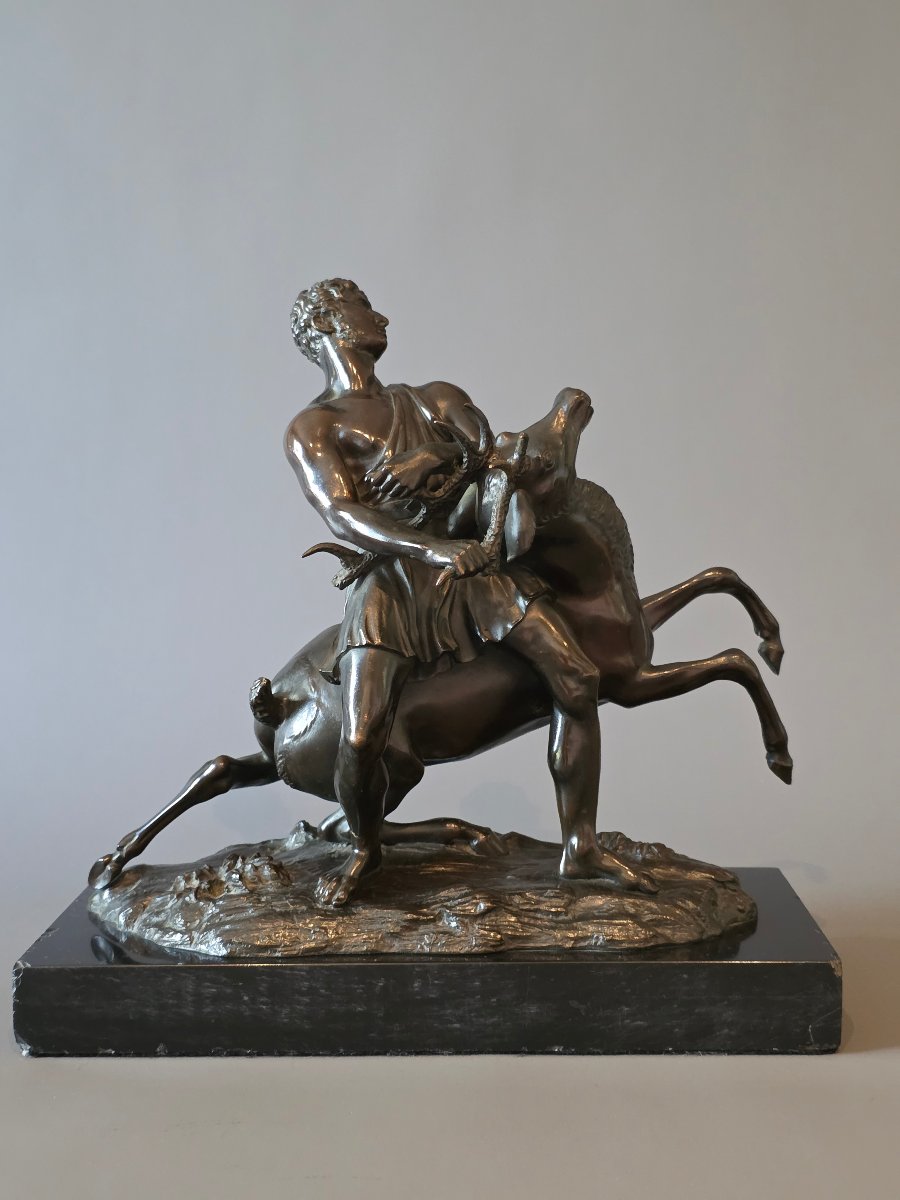
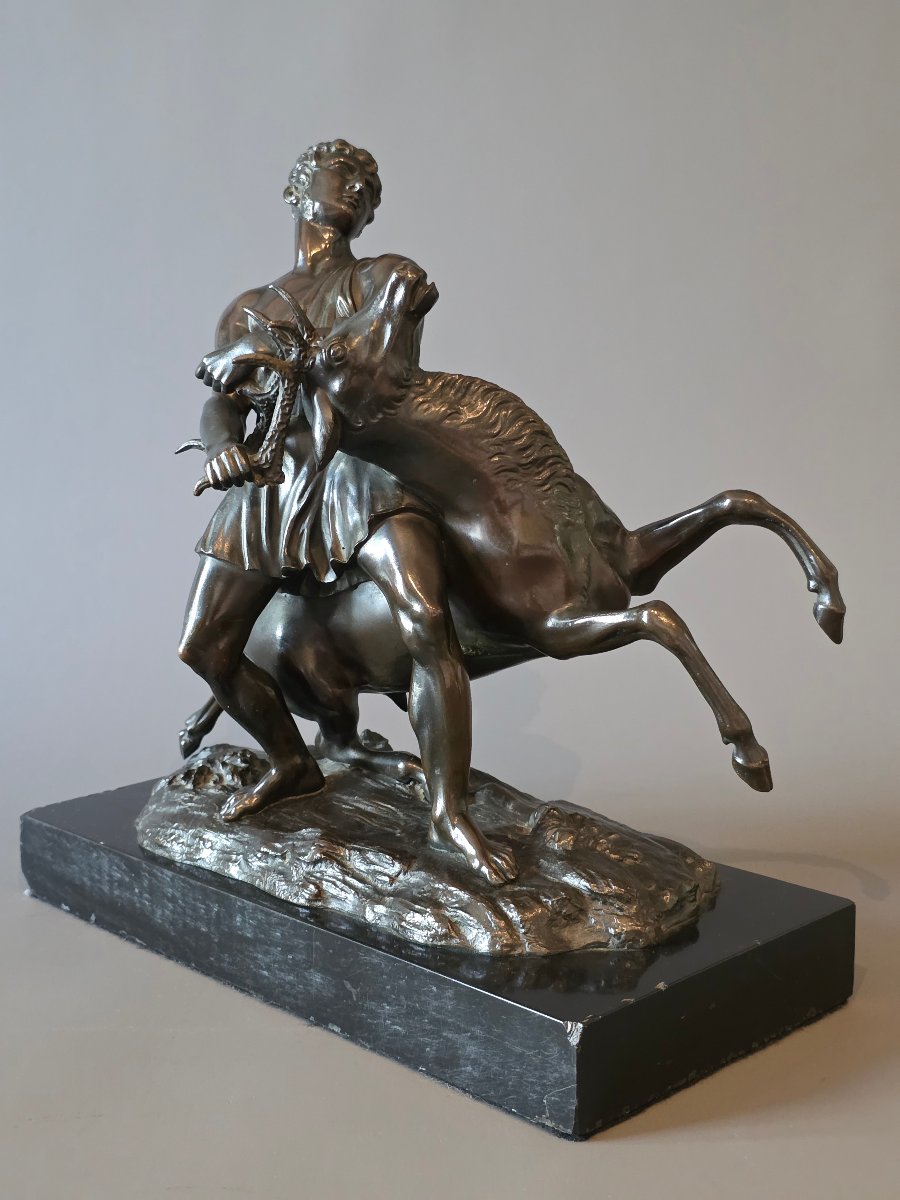
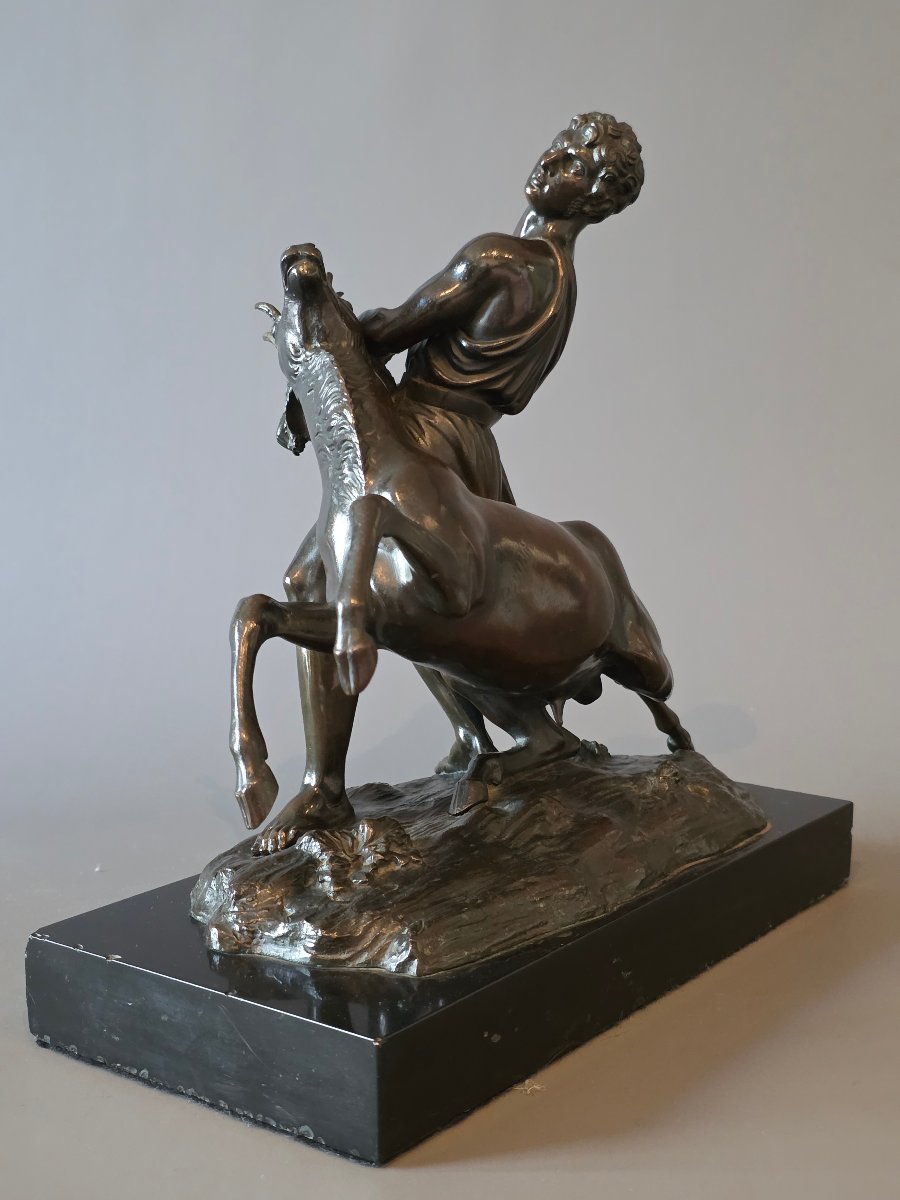
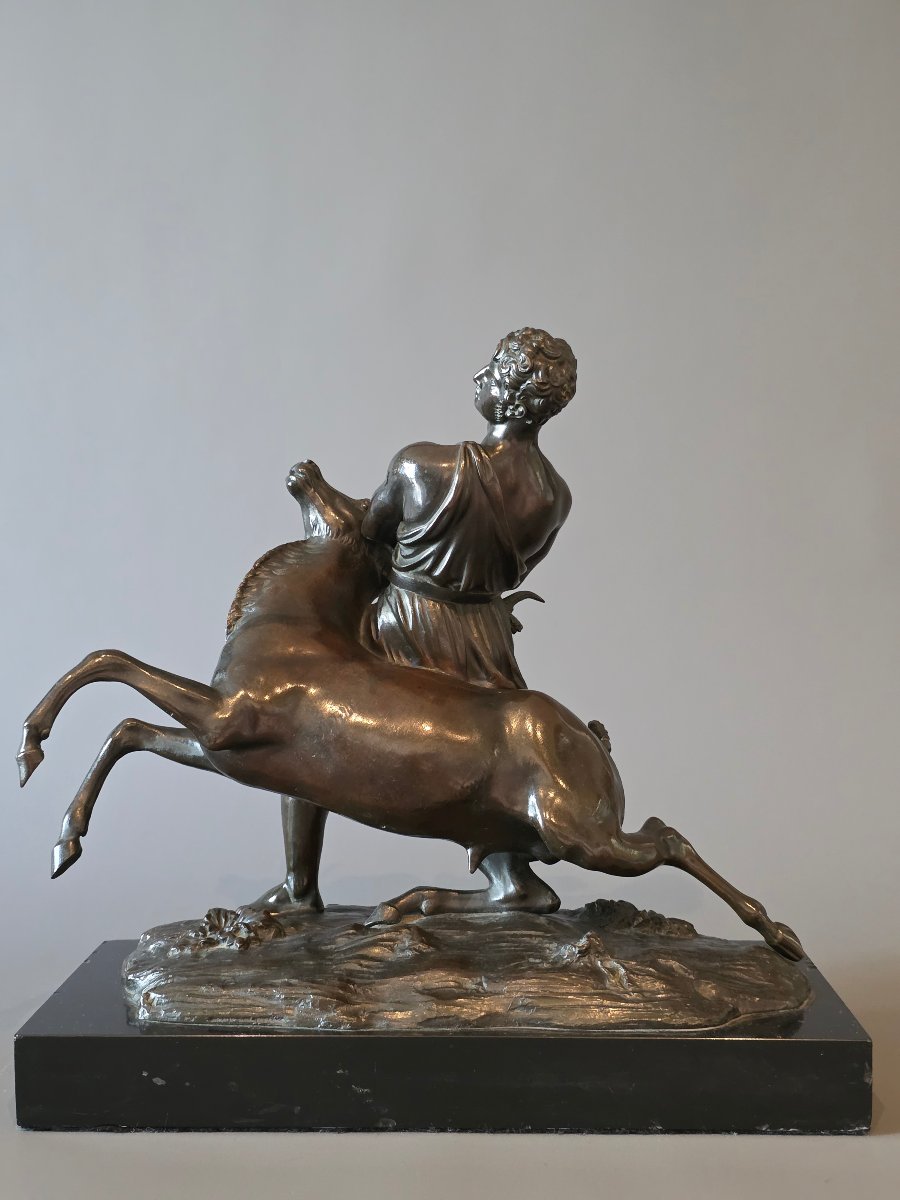
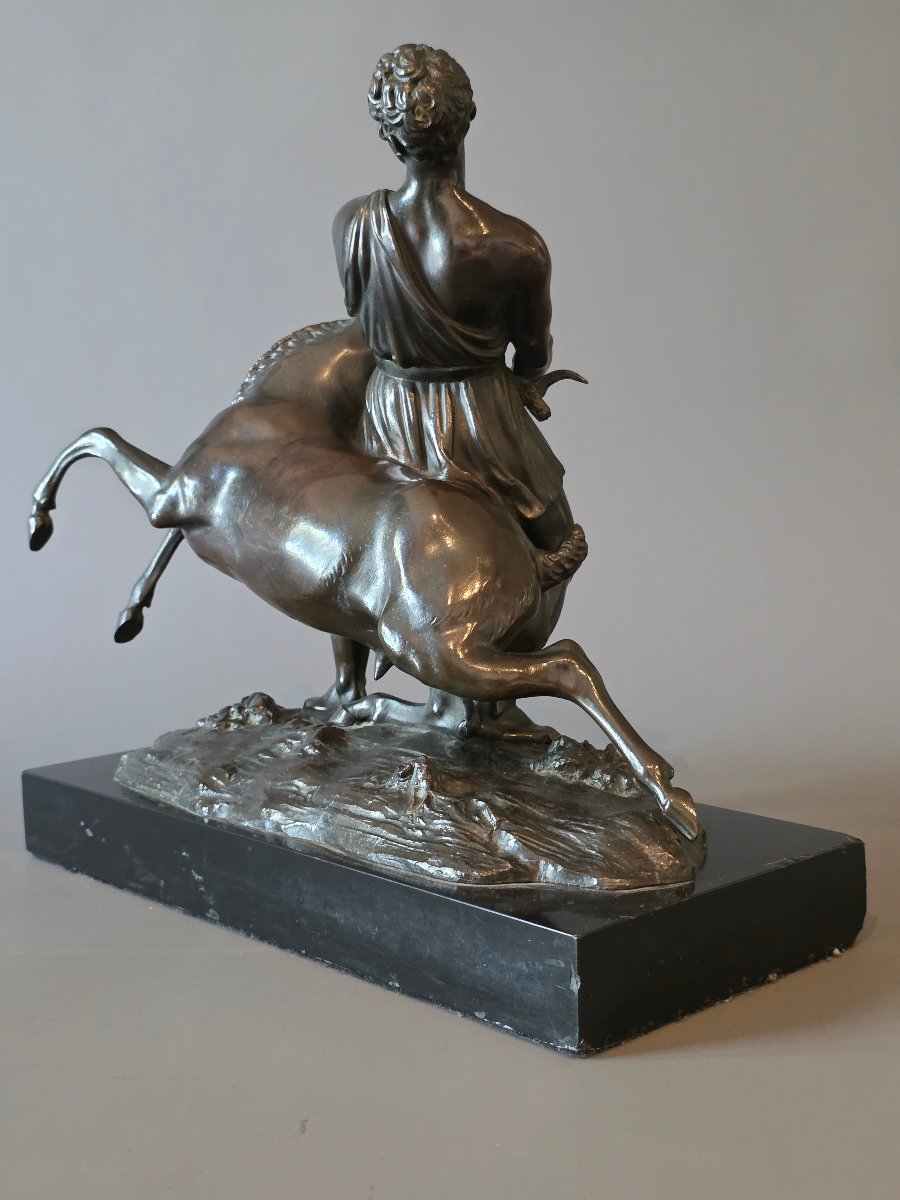
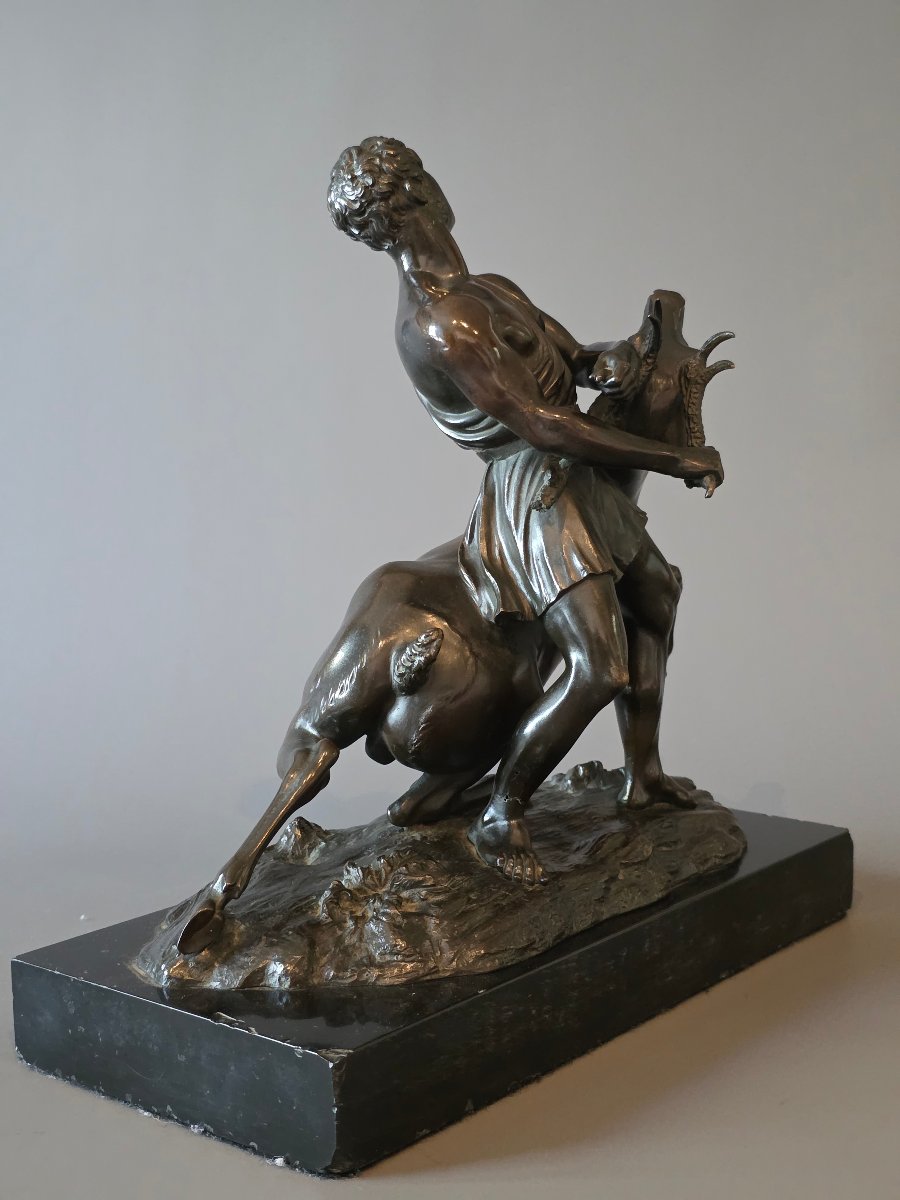
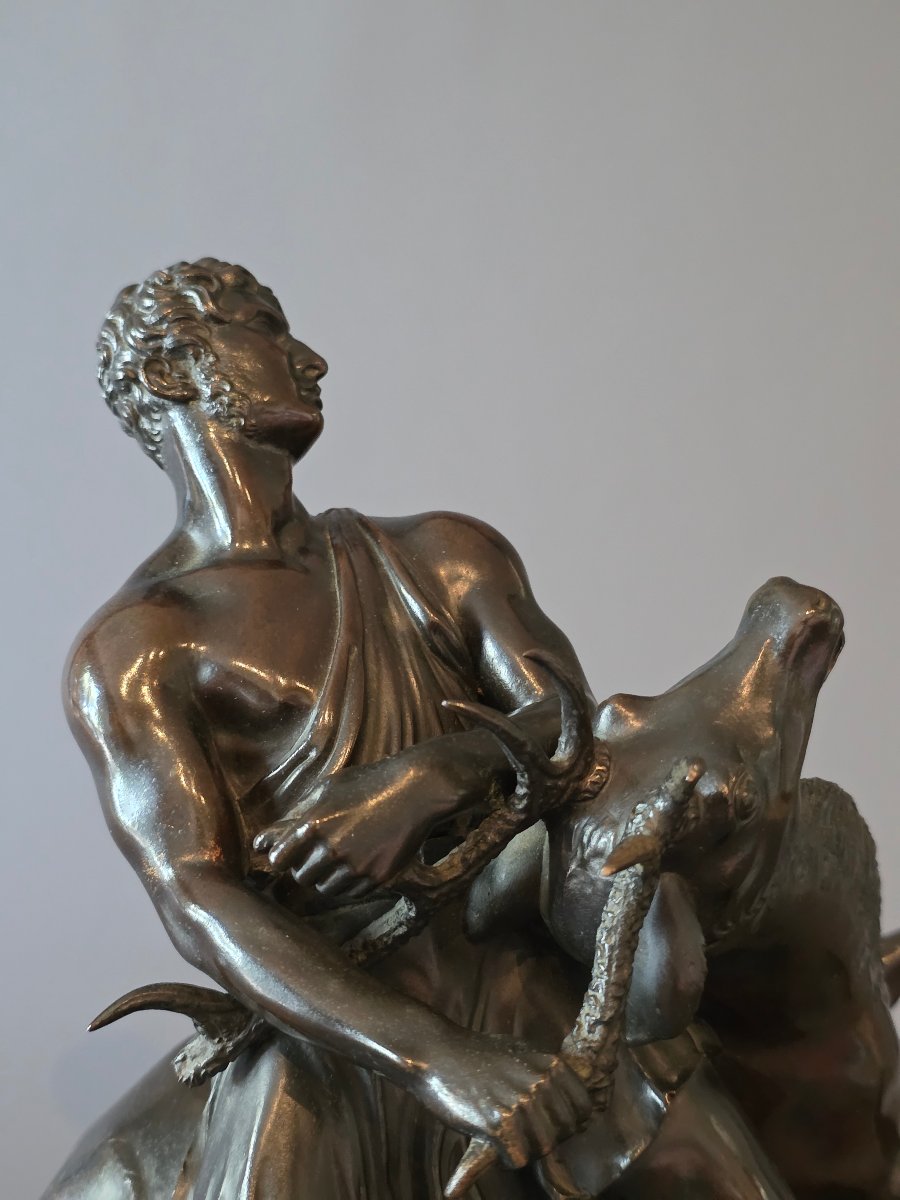
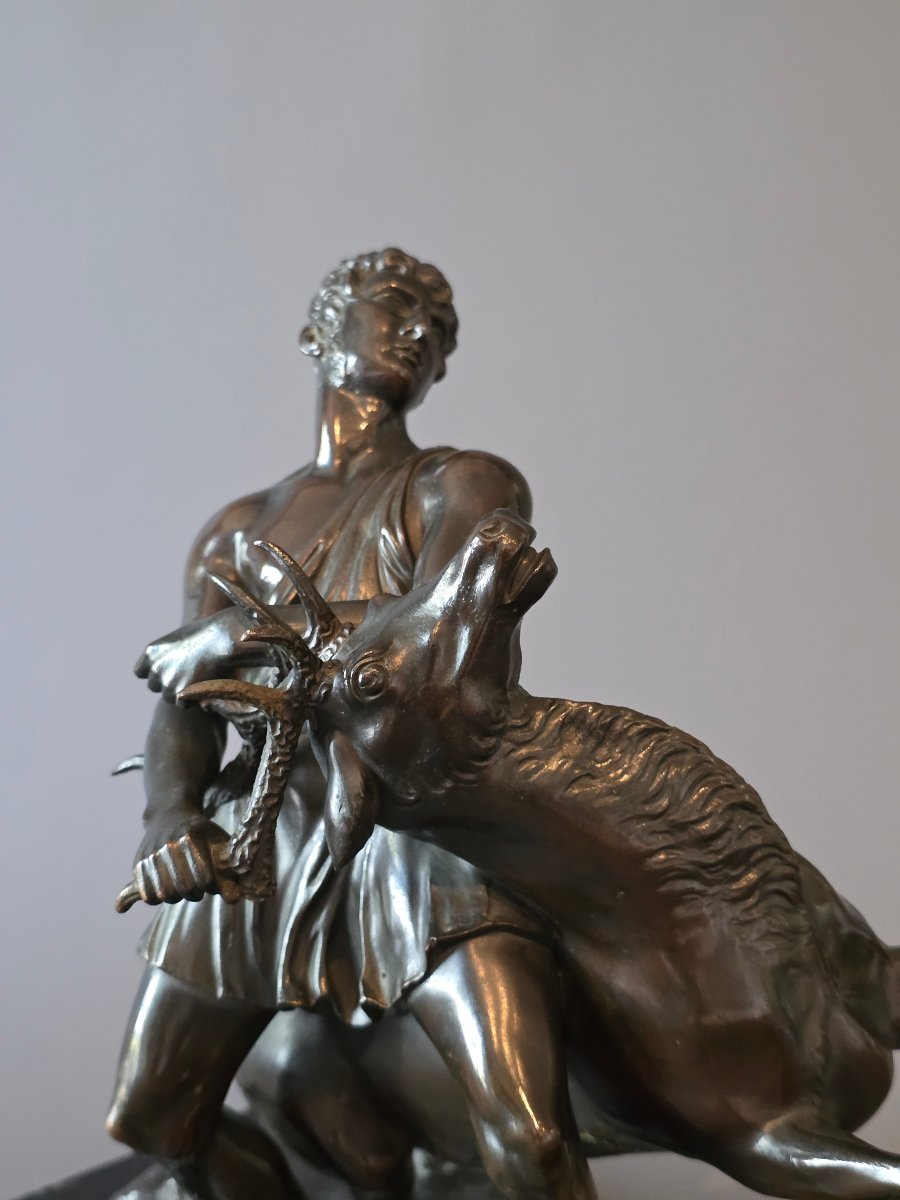
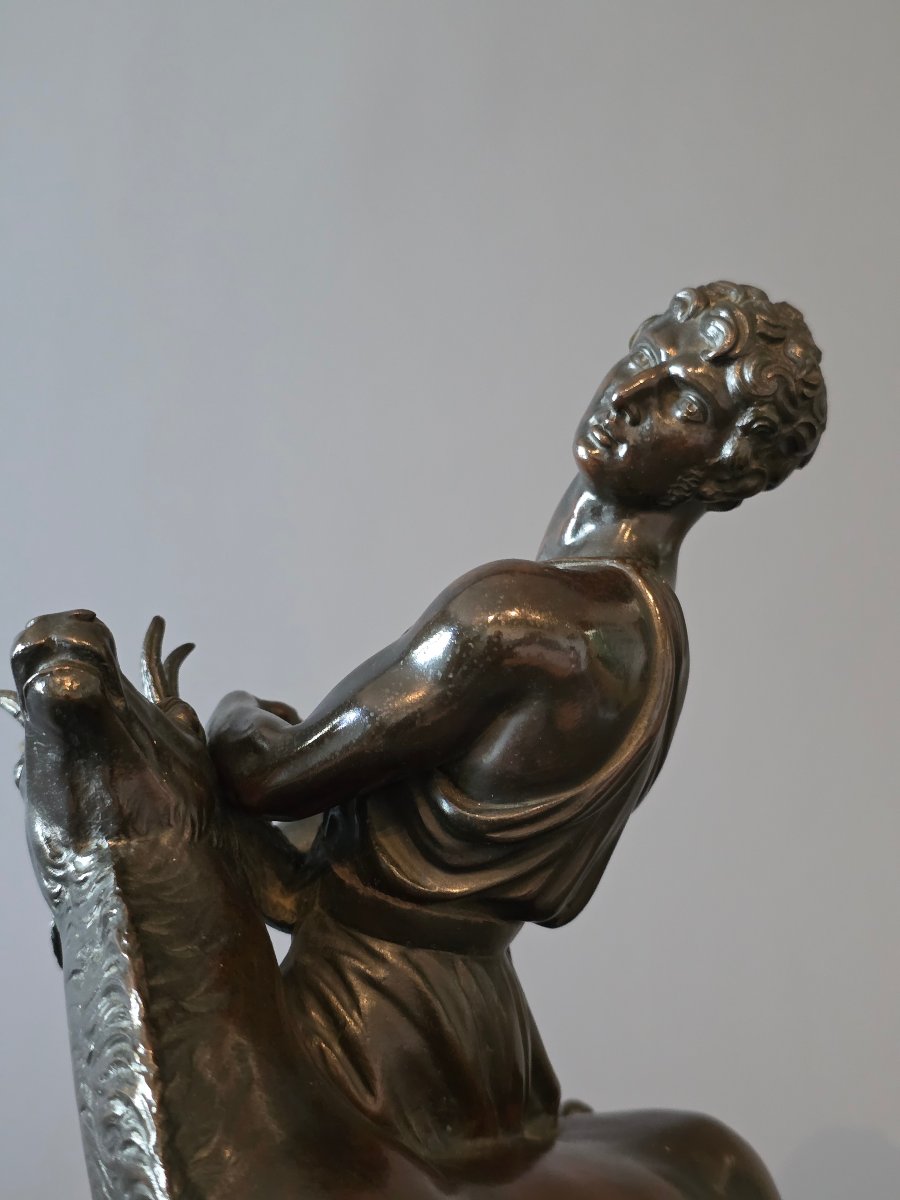
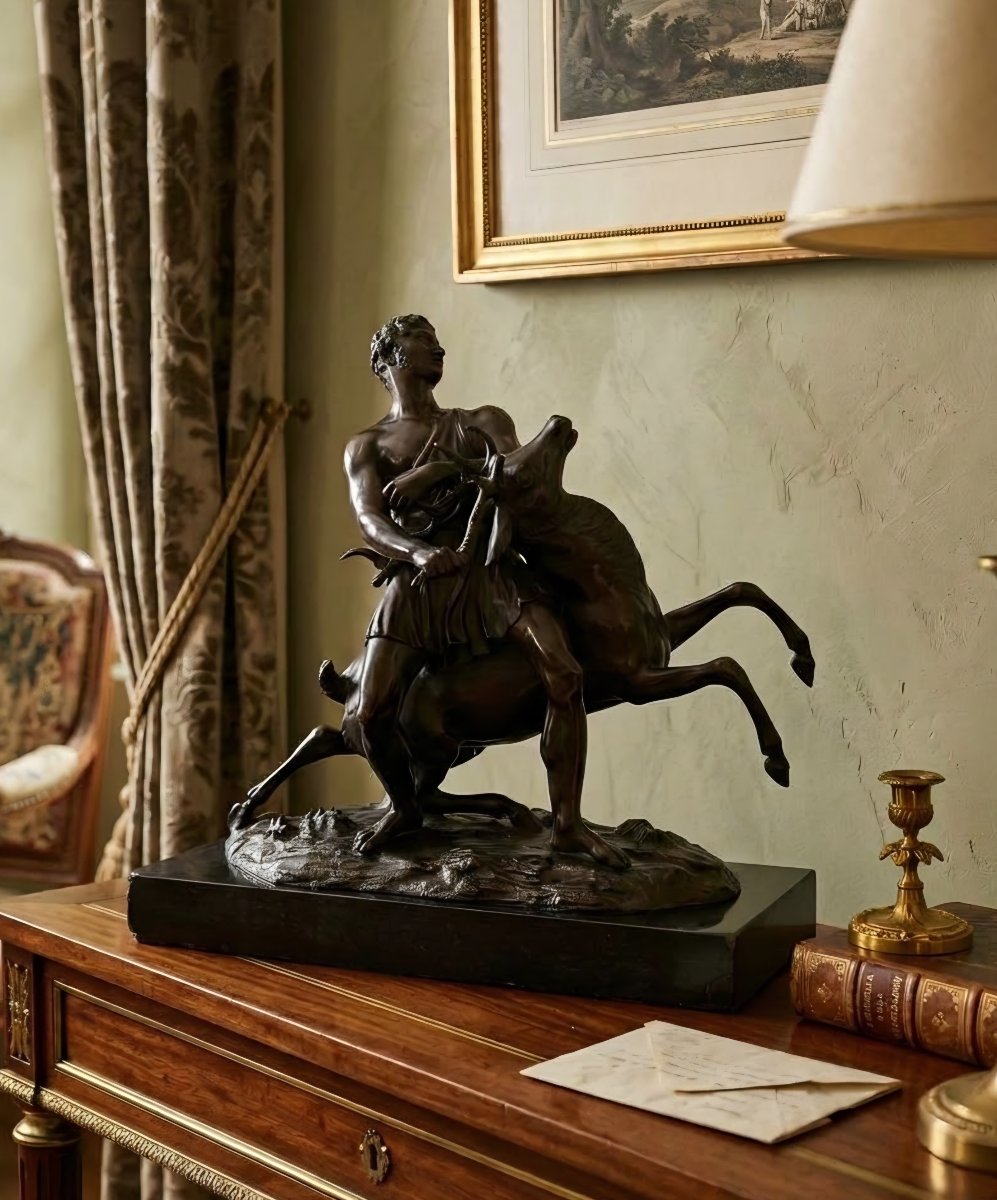
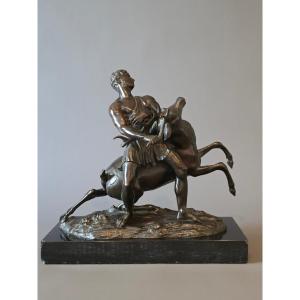


Hercules And The Ceryneian Hind, A Rare 19th-century Bronze Sculpture.
A rare bronze group with a brown patina depicting the third of Hercules’ twelve labors: Capturing the Ceryneian Hind.
Eurystheus, king of Tiryns and Mycenae, orders Hercules to bring the Ceryneian Hind—which was then living in Oenoe (in the Argolis)—back to Mycenae alive. This sacred animal is a doe with golden horns and bronze hooves, dedicated to Artemis.
Since he does not want to hurt her, much less kill her, Hercules must chase her for an entire year. Finally, the doe, exhausted from so much running, takes refuge on Mount Artemision; it is there that Heracles captures her, hoists her onto his shoulders, and sets off for Arcadia. But on the way, the son of Zeus encounters Artemis and Apollo.
The furious goddess snatched the doe from his shoulders and accused him of trying to kill her sacred animal.
Hercules apologized profusely, explained the entire situation, and made it clear that Eurystheus alone was to blame.
Artemis, understanding the situation, allowed Hercules to take the doe to Mycenae without any harm coming to her.
To reassure the reader, the story ends rather well.
In the morning, Eurystheus went to the cell where the doe was being held captive, intending to have her golden antlers cut off.
But when he opened the cell door, the animal had vanished.....Artemis, elsewhere, flashed a victorious smile.
A very fine cast from the second half of the 19th century, later mounted on a black marble base (small chip in one corner).
Provenance: Collection of Lord George Farrow (1916–2001). Sold at Christie’s and then Hutchinson, November 2011.
Dimensions:
Height 34 cm
Width 34.5 cm
Upon request, we can arrange delivery for you within France and internationally. Shipping terms depend on your location. Please contact us to determine the cost and arrange your delivery.
We ensure that your purchases are packed and protected with the utmost care.
Manuel Keepfer & Géraldine Buisson.
INSTAGRAM: @references.d.art
Eurystheus, king of Tiryns and Mycenae, orders Hercules to bring the Ceryneian Hind—which was then living in Oenoe (in the Argolis)—back to Mycenae alive. This sacred animal is a doe with golden horns and bronze hooves, dedicated to Artemis.
Since he does not want to hurt her, much less kill her, Hercules must chase her for an entire year. Finally, the doe, exhausted from so much running, takes refuge on Mount Artemision; it is there that Heracles captures her, hoists her onto his shoulders, and sets off for Arcadia. But on the way, the son of Zeus encounters Artemis and Apollo.
The furious goddess snatched the doe from his shoulders and accused him of trying to kill her sacred animal.
Hercules apologized profusely, explained the entire situation, and made it clear that Eurystheus alone was to blame.
Artemis, understanding the situation, allowed Hercules to take the doe to Mycenae without any harm coming to her.
To reassure the reader, the story ends rather well.
In the morning, Eurystheus went to the cell where the doe was being held captive, intending to have her golden antlers cut off.
But when he opened the cell door, the animal had vanished.....Artemis, elsewhere, flashed a victorious smile.
A very fine cast from the second half of the 19th century, later mounted on a black marble base (small chip in one corner).
Provenance: Collection of Lord George Farrow (1916–2001). Sold at Christie’s and then Hutchinson, November 2011.
Dimensions:
Height 34 cm
Width 34.5 cm
Upon request, we can arrange delivery for you within France and internationally. Shipping terms depend on your location. Please contact us to determine the cost and arrange your delivery.
We ensure that your purchases are packed and protected with the utmost care.
Manuel Keepfer & Géraldine Buisson.
INSTAGRAM: @references.d.art
2 800 €
Period: 19th century
Style: Rome and Antic Greece
Condition: Excellent condition
Material: Bronze
Width: 34.5 cm
Height: 34 cm
Reference (ID): 1840139
Availability: In stock
Print